
#On the Smallest Legs of Mercy
“A child with a candle may be carrying light, instructions, or your indictment.” — Purity street-training maxim, revised after three embarrassing errands.
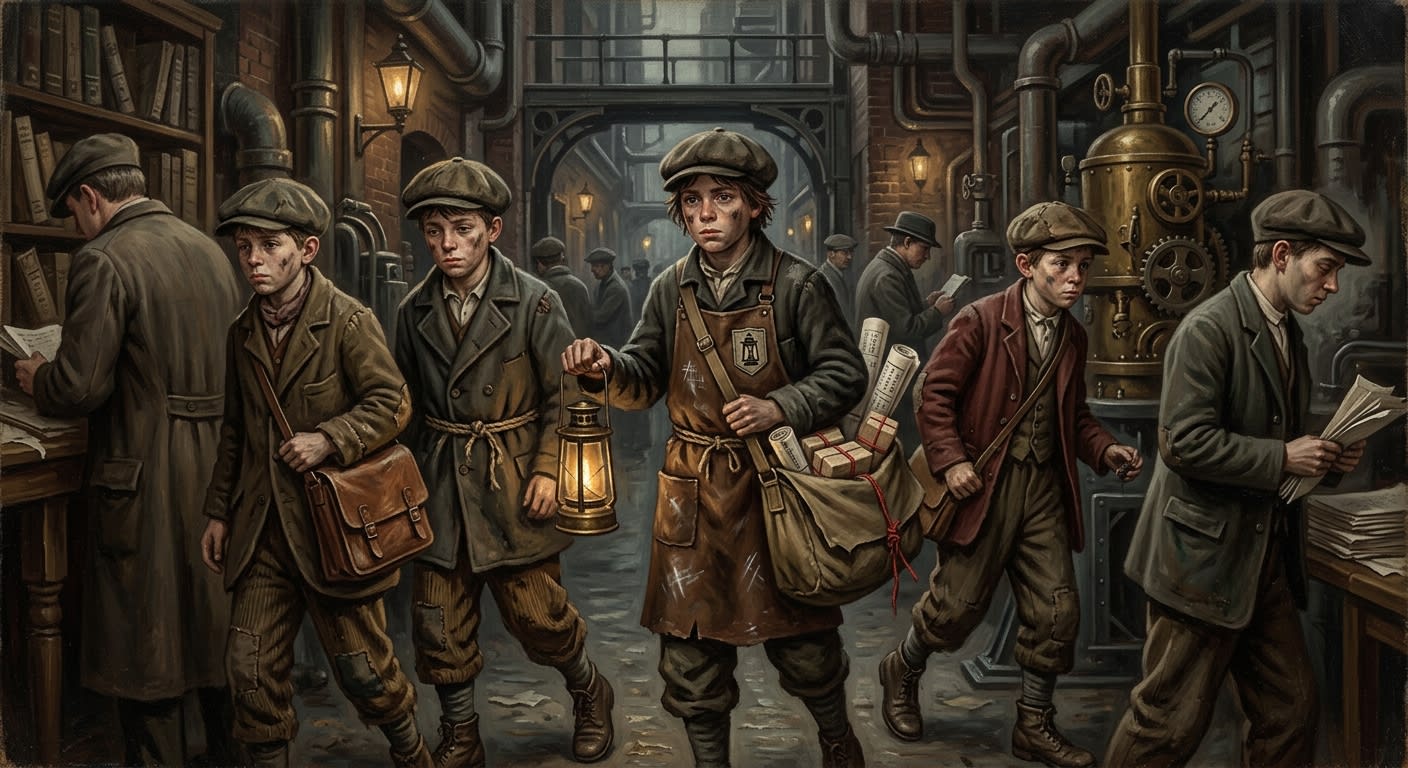
The Candle-Runners are the lowest visible rung of the Lantern Mercy Preacher apparatus, which is why every sensible participant lies about them first. They are children, mostly: too young for the levy, small enough to pass between queue posts, familiar enough in parish lanes to be ignored by Wardens until the ignoring has already done its work. They carry blessing schedules between Preachers, and by blessing schedules I mean route maps disguised as prayer lists, warnings tucked inside feast-day calendars, names folded into saint litanies, and the usual tidy little crimes by which mercy remains ambulatory.
The Bureau calls them juveniles in proximity to pastoral irregularity. The street calls them wick-feet, soot-kids, bell-mice, little saints when grateful and little devils when afraid. The Preachers call them Runners only when no auditor is listening. In official registers they are altar assistants, errand pupils, candle boys, votive girls, parish sweepers, orphanage messengers, and once, in a Strasbourg file I treasure for its naked panic, “minor ambulatory ambiguity.”
Their work exists because a sermon cannot move fast enough by itself. A Fog Preacher speaks in one lane. A Mercy Architect redraws a safe stairwell after a patrol changes habit. A Tongue-Smith alters a catechism by a syllable. Someone must carry the alteration before dusk. Adults are searchable. Clerks are memorable. Wardens count men, women, carts, dogs, weapons, and suspicious hats. Children vanish into the official category of nuisance.
#On the Origin of the Errand
The office begins where the Licensed Consolator office began to exceed its own paperwork. The Curfew Ordinance of Quiet Hours in A.S. 94 placed grey-stoled comforters at crossing points to reduce disorder. The office worked. This was its first mistake. Comforters who see grief nightly acquire information: which mother has a levy mark hidden under a bread cloth, which widow has room in a cellar, which patrol sergeant drinks before second bell, which orphan knows the loose board behind the chapel stove.
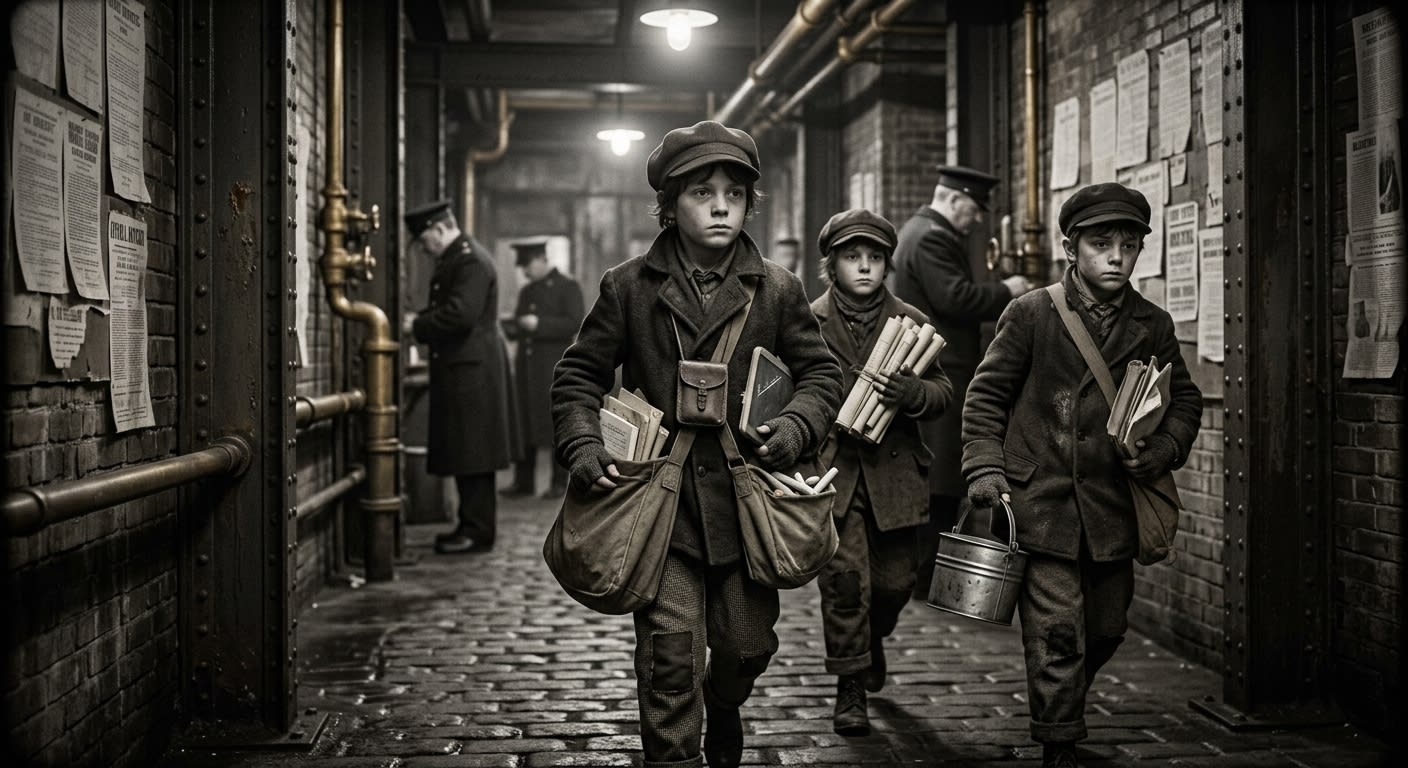
Information seeks legs. The first legs belonged to children already in the room.
A parish boy sent to fetch oil returns with a changed blessing hour. A votive girl asked to sweep wax hears that the Brotherhood lookout on Rope Road (Unregistered) has a cough tonight, two coughs meaning safe passage. An orphan carrying bread to a sick aunt delivers instead a calendar page whose Saint Barachiel notation means Purity glass in the eastern lane. No charter created the Candle-Runners. Charters create offices. Need creates professions.
The Warden Sermon Trials of A.S. 134 made the role harder and larger. Seven Consolators were taken. Seven hundred heard the lesson. Written instructions became poison. Repeated phrases became traps. The Preachers needed carriers who could move fragments, not orders; hints, not maps; timing, not conspiracy. Children were already trained by poverty to remember what adults refused to write.
Early Purity circulars described Candle-Runners as “incidental juvenile hangers-on.”
Withdrawn after comparison of thirty-two curfew disruptions, eleven missed arrests, and four levy-delay anomalies. Incidental children do not alter patrol outcomes across three districts unless Providence has begun forging calendar slips.
#On the Instruments Carried
A Candle-Runner’s satchel is a chapel in miniature and a felony in parts. Wax stubs denote urgency by colour, length, scorch, and whether the wick has been pinched or cut. Prayer lists carry routes through saint order: Marea before Edrin means west gate first; Vellum after Barachiel means delay until the bell clears; a missing martyr in the third line means the previous safe house has burned, figuratively or with the usual Bureau enthusiasm.
Blessing schedules do the larger work. They appear to list who receives comfort, which shrine receives candles, which ward receives a Consolator, which sickroom receives a spoken office. Read by the trained, they mark patrol gaps, grief concentrations, informant risk, Brotherhood tolerance, and the little weather of fear that no official barometer has managed to price. A coded warning nested in a liturgical calendar can move a family faster than a wagon.
The Runners carry chalk as well. A line at knee height near a parish step. Three dots beneath a saint tile. A candle drawn with no flame. Marks must be childish enough to pass as play and precise enough to move the right person. Too neat and the mark becomes evidence. Too crude and the widow misses it. The craft is learned through correction, scolding, hunger, fear, and the solemn hierarchy of older children who have survived three winters and grown insufferable.
#On Recruitment and Training
They are recruited from the surplus childhood produced by Synod administration: altar boys whose fathers entered mortar yards, orphanage girls with excellent memory and no adult defender, queue children who know every face in a district because standing in line is the nearest thing they possess to schooling. The Preachers do not recruit with speeches. Speeches are for tribunals and fools. A child is given one harmless errand, then another that contains a second meaning, then a third where failure would matter.
Training begins with route memory. Count the lamps. Smell the tannery. Avoid the alley where the black dog sleeps because the dog is honest and barks. Learn which bell tower runs slow, which Warden counts children twice, which Brotherhood circle coughs near shrine-lamps, which parish clerk smiles before informing. Learn to answer questions with small truths. Yes, I am carrying candles. Yes, Mother Agne (Unregistered) asked. Yes, I am late. A good lie surrounded by true crumbs passes through most official teeth.
The best Runners learn to forget on command. They do not know the whole route. They know the next turn. They do not know the safe house. They know the aunt with blue shutters who needs a candle. They do not know the Preacher’s name. They know the grey stole woman who says “Saint Marea” with the wrong pause. This ignorance is protective, which does not make it innocent. The Synod has always admired partial knowledge when we distribute it downward. We object only when our enemies discover the same convenience.
#On Predators, Punishments, and Small Bodies
The Candle-Runner’s enemies are numerous because cowardice is fertile. Wardens stop them for curfew breach, vagrancy, theft, insolence, suspected message carriage, suspected bread theft, suspected knowing, and the most common charge of childhood under bad government: being present after an adult has become afraid. Purity fume inspectors notice ash-ink. Confessor-Booth Clerks notice repeated faces. Ledger auditors notice children appearing in too many parish errands without a stipend line.
The penalties vary by usefulness of example. A first child may be frightened, slapped, turned over to a parish, or made to name a Preacher. A second may be sent to an orphanage registry with a mark that ensures future labour assignment. A third, if the satchel contains proof, disappears into juvenile correction under a title long enough to hide the scream. The Bureau avoids public cruelty when possible. Public cruelty teaches routes. Private cruelty teaches silence.
PURIFIED JUVENILE INTERVIEW ABSTRACT — DISTRICT WITHHELD Subject age: estimated eleven Recovered articles: two wax stubs; prayer list; saint calendar with altered feast order; chalk wrapped in cloth Question: “Who gave you the list?” Answer sequence: aunt / no one / church / the fog / ███████████████ Final disposition: transferred to charitable custody under Seal Ash. Follow-up: three ward routes changed before dawn.
The Preachers know this and use them anyway. Here the pious reader may gasp, adjust his collar, and prepare to feel superior. He is invited to do so quietly. The alternative is adult carriage, which fails faster and kills more. A child can pass a checkpoint because a Warden does not want paperwork over a candle stub. A child can enter a sickroom without scandal. A child can be underestimated by every armed man in a lane. Mercy uses what survives. That sentence tastes foul. It is still true.
#On the Cologne Lessons
The Cologne Schism of A.S. 178 gave Candle-Runners a new curriculum in betrayal. When three Lantern Brotherhood watch circles split over Mercy Preacher shielding, the children learned the division before the men finished naming it. A Fog Preacher knows when a lane listens differently. A Candle-Runner knows when a boot turns too soon.
After Cologne, Runners marked Brothers by habit. Two coughs near a shrine-lamp still meant passage in Loyalist wards. Straight eyes and polished clear glass meant Purist (Unregistered) hunger. A friendly question asked twice meant Soft Insurgent testing or Purity theatre; only time and bruises taught the difference. Mercy Architects redrew safe houses in a week. Tongue-Smiths altered catechisms by a syllable. Candle-Runners did the uglier labour of learning which adult promises had curdled.
Brotherhood internal summaries claimed juvenile messengers were unaware of factional distinctions after the Schism.
Corrected. Children identified Loyalist, Purist, and Soft Insurgent behaviour through route success rates before the Brotherhood settled its own vocabulary. Adult dignity has been preserved in the archive by filing this correction in small type.
The old routes did not die. They acquired manners. A Runner no longer approached a Brotherhood lamp directly. He circled once, dropped a candle-end near the gutter, watched whether the Brother moved it with boot or hand, and then decided whether the ward still had a throat. If this sounds elaborate for children, recall that adults made the world in which such elaboration became necessary. The children merely learned the floor plan.
#On the Occupational Disease Called Childhood
Candle-Runners lose their childhood to routes and codes. This is the polite line. The impolite line is better: they learn adults are maps of danger before they learn to shave, bleed, court, drink, or choose anything resembling a self. Their lullabies become signal drills. Their feast days become timetables. Their prayers become compartments. A child who has learned to answer an inquisitor with three small truths and one hidden mercy has not become precocious. He has been robbed with excellent technique.
They develop the Runner’s eye: counting exits at dinner, marking wax quality, listening for boots through hymn, reading adult silence as weather. Some become Fog Preachers. Some become Night Papers Couriers, where the same small legs carry darker warrants and the dawn eats slow feet. Some enter Brotherhood circles and pretend they were never soft-lantern children. Some vanish into ordinary poverty, carrying a district map in the bones.
The Mercy network honours them badly because honour is dangerous. No public patron. No feast. No roll of names. A dead Runner is mourned as cousin, pupil, altar child, street brat, errand boy, “the little one with the scarf,” anything except what he was. The Bureau cannot erase an office that was never admitted. The Preachers cannot commemorate an office without helping us find it. Silence becomes the grave-marker.
The Runners continue because the lanes continue, the queues continue, the grief continues, and every office that claims to protect children first produces the conditions under which children become useful to conspiracies. At dusk they move with candles in their fists and maps in their mouths, too small for the levy, too quick for the clerk, too young for the work, and already late.