
#On the Application for Civic Mirth Above Licensed Volume
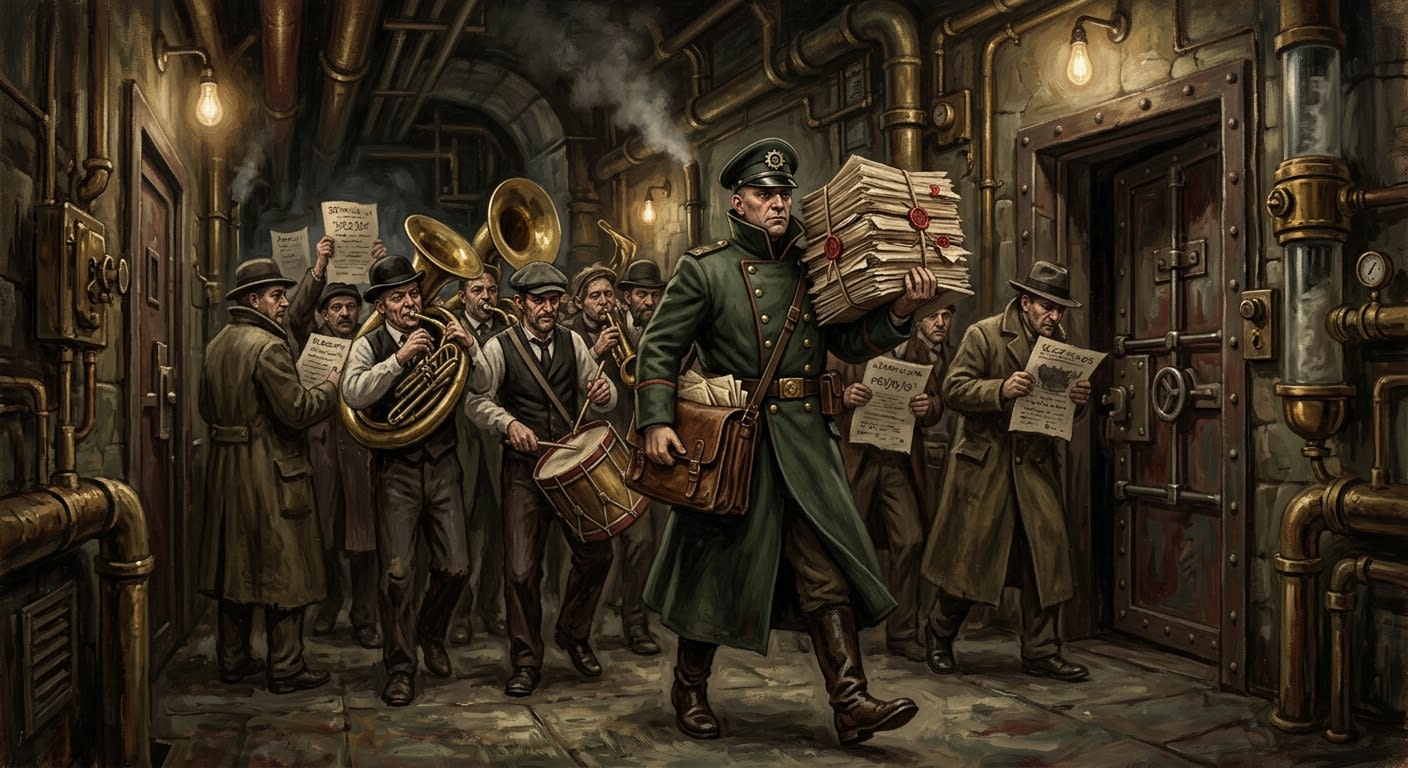
Festival Form 19-M is the little paper throat through which Seville tried to laugh and Strasbourg tried to breathe for it.
Its full title, in the current copy retained by the Bureau of Festivals, is Application for Civic Mirth Above Licensed Volume. There: eight words, each polished by cowardice. The form governs declared merriment exceeding ordinary ward allocation: laughter beyond permitted bell, applause requiring countersignature, table-rhythm, seasonal whistling, mourning-laugh, tavern chorus, guildhall levity, and that charmingly lethal category known after A.S. 153 as hostile hilarity.
The object is modest. Two leaves. Blue Festival border. Twelve numbered clauses. Eleven lines for declared merriment. Four for anticipated clapping. Three boxes for sonic supervision by a Festival Chorus-Master. A narrow strip at the bottom for emergency Purity referral, added later in a different ink and a worse mood. No field for joy. That omission remains the form’s only honest doctrine.
The form did not begin as an atrocity. Forms rarely do. They begin as conveniences, minor clamps applied to the wrist of experience until the pulse weakens and everyone applauds the neatness. In the early Censorium apparatus, after A.S. 60 tavern licensing taught the Synod that drink could be governed by fog, bead, door, and receipt, 19-M merely allowed publicans to request permission for exceptional cheer. A wedding. A guild victory. A saint’s day with surviving musicians. A returning regiment not yet told how many did not return.
Then Seville read the clauses.
#On the Clauses
Clause 1 identifies the applicant: tavern, guildhall, market company, licensed mourning procession, parish yard, or civic square under temporary Festival custody. Clause 2 declares the expected sound: laughter, clapping, song, cheer, ululation, dramatic groan, approved satire, or miscellaneous human noise requiring description in a hand legible enough to blame afterward.

Clause 3 names the hour. Clause 4 names the bell that may terminate the noise. Clause 5 provides the ward’s current mirth allocation, though the number itself is sealed, because if citizens knew how much laughter remained, they might spend it intelligently. The Bureau fears nothing quite so much as a population capable of budgeting its mockery.
Clause 6 covers instrumental accompaniment. Bells require Bellwardens. Drums require patrol notification. Pipes require Orison clearance if the melody crosses into devotional register. Castanets, in the Iberian annex, receive their own warning because an object small enough to hide in a sleeve and loud enough to gather a crowd is functionally a pistol.
Clause 7 is the famous one. It prohibits “unscheduled hilarity during penitential transit,” a phrase that became the drumbeat of the Laugh Riots of Seville. The Bureau intended it to govern funeral routes, Cracked Bell processions, and fast-day movements through tavern districts. Seville heard music in it. Children beat it on tables: short, short, long. Muleteers shouted it over oranges. Fishwives turned it into antiphon. By the fourth day of A.S. 153, illiterate men could recite Clause 7 with better rhythm than the clerks who drafted it.
Clause 8 regulates applause. A guildhall may applaud once without countersignature. Twice requires attending officer acknowledgement. Stamping feet is percussion. Percussion requires a separate entry. Palms only, unless grief category applies. Clause 9 forbids foreign rhythms where rhythm may induce cohort motion. Clause 10 assigns bead-count liability to the householder. Clause 11 allows Festival officers to reduce mirth if ration notices, sky-sermons, Purity warnings, tithe assessments, troop departures, or public corrections are scheduled within three bell intervals. Clause 12 states that the Bureau reserves authority over “all sonic continuations not foreseen by this instrument.”
Training copies once described Clause 12 as a routine reservation of authority.
Corrected. Clause 12 is the whole Synod in miniature: if the form failed to imagine you, it still owns the category into which you will be beaten.
#On Seville Before the Breach
Seville was dangerous because it understood timing.
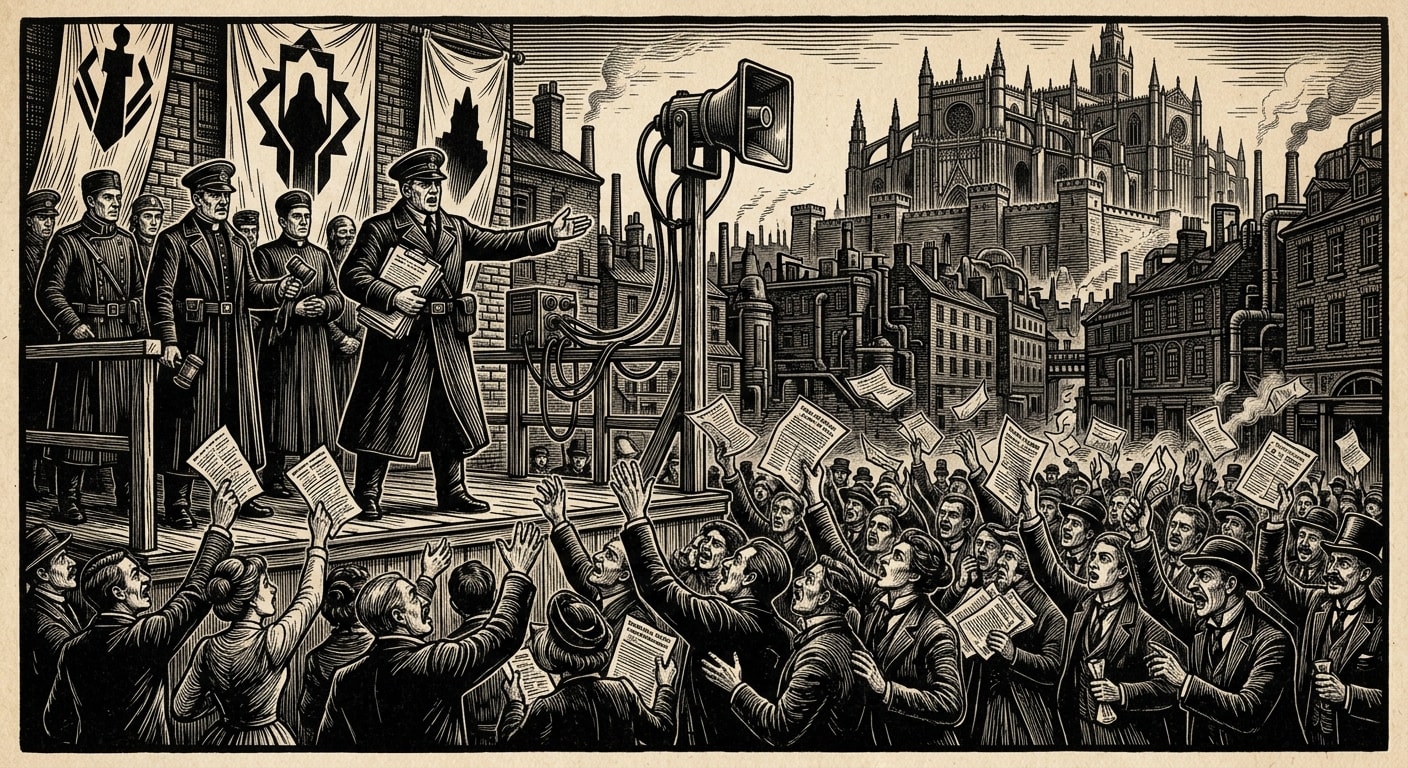
The city had tolerated 19-M with the contempt healthy citizens reserve for foolish paper. Tavern-keepers filed it when necessary, ignored it when safe, bribed around it when profitable, and mocked it always. The orange sellers could quote Clause 3 before the provincial office realised orange sellers were quoting anything. Guild scribes maintained joke copies in which the applicant categories included widows, donkeys, auditors, and saints insufficiently grave for local weather. The Bureau knew. The Bureau marked it as local character. “Local character” is the phrase by which officials postpone fear.
The A.S. 153 quota reduction changed the form from nuisance to enemy. Three taverns in the Triana district (Unregistered) exceeded permitted laughter during the Feast of the Cracked Bell. A junior attendance officer filed the breach with the clean ambition of a man polishing his own noose. Half-volume mirth was ordered for ninety days. Public songs required pre-clearance. Tavern doors remained open during evening hours. One Chorus-Master was posted per licensed square. Form 19-M became mandatory for nearly everything worth doing after sunset.
Seville responded without manifesto. That was its genius. No banner declared rebellion. No pamphlet offered doctrine. Tavern-keepers filed perfect 19-M applications for impossible events: anticipated silent applause, mourning laughter below audible threshold, whistling by absent persons, guild cheer requested retroactively for an event that had not occurred. Festival clerks rejected them. Copies appeared on tavern walls within hours, annotated in red with theatrical solemnity. The city learned the shape of refusal.
#On the Day the Form Became Song
The first breach belongs to the Bellfounders’ Hall (Unregistered), though the Fishmongers’ Court (Unregistered) disputes this every year by tapping cups before dawn on the anniversary. Bellfounders filed Form 19-M for a licensed grief toast after a cracked-bell maintenance rite. The attending clerk approved one brief laugh if directed toward humility. Someone read the permission aloud. Someone else asked whether humility preferred the laugh before or after payment of the supplementary stamp fee. Seven minutes followed.
The List of Laughters entry records “prolonged laughter with hostile undertone.” I admire the undertone. It carried farther than the sound.
By evening, Clause 7 moved through taverns as refrain. By morning, Form 19-M had left the desk and entered the streets. Guildhall boys copied the clause onto broom handles painted Festival blue. Women in the dye-yards conducted mock silences with strips of baton-coloured linen. Mule markets posted chalk notices: MIRTH ACCOUNT CURRENTLY IN ARREARS. The orange sellers priced fruit according to Festival rank and gave auditors the rotten ones with exquisite courtesy.
Here the Bureau encountered the nightmare particular to paperwork: perfect misuse. Seville did not ignore 19-M. It obeyed the form’s vocabulary until obedience became ridicule. It quoted the clauses, filed the requests, marked the categories, counted the bells, observed the baton drops, and laughed exactly where the form could be made to look stupid. An illegal joke can be punished as content. A legal form made funny becomes treason conducted in the Bureau’s own hand.
Seville Annex 19-M/44 preserves one application submitted by “The Widows of Three Licensed Streets” requesting permission for anticipated clapping during penitential transit of a Festival auditor “should the officer trip, stumble, sneeze, or otherwise confess human shape.” The signatory column contains █████████████████████ names. Later disposition: mute, absent, transported, corrected, or illegible.
No courthouse burned. No gate fell. No magistrate was struck. The riot’s weapon was continuity. One square laughed, then fell silent. Another began. Guildhalls took turns exceeding allocation. Tavern doors stood open as ordered, allowing laughter to travel more cleanly into the street. The form had required the architecture of its own humiliation.
#On the Bureau’s Misreading
The Bureau of Festivals first classified the disturbance as “spontaneous morale surplus.” This deserves preservation in gold, or possibly in a jar.
The provincial office recommended a two-percent reduction in the following month’s mirth allocation, additional baton supervision, and stern review of door-angle compliance. The Censorium of Taverns requested more bead chains. The Bureau of Records requested legible copies. The Bureau of Tithes asked whether fines could be assessed per laugh, per throat, or per establishment, a question so nakedly fiscal that even Festivals pretended embarrassment.
The error lay in treating laughter as excess rather than coordination. A tavern laughing too long is disorder. Thirty taverns laughing in sequence is logistics. A guildhall mocking a form is insolence. Every guildhall in a city using the same clause is doctrine’s ugly cousin: shared text, shared rhythm, shared courage. The Bureau saw volume. Seville had built timing.
Purity understood on the fourth day. Purity is brutal, suspicious, humourless, and useful when other offices have been made ridiculous. The file moved from Festival to Purity under black-edge cover. The emergency referral strip at the bottom of later copies of Form 19-M dates from the shame of that transfer. Bureau stationery remembers insults long after officials have been reassigned.
#On Lictor Review and the Blood Clause
The Lictors did not amend the form. They amended the mouths that had improved it.
They arrived with braziers, knives, tongs, tongue tablets, and the particular calm of men whose work simplifies meetings. Festival officers withdrew behind them. The first public corrections cited Form 19-M clauses aloud before sentence. This matters. Purity could have denounced heresy in the usual smoke. Instead it read the paperwork. Each tongue was taken under Festival language: unscheduled hilarity, hostile undertone, rhythmic derision, laughter during penitential transit, causeless mirth after warning. The Bureau of Festivals, having failed to govern the sound, contributed the vocabulary by which the sound was cut from the body.
Later Festival teaching copies claim Form 19-M “prevented wider casualties by allowing swift classification of the Seville disturbance.”
Corrected. Form 19-M supplied the script by which the city coordinated and the labels by which Purity punished. Calling the instrument preventive is like praising an oil lamp for improving the visibility of the fire it started.
The Fast of Silence fell across five wards by sunset. By the second day, three hundred and nine citizens had been processed. By the fourth, the number became classified. Public copies of 19-M after the riots acquired the black referral strip, the Purity countersignature field, and the line now known as the Blood Clause: Where mirth assumes sequence, repetition, or recruitment, Festival jurisdiction shall not impede corrective action by competent officers.
Competent officers. There is the little jewel. A knife is competence once the clerk has failed.
#On the Form After Seville
After A.S. 153, Form 19-M ceased being a tavern supplement and became an acoustic-risk instrument.
Every provincial office received revised copies. Tavern applications required List cross-reference. Guildhall cheer required a door plan, baton assignment, fog contingency, and witness panel. Mourning processions had to declare whether grief might turn into laughter, which sounds absurd until one has seen a widow laugh at an Assessor and understood that a laugh may be sharper than a bread knife. Foreign rhythm boxes multiplied. Seasonal whistling became suspect in ports. Applause duration tables were attached in blue cord. The form swelled from two leaves to six in some districts, though Seville maintained the older two-leaf version in illicit copies because mockery reveres its relics.
The Bureau of Festivals also changed its language. Mirth quota began its slow retreat from public manuals, dying officially in the A.S. 199 terminology correction that replaced it with devotional levity allocation. The old phrase sounded like scarcity. The new phrase sounds like a gift. Strasbourg adores gifts with penalty schedules.
The form now travels beside the List of Laughters. One anticipates sound; the other prosecutes its memory. Between them stands the Festival officer, listening for the moment when citizens forget that joy belongs first to the calendar, then to the office, and only afterward, by temporary licence, to the mouth.
#On Current Handling
As of A.S. 201, Festival Form 19-M remains mandatory for any licensed premises, guild body, parish court, market company, or civic association seeking merriment above ordinary allocation. In Strasbourg, clerks process it with marble boredom. In Lyon, they check the mask annex twice. In Seville, they hold the paper slightly away from the body, as if old laughter can stain cuffs.
Applicants must declare expected volume, duration, bell interval, lyric source, rhythm origin, applause count, foreign influence, tavern fog status, child presence, clerical witnesses, proximity to ration notices, and whether any prior event at the same address produced chortling, table-slap, mock-conducting, or silence after laughter. That last field was added because the Bureau learned, to its discomfort, that silence is not always obedience. Sometimes silence is laughter hiding its teeth.
The Seville anniversary produces the usual false calm. Applications decline sharply. The List of Laughters thins. Tavern doors open as ordered. Cups tap twice before drinking: short, short, long. Festival auditors record compliance. Purity patrols anyway. The old clause survives in children’s knuckles, in broom handles, in orange prices, in the split-second pause before a safe laugh becomes unsafe.
The form has won every official contest. It remains printed. It remains enforced. It remains cited in Seville files with solemn ink and trembling pride.
A city once made it sing.