
#On the Name and Its Reach
"If your voice goes thin, you lose heat."
Lung-Rot is a word before it is a diagnosis, and at Bastion-Irongate the word is enough. It is spoken at the intake desk, written in the ward register, whispered across the bunk seals of the First Lung, and tapped through the pipes of the Underchords at a price. Whatever the thing is in the chest, the thing on paper is a sentence: diminished breath, diminished tier, diminished claim upon the mountain's heat.
The name travels. Candlewick physicians attach it to the dye-dust that settles in the throats of their vat-workers. The diehouses of Sable Court apply it to men who breathe filed metal for a living. Mournwater calls its Lung-Rot a thing of the water, and the frontier ledgers of Black-Snow Lor list it between plague and weather as though the distinction were a clerical courtesy. The Bureau has not ruled whether these are one affliction, several afflictions sharing a convenient noun, or merely the word a clerk reaches for when a labourer begins to cough in a way that alarms the accounts. I decline to rule ahead of the Bureau. It is the only modesty I practise.
The Irongate also keeps a separate term, ice-lung, for the thickening that fine stone dust works upon its tunnellers. The garrison uses both words. The registers keep them in separate columns. Nobody has explained to me what lies between the two columns, and I have asked.
What the Irongate record does establish is the outbreaks of A.S. 199, and what followed them.
#On the Measured Breath
"Hold the flame. Hold it. Clerk, mark the time."
Two examinations govern a throat in the Irongate, and the stranger to the mountain confuses them at his peril.
The first belongs to the Choir Magistracy. It is the stanza test, over which Cantor Ys Varr presides: a prescribed harmonic, at a prescribed volume, held for a prescribed duration, while a Choir Warden watches the pressure gauge and the worker's future at once. The stanza test decides voice tier, and voice tier decides heat, rations, bunk and residence. A worker who fails it may lose that tier where he stands. His appeal belongs to the Hush Court. His supper, meanwhile, belongs to someone else.
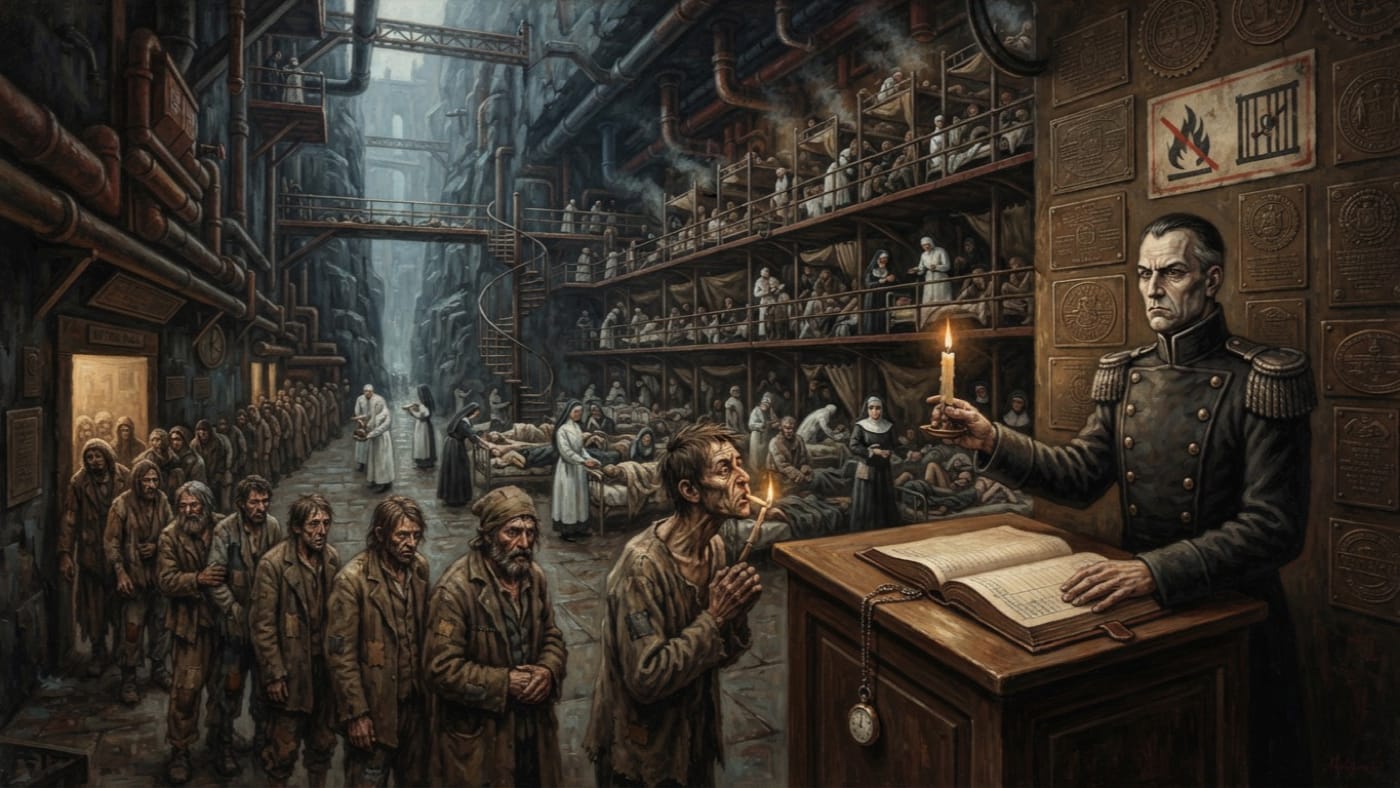
The second belongs to the Transit & Breath Office, and it is humbler and therefore crueller. At the Intake Gateworks a clerk holds a candle at arm's length. The applicant blows. The clerk times how long the flame stays bent. The apparatus is a stub of tallow, a pocket-watch and a column of figures. The applicant supplies the drama, discovering in front of a queue how much air remains to them.
The Breath Office has never published its threshold. I have requested the figure through three channels and received three courteous acknowledgements. A threshold exists, and men fall below it daily. The number itself is apparently too valuable to waste on the public.
Let it be stated for the Ledger, because the Ledger is easily flattered: the candle measures capacity. It names no contagion, proves no infection, and identifies no particular rot. A failed candle test establishes that a worker could not bend a flame long enough to satisfy a clerk. Since A.S. 199, that has been enough to place him in custody.
The Office divides its powers with a care that would please any canonist. Seal-Broker Lysa Murne stamps the permits and the quarantine clearances, and the fear she trades on most profitably is the fear of a Lung-Rot entry on one's record. Commandant Hadrik Sorn holds the gates, the Transit Spine and the compartment lockdowns. Murne decides whether a person may leave the ward on paper. Sorn decides whether any corridor will let them leave it in fact. The two decisions are rarely made in the same room, which is how both officials sleep.
#On the Quarantine Wards
"Everything in the Breatheries smells of bleach and mint, so that nothing smells of anything worse."
The Breatheries lie beyond the Choir Nave and the Valve Quarter: infirmaries, lung clinics, and wards cut into damp basalt, where the walls sweat river-cold and the orderlies scrub them anyway. The outbreaks of A.S. 199 expanded the Breath Office's quarantine powers to include compulsory isolation of any worker whose breathing test falls below threshold. An office may decline to use a power it merely holds. A compulsion admits of no declining, and compulsions fill rooms.
Ward Seven is full. It has been full long enough that "full" has stopped being a report and become an address.
Ward Eight is being cut from the rock behind the Third Lung. This is the same Third Lung that the Great Hush of A.S. 94 compacted into stone, iron and men, and that the rescue crews spent eleven months digging out. The Breath Office required more beds, so the mountain was asked for them. The mountain, as is its custom, takes its payment in dust.
The excavation crews are labourers, and labourers breathe what they cut. The Shaft Priory's doctor has observed, with a frankness the Priory's tolerated status barely affords, that the crews' own breath scores are insufficiently monitored. I set the matter down plainly because it needs no ornament from me: the ward intended for those who failed the candle is being dug by men nobody is holding the candle up to.
Ward Eight has not been reported finished, and I report no completion here.
#On Care and Clearance
"A clean record is warmer than a clean lung."
Inside the wards, two economies of mercy operate side by side and decline to acknowledge each other in writing.
The first is official. A quarantined worker is entered in the register. Of all the notations the garrison can carry, a Lung-Rot entry is the one it most fears to have recorded against its name. Clearance requires Murne's stamp. Her stamp requires her satisfaction. The Breath Office has issued no guidance on what satisfies her, and the garrison has formed many opinions on the subject.
The second belongs to the Shaft Priory. The Priory works the Breatheries and the emergency galleries, sheltering the injured and the unlicensed. It protects them by the method the Synod most despises in others and most practises itself: it keeps false records. A patient may leave the Priory's beds under another name, in another column, with another account of what was wrong. The sisters keep their registers in a hand the Breath Office cannot fault and should not trust.
The Priory also dispenses throat-wax, a local preparation that the garrison swears by and the Bureau has never analysed. I cannot say what it contains, and I will not pretend to know whether it does anything for Lung-Rot. The Codex reports remedies. It does not prescribe them.
#On the Price Below
"Five rings for a breath. Twelve for the way out. Nothing for the way back."
Where the candle closes the stairs, the Underchord Cartel sells the crawlway.
It sells oxygen bulbs, pilfered from emergency reserves and filled through illegal valve taps. It sells counterfeit voice-licenses folded in waxed cloth. It sells quiet passes: route, timing and silence, tapped out in fragments to runners who each carry only part of the path. Prices move with every pressure reading and every rumour from the wards. After a Lung-Rot notice, five gasket-rings may buy a bulb. Twelve may buy a quiet pass from the Breatheries to the Transit Spine, provided the route avoids the Dead Gallery. Routes through the Gallery cost less, for reasons the survivors of such routes have been reluctant to discuss.
A bulb is air. It is sold by breath-count and lasts exactly as long as the breaths it holds. Nobody below has ever claimed it cures anything. The Cartel, to its considerable credit as a commercial body, has never advertised a cure, which is more restraint than several cathedral relic-sellers I could name.
The outbreaks of A.S. 199 swelled the Cartel's routes in step with the wards. Workers failed the candle, the wards filled, tiers were stripped and heat was withdrawn. Some accepted discharge and walked into the Carpathian winter with certificates in their pockets. More paid below. The Cartel did not rescue them. It processed them, and it processed them faster than the Breath Office did.
Payment purchases a route. It does not purchase loyalty. Somewhere in the fragments of every quiet pass is the name of the passenger to abandon if the pressure drops, and the passenger is never told which runner holds it.
Desperate singers make willing listeners, and the Counterkey Circle works the same corridors. The Hush Court would find this suggestive. The Codex records that a failing lung is no forbidden harmonic. The Cartel and the Circle remain separate enterprises with separate creeds, the one in profit and the other in heresy, whatever stairwells they share.
#On the Continuing Assessment
The Irongate sings in three eight-hour watches, and every watch needs lungs. Each failed candle subtracts a voice from the Choir that holds the seals. The Breath Office knows this arithmetic. It isolates the failed workers regardless, because a register must be kept. The Choir Magistracy strips their tiers regardless, because a tier must be earned. The mountain is indifferent to both offices and goes on requiring its song.
In A.S. 201, Ward Seven remains full and Ward Eight remains under the pick. The candle is still held at arm's length at the Intake Gateworks, and the clerk still marks the time. Lysa Murne's seal is still the smallest brass in the mountain and the hardest to obtain. Below the baffles, the gasket-rings circulate at Lung-Rot rates.
The Creator gave the worker breath. The Breath Office measures it. The Cartel resells what the Office refused. So far as any assessor has determined, the Great Deceiver was not required.