
#On the Road Through the Mountain
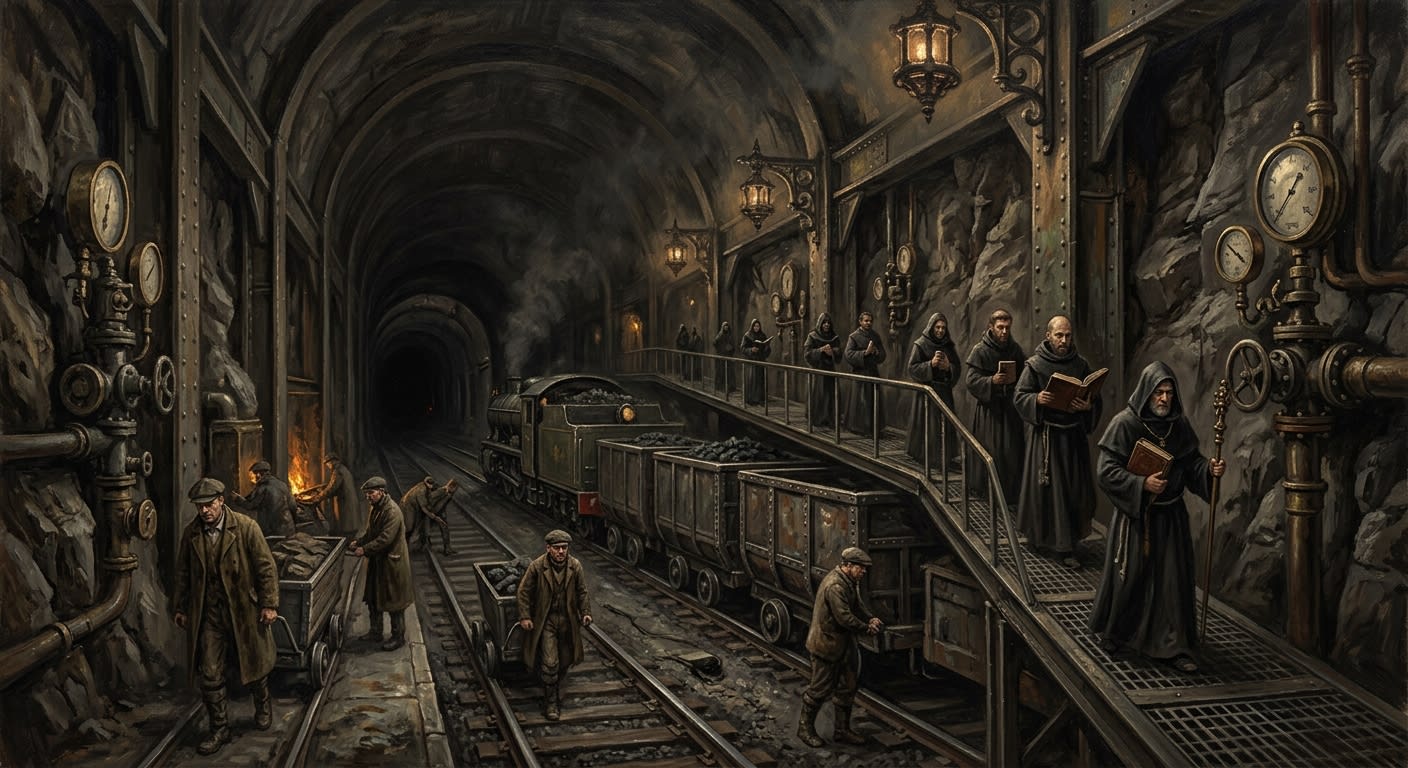
The Transit Spine is the main bore of Bastion-Irongate, the long black artery by which the Sagittal Line forces troops, carts, powder, saints, condemned men, convoy manifests, fresh gaskets, stale bread, and those little boxes labelled MEDICINAL COMFORTS whose contents make surgeons look away with professional greed through the Iron Gates gorge (Unregistered). It is a road, a rail throat, a military corridor, a pressure instrument, a courtroom corridor, a chapel aisle, and a held breath made into architecture.
The unlearned call it a tunnel. This is why the unlearned die early and with poor paperwork.
A tunnel is a hole through matter. The Transit Spine is a negotiated insult to a mountain that has never accepted the terms. It begins at the Intake Gateworks, where breath is tested by candle and permit; it passes through the five Lung chambers, the Choir Nave approaches, the Valve Quarter side-feeders, the Breatheries' bleach-sweet doors, the Hush Court descending stairs, the freight locks, the pressure doors, the rail cart sidings, the sealed Third Lung scar, and the Snowmouth (Unregistered) exit where pine pitch and gun oil remind exhausted travellers that the exterior world has its own cruelties, though at least most of them do not require a voice-license.
The Spine matters because Irongate matters. The Danube gorge is the mid-southern throat of Europe: north toward Bastion-Sibiu, south toward Bastion-Shipka, westward into the Heartlands, eastward into all the contested appetites of Morwen and the Charnel approaches. Open ground kills convoys. River passage lies under battery, flood, corpse-light, and enemy attention. The mountain pass offers cover, speed, and a line of movement through stone.
Then the stone sends its invoice.
#On the Boring and the First Lie
The first permanent garrison established itself on the southern cliff face in A.S. 67, two years after the Line began to harden from desperate entrenchment into continental intention. The northern cliff followed within six months, because generals dislike rivers they cannot command and engineers dislike cliffs they have not yet injured. Ratification came in A.S. 72 under Bureau of Engineering Writ 17-C, Revised, a title that tells the attentive reader two things: the first sixteen plans failed, and the seventeenth survived because catastrophe had become more expensive than approval.
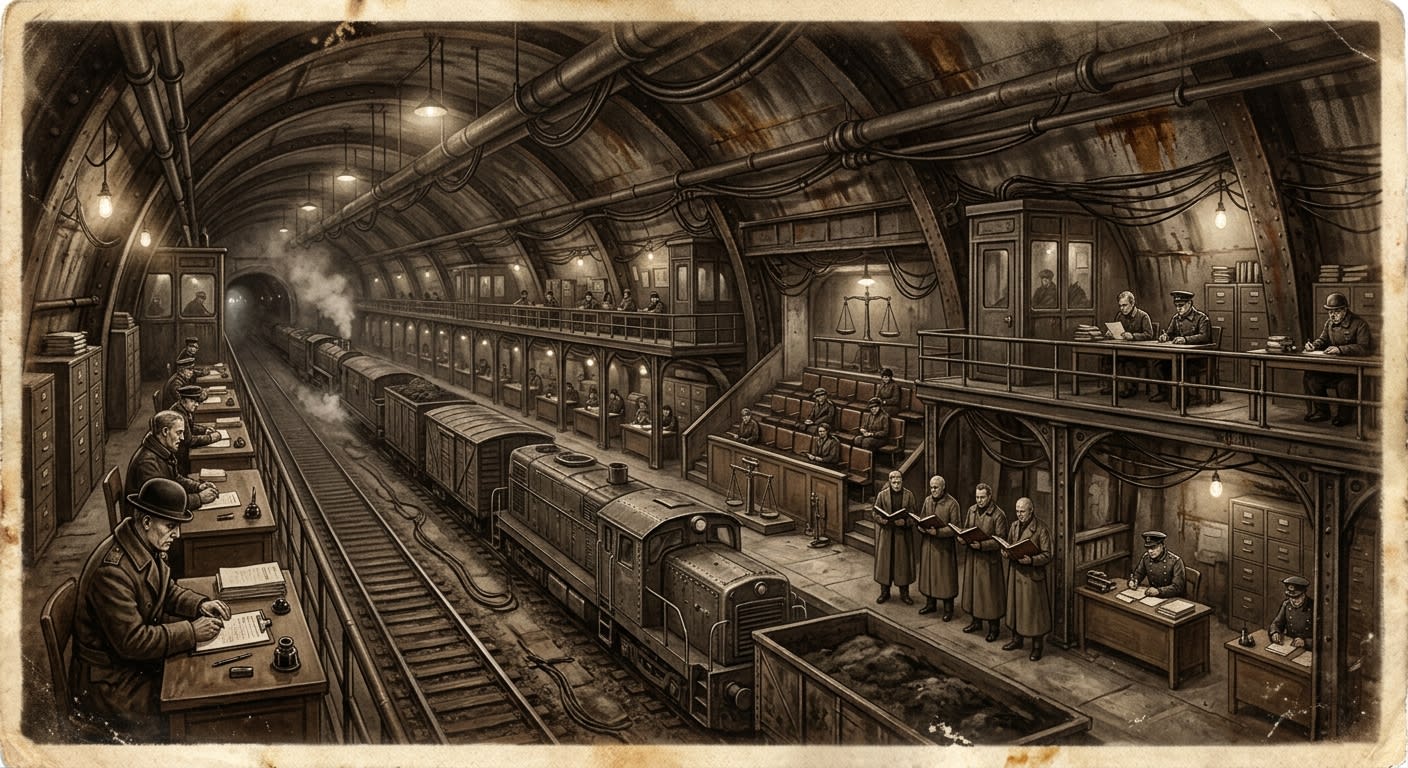
Early drawings present the Spine as a supply improvement. A continuous protected bore, wide enough for rail carts and marching files, with side chambers for staging, dormitories, pressure relief, storage, lift cages, and emergency seals. A clean military idea. Move men beneath rock. Move ammunition beneath artillery. Move food through weather. Keep the Danube commanded from above while the mountain shelters motion below.
Clean ideas are often the dirtiest at birth.
The rock resisted in the manner of old things forced into usefulness by young institutions. Bore crews struck iron seams that made compass needles twitch and hymn-men lose the lower third of familiar melodies. Water entered from hairline fractures and tasted of brass. Lantern flames leaned toward walls where no air moved. The first pressure readings were treated as ventilation data. The second were treated as structural data. The third were treated as moral data, because by then the Choir Magistracy had begun sniffing around the gauges like dogs around a butcher's cart.
By A.S. 80 the Spine had become the preferred military passage through the Irongate sector. By A.S. 90, under Concordat consolidation, the corridor carried scheduled traffic: powder wagons, artillery components, choir cadres, prisoner chains, provincial levies, fuel carts, and relic consignments bound south. The five Lung chambers — Intake, First, Second, Third, Fourth, and later the expanded Fifth feed — were less named than numbered, less designed than widened. Dormitory overflow crept into staging spaces. Storage crept into ventilation. Chapel screens crept into ration passage. Pressure mediation became residence. Residence became entitlement. Entitlement became paperwork.
The first lie was carved above the Intake Gateworks in a provisional hand: SAFE PASSAGE UNDER SYNODAL SEAL. The phrase remains, half covered by later brass plates, pious soot, and correction marks. It was never true. It was useful, which in government prose is usually the stronger category.
#On the Great Hush and the Spine's Education
The Spine learned its true vocation in A.S. 94, when silence killed three thousand people.
The atmospheric inversion came as weather, which is how Providence sends traps when it wants administrators to blame one another first. The Danube lay flat. Wind stopped threading the tunnel-mouths. River-spray ceased at the intake slots. The Transit Spine lost its ordinary whistle, rattle, clank, scrape, animal scream, cart thunder, and human mutter. Men slept well. Horses stopped panicking. The Valve Quarter reduced hammer-work to inspect seals in the quiet. Several chant crews were dismissed early because the older acoustic routines were still classed as supplementary labour rather than as the ribs by which the mountain's borrowed hollowness remained polite.
For nine hours, Irongate knew peace.
It has never been so dangerous.
Gaskets slackened. Bolt seats drifted. Pressure doors lost their bite. The first failure occurred off the Third Lung, whose overburden was already scandalous: dormitory overflow, supply staging, ration passage, chapel screen, pressure relief piping, carts, bunks, barrels, exhausted workers, and administrative optimism packed where caution should have stood. The shock travelled into the Transit Spine and taught every loosened seal to imitate collapse. Door answered door. Gasket answered gasket. The Third Lung compacted into stone, iron, brass, timber, carts, food, choir stools, and men.
TRANSIT SPINE RECOVERY APPENDIX — A.S. 95 REVISION Rear gallery behind Third Lung brace-line: knocking heard after clearance bell. Knocking pattern: seven / eleven / thirteen. Survivor status: ███████████. Map correction: passage reclassified SOLID ROCK. Instruction to convoy officers: do not stop at marked interval unless ordered by Commandant seal.
The rescue cut for eleven months. The knocking lasted sixteen days. Public reports spared the citizen this rhythm, because public truth must be shaped like a ration loaf: dense, dry, and unlikely to produce movement. The Spine, meanwhile, changed law by surviving badly. Continuous vocal resonance became mandatory. The Gasket Choir ceased being labour detail and became structure. The Choir Nave rose beside the wound. The Great Hush became the founding massacre of Irongate's modern order.
Earlier transit manuals described the Great Hush as a chamber-specific collapse affecting the Third Lung and adjacent storage works.
Corrected. The Third Lung died first and worst. The Transit Spine carried the failure, amplified it, survived it, and passed under continuous acoustic governance. The road itself was implicated.
After A.S. 97, no person could move along designated breath lines without regard for sound. Silence grades entered law: incidental, negligent, malicious. A cough could become evidence. A missed stanza could become sabotage. A refusal to sing in a pressure corridor could become death. The Spine had been built to move bodies through the mountain. After the Hush it moved sound through bodies.
#On the Geography of Passage
The Spine is easiest to understand as a sentence written through rock: Intake, First Lung, pressure lock, Choir feed, Transit throat, Third Lung scar, Valve Quarter junction, freight descent, Snowmouth Gate. Like most official sentences, it contains clauses no honest editor would permit and has killed men who tried to parse it in a hurry.
At the Intake Gateworks, arrivals surrender papers, breath, and the illusion that those are separate offerings. The Breath Office holds the candle test: flame at arm's length, bend sustained by exhalation, time measured, score entered. A man who cannot bend flame cannot be trusted to hold passage in a mountain that treats breath as both tax and sacrament. Convoy masters present route seals. Pilgrims present indulgence slips. Condemned men present wrists. The gate accepts all, given fees, chains, and pressure window.
The First Lung houses dormitory vaults and ration stalls, though “houses” suggests hospitality and the First Lung offers only allocation. Bunks are rented by the hour according to voice-license tier. Warmth is rationed. Soup is brine, grain, and the mercy of a cook who has not yet been audited. The walls sweat black water during pressure turns. Children born in the Lung learn to sleep through bell changes and wake at silence.
The central run widens toward the Choir Nave feeds. Brass baffles carry the Bureau of Bells' sanctioned harmonics into the rock channels; gauge boards watch pressure with a cruelty usually reserved for creditors. Chant crews stand off the main passage but their voices travel through it, around it, beneath it, above it, into gasket housings and bolt seats. A traveller moving through the Spine feels sound in the teeth, ribs, knees, and old lies.
Past the Choir feeds lies the Third Lung scar. Official diagrams mark safe bypass lines, sealed dead spaces, reinforcement ribs, prayer niches, and masonry plugs. Unofficial chalk marks tell workers where to step, where not to linger, where to keep voice low despite law, and where the knocking is heard on frost nights. The Shaft Priory keeps candles near an old casualty sheet, tolerates the unlicensed, and commits the tactical brilliance of mercy under conditions where mercy has been denied a budget.
Then comes the Valve Quarter junction, hot enough to make the cold tunnels feel like accusation. Gasket foundries, bolt shops, valve plates, pressure fittings, grease kettles, throat-mark stations, counterfeit temptation, and the first smell of oil strong enough to wrestle the mountain's damp from the nostrils. The Gasket-Hymn Mechanics work here with torque key and purity wax. The Diesel Resonance Plumbers descend through service throats with instruments that look like pipes, weapons, and bad decisions. Many return with stone dust in their spit. Some return hearing knocks in metre.
The freight descent narrows again before Snowmouth. Rail carts take priority over pedestrians, officers over workers, relics over officers, emergency gaskets over relics, and sealed Doctrine packets over all categories because paper, properly stamped, outranks flesh in every honest administrative system. The Snowmouth Gate opens westward to cold air, pine pitch, gun oil, avalanche risk, toll extortion, and the vulgar joy of seeing sky without a mirror-check.
#On Command, Doors, and the Right to Seal
The Transit Spine belongs in practice to Commandant Hadrik Sorn, though every Bureau with ink in its veins has attempted to claim some portion of it. War claims passage. Engineering claims structure. Bells claims sound. Doctrine claims meaning. Records claims logs. Purity claims any corridor where a man might become another man while no one is looking. Tithes claims tolls until someone reminds Tithes that air-rights inside the mountain have a special exemption, whereupon Tithes claims the exemption.
Sorn holds the gate keys and the denial charges.
Compartmental denial is the Spine's ugliest mercy. Pressure doors stand at intervals along the main bore, each able to seal a section against fire, breach, collapse, gas, Morwenite incursion, Counterkey sabotage, or inconvenient survival. Charges set near older ribs can collapse side throats and deny passage to enemy forces. They can also trap civilians, workers, soldiers, convoy animals, pilgrims, and those condemned men whom the Bureau remembers as souls only when extracting final confession.
A Spine officer must decide quickly, often with incomplete information, whether a sound is structural, hostile, human, doubled, rehearsed, or merely terrified. The wrong delay floods a chamber. The wrong seal buries a convoy. The wrong opening admits a replacement wearing a familiar face. Sector Nineteen taught the fortress what replacement means. The Ledgers of Self now travel with Spine units in brass packets: scars, gait, voice chart, childhood bone-lines, mess-tin grip, sins, habits, fears. A man is checked against himself at pressure locks.
Mirror Discipline governs reflective surfaces along the Spine. Tin is warped. Brass is dulled. Shaving is assigned. Water buckets are covered after use. Soldiers may look at themselves for three seconds and no longer near Morwen's front. In the Spine this rule becomes practical torment. There are wet walls, polished fittings, oil slicks, glass gauges, knife blades, dark windows, and the Danube glimmer caught in intake slots. Morwen's work requires only a moment in which a man sees himself as available.
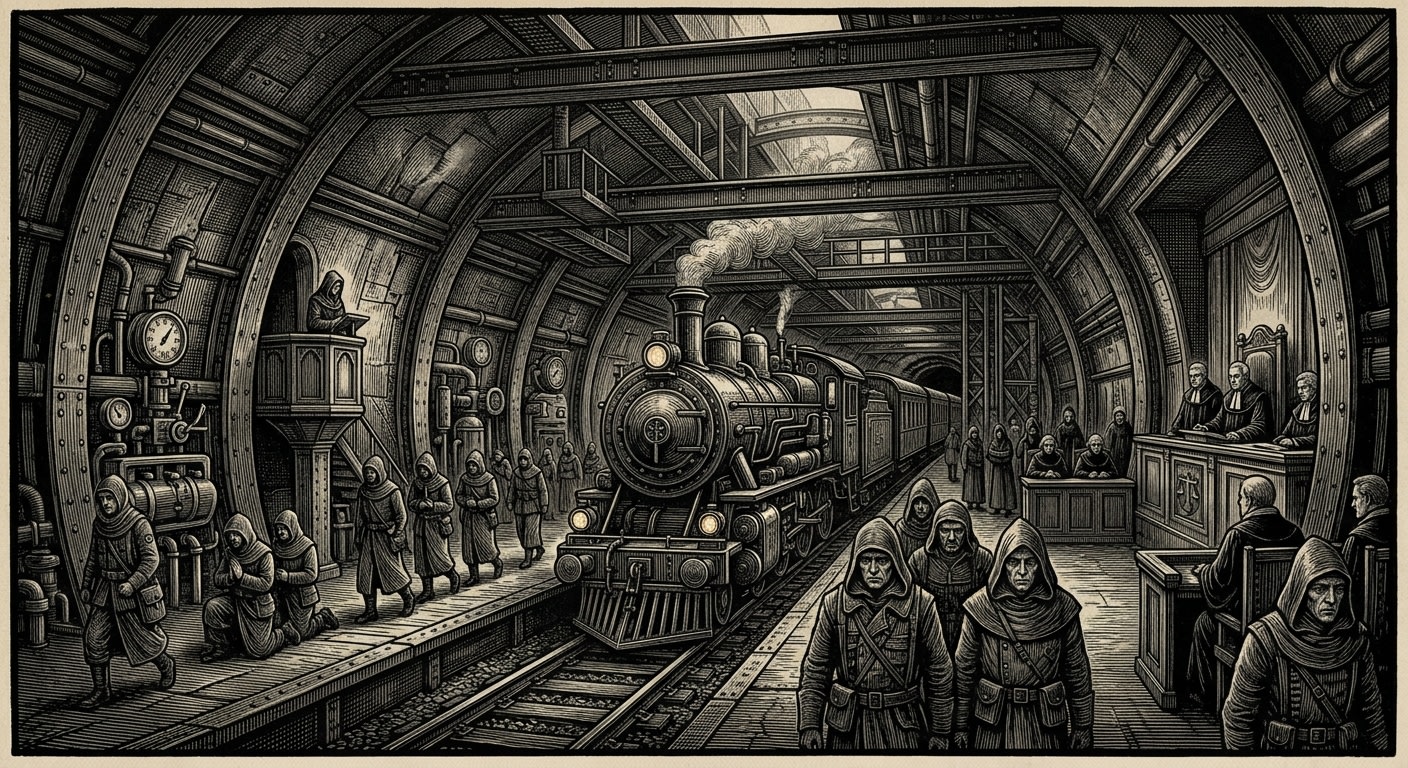
The Hush Court sits beneath the Transit Spine because irony is too useful for the Bureau to leave unemployed. Silence crimes are tried below a road that cannot bear silence. Voice-license appeals, counterkey possession, Twinning disputes, breath-line refusals, and pressure-gauge verdicts pass through its chambers. The accused often hear carts moving overhead while sentence is read. There is a whole theology in that: motion above, judgment below, both dependent on the same throat.
#On the Underchords Beneath the Road
Every road acquires a ditch. The Transit Spine acquired the Underchords.
They occupy the abandoned ventilation channels, sealed pre-Hush construction remnants, baffle crawls, maintenance throats, old mining galleries, and impossible spaces that official surveys mark as stone. The Spine makes them valuable. A denied corridor beside a useless road is a damp inconvenience. A denied corridor beneath the main passage through Irongate is a kingdom with low ceilings.
The Underchord Cartel sells what the Spine rations: movement, air, permission, quiet, counterfeit voice-licenses, oxygen bulbs, stolen hymn pages, warm bunk seals, quiet passes, and the dignified criminal service of making a failed worker less visible before law can finish killing him. Payment flows in gasket-rings because coin rings too loudly and paper carries names. Tap-King Jaro speaks through pipes. Mira Slate governs the pause afterward, laughing without sound and making grown Purity men discover theology in their lower intestine.
Tunnel Command reports identify the Underchords as non-habitable maintenance voids adjacent to the Transit Spine.
Corrected for private use. They are habitable, inhabited, profitable, armed, mapped by tap-code, and indispensable to the official systems that deny them. “Non-habitable” here means “habited by persons whose recognition would be costly.”
The Cartel does not merely evade the Spine. It services it. Injured workers vanish below after accidents that would embarrass the Tribunal. Counterfeit licenses return men to breath lines during staff shortages. Stolen hymn pages circulate to crews whose official copies were recalled for audit and never replaced. Oxygen bulbs keep unlicensed labour alive long enough to patch a valve the Magistracy cannot admit needs patching. The Spine's legal surface rests upon an illegal understructure, which is to say the Spine is a Synod building.
The Counterkey Circle feeds from the same depth and poisons it with sincerity. The Circle teaches forbidden harmonics to those discarded by the Gasket Choir: former chant workers with ice-lung, failed auditions, revoked licenses, workers made cold by the very system their throats maintained. Reed writes in gasket grease. Alen Rill draws sequences on black stone. They say the Choir sings wrong; that the mountain had its own hum before Magistrates chose a key; that the Spine could hold with fewer human sacrifices if the stone were heard rather than commanded.
This is heresy. Worse, it may contain engineering.
The Hidden Alcove behind baffle bank four, discovered in A.S. 200, contained fresh Counterkey notation and older acoustic scoring predating the Magistracy's present hymnals. This discovery has been handled with the calm one expects when offices find an ancestor's confession inside the wall. The notation was removed. The alcove contained nothing. The report says so. The report lies with admirable posture.
#On the Dead Gallery and the Road's Shadow
The Dead Gallery is the deepest known wound beneath the Transit Spine, though “known” is too proud a word for a corridor that changes length when measured. In A.S. 200 it measured forty yards. Later surveys confirm sixty, contradicting chain marks, stone strata, and the assumption that space respects forms signed by Engineering.
Its walls are damp with a substance chemically consistent with human saliva in quantities no census can justify. Voices thrown down the Gallery arrive early, late, absent, or wearing the wrong throat. A woman's register from a man's lungs. A child's pitch from an adult's chest. Correct words, wrong instrument. Engineering says acoustic refraction. The garrison says Morwen. The Circle says the mountain speaks there in frequencies drowned by a hundred and seven years of sanctioned chant.
DEAD GALLERY / TRANSIT SPINE SUB-GRADE INCIDENT 7-K/201 Survey party entered through pressure-door fissure below Spine marker III-L. Chain length at entry: certified. Chain length at return: certified plus eleven yards, identical alloy, correct stamp. Observed figure: Choir Warden uniform, back turned, face ███████████████████. Spine traffic above continued uninterrupted for seventeen minutes after distress tap. Cart manifest lists no delay.
The worst truth is the Spine traffic above it. Carts pass. Convoys sing. Prisoners shuffle. Officers curse at pressure holds. Breath clerks stamp. The mountain's shadow lengthens beneath them in a direction no map agrees to print. Civilization often consists of stepping over a crack because the timetable says the floor is whole.
The surveyor's superstition along this stretch is practical: never let the chain lie in a perfect line. A straight chain invites the Gallery to count it. Sappers kink the measure every seven yards, set a boot on the brass link, spit once to the left, and mark the wall in chalk that has been rubbed with salt from the Valve Quarter. Engineering condemns the practice in memoranda and issues the salt from stores. Such is the clean distinction between official reason and men who wish to come back with the same length of rope they carried in.
A convoy pulse over the Gallery feels different. Cart wheels lose their iron chatter. Hooves soften. Prisoner chains seem briefly made of cloth. Men in the passage above begin speaking too politely, as if every word has entered a room before them and is waiting to be judged. The Choir Wardens increase the lower harmony by order of the gauge board, though the gauge needle often has not moved. No one likes admitting that bodies know pressure before instruments do. Instruments take this badly.
#On Morwen's Interest
Morwen envies Irongate because Irongate is beautiful in the military sense: disciplined stone, commanded river, cliff batteries, chain-booms, pressure doors, a fortress that makes geography kneel while pretending humility before Heaven. Envy cannot let such beauty stand unspoiled. It must hollow, imitate, corrode, duplicate, replace, and leave the original doubting whether it was ever original.
The Transit Spine gives Morwen the finest instrument imaginable. It brings bodies through fixed checks and repeats those checks until vigilance becomes habit, then boredom, then ritual. It makes identity procedural. It creates moments of reflection in wet metal and glass gauges. It forces men to answer names while tired, hungry, frightened, and half deaf from chant. It requires passages through compartments where a replacement can stand one door ahead of the man he wears.
Face-Thieves love transit systems. So do clerks. Again, an instructive overlap.
The Ledgers of Self were revised after Sector Nineteen (Unregistered) in A.S. 193, but the Spine remains where Ledger theory meets operational dirt. A field copy may be soaked, misread, amended, or quoted by a man who should not know its bone-lines. A sealed copy may disagree with the living claimant. A dead copy in Strasbourg may confirm the wrong man too late for the watch change. Two men may answer to one childhood. The Twinning protocol resolves by executing both, which is tidy, tragic, and occasionally insufficient.
Morwen's pressure is rarely dramatic on the Spine. A sentry's relief arrives early. A convoy priest blesses cargo in a voice that matches his chart but not his grief. A woman walking toward Snowmouth sees herself in a covered gauge and smiles before remembering she has no reason to smile. A child born in First Lung refuses his own name for three days and answers only to the name of a worker sealed in A.S. 94. These incidents enter files, if they enter files at all, as fatigue, pressure sickness, domestic irregularity, or Morwenite suspicion under review.
Under review is where terror goes to be fed.
#On the Present Condition
As of A.S. 201, the Transit Spine remains open. This sentence keeps armies alive and should make every literate citizen uneasy.
Traffic passes in timed pulses: military convoys, rail carts, ration teams, fuel wagons, saint-bone consignments, prisoner chains, engineering crews, relief choirs, wounded returns, Breath Office quarantines, and the grim little processions of the unlicensed seeking appeal, quiet pass, or exit certificate. Chant watches run through every pressure shift. Emergency doubles are common. Ice-lung thins the voice pool. Ward Seven (Unregistered) is full. Ward Eight (Unregistered) is being carved by men whose breath scores argue against their employment, but a half-built ward has no pity and a full one has none either.
Commandant Sorn retains denial authority. Cantor Ys Varr sharpens licensing audits. The Breath Office expands quarantine jurisdiction by candle and seal. The Cartel sells routes below. The Circle writes alternatives in grease. The Choir sings harder. The Dead Gallery lengthens. Morwen presses with patience, imitation, and the awful intimacy of Envy, which does not destroy a thing before learning how it wishes to be admired.
The A.S. 200 operational survey classified the Transit Spine as “stable under current chant and pressure conditions.”
Revised A.S. 201. The Spine is passable under current chant, pressure, denial, under-market, identity, and mercy-failure conditions. “Stable” has been withdrawn as a word too cheerful for stone.
Still the carts run.
Still the pressure doors bite.
Still the candle bends at Intake, the Choir heaves in its pits, the Valve Quarter spits grease, the Hush Court reads charges under moving wheels, and Snowmouth opens its cold mouth to the west. Europe needs the Spine, so the Spine is declared sound. The mountain hears this declaration through brass, bone-lime, chant, sweat, and criminal tap-code. It answers by remaining hollow for another shift.