
#On the Room Beneath the Breath
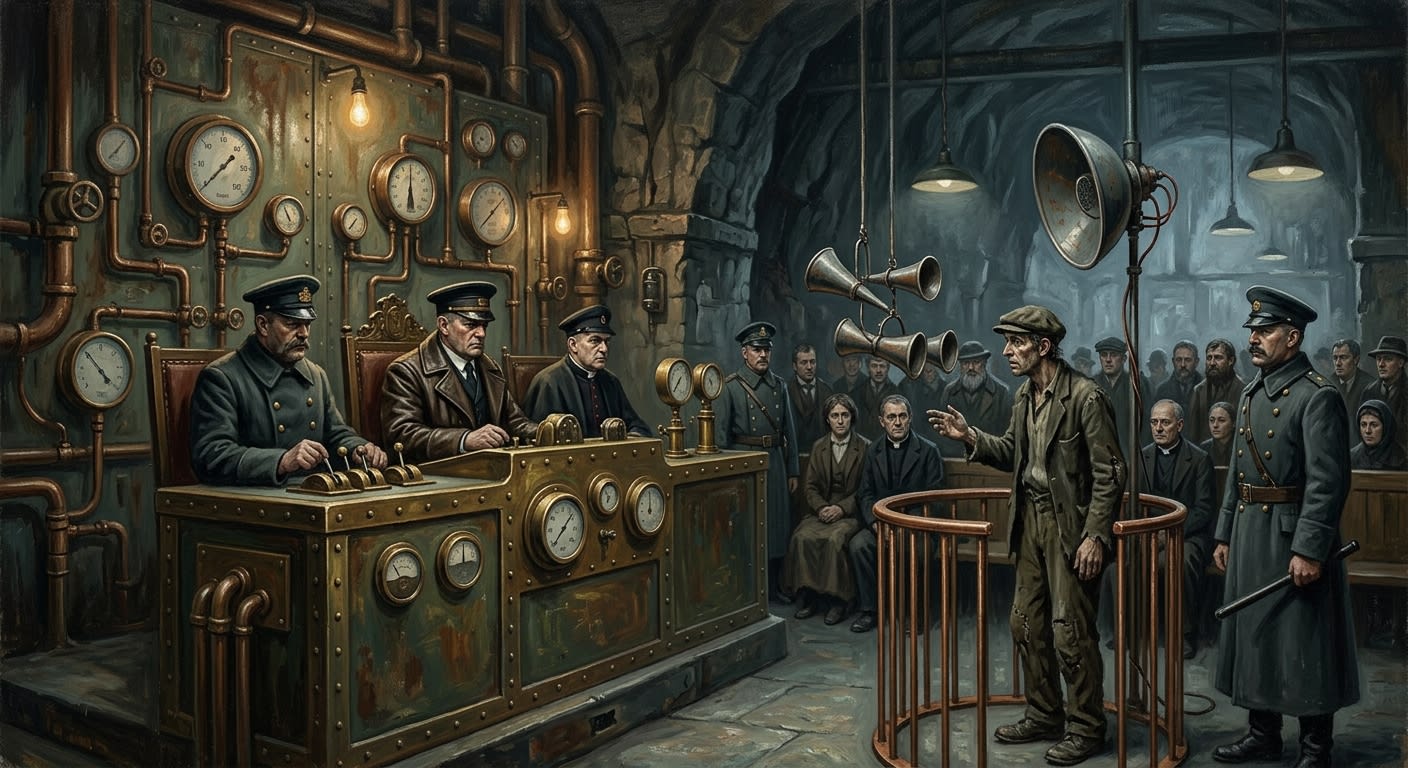
The Hush Court sits under the Transit Spine of Bastion-Irongate, close enough to the main rail line that every verdict feels the carts pass overhead and close enough to the Third Lung scar that the dead of A.S. 94 remain, in juridical terms, available for consultation. Its benches are black basalt. Its gauge board is brass. Its ceiling has been repaired three times, certified twice, doubted hourly, and trusted only by men whose salary depends upon confidence. The air is dry by Irongate standards, which means it merely tastes of stone dust, old wax, throat blood, lamp oil, and fear kept in good order.
The Court tries silence crimes (Unregistered), identity contradictions, voice-license appeals that have become inconvenient, counterkey possession, suspicious quiet, disputed selves, hidden hymn pages, and any case in which a wrong sound threatens to stop being musical and start being architectural. Strasbourg files it under acoustic tribunal practice. The garrison calls it the room where lungs become evidence. The Choir Magistracy calls it necessary. Necessity is the finest perfume ever invented for cruelty. It covers almost everything, given enough ventilation.
A defendant enters through the lower pressure arch. The arch is narrow by design. Two wardens can hold a man there. Three can hold two men if both claim the same name, which occurs often enough that the hinges have been blessed for duplication. A Records clerk sits behind a veiled desk with field copies, sealed copies, blank penalty slips, a sand tray, and a small knife for cutting wax from emergency orders. A Doctrine witness stands beside the gauge board. A Purity officer watches eyes, hands, reflective surfaces, and the defendant's appetite for his own reflection. Engineering attends whenever the room's decision may endanger load-bearing facts, which is every decision and only the embarrassing ones.
The Bench faces the gauge rather than the accused. This is the Court's first honesty. Men lie. Pressure rarely does. Pressure may be misread, delayed, falsified, altered by bad seals, or used by tyrants with clean gloves, but it does not flatter counsel. When the needle steadies after a sentence, the Bench receives that steadiness as witness. When the needle trembles, every living throat in the room becomes newly interesting.
#On the Great Hush as Title Deed
The Court's ancestry is the Great Hush of A.S. 94, though ancestry is too tender a word for three thousand men compacted into stone, timber, iron, bread carts, prayer stools, and the professional shame of Engineering. Before the Great Hush, Irongate had hearings, work panels, punishment benches, chaplain boards, pressure inquiries, and all the little provisional cruelties by which a fortress pretends its emergencies will end. Then the wind stopped, the gaskets slackened, the Third Lung fell inward, and provisional cruelty discovered a permanent vocation.
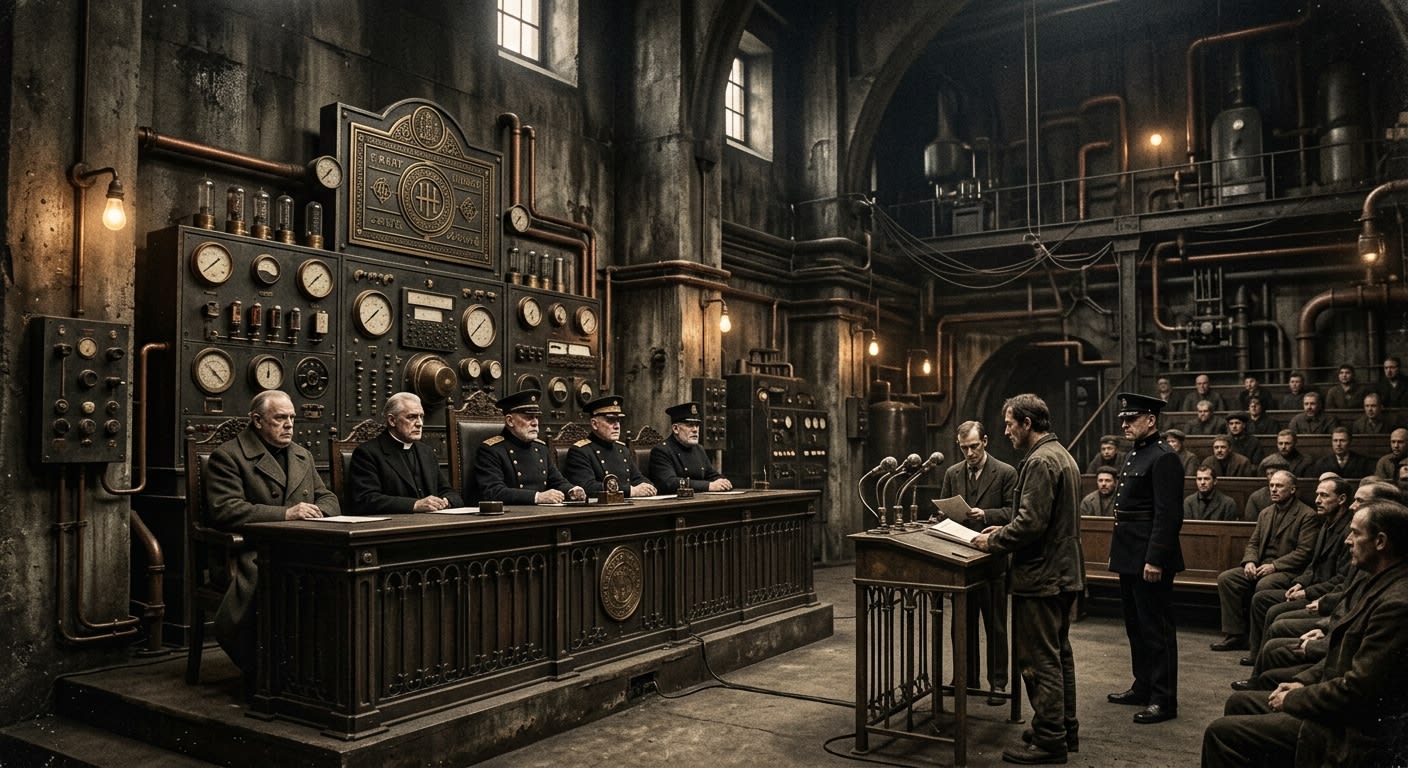
For nine hours the mountain was quiet. Witnesses called the quiet beautiful. Several were alive afterward and had the opportunity to regret poetry. The pressure doors failed in sympathy. The seals crept. By dawn the Third Lung was a single doctrine of gravity. Rescue crews heard knocking for sixteen days. The knocks followed no known code. The public report preferred weather, fatigue, timber selection, and other nouns with no widows attached. Doctrine clarified the matter: silence killed them.
Silence had to be punished because silence had already punished first. That is how the Hush Court was born: a response to a physical fact dressed, over three years, in robes, benches, custody rules, appeal schedules, evidence forms, and the righteous little hunger of any office that discovers death can justify its existence.
Early Irongate memoranda described the post-Hush hearing bench as an emergency safety panel “pending final structural remediation.”
Corrected. The remediation became song. The safety panel became court. Emergency arrangements that acquire seals, budgets, execution authority, and habitual defenders have become government.
By A.S. 97, the Voice-License Tier System (Unregistered) was ratified. By A.S. 105, residents were classed by vocal utility. By A.S. 134, the Bench had learned to treat a cracked throat, a missed entry, a hidden cough, a forbidden pause, and a political complaint as neighboring forms of acoustic risk. The distinction mattered only when the gauge could afford mercy. Gauges are poor patrons.
The Court recites the Great Hush before novice Bench Wardens. It is not recited as lament. Lament might encourage families to ask after the dead as persons rather than precedent. The Hush is recited as title deed: three thousand dead granting the living Bench custody of every breath inside the mountain. An institution with corpses in its foundation stands securely. It may also sink. The Court has chosen the first interpretation and reinforced the floor accordingly.
#On Silence Crimes
The Hush Court divides silence into grades because classification is the Bureau's way of stroking a knife before use. Incidental silence belongs to flesh: fainting, vomiting blood, choking on stone dust, losing breath after injury, missing a measure because the body has petitioned for mercy without filing the correct form. Negligent silence belongs to conduct: missed entries, hidden coughing, unsanctioned sleep, private weeping in breath lines, laughing a singer off tempo, failing to report a cracked neighbor, failing to report a spouse who has begun humming low before pressure weather. Malicious silence belongs to intention, or to whatever the Bench needs intention to mean before luncheon.
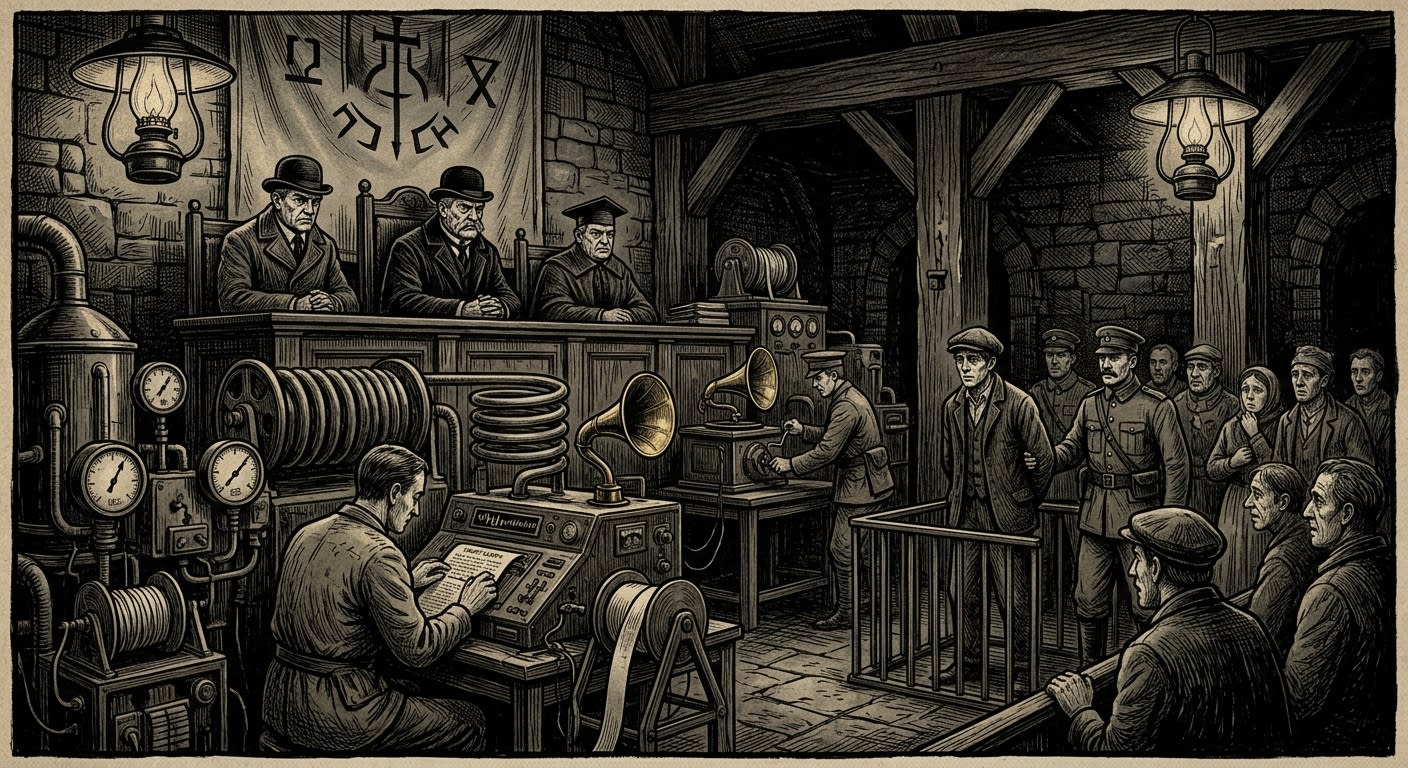
Malicious silence includes refusal to sing, possession of stolen hymn pages, ear-plugs, muffled baffles, counterkey markings, strike murmurs, tap-code assembly, deliberate wrong notes, and that grey legal swamp called listening to the mountain without Magistracy supervision. The Counterkey Circle lives in that swamp. So do half the useful mechanics of Irongate, though only the Circle is impolite enough to write its discoveries in gasket grease.
Proceedings begin with a note. A Choir Warden strikes the tuning fork assigned to the chamber, sets it on cloth, and waits for the accused to answer. The answer may be spoken, sung, tapped, written, coughed, or absent. Each carries risk. A spoken defence may reveal voice drift. A sung defence may reveal counterkey sympathy. A written defence may reveal Circle notation. A tapped defence may suggest Underchord schooling. An absent defence becomes confession if the room is in the mood to finish early.
The famous file 34-K/199 remains the Court's ugliest little relic: unlicensed worker, malicious silence during Third Lung reinforcement, no audible defence, medical appendix stating vocal cords fused by ice-lung scarring, sentence carried out, pressure stabilised forty minutes later. Training materials cite the case as successful deterrence. Families cite it differently, when no Warden is near enough to hear.
The Bench's defenders point to the pressure result. The pressure held. There speaks the whole theology of the room. If a dead man produces a stable gauge, the gauge becomes advocate, witness, judge, and clerk. The objector must argue against the ceiling. Ceilings rarely grant appeal.
#On Voice, Heat, and the Little Deaths Before Sentence
The Hush Court rarely begins a man's punishment. It usually blesses one already underway. A cracked note first appears at the audition bench, where Cantor Ys Varr tilts her head and hears more than the worker can afford. The Breath Office (Unregistered) lowers tier. Heat allocation follows. Ration order thins. Bunk hours shrink. The children learn to sleep nearer pipes. The wife sings lower at supper to cover a husband's failing line. The Warden notices. The file fattens. By the time the man enters Court, the sentence has been rehearsing in his kitchen for weeks.
This is why the Hush Court is feared beyond its actual schedule. It does not need to convene often to govern continuously. Its existence sits behind every candle test, throat audit, heat slip, lozenge search, hymn-page recall, and corridor cough. A worker who hears his own breath rasp at night hears the Bench clearing its throat.
Voice is worth more than testimony in Irongate. A man of rotten character and strong lower register may survive longer than a saint with ice-lung. Doctrine may dislike this arrangement in sermons; it endorses it in seal-work. The mountain does not inquire after virtue when the Third Lung mourning tone thins. It asks for frequency. Frequency has no moral imagination, which makes it an excellent servant and a dangerous idol.
The Court's penalties respect this economy. A guilty man may be executed. He may also be lowered one tier, barred from heat, assigned to punitive chant, moved to a colder bunk, stripped of family warmth, confined in a dry cell until his voice returns or goes entirely, or ordered to sing a dangerous reinforcement line during pressure weather. The last penalty is admired by administrators because it converts guilt into labour. A man may atone by holding the ceiling above the people who will not meet his eyes afterward.
Children know the Court before they know doctrine. They learn: do not cough in rhythm, do not hum the wrong lullaby, do not tap pipes after dark, do not count to four before tin, do not ask why Uncle's heat seal changed, do not repeat what the lower corridor man said about old notes. Childhood at Irongate is civic education by acoustic terror. The results are efficient, if one has no taste.
#On Twinning and the Ledgers of Self
The Hush Court's second jurisdiction concerns identity. Morwen made that necessary, which is to say Morwen found an existing bureaucratic talent and gave it fangs. At Irongate, a man may become uncertain through reflection, imitation, grief, envy, old brass, still water, or the dreadful kindness of someone wearing his mother's face. Mirror Discipline limits exposure. The Ledgers of Self record the person in portable fragments: scars, gait, sins, bone-lines, childhood dogs, fever dreams, grip on a mess-tin, the prayer muttered when a rifle jammed. The Hush Court decides what happens when the fragments disagree.
A Ledger hearing is colder than a silence trial. Silence trials at least involve action. Identity hearings involve grammar. The subject is brought to the Bench. Records opens the field copy. The sealed copy waits under wax. The dead copy in Strasbourg remains, one hopes, dead. Witnesses stand behind screens. The clerk asks public particulars, then witnessed particulars, then bone-lines. The Purity officer watches the eyes during memory. Doctrine watches the clerk. Engineering watches nothing useful and attends only if the hearing might affect shift assignment.
If Ledger and person agree, the subject receives a chit: IDENTITY ACCEPTED AS OF HOUR AND DATE. It is one of the most honest documents in Europe and for that reason should be kept from children. If they disagree, the subject is held. If two persons agree with one Ledger, the Twinning begins.
HUSH COURT TRANSCRIPT TWIN-44, A.S. 199: Claimant A and Claimant B recited identical bone-lines. Both wept at the yellow dog clause. The Ledger amended itself during recitation to include a third childhood prayer. Clerk Voss asked permission to stop reading. Permission denied. Third claimant found ██████████████████ inside acoustic baffle four, alive, adult, and nine years old.
The standard resolution when two claimants remain equally valid is execution of both. War calls it efficient. Doctrine calls it canonical. Families call it murder if they possess courage or privacy. The Court calls it containment. That word is a locked reliquary: open it and the smell comes out.
There have been exceptions. A pair of fourth-tier altos in A.S. 200, identical in audit score and throat scarring, produced improved pressure when singing together. The Court sealed the disposition. The Bench annotation reads: do not permit harmony to establish identity. I envy the clerk who wrote that line. It is vile and excellent. Posterity will steal it from him, as posterity steals from all lesser stylists.
#On Counterkeys, Underchords, and the Court as Recruitment Office
The Hush Court hates the Underchords with the intimate fury of a landlord whose cellar has begun issuing opinions. The denied tunnels below Irongate hold counterfeit voice-licenses, gasket-ring markets, stolen hymn pages, oxygen bulbs, quiet passes, illegal true glass, hidden kin, failed singers, aphonic workers, Shaft Priory mercy, Tap-King Jaro's pipe language, Mira Slate's routes, and the Counterkey Circle's grease marks. Every sentence passed above sends someone below. Every raid below supplies evidence for new sentences above. The system denounces its own shadow and then complains that the shadow follows.
The Counterkey Circle's accusation is precise: the Magistracy's prescribed harmonics hold the mountain badly and profitably; other harmonics might hold it with less labour, less licensing, less heat tyranny, less Bench. This makes the Circle dangerous in two ways. A false counterkey can unseat a gasket. A true counterkey can unseat an office. Guess which threat receives more confidential memoranda.
After the A.S. 198 classification of the Circle as Active Heretical Cells, Category: Structural, the Court acquired appetite. Standing Order 34-K (Unregistered) waived voice testing for Reed, the aphonic leader who burned his own vocal cords rather than submit again to the prescribed stanza. Waived voice testing. There is a rare legal jewel: a court so committed to acoustic jurisdiction that it writes an exception admitting the accused cannot answer its central ritual.
The A.S. 199 audits fed fourteen workers from Varr's bench into the Hush Court. Four bore Circle marks. Six were exhausted workers whose voices cracked under ice-lung and terror. Four remain indeterminate, which is Bureau-Latin for graves insufficiently useful to reopen. The Court executed all fourteen. The Circle moved deeper. Recruitment improved. Purity requested wider authority. The Bench approved tighter audits. The mountain held, and every party claimed the holding as proof.
The Hidden Alcove behind baffle bank four made the Court more anxious than any sermon could. Fresh Circle notation beside older acoustic scoring means the present hymnals have ancestors. Ancestors imply choices. Choices imply responsibility. Responsibility is poison to institutions that survive by presenting themselves as physics with a stamp. The Court countersealed the removal annex, transferred the slabs west as damaged hymn stands, and instructed the maintenance report to describe satisfactory baffles. The baffles, being brass, did not object. Brass is wiser than clerks.
Standing Order 34-K multiplied after the Alcove. The first version named Reed. The second named unlicensed persons carrying lower-sequence notation. The third added those who translated tap-code into stave marks, those who sheltered a Circle teacher, those who possessed old scoring without explanation satisfactory to the Bench, and those who asked why old scoring required explanation at all. Law grows fastest where fear waters it. By winter A.S. 200, the Hush Court had acquired a vocabulary for every corridor habit it disliked: listening without licence, humming with intent, silent assembly, kin concealment, baffle curiosity, pre-Hush sympathy. Each phrase was absurd. Each phrase could move a body into custody. Absurdity becomes serious once the key turns.
The Underchords answered with jokes, which are the poor man's sealed memorandum. They called the Court the Warm Grave, the Dry Choir, the Ear With Teeth. They drew a little bench on pipe walls, then drew legs beneath it, then boots, then a leash leading upward to Varr's office. Purity scraped the drawings away. More appeared. A court that fears caricature has already admitted jurisdiction over its own vanity.
#On Mercy, Procedure, and Other Expensive Materials
The Hush Court permits appeal. This is its favorite joke after preventive maintenance. Appeal must be audible unless the matter concerns identity, in which case it must be witnessed, signed, countersealed, and delivered through a Records clerk whose neutrality has been inspected for damp. A worker whose cords have fused may petition in writing. A worker suspected of counterkey notation may not be trusted with writing. A worker suspected of Underchord contact may submit through a kin witness. Kin witnesses trigger tier review. The circle closes with admirable neatness.
Father Lukasz of the Shaft Priory once answered the Court's inquiry with the line that has since irritated three offices and comforted several hundred illegal souls: the Priory offers spiritual comfort to all who dwell within the mountain, regardless of licensing status. The Hush Court filed this under revisit when convenient. Convenience has not appeared. Lukasz keeps names on wax tablets warmed smooth each night, proving that a priest without a register can outwit a court whose sharpest hook is legibility.
Provincial lectures describe the Hush Court as “mediation between labour need and structural safety.”
Amended. Mediation presumes parties of comparable standing. The worker has lungs. The mountain has mass. The Court owns the room. Call the thing by its name: adjudication by ceiling.
Mercy exists there, though I resent admitting it. A Bench Warden may delay heat denial for a worker whose child is under fever audit. Varr may lower a man to first tier rather than refer him, buying seven days while surveillance watches which lower corridor answers. A Records clerk may misplace a summons until pressure weather passes. A Choir Warden may strike the note a fraction lower for a man whose upper register died in service. These acts are mercy only if one is feeling devotional. They are also calculation, triage, bribery of morale, and occasional cowardice. Mercy in Irongate never travels alone. It moves with escort.
The Court's cruelty cannot be dismissed as error. Error would be comforting. The room often works. Hidden mufflers are found. Stolen pages reappear. Counterkey cells scatter. Pressure stabilises. Duplicates are caught before they reach gate duty. The Transit Spine remains open. The Danube gorge stays in Synod hands. Useful tyranny is still tyranny; usefulness merely forces honest men to hate it with better footnotes.
Its paperwork has the same double edge. Every Hush Court file contains a pressure result, a human result, a doctrinal note, and a disposal line. The pressure result is precise: stabilised, worsened, unchanged, delayed, inconclusive under convoy vibration. The human result is terse: tier reduced, body transferred, voice removed, kin notified, kin unlocated, no kin admitted. The doctrinal note is almost always longer than the corpse deserves and shorter than the widow wants. The disposal line does the true work. It tells future clerks which part of the event may be reused.
Records loves the Court because fear produces excellent documentation. Purity loves it because ambiguity can be given a room number. War loves it because an ugly verdict that holds a tunnel is easier to defend than a merciful hesitation that drops one. Bells loves it until the Court asks whether a frequency is loyal. Engineering hates it until the ceiling cracks. Doctrine, naturally, loves it best when it is wrong in a useful direction.
The Court's files have entered training across the Line. Brest studies its brevity. Sibiu studies its identity procedure. Shipka studies its warnings against silence and learns the wrong lesson, as Shipka often must, because Syrion's quiet is bait rather than absence. Constantinople requested copies for harbor security and received heavily redacted extracts, which is to say it received enough to terrify and not enough to sue. The Hush Court is becoming doctrine by export. A local cruelty has put on traveling boots.
#On My Inspection
I entered the Hush Court during second watch with Varr to my left, a Records clerk to my right, and Commandant Sorn's silence somewhere behind me like a pistol with manners. No case was in session. The room was waiting. Waiting rooms reveal more than trials. Trial theatre flatters itself. Empty instruments confess.
The benches shone where frightened hands had polished basalt with sweat. The gauge needles rested at a tremble no one mentioned. The test forks lay on black cloth, each tagged by chamber and pressure condition. A sand tray held three scratches that had been smoothed, then returned, then smoothed poorly. Behind the clerk's desk hung a small sign reading SPEECH BY SUMMONS ONLY. Someone had scratched beneath it: BREATH ALSO. The scratch had been scraped away. The scar remained more legible than the sign.
I asked whether the room had ever acquitted a defendant. The clerk answered yes too quickly. Varr answered with dates. Sorn did not answer. The clerk's yes was moral furniture; Varr's dates were weapons; Sorn's silence was the only reply I trusted. Acquittal in the Hush Court means the ceiling did not demand your body that morning. Congratulations are excessive.
A worker was brought in while I stood there, though no hearing was scheduled. Second-tier, male, forty-three, ice-lung onset, suspected Underchord kin contact. He sang badly. He lied worse. His son had vanished below after a heat reduction. Varr listened. The gauge showed drift, minor. Records had already written his decline in the margins of three forms. The Court did not convene. Varr lowered him to first tier, postponed heat reduction for seven days, ordered kin surveillance, and dismissed him.
Was that mercy? Yes. Was it bait? Yes. Was it good administration? Infuriatingly, yes. The man's family slept warm for one more week, and every person who visited them became interesting. The Court had acted without sitting. That is when I understood it properly. The Hush Court is not the room. The room is merely where the Court becomes visible.
#On the Present Court
As of A.S. 201, the Hush Court remains active, feared, necessary, compromised, effective, corrupting, and insufficiently ashamed. The voice pool is shrinking. Ice-lung advances through the older tiers. Counterfeit licenses circulate despite three purge cycles. The Counterkey Circle persists. The Underchords lengthen through denial. Morwen presses the gorge through envy, reflection, imitation, and the daily comparison by which one warm bunk becomes an accusation against twelve cold ones.
The Court wants broader authority over unlicensed kin, faster access to dead copies of Ledgers, direct control over throat medicines entering the bastion, and permanent Purity attachment for acoustic heresy cases. Engineering wants fewer sentences that affect load-bearing workers without consultation. Bells wants cleaner data. Records wants pages that do not amend themselves during testimony. War wants the gorge open. The workers want warmth, lozenges, sleep, and a judge who can hear the difference between treason and a ruined lung.
At shift change the Court hears the Choir above it pass the mountain from throat to throat. The sound comes down through stone as a pressure in the teeth. The Bench waits. The forks wait. Records ink waits uncapped. Somewhere below, a pipe taps twice, pauses, taps once, and falls quiet before a Warden can locate the source. Somewhere in the Dead Gallery, a corridor has grown another yard and told no surveyor. Somewhere at baffle bank four, the panel hides a history the official hymnals would rather not sing.
The ceiling holds. That is the Court's defence. Men live under it. That is the indictment. The Hush Court has learned to make both sentences true and to stamp the space between them.