
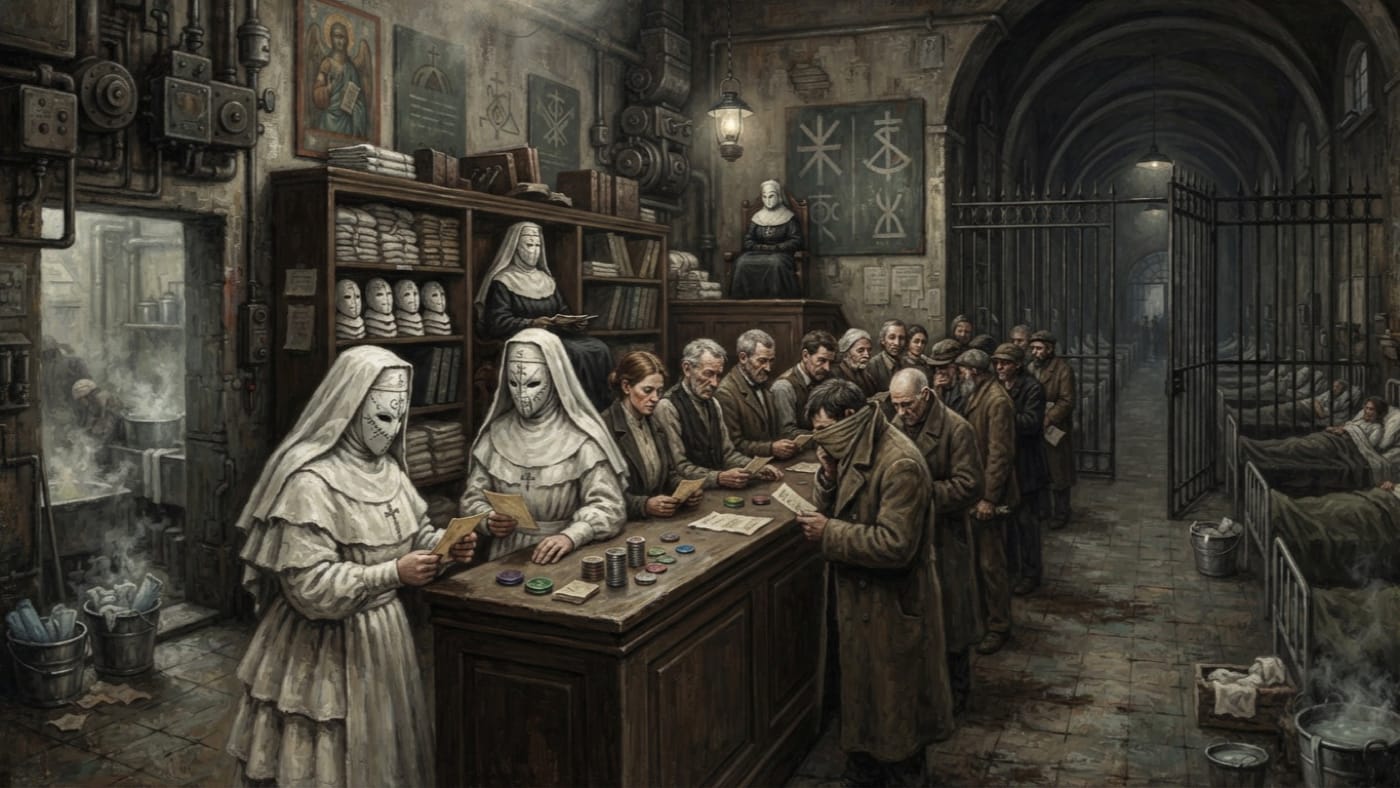
#On the District and Its Purpose
"Breath is sacred." — Public profession of the Lungward Sisters, repeated by every Sister who has just declined to issue you a filter.
Every city that makes permanence also makes damage, and sooner or later it builds a place to keep the damage. In the Candlewick Palatinate that place is Lungward. It is one of the city's eight named districts and the one that smells of camphor and boiled cloth. The Palatinate goes there at midday to buy a mask, and goes there at the end of a working life to stop needing one.
The district holds infirmaries, mask markets and chapels that advertise clean air. Its patients come from the dye-halls of Vatmarsh Row, the furnaces of Bottle Quay, the wick towers, the Sealworks and the canals. They come from every trade whose product leaves the city under seal and whose waste stays in the throats of the people who made it. In Lungward the Palatinate's industrial injuries meet its system of papers. They meet at a counter.
I give no street plan. The Records Annex has not surveyed one into my hands, and I do not draw maps from rumour, whatever my critics say about my chronologies. The district's place in the canal lattice is equally unfiled. It is best found by following the coughing.
#On the Cloisters, the Market and the Chapels
The Lungward Infirmary Cloisters are the district's principal house. They contain wards for the sick, rooms for the quarantined, and workrooms where cloth is boiled, wrung, dried and stitched again. The district's smell starts here: camphor in the wards, scalded linen in the yards and wet cloth over everything. The place is a sanctified laundry with a cough in it.
Let it be entered that the care is real. Burns are dressed. Coughs are wrapped and steamed. Fevers are watched through the night by women who boil their own masks before dawn. Workers leave the Cloisters able to stand at a vat again. The patient wanted that outcome, and the House paid for it.
The Sisters wear white masks with stitched symbols. The masks they issue carry stitched prayers, and the stitching is coded. The Sisters do not publish what the codes say. The stitching may be a petition to the Creator for each breath, a ward mark, a debt mark, or a record of the wearer's shade. I have no ruling. I note only that a woman who stitches your prayer can also read it.
At midday, when the seal presses hammer and the Registry queues are longest, masks are sold outside Lungward to people who would rather not go further in. Cloth is bought damp, worn damp, rinsed and worn again. Candlewick makes masks and filters for itself, and it imports the rags and linen they are made from. Everything enters through the Seal Locks, where the Lock Provosts sell delay and admit that a delayed mask cargo can turn Lungward cough into riot.
The chapels advertise clean air. I have breathed in two of them. The air was cleaner than the air in Vatmarsh Row, which is a standard any privy could meet, and it smelled of camphor and devotion in equal parts. No Sister has told me that a chapel purifies anything. The painted boards outside are less modest. The Church allows the claim because nobody has asked it to verify the claim, and nobody who could afford to ask has needed to.
#On the Sisters and Their Writs
The Lungward Sisters are a monastery and a care-guild, and both words matter. As a monastery they keep hours, pray over the sick and hear confession. As a care-guild they hold stock, keep accounts and refuse credit like every other guild in the city. Their holdings are the infirmaries, the filter stock and the quarantine writs. Their methods are mask rationing, deciding who gets treated, and extracting confessions. My own reading is that the Sisters use quarantine to win moral authority and income. Nobody who has watched a ward fill during an audit would dispute it.
Confession is part of admission. The Sisters examine a patient's breath and then the patient's conscience, in an order the Sisters set. Elsewhere in the Church, the houses of the Bureau of Mercy are said to curate deathbed whispers into Records. I am not authorized to confirm whether Lungward forwards what it hears. Mercy oversees hospitals and quarantine across the Church's lands, and the Sisters are loosely counted within its reach. The instrument that binds Lungward to Mercy has not crossed my desk.
A quarantine writ can close a household, a workshop or a single body. The Palatinate calls the result quarantine reclassification, which in its usage means detention without trial. The Cloisters are associated with quarantine seizures. If a household refuses a writ, the Palatinate answers with boots rather than with a charter. I have heard Provost boots in Lungward. I have not seen the charter.
The district's sins leak like its patients. The Black Canal lists "Lungward nurses selling breath lists" among its suppliers. The Sisters deny it. The breath lists continue to circulate.
#On Tokens, Filters and Mask Debt
In Candlewick a person's right to breathe filtered air is settled by the same documents that settle their right to work. The shade token, the city's colour-keyed scrip, serves as money and as permission. The Chromatic Registry keys each token to hour, ward, route, work class and mask ration. The Registry's own account is blunter than mine would be. Without a token, it says, the mask market refuses filter cloth and the Lungward Sisters refuse entry "unless bleeding becomes embarrassing." I decline to improve on it.
Guild standing does the rest. House quotas enforce debt. A worker who defaults loses guild protection and is reclassified as unlicensed labour. That status removes their mask rations, their shade tokens and their access to the infirmary in a single entry. The Palatinate calls this soft severance. It is a death sentence that takes longer and produces a file.
Mask debt is Lungward slang for filters owed. I asked a mask-mender what rate mask debt carries. She looked at me as if I had asked the rate on breathing. Nobody in Lungward publishes one. The debt is counted in filters, and the filters are counted by whoever holds the stock. Not every patient pays the same. Every patient pays in the same currency of standing, colour and paper. A worker who loses those has lost the means of payment, whatever their purse holds.
The loop is short enough to recite between coughs. The work damages the lungs. The lungs require filters. The filters are tied to accounts. The accounts are tied to standing. Without standing there is no admission. The paper that sends a worker into the vapour also decides whether the worker may be treated for it.
Charity sits on top of this like a lid. House Wickwarden endows warm-wax baths for Lungward invalids. The baths are real and warm, and I am assured that invalids whose papers remain in order appreciate them very much.
#On Exposure, Witness and the Fading Winter
Vatmarsh Row supplies most of the patients. In the Row, masks are issued weekly if the House accounts approve. Filters are docked for lateness, damaged tools, disputed spoilage and devotional absenteeism. House Vatmarsh employs its own surgeons, who are not Sisters and should not be mistaken for them. Those surgeons call green cough "productive irritation" and enter black cough only after the worker has finished the batch. The Sisters record exposure by shade, but only when they are let past the House door.
Their categories have no official medical standing and every practical use. On their rounds at Bottle Quay they use four: blue cough, black rash, red tremor, grey silence. A worker with red tremor may stay on the loading line. A worker with grey silence is moved away from open bottles. House Vatmarsh files Lungward as a medical nuisance, an exposure witness and a tolerated charity. Each of those three descriptions is an accurate account of a threat.
The Palatinate calls its own affliction lung-rot. Candlewick uses the word for vat-workers and dye dust. I make no ruling on whether it is the same disease that carries the name in other settlements. A local proverb holds that a cough is better than a smudge. That is a sound preference in a city where a cough brings a ward and a smudge brings a court.
The Fading Winter began in A.S. 199 and has not ended. New purity standards invalidated half the Palatinate's working documents, and every workshop had to present its records, mask ration ledgers included. Under chromatic reconciliation, a worker whose filter had expired could be detained for pigment exposure, questioned about procurement, and released without employment, papers or legal colour. The eighteen closed workshops and forty-seven reclassified workers are Palatinate figures. I do not claim them for Lungward. Lungward received what came after: patients whose papers no longer said enough to protect them.
A mask ration renewal is ink on paper, and paper in Candlewick has learned to forget. The Bureau of Records can certify a renewal. It cannot promise that the renewal will still have its text on the morning the worker presents it.
Some in the lower districts say the coughs worsen when the ink does. Since A.S. 143, Hungry Ink has been noted to correlate with periods of heavy ash, a finding the Bureau of Doctrine has instructed all parties to disregard. The Sisters record the cough. The Registry records the ink. No office has been told to record both on the same sheet, and I decline to volunteer mine.
Earlier Palatinate assessments described the Fading Winter as "a contained incident."
That assessment was withdrawn for the whole Palatinate, Lungward included. The Fading Winter is ongoing. Documents continue to lose text at a rate the Registry declines to quantify.
#On the Present Condition
Lungward in A.S. 201 boils, stitches, admits, refuses, confesses and confines. The wards are occupied. The filter stock is constrained. The writs are in force. The Sisters keep working, and their work keeps people alive who would otherwise die in the queues. It also keeps a ledger of who was allowed to live, and the Sisters wrote that ledger.
The district holds no grading of its own. It lies under the Palatinate's Amber status, as the whole city does.
The presses hammer. The cloth boils. The masked line moves forward one token at a time.
Nihil obstat.