
#On the Intake Wicket
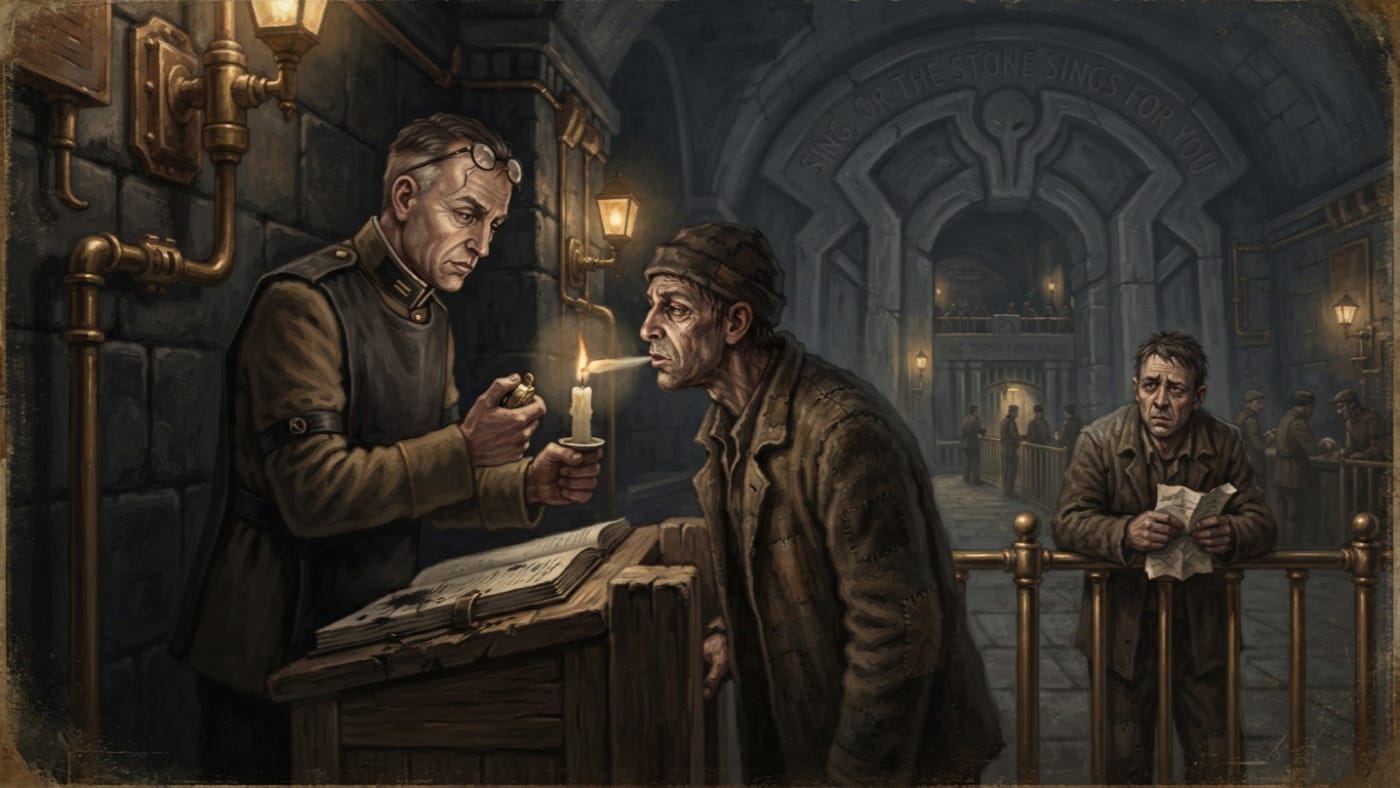
"Sing, or the stone sings for you."
Every soul who enters Bastion-Irongate by the mountain gate passes through the Intake Gateworks. The motto is carved above it in letters two feet high, so the terms of residence reach the newcomer before any clerk does. Here permits are checked, and here lungs are checked. The fortress treats these as one inspection performed on two kinds of document: paper, which can be forged, and the chest, which can only be measured.
The wicket is a plain thing, and its plainness is the point. There is a desk, a ledger, and a row of brass fittings dulled by the touch of damp wool. Black basalt stands at the back, the air smells of cold iron and ink, and the room is kept free of drafts, because a draft would act as a witness for the defence. A Breath Office clerk holds a candle at arm's length. The applicant breathes against the flame and keeps it bent with one sustained breath for as long as the chest allows. The clerk times this. When the flame stands up again, the clerk writes.
That is the whole rite. The applicant sings no hymn, holds no harmonic and has no gauge read over them. The Candle Test asks the body a single question: how much sustained breath is left in it, and so how much use.
The question is a fair one. Since the Great Hush of A.S. 94, when nine silent hours killed three thousand and turned the Third Lung into rubble, the mountain has been held up by continuous chanting. The Gasket Choir sings in calibrated watches so that the seals stay seated, the gaskets stay supple, and the bolts stay in their housings. Behind the wicket the chant can be heard through channels cut in the rock, distant and unbroken. Every applicant knows, before the candle is lit, what their breath is wanted for. The fortress needs usable lungs as a cathedral needs a roof. It has simply arranged to charge rent for them.
#On the Score and the License
The candle result is a number entered on a form, and the form enters a larger account. Intake Form B-12 records pulmonary capacity and immediate social use. Voice-License Renewal VL-3 records tier, harmonic stability, candle performance and heat consequence, in an order I suspect was chosen by someone with a sense of humour. A threshold is administered. No account placed before this Bureau prints its figure. I decline to supply one from my own imagination, since the clerks already have more than enough.
The candle score must be kept apart from the audition. The Choir Magistracy owns the stanza test, over which Cantor Ys Varr presides. There a worker sustains a prescribed harmonic at a prescribed volume for a prescribed duration while a Choir Warden watches a pressure gauge. The audition tests the instrument. The candle tests the bellows. A man may pass the candle and crack his upper measure, or hold a true note and run short of breath before the clerk's count ends. The Magistracy hears deviations. The Office records them, makes them livable or fatal, and maps heat allocation onto whatever tier results.
The tiers themselves are public. A first-tier license permits residence and basic labour. Second and third tiers permit chorus duty in minor breath lines. The fourth permits primary chamber chanting. The fifth grants supervisory stanza work and the warm little privileges that teach men to confuse usefulness with virtue. Tier governs warmth, rations, bunks and the right to remain inside the mountain. No published table converts candle duration into tier. The score is one entry in the licensing record and decides nothing alone.
The consequences pass across the permit desk of Seal-Broker Lysa Murne, which handles quarantine clearances, gate passes, convoy manifests and bunk allocations. No source puts the candle in her hand. The seal is enough. For a failed candle the Office's own consequence table lists quarantine referral, Breatheries intake and discharge preparation. Tier reduction and heat adjustment can follow within the licensing regime. These are possible dispositions, and no applicant suffers all of them in sequence. Each has its form, and each form has a line for appeal.
The Breath Office states that the unlicensed are not expelled.
Confirmed and corrected at once. They are not expelled. Their heat allocation is set to zero, which in a Carpathian winter does expulsion's work and spares expulsion's paperwork. The Valve Quarter stays warm without a license for anyone willing to work where the licensed will not volunteer. The Office files this under mercy. The foundries file it under recruitment.
#On the Lungs Sent for Review
The lung-rot outbreaks of A.S. 199 gave the candle sharper teeth. The Breath Office's quarantine powers were expanded to include compulsory isolation of any worker whose breathing test fell below threshold. A test built to measure usefulness became a gate into custody as well.
Two afflictions must stay apart here, because the clerks find it convenient to blur them. Lung-rot is the outbreak disease of A.S. 199, the thing quarantine exists to contain. Ice-lung is the garrison's name for chests thickened by fine stone dust, a slow wearing-down of breath and voice that comes from living inside the mountain. A low candle score proves neither. It proves that on one day, in one draftless room, a body could not keep a flame bent for as long as the Office required. Exhaustion, cold, fright and age can all be read at the wicket as insufficiency. The candle cannot tell them apart and does not try. It also proves no sin. The Office's language of utility and obedience is the Office's interpretation, and the flame has never been consulted about it.
The protective purpose is real, and I record it so that no reader can accuse this survey of sentiment. The candle catches dying workers before a chamber trusts its seals to their throats. Quarantine keeps rot from becoming garrison arithmetic. A bad system that sometimes saves you is harder to tear down than one that only kills.
As of A.S. 201, Ward Seven of the Breatheries is full. Ward Eight is being carved from the rock behind the Third Lung. In the opinion of the Shaft Priory's doctor, the crews doing the carving have their own breath scores insufficiently monitored. The Breatheries treat. The Breatheries also hold. Both functions run on the same intake authority.
#On the Market Below
The Underchord Cartel neither devised the Candle Test nor administers it. It harvests what the test leaves behind. Every refusal at the wicket creates a buyer below the acoustic baffles, in the Underchords, where speech is dangerous and business is conducted by tap-code against pipe.
The Breath Office's own list of the forgeries its administration breeds includes altered candle scores, beside counterfeit voice-license seals, forged quarantine clears and dead men's tier renewals. The Cartel sells all of these. It sells oxygen bulbs, pilfered from emergency reserves and filled through illegal valve taps. Its premium indulgence is the quiet pass: route, timing and silence rendered into knocks. A quiet pass leads around gate checkpoints, permit desks, Choir auditions and quarantine ropes, past every station at which the candle's verdict would otherwise be enforced. Payment is made in brass gasket-rings from the Valve Quarter. They are small enough to hide under the tongue and scarce enough to bleed for. Prices move with pressure readings, quarantine rumours and seizures, and any figure printed here would be out of date before the ink dried.
When the outbreaks of A.S. 199 multiplied the candle failures, the routes swelled. Some failed workers presented themselves for discharge and walked toward the winter with certificates in their pockets. More paid below. Tap-King Jaro commands the traffic by signal and has not spoken since A.S. 187. Mira Slate appears where orders turn into payments. Neither shows kindness. Both are punctual.
Purity condemns this trade and depends on it. The Magistracy hunts the Underchords while relying on the same illegal traffic to bleed failed workers out of public view. The Cartel is also distinct from the Counterkey Circle, however often the two share a corridor. A worker who fails the candle and buys a route has bought a route. He has not acquired a creed, and the Hush Court would serve its own ledgers better by keeping the distinction than by convicting the breathless of heresy for the crime of having nowhere warm to stand.
#On the Proper Use of a Candle
Three procedures in the Church's possession bend or watch a flame, and the vocabulary invites confusion that the Bureau will not tolerate.
The Candle Proof belongs to the Bureau of Relics. An examiner sets a lit taper near a suspected relic and observes how the flame responds to the object. Its apprentices are taught one instruction with special severity: do not breathe across the proof. In the Proof, breath spoils the evidence. In the Candle Test, breath is the evidence.
Demon-glass polishers keep a silence test of their own, examining reflections with a candle, a name-list and breath fog. It inspects glass. It grades no one's lungs.
Neither practice lends the Candle Test any supernatural sign. At the Intake Gateworks the flame bends because a body pushes air at it, and it straightens when the body runs out. Whatever holiness the procedure has lives in the counting, the form and the seal. In A.S. 201 the wicket remains open, the threshold remains unpublished, Ward Eight remains under the pick, and the pipes below are taking orders.