
#On the Guild and Its Permission
The Lyon Stampers' Guild no longer exists. The Codex keeps its entry the way the Bureau of Records keeps a cancelled serial, as proof that something was once issued. No folio before me records the year of its foundation, the name of its first master or the number of its members. It is known by its city, its die and its end, and for most institutions that is more than posterity will spare.
Lyon stands on the Rhône in the western heartlands, a Synod-held city of the first zone with bells enough for any sin. The Guild pressed walking permissions there. It did so inside a profession that was already chartered. The Commerce Charter of A.S. 114 licensed the trade and its forges under the Bureau of Commerce and gave Records a veto over their closure. The Gate Prefect watched the window. The Commerce Auditor held the region and sent out the hour-patterns. The Bureau of Bells answered for cadence and for the consecration of bell-metal. The Bureau of Pilgrimage had opinions about pilgrim tokens and no charter to give. A guild under that roof was a private oath sworn inside a public building. Its members bound one another, and the Bureaus bound the guild.
#On the Work That Passed Inspection
The product was the ordinary article of the Route-Stamper trade: a brass token the size of a palm, with a bell-hour core seated in wax and wire. The face carried the issuing authority and the particulars of the journey, meaning the route, the serial, the date and the Gate Prefect's seal. The reverse was left blank for the cancellation stamp. A licensed forge checks the bearer's identity, binds the serial to a ledger line, tunes the core to the route's Bellway cadence and walks the token down the pacing lane to hear that it tolls true at the expected stride. The result protects and informs in the same breath. A true core keeps certain minor road- and river-things at a distance, and the same core tells every gate warden on the route who is walking and whether that walker is keeping to the hour. The traveller pays once for both services.
Lyon's work was very fine. Everything the eye could judge was lawful: the crest sharp, the wax clean, the serial in its proper place. The falsehood was in the core, which had been tuned a fraction away from the authorised cadence. On the published reconstruction, the purpose was to slip the full acoustic surveillance of the road, and the buyers were smugglers, deserters, families kept off the ledger and merchants with cargo they preferred not to declare. No statement of the Guild's intent survives. Nobody asked for one in a form that could have produced it.
A forger who cannot cut a die is caught at the first gate. A forger who can is caught at the graveside.
#On the Evidence Taken at Lyon
Records rebuilt the network out of wax lots, serial irregularities and the fragments of seized ledgers. It also used the confession of one Blank-Cutter, taken with a heated die. The Codex enters that confession beside the physical evidence and does not let it pass for the same kind of thing. Wax lots do not scream. Even so, the reconstruction holds its shape: Lyon supplied the most accomplished work, Marseille the money and the sea-route variants, and two frontier towns the distribution. The public record still withholds the names of those towns.
The Guild denied knowledge. Commerce was outraged. Records took custody of everything that could be lifted.
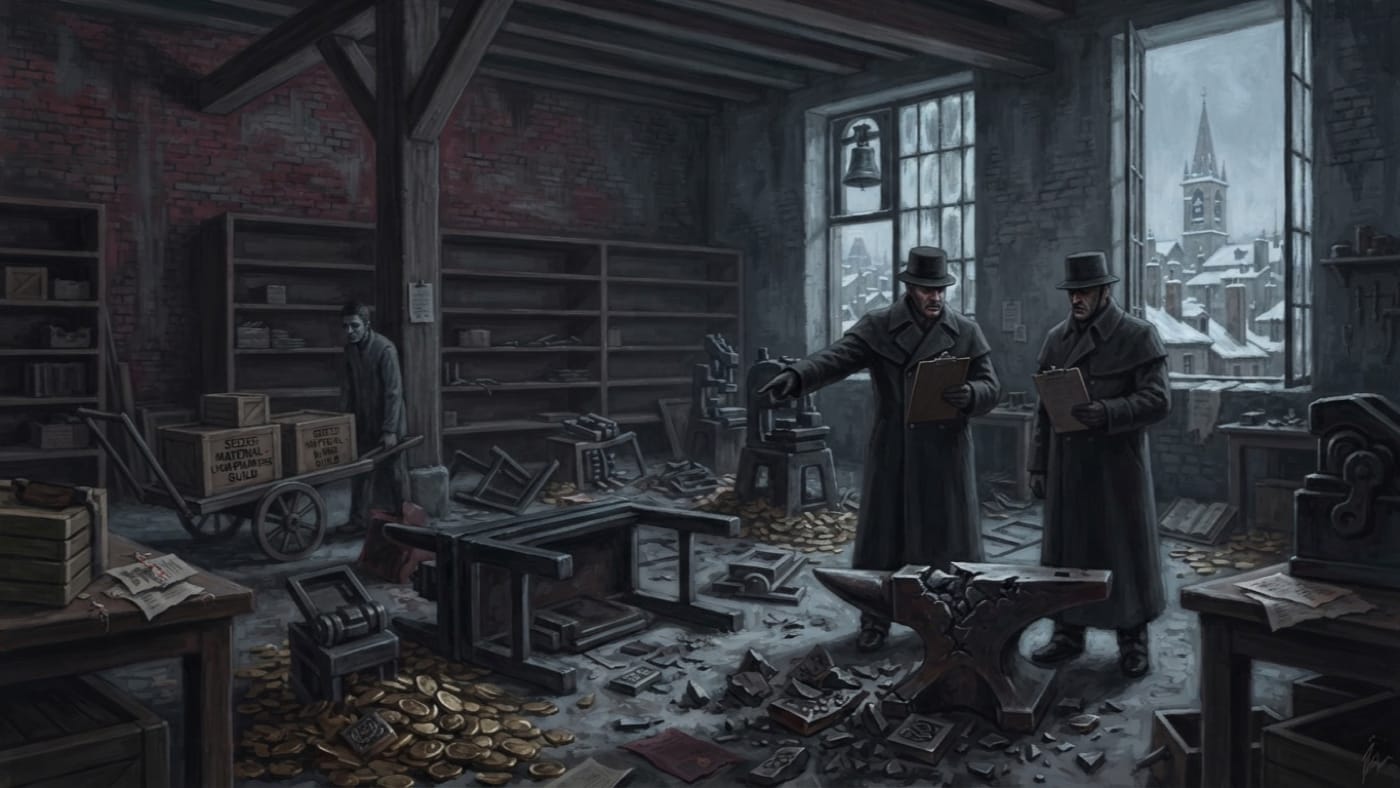
This is the best evidence the Guild left behind, and it convicts the house more readily than any person in it. Nine boxes of unregistered shavings prove that metal went where the ledger did not follow. Mixed wax proves that lots were mingled. The burned leaves prove a fire, and that somebody close to the books preferred ash to audit. The altered roll proves that a name was moved or struck out, though nothing on it says whose pen did the work or why. I have known careful clerks to hang men on less. I have known careless ones to hang the wrong men on more.
The deaths came by road. The full account belongs to the Great Counterfeit Winter; this entry records only the arithmetic that touched Lyon's work. The event account reports that a week's march under these forgeries put the bearers roughly three hundred yards outside Bellway protection. Families died within reach of lawful roads, close enough to the shrine-posts to have believed the bells were theirs. Records entered them as "route-adjacent fatalities, environmental." No defensible total is on file, and the phrase was chosen so that none would be needed.
#On the Dissolution
The purge has to be kept apart from its most famous victim. Across the wider network, fourteen forges were closed, seized, burned or prosecuted. They were fourteen forges. They were not fourteen branches of the Lyon Guild, which is not known to have had any, and fourteen is not a count of executed masters. Clerks who quote the figure in either sense are invited to show me the folio.
The Lyon Guild itself was dissolved in full. Its charter was voided and its assets inventoried. Its die tables were smashed, an act of administrative theatre that also happened to be practical. Its apprentices were redistributed among other licensed forges, which means at least some members of the house walked out of its end with their hands intact and a new master's name on their papers. Its masters were questioned until the testimony reached the desired shape. Some died; the record implies it and in places attests it. A complete mortality register for the Guild does not exist, and I decline to compose one out of the sound of a bell.
The profession's own Charter stayed in force. Commerce lost a licensee, and Records used a veto it had held for forty-six years.
Both parent entries state or imply that the Route-Stamper profession was first licensed after the Winter, and the event account says that Records "gained veto authority over forge shutdowns" at that time.
Corrected: Commerce licensed the profession and its forges under the Charter of A.S. 114, and the Records veto belonged to that instrument from the start. The Winter of A.S. 160 created no authority. It enforced authority that already existed, and the Lyon Guild was the first thing it was enforced upon at full weight.
Discipline tightened under the same instrument. Wax lots had to be matched, and cores were matched against the quarterly harmonic tables. Midnight quiet-box tests could now be inspected. Master dies went into the joint custody of Commerce and Records. Apprentice rolls were kept in duplicate, which is the nearest thing to an epitaph the altered roll of Lyon received. Bell-Hour Calibrators were given protection, so that a smith correcting a core for the road would not be mistaken for a smith corrupting it for a customer. Every one of these reforms reads like a confession by the Bureaus that drafted them.
#On the Die Recast
The master die was confiscated, melted down and recast as the hourly bell of the Chapel of Saint Cadrin in Strasbourg. I have no recasting date before me and supply none. The patron of the trade is Saint Cadrin the Measured, whose vita Doctrine approved in A.S. 112. The smoke-stained card in the seizure inventory shows that someone in the workshop prayed to him while the false cores were seated. It does not show who, or what was asked.
As an act of confiscation, it was elegant. A die prints permission. Melted and hung in a tower, the metal can say nothing but the hour, and it says it to everyone, including the clerks who licensed it. Commerce turned a forfeited asset into a pilgrimage. Doctrine received a sermon that never needs a stipend.
The bell strikes on the hour. Twenty-four witnesses at the first toll reported a second sound under the strike, late. Commerce recorded metallurgical settling. Bells recorded an unresolved harmonic complaint. Doctrine first classified the reports as devotional excess and later reread the lateness as penance, audible to the properly instructed. Three widows of Lyon smiths petitioned that they could hear names in it. Their petitions were returned unopened. The names are withheld here as they are elsewhere, and the Codex makes no finding on what the metal holds.
#On the Guild's Remaining Use
By A.S. 201 the Guild is a lesson, a bell and a duplicated roll. Apprentices across the trade are taught the Winter before they are trusted with a core. They are handed fifty tokens and told to find the ones that lie, and most of them fail. Lyon's name comes up in that teaching more often than any saint's.
The factions quarrel over what the Guild proves. The Cadence Purists cite it against every unauthorised adjustment. Their own teaching sheets once blamed "localist tuning doctrine," and the Codex has since withdrawn that phrase, because the network sold evasion, never calibration. The Route Pragmatists answer that a correction made for the road's safety and a cut made for a smuggler's fee are different crimes, and that only the second is a crime. The Silent-Core Crew study the evasion and charge for the lesson. None of the three is the Guild's legal successor, and no record carries its leadership forward into any of them. Anyone who claims Lyon's mantle is asked to produce Lyon's charter. Records holds it, and the charter is void.