
#On the Chapel's Station
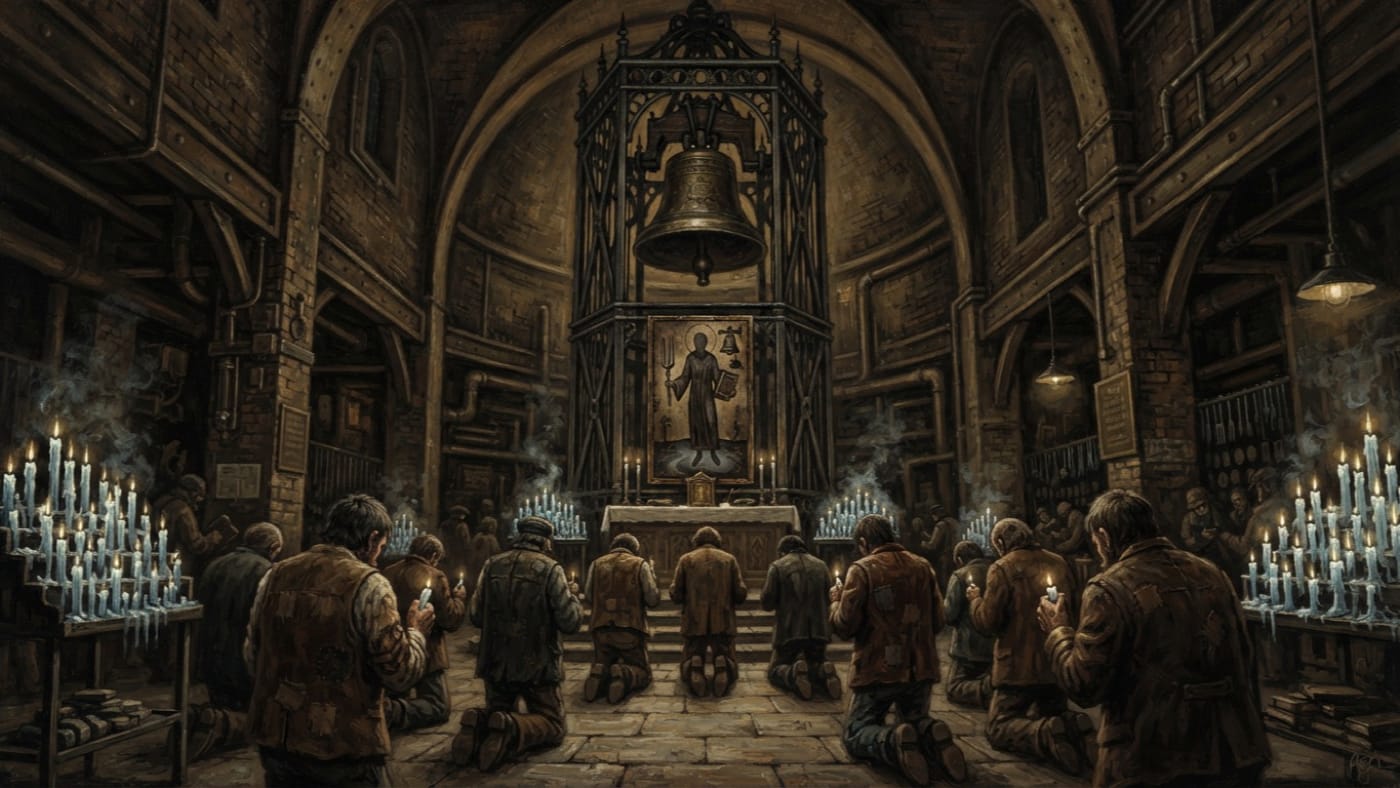
Strasbourg keeps a great many bells. The Cathedral has its canonical peals, the gates their curfew chimes, and the carillons a festal arithmetic sung over roofs that have heard it since the Concordat. The Chapel of Saint Cadrin has a small voice by comparison. It is the only voice in the city cast from a crime.
The chapel is the primary seat of the cult of Saint Cadrin the Measured, patron of the Route-Stampers and Indulgence-Token Smiths. Mainz has its lintel proverb. Cologne has three forks of contested priority. Strasbourg has custody, and in the Synod's capital custody outranks birthplace, burial and plausibility together.
Pilgrims ask me which street the chapel stands on, as though a street name would make it holier. The Codex fixes neither its district nor its dimensions, nor its distance from the Cathedral, and I see no reason to improve on that discretion. The chapel is wherever its bell can be heard. For the people who come to it, that is the only survey that matters.
The bell tolls every hour. It was once the master die of the Lyon Stampers' Guild.
#On the Measured Patron
The Bureau of Doctrine approved Cadrin's vita in A.S. 112. In A.S. 114 the Bureau of Commerce chartered the profession he protects. Doctrine supplied the halo and Commerce the fee schedule. Neither kept the other waiting.
The miracle assigned to him is the siege-ring. A man walks the circuit of a besieged city through the night, counting every step aloud and losing nothing of the hour, until the city bells answer his count at dawn. Which city? Three approved chapbooks say Ulm. Two older sermon drafts say Worms. A classified annotation in a Bureau of Records copy proposes Nowhere, A.S. Never. The vita is ratified and the siege is unlocated. Separate desks issued those two certifications, and a pilgrim who confuses them has mistaken a seal for a witness.
Strasbourg's claim says nothing about where Cadrin was born, where he walked or where he lies. It says where his cult is administered. The faithful cannot see the difference. The archive depends on it, because the archive produced this saint to its own specification: a patron of lawful movement, delivered in good time for the charter that would sell it.
#On the Metal of Lyon
The Great Counterfeit Winter of A.S. 160 arrived by road. Workshops in Lyon, Marseille and two frontier towns that the public record declines to name put forged tokens into circulation. Their bell-hour cores were tuned a hair away from the authorised cadence. The tokens looked lawful and stamped lawful, and they tolled close enough to lawful to comfort the tired. Over a week's march the error accumulated until the bearers were walking roughly three hundred yards outside the protection of the Bellway. Three hundred yards is a short walk for a family and a long one for the men sent afterward with carts. Records entered the dead as "route-adjacent fatalities, environmental." I have read warmer inventories of spoons.
The purge reached fourteen forges through closure, seizure, fire or prosecution. The Lyon Stampers' Guild was dissolved in full. Its master die was confiscated, melted down and recast as a bell for this chapel.
A master die presses permission into brass. Every token struck under its authority carried that face to a gate and told the guard this one may go. The Synod took that mouth and heated it until it forgot its face. Then it hung the metal where it can say only one thing, on the hour, to everyone. The die once licensed motion. Now it keeps time over the people who license it. As a conversion of a seized asset, it was very sound.
Commerce lost a die and gained a pilgrimage. Bells acquired an instrument it had not tuned and would never be permitted to retune. Doctrine acquired a sermon that preaches itself every sixty minutes and never asks for a stipend. Each Bureau calls the outcome a regrettable necessity. In Strasbourg, regrettable necessity is the usual name for a good bargain.
The entry on the Route-Stamper profession states that the Synod chartered the trade under Commerce "after the Winter."
The Commerce Charter dates to A.S. 114, forty-six years before the Winter, as the hierarchy record in that same entry already shows. The Winter of A.S. 160 chartered nothing. It brought enforcement, a purge and a bell. The trade had been licensed for two generations before it was frightened.
#On the Second Strike
The first toll after the recasting had an audience. The record names twenty-four witnesses. All of them heard the strike. They also heard a second strike beneath the first, which they described as "late."
Three Bureaus heard it and filed three different sounds. Commerce recorded metallurgical settling. Bells recorded an unresolved harmonic complaint. Doctrine recorded devotional excess. Years later, Tuners drunk enough to be useful still report a lateness under the hour. Doctrine's present position is that this is penance, audible to the properly instructed. Each finding stands under its own seal, and none may correct another. I report them in that condition and add nothing to them.
Three widows of Lyon smiths heard something else.
CHAPEL OF SAINT CADRIN — FIRST TOLL AFTER RECASTING — SUPPLEMENTARY Petitioners: three. Status: widows, Lyon Stampers' Guild, dissolved. Claim: names audible in the undertone. Names reported: ████████████, ██████████████, ███████████. Bureau of origin for reply: ████████. Disposition: returned unopened.
A returned petition is still a document. It proves that a clerk held the thing in their hand and chose not to know what was inside. The archive keeps plenty of answers, and it keeps a separate, more carefully guarded shelf of refusals.
#On the Hands Beneath the Icon
The faithful of this chapel are known by their hands. Blank-Cutters, Stamp-Hands, Tuners, Indulgence Smiths and Bell-Hour Calibrators kneel here with thumbs scarred by fine burns and printed with accidental crests, and with ears that ring at the supper table. They smell of hot brass and wax smoke. A deacon could sort them by trade with his eyes shut.
They kneel before the standard image. Cadrin holds the tuning fork in his right hand and the ledger in his left, with a bell above his left shoulder and his feet lifted a finger's breadth from the road to show measured motion, which is a different thing from walking. His face changes with every painter. Nobody petitions about it. A patron of lawful passage is safer without a recognisable face.
The customs belong to every stamp-chapel and every forge in the trade, and the cult carries them here as it carries them everywhere. Blue-white candles are lit beneath the icon before convoy surges. At the start of a shift the smith taps the die three times and strikes the tuning fork once. Never twice, because a second strike invites a harmony, and an invited harmony is a guest nobody wants to feed. Cadrin is invoked before the midnight quiet-box test, when sample tokens are heard after the canonical hours and the smiths listen for the one that sounds wet. To a congregation that holds a second strike to be dangerous, a bell that answers itself with one needs no homily.
The relic stalls supply forks to suit every grief. Processional forks are carried at route blessings. Mourning forks are blackened for travellers lost to drift, and the Winter keeps that line in stock. Apprentice forks are sold after a child's first burn, and pilgrim forks are so small they cannot sound. Across the whole cult, the Bureau of Relics audits some four thousand Cadrinic forks a year, each attributed to a saint who owned, at most, one. Nobody calls this fraud while the stall pays its tithe on time.
None of this devotion is idle. A smith who denies a token to the fifth child at the gate goes home past this icon. The ledger is open in Cadrin's hand, and the cruelty has already been arranged into doctrine. The pilgrim token is a permission, a permission is a judgement, and a judgement is far easier to deliver beneath a saint who counted.
The factions draw opposite lessons from the same metal. The Cadence Purists hear drift condemned every hour and conclude that adjustment kills. The Route Pragmatists hear the same toll and ask who last measured the road. Both claim Cadrin, and neither owns the chapel. The bell answers to the hour, and the hour does not take sides.
#On the Present Cult
In A.S. 201 the cult remains active and the bell still tolls on the hour. Candles still go up before the convoy seasons. Every apprentice in the trade is taught the Winter. In Strasbourg the lesson repeats itself through the city air at no charge, and no lecturer has to stay sober for it.
Mothers come to the chapel to buy small forks for children about to walk the roads. Old Stampers come with their ears ringing to hear something that rings back. Now and then a smith arrives from Lyon and stays until the hour, then leaves before the next one. Nobody asks what they were listening for. The Records clerks who might ask have received their instructions.
The chapel neither claims nor requires a founding legend or a famous architect. What it has is a saint the archive produced on schedule, a congregation with burned hands, and a lump of confiscated permission that strikes twelve times by day, twelve times by night, and once more, faintly and late, beneath each blow, for anyone instructed to hear it.