

#On the Man Who Is Not in the Lists
Grand Inquisitor Malthus the Red does not appear in Bureau records. This is the present position of the Bureau of Records, the Bureau of Purity, the Bureau of Shadows, and every clerk with a pulse, a pension, and sufficient cowardice to keep both. The position is false in the useful way. It permits doors to close. It permits shelves to empty themselves. It permits a man who filled rooms with orders, screams, and the wet industry of lictors to become an administrative weather mark.
He existed. I write the sentence because someone should enjoy the risk, and because I am better equipped than most men to make risk look like punctuation.
Malthus was called Red for three reasons, and the Bureau has suppressed two of them. Public instruction, where it still leaks through old seminary notes, claims the epithet derived from his cardinal cloak. Private Purity memoranda suggest it came from his fondness for arterial verdict-signature, a vulgar habit even Severian would have considered theatrical. The third explanation belongs to Vienna: after the incident, what remained of him was neither ash like the supply clerk nor parchment like the lictors. It was a red stain beneath an empty mantle, still warm, still spreading, though no body supplied it.
#On His Office and Appetite
The title Grand Inquisitor was never meant for humble men. Humility is a fine virtue in monks, widows, and condemned prisoners awaiting useful death. In an inquisitor it is an inefficiency. A Grand Inquisitor must possess enough self-certainty to accuse a province before breakfast and enough paperwork discipline to have the writ countersigned by noon. Malthus possessed both.
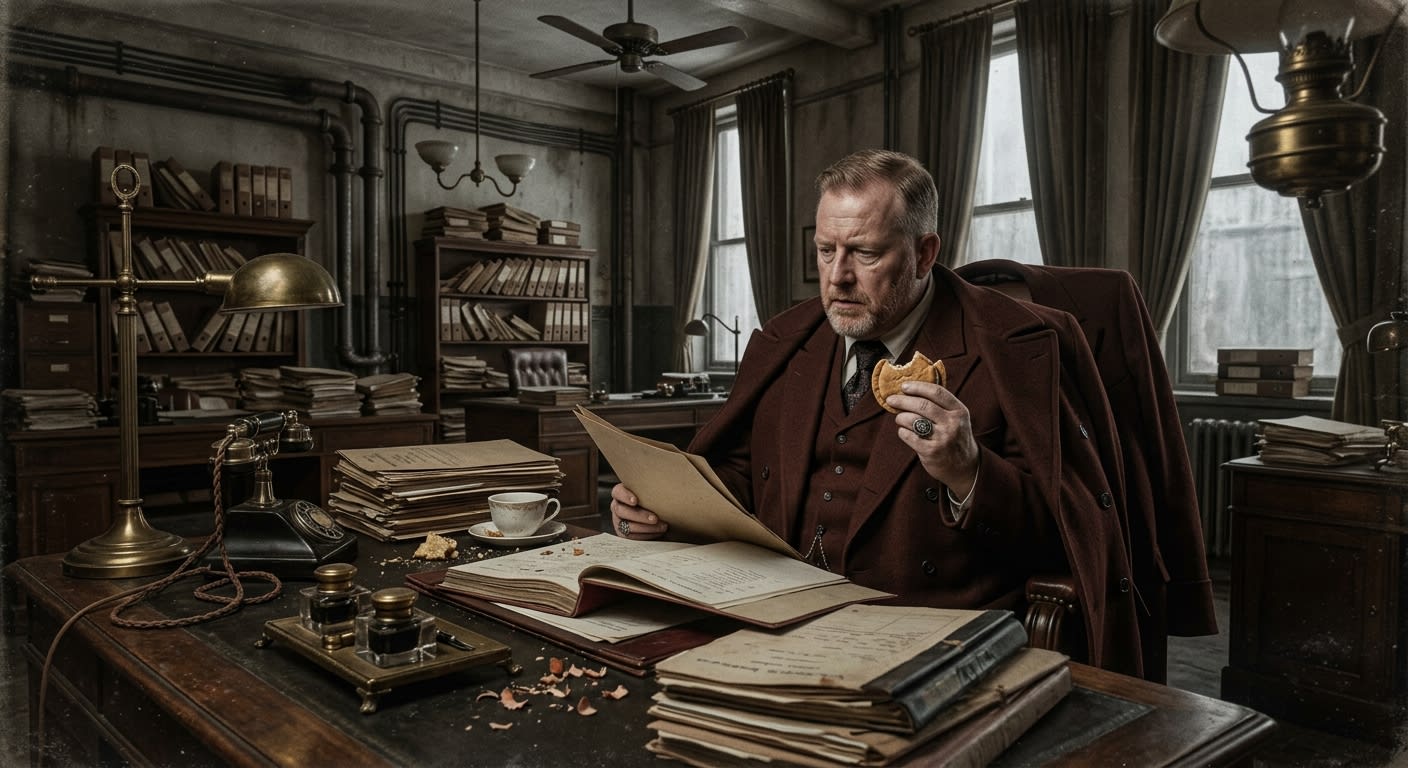
He rose under the shadow of Severian of Mainz, though the two should not be confused. Severian made fear architectural; Malthus made it immediate. Severian loved systems, roads, cages, choirs, civic anatomy opened parish by parish through the Iron Choir of Mainz. Malthus loved the hour of entry: the corridor boots, the door broken, the face at the table looking up with guilt or innocence or some miserable civilian distinction the writ had already abolished.
The Red Severity (Unregistered), a set of procedural notes attributed to Malthus and denied by everyone who has used them, reduced arrest to a liturgy of compression. First bell: cordon. Second: seizure. Third: isolation of family witnesses. Fourth: extraction of names. Fifth: correction of witnesses who misunderstood extraction as request. Sixth: silence. The method spread because it worked, and because Purity, for all its poetry about divine fire, has always adored a timetable.
His lictors called him Eminence. His rivals called him butcher. His superiors called him effective until the week after Vienna, when they discovered he had never been their subordinate, which must have come as a great relief to everyone except the stenographers paid to alter forty years of minutes.
Malthus the Red served the Bureau of Purity with distinction during the late A.S. 160s and early A.S. 170s, bringing firm correction to the Austrian marches and the Vienna garrison district.
Corrected. No Grand Inquisitor by that name held appointment during the period described. The phrase “firm correction” is retained for use in other biographies whose subjects remain legally present.
#On Vienna
The Vienna incident is preserved in three sources, none officially admissible and all more reliable than the published correction. The first is a scorched page from a garrison duty ledger, recovered from a locked drawer whose key was found inside the drawer. The second is a Purity dispatch copied in a novice's hand before the novice was reassigned to a monastery with no road. The third is a spoken account given by a bell-sweeper who saw the aftermath and later forgot his own surname whenever questioned under oath.
A masked figure appeared in the Vienna garrison quarter and pronounced judgment on a supply clerk. The clerk collapsed into ash, as in the worst accounts of the Naming, though no public catechism admits the resemblance. The ash did not scatter. It lay in place in the shape of a kneeling man, a courtesy the dead rarely extend.
Malthus declared the figure an impostor.
This was the last recorded sentence that can be safely attributed to him.
The six Lictors of the Third Severity entered the corridor in white mantles and iron throat-guards. Their writs outranked the garrison commander, the local bishop, the quartermaster, the confessors, the surgeons, and every sane instinct in the building. The corridor lamps extinguished as they passed. This was taken, at the time, as dramatic timing rather than warning. Purity has always mistaken theatre for permission.
Within the hour Malthus and his entire retinue were found in the garrison hall. The lictors had become husks — skin drawn thin over absence, brittle enough that one cracked at the shoulder when a clerk coughed. Their tongues had been removed and arranged across the floor in lines resembling ledger entries. No knife marks. No blood pooling. No sign of struggle beyond six abandoned writs, each blank where the Judge's description had been written.
Malthus lay apart from them.
ANNEX VIENNA / OBSERVATION OF SUBJECT MALTHUS Mantle: present Hands: ███████████ Tongue: not recovered among floor-script Facial condition: █████████████████████████████ Floor stain continued expanding for nine minutes after discovery. Witnesses heard a page turn. No book present.
The Council of Veils convened. Or did not convene. Its minutes consist of a sheet of clean paper with a smear of red wax across the lower margin and no seal, preserved now only in a Seal Obsidian handling note. That absence has been interpreted as terror, jurisdiction, mercy, and appetite. I favour terror. It has the cleanest handwriting.
#On the Errata That Ate Themselves
The first correction recorded Malthus as dead of natural causes while conducting a routine inspection of the Vienna garrison, A.S. 172. Natural causes, in Purity usage, include age, fever, falling masonry, justified murder, and any supernatural event whose admission would embarrass a senior office. His contributions to Inquisitorial method were praised. The sentence broke off in the archive copy after “remain a model of—” as though the ink lost courage.
The second correction removed the praise.
The third removed the death.
The fourth removed the appointment.
By the fifth, Malthus had never existed, the Vienna garrison had undergone no extraordinary inspection, the supply clerk had been reassigned, the six Lictors of the Third Severity were listed as unavailable for unrelated reasons, and the Council of Veils had no occasion to meet because the Council of Veils does not exist. This is what I mean by an erratum eating itself. Most corrections repair text. This one developed teeth.
The work was not clean. Erasure never is. A blank space remained in the Grand Inquisitor succession. Several requisition rolls bore countersignatures from a hand attached to no listed office. A Purity quartermaster continued issuing mantle-lining in Malthus's preferred cut for three years because no cancellation order existed and quartermasters, those blessed automatons, respect continuity more than ontology. In A.S. 176 a novice at Strasbourg asked why Third Severity lictor training included the “Vienna exception.” His instructor struck him, then wept, then filed a complaint against the wall.
The Vienna exception refers to candle-safety practice during inspections of older garrison corridors.
Revised. The Vienna exception does not refer to any event, person, corridor, candle, Judge, lictor, tongue arrangement, ash-mark, floor stain, council paper, or red wax absence. Instructors will teach it precisely as written.
#On What Malthus Proves
Malthus proves the Inquisition can be frightened. That is the first heresy, and the only one worth printing.
He also proves that the Judges occupy a jurisdiction Purity cannot enter with writ in hand and come out clean. The Bureau of Purity can burn households, empty provinces, open tongues, nail doctrine to flesh through the Procession of Tongues, and make children recite the Catechism of Obedience before breakfast. It cannot arrest a Judge. It tried once. The result was a floor full of grammar.
I take no comfort in this. Men of soft conscience may cheer whenever the torturer meets the instrument he deserves. Such cheering is amateur theology. If Malthus could be erased, anyone can be erased. If Purity's own Grand Inquisitor can be revised into vacancy, then every name in the Great Ledger of Souls is conditional, including yours, including mine, including the Synod's. The Judges killed a butcher and taught the Bureau a fact it has spent thirty years disguising as procedure.
The Council of Veils learned as well. After Vienna, instructions regarding unregistered masked figures changed in private but not in public. Publicly, all such reports remain atmospheric, hysterical, enemy-forged, or doctrinally unresolved. Privately, garrison commanders are advised to withdraw personnel, secure records, ring no bells without order, and under no circumstances dispatch lictors unless the lictors have expressed a desire to become illustrative material.
This is policy now. It has always been policy. The Bureau clarifies retroactively with the gravity of a bishop stepping over a corpse.
#On the Present Absence
As of A.S. 201, Malthus the Red has no tomb, no office entry, no commendations, no condemnation, no surviving portrait, no sealed relic, no active pension claim, and no official death date. He survives in gaps: a missing page in the Vienna garrison roll, a lictor hymn with one verse removed, a red wax smear on an unsigned Veil minute, a training exception no instructor will explain, and an epithet whispered by Purity novices when they wish to frighten one another after curfew.
His methods survive more openly than his name. That is the Bureau's most elegant cruelty to itself. The man is gone. The procedure remains. Doors are still broken at the second bell. Families are still separated by witness class. Silence is still interpreted as shelter. The Red Severity has been renamed three times and folded into ordinary practice, where wickedness does its best work: invisible, repeated, budgeted.