
#On the Figure
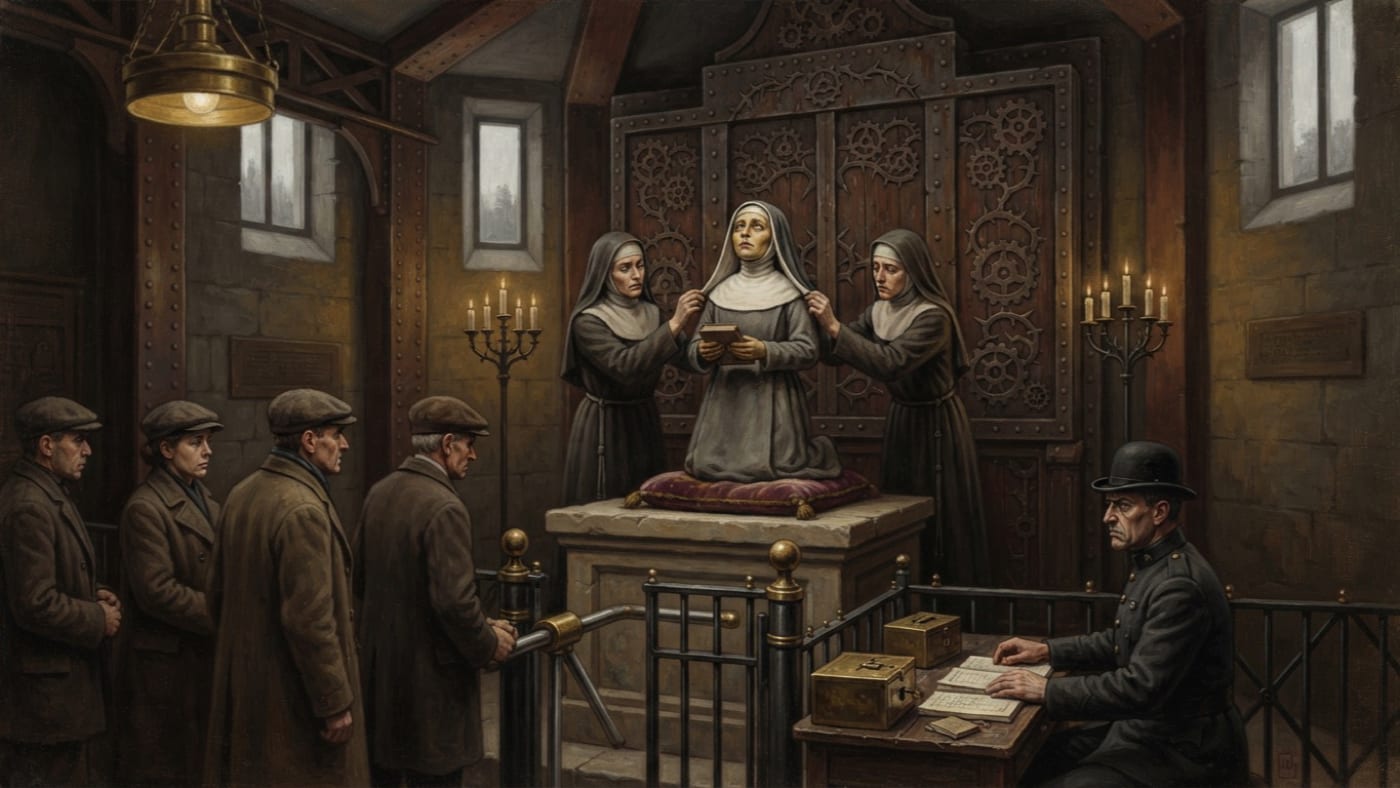
She kneels. Anyone entering Margaux Chapel at the convent of Sainte-Claire-des-Landes meets her first. The Bureau's files do not say who arranged the chapel or in what year, but the arrangement allows nothing else in the room to compete with her. She is a life-sized woman made of wax and kept small, because the Martyrology's registry says she was small. She wears the wimple, her hair is grey, and she holds a psalter in both hands. Her two glass eyes are fixed on a point somewhat above the visitor's head. The sculptor intended the expression to be beatific. The Bureau of Rites certified it as "doctrinally appropriate." Only the second of those achievements carries a seal.
The figure is tended by the sisters of the Order of the Blessed Thorn. As of this survey there are twelve of them, and maintaining the chapel is their primary duty. A wax saint does not keep herself. Somebody has to answer for her collar, her cheek, her posture and her book. The sisters who answer for them were trained in the care of the old and the mending of linen, which suits the work well. The old woman they serve now simply never asks for anything.
#On the House Before the Pilgrims
The Order of the Blessed Thorn is a mendicant sisterhood. At its peak it numbered perhaps forty women. Its work was the care of the elderly and the repair of linens, and the Bureau's archive has found nothing more remarkable to add. The house stands in Brittany, six miles from the sea, in country the Synod calls a western heartland and the Bretons call home. Before the formal Synod existed, and before anyone thought to number the years from a wound, a wheelwright's daughter from Ploërmel entered the house at seventeen. She remained for forty-six years.
In A.S. 10 / 1720 CE Sister Margaux joined the pilgrim procession out of Dinan, which was bound for the Chapel of the Tide. On the cobblestones of Saint-Malo she knelt with her psalter and was killed among the thirty-one certified dead. An early ecclesiastical tribunal at Strasbourg recognized her in A.S. 14 on seven depositions, without an authenticated miracle. The Bureau ratified that recognition later. A Bureau never declines a finished saint.
The convent's own milestone came seventy-eight years after her recognition. In A.S. 92 the Bureau of Pilgrimage raised Sainte-Claire-des-Landes to the rank of First-Tier Pilgrimage Site. In the same year the Bureau of Doctrine reclassified the Order of the Blessed Thorn as "Venerable." Both dates are on record. The founding of Margaux Chapel is not. No document I am permitted to cite names the year the chapel was built, its builder, or the hand that first shaped the wax. A Warden who filled those blanks to please a reader would be doing what the brochure once did, and that error appears later in this entry. The convent was elevated in 92. The chapel exists in 201. I certify the gap between those two facts and no further.
#On the Approved Likeness
The Church settled Margaux's face long before anyone set it in wax. An early scriptoria pattern of A.S. 47 showed her kneeling and wimpled, the psalter raised in both hands and the eyes lifted. The later Bureau of Doctrine adopted that composition as approved iconography and has not revised it since. The chapel figure keeps the kneel, the wimple, the book and the upward gaze. No surviving paper states that the sculptor worked from the pattern. None needs to, since a sculptor in Brittany who carved Saint Margaux any other way would have produced a curiosity, or a fine. A standing Margaux is suppressed in print, and it is suppressed in wax just as surely.
So the effigy is a likeness of a likeness. The registry gave the living woman a height, a weight, grey hair beneath the wimple, and in the column for distinguishing features the single word "none." Rites has since issued her a certified expression.
The book in her hands should be noted carefully, because pilgrims do not always note it. It is the figure's book. The psalter Margaux actually carried is Relic 23-M(Ratified), held in the Bureau of Relics' secondary vault in Strasbourg. It is a prayer-book bound in brown leather, unilluminated and undated. Its bloodstains are preserved under lacquer and its brass clasp still works. The chapel's book shares its posture and its purpose. The archive records nothing of where it came from or what it is made of. It has not been entered as a relic, and nothing in this entry should be read as making it one.
The distinction is the whole craft of the place. Relics authenticates things that were present. Rites certifies things that look correct. A martyr's psalter carries evidence, while a martyr's effigy carries instruction. The faithful who kneel before the wax receive no witness from the cobblestones. They receive the approved manner of remembering it, at full size and lit for viewing. The Bureau's files attribute no miracle to the figure, and the figure's devotees do not seem to need one.
#On the Sisters and the Gate
Nine thousand visitors come to Sainte-Claire-des-Landes each year. Each pays the Bureau of Pilgrimage's standard gate fee. That figure counts arrivals at the convent, and it should not be quoted as a chapel tally. The Bureau has never separately counted how many of the nine thousand stand before the wax. I suspect it is all of them. Suspicion is not a ledger entry.
Once the house held perhaps forty women. Today it holds twelve. The rest were reassigned to accommodate the visitor infrastructure. The Bureau's phrase is exact, and I preserve it as written. A pilgrimage site does not run on prayer alone. Gates have to be kept, crowds have to be ordered, the brochure has to be printed and corrected, and visitors have to be received in numbers that no community of linen-menders was built to manage. Some sisters were moved to serve that apparatus. Those who stayed received the chapel.
From an administrative standpoint the arrangement is close to perfect, and I say so as someone who has drafted worse ones. The Order was founded to care for the aged. It now cares for one aged woman whom it may never let decline. Every visitor pays at the gate, and every coin passes through Pilgrimage's books before any of it reaches the house. Margaux mended linens here for forty-six years and was paid nothing anyone recorded. In death she draws nine thousand paying guests a year to the same house. The sisters who succeeded her keep the same hours of obedience. Their linen now drapes a figure that has no need of it.
None of this makes the devotion false. The pilgrims come because a small grey woman died on her knees at Saint-Malo, and that is attested. The sisters keep her because the duty was assigned to them, and also, I am told, because they consider her theirs. The Bureau has not yet found a form on which to record that second reason.
#On Provenance Revised
The wax figure has one virtue that the Bureau's more celebrated holdings lack. It has never claimed to be anything other than wax. Nobody passes the glass eyes off as hers. The grey of the wimple came out of a dyer's pot, and no reliquary was ever made for it. An effigy that never pretended to be a relic cannot be caught pretending.
The convent did not always keep to that standard.
The convent's visitor brochure formerly listed a lock of Saint Margaux's hair among the devotional holdings of Sainte-Claire-des-Landes.
The lock was re-examined in A.S. 189 and found to belong to a horse. The Bureau of Relics reclassified it as "Category D: Material of Devotional Association, Provenance Revised" and removed it from display. The brochure has been corrected. Pilgrims who bought commemorative lockets containing strands of the hair are advised that their lockets remain "spiritually valid." No earlier authentication of the lock is relied upon in this entry, and none should be.
I do not offer the horse as proof that every relic in the Theocracy is a stable sweeping. The psalter in Strasbourg has been authenticated four times and has passed each time. The lesson of A.S. 189 is narrower and more useful. A house that receives nine thousand visitors a year and keeps a saint has every reason to want more of her, and somewhere between that wanting and the display case a horse was put forward and accepted. Relics corrected the error, and in doing so it showed that an examination can come very late and still come. Its ruling on the lockets also showed that the Bureau prefers not to refund devotion once it has been sold.
Today the chapel keeps a book that is not the book and a body that is not the body. The house holds no hair at all, which is the most honest inventory it has had in living memory.
#On the Present Custody
The figure kneels as it did when this survey began. The psalter stays in her hands. The glass eyes look upward at their certified angle. The twelve sisters of the Blessed Thorn tend her as their rule and their assignment require. At the gate the standard fee is taken. In the Strasbourg vault, some hundreds of miles east, the actual book lies under its lacquer with its clasp still working. Nobody in Brittany expects to touch it.
On 14 Corvus the Church keeps her feast alongside the Day of the Thirty-One Names. No record describes a particular observance in this chapel on that day. None is needed for the wax, which kneels the same way on every day of the year.
Sister Margaux walked out of this house to visit another saint's shrine and never came back. The Bureau has since made her house into a shrine of her own and charges admission at the door. The Order of the Blessed Thorn has been reduced to twelve women, who keep the effigy ready for inspection.