
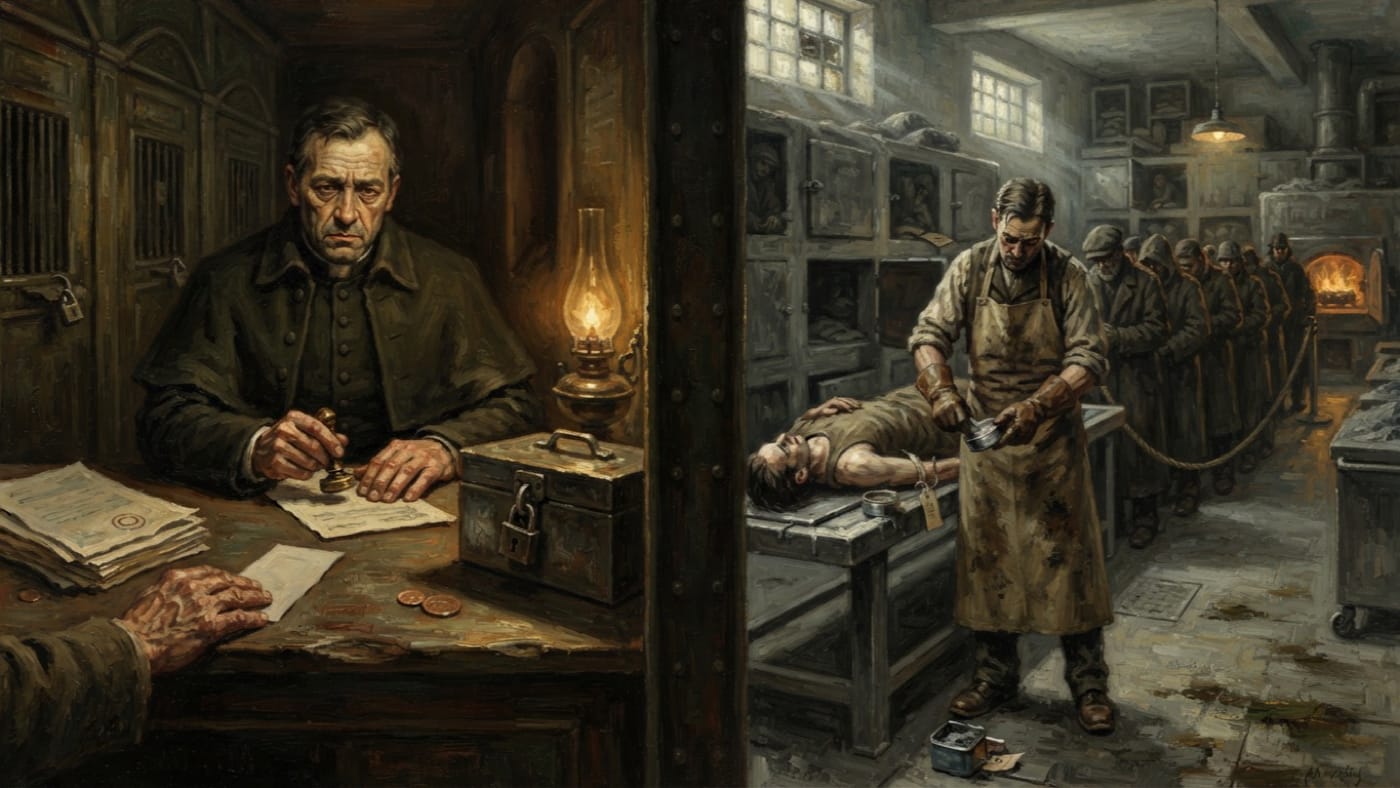
#On the Mercy Mark
A citizen in a queue may carry three kinds of paper and be unable to tell them apart by weight.
The first is a receipt. A Confessor-Booth Clerk issues it after hearing the sin, choosing its category, taking the fee and assigning the penance. It proves processing. Ration desks honour it, checkpoints glance at it and hiring registers file it. It forgives nothing, and nobody holding one at the bread window has ever cared.
The second is a mercy stamp in the lawful sense. Since A.S. 134 that impression has been reserved to licensed confessors and kept under a lock the clerk does not hold.
The third is the thing Marrowgate calls by the same name: a smear of ash on a mortuary tag that means look again, and sometimes before noon.
That is two jurisdictions, two physical signs and two separate histories under one phrase. The street uses one word because the street has one stomach. This survey records both at their A.S. 201 standing and keeps them apart, which is more courtesy than either received in use.
#On the Lawful Hand
The Confession Reform of A.S. 104 let lay hands perform the mechanical labour of confession. The Booth Proliferation Decree of A.S. 112 multiplied those hands until a booth stood within reach of most sinners in any respectable city. Clerks heard, sorted, charged and stamped. In principle, priests forgave, more slowly and at a greater distance.
The word mercy crept into that distance. A clerk with a stamp and a queue could soften a category, delay a concern packet, or mark a slip so that its bearer moved faster through the offices that feed people and grant permits. Some of this was bribery and some was triage. Some was pity, which Doctrine regards as the most expensive of the three because it cannot be invoiced.
The Mercy Rationing Reform of A.S. 134 settled the matter by statute. The Bureau of Rites restricted mercy stamps to licensed confessors. The Bureau of Doctrine affirmed the distinction, and unauthorised issue became a breach of sacramental custody. The clerk kept everything else: intake, category, fee, penance, receipt, tally and the forwarding of concerns. The clerk lost the one act the queue actually wanted.
The formulas followed, printed above grilles where citizens read them while paying. Processing is not forgiving. I process. I do not forgive. The booth hears; the Synod decides. Each is accurate. Each is also a polite way of sending a hungry man three districts away to find a confessor.
Early public notices described the Reform as "expanding access to properly licensed grace."
Corrected. Improper access was cut, sealed and counted, and the lawful channel narrowed accordingly. The approved phrase is "protecting the lawful channel of grace."
#On the Other Inventory
The lawful stamp is known chiefly by what surrounds it. After the Reform, mercy stamps were recut with a small inner ring that shows under lamplight. Tilt the paper toward the flame and the ring rises in the impression like a pupil. Confessor seal-boxes took a second lock. District registrars counted mercy foils on one sheet and blank receipts on another, so that a missing foil could not hide among missing paper. Records opened a ledger class for irregular kindness and named it non-standard pastoral output. The Bureau of Purity received the right to audit all of it.
Readers who want the die's dimensions, its metal, the colour of the foil, a serial sequence or a term of validity will find none of these in any record I am permitted to rely upon. The ring is the test and a lamp is the instrument. The rest belongs to the confessor's box and stays there.
The booth's saint guards this inventory. Blessed Clerk Harlowe "Dry-Ink" is remembered for refusing mercy stamps during a drift wave and keeping a district clean by saving the ink for lawful use. His historicity is devotionally sufficient, and Rites asks no more of it. His dry hands are printed on cards that hang beside stamp shelves, where clerks with brine-cracked knuckles can see them while a woman at the grille says the word.
#On the Ash Beside the Rope
At Marrowgate the word went to the dead.
Among Dead-Goods Tariffers, mercy stamp is slang for fast clearance: remains classified, tariffed, purity-checked and routed ahead of their turn. Clerks in that trade fall informally into Pure Chain and Mercy Stamp tendencies. The first hold to sequence. The second hold to whichever family stands in front of them with something in its sleeve. These are habits of hand. Neither tendency has a charter, a founder or any power to absolve, and no record moves a confessor's die into a corpse bay.
The documented episode belongs to the Gray Clearance of A.S. 157, when emergency procedure collapsed the mortuary classifications into Cleared and Held. In the second week, families of the Held formed a queue at the left-hand rope outside the Tariff-Chapel of Saint Morin, beside the corpse bays. That rope became the Mercy Line, and the little mark became its sacrament.
The mark had no standard. Sometimes it was a rectangular touch of ash. Sometimes it was a thumb smear, or a diagonal crease rubbed with soot and vinegar. It was separate from the legal Gray stamp and the public Clearance mark, and in law it released nobody. It asked for attention. A clerk walking the rope at Prime touched certain tags, and those bodies tended to clear before noon.
No circular set a fee. Families paid in wax coins, in silver hidden inside hollowed medals, in wedding rings, salt and linen, and in confession material that could damage a rival household. Some paid in pleading and some in pressure. I am obliged to record that some paid nothing and were marked because a tired clerk had not yet finished killing a conscience. The mark does not say which.
Speed was a real good. A body cleared before noon rotted less, and its family spent fewer days waiting in the cold. Speed also outran the count. Tags parted from heads. Kin claims lapsed before the kin bell. Families received ashes whose tag fibres matched nothing they had ever owned. The ash that spared one household its wait cost another household its name.
Revocation came in A.S. 158. The Gray Clearance ended, normal classification resumed, and the rope came down the same afternoon.
#On the Price of a Clean Mark
The two economies trade in different goods. The confessional market sells counterfeit authority, and the mortuary market sells time.
In the booths, the contraband is a real thing in the wrong hands: mercy stamps stolen from priests, counterfeit impressions, blank receipts and solvent for edits. Clerks call the bribe wash money or ink oil. The street speaks of grace chits and little crescents, which are nicknames and not denominations, whatever a broker may claim across the table. Brokers sell appointments with real confessors. Soft stampers sell nothing and simply give away a downgraded category, which Purity finds harder to forgive than theft. A stolen stamp at least respects the price of what it stole.
At Marrowgate there was nothing to steal. The mark carried no authority worth counterfeiting, so its price was the price of a clerk's attention. That price floated with the weather, the state of the body, the room left in the Lime Yards before Vespers and the nerve of whoever held the ash dish.
Both markets share the same flaw as evidence. A correct-looking impression may come from a confessor's hand or a thief's. An ash crease may record a bribe, a threat, an act of mercy or a tired thumb. The paper shows that someone was moved. Motive leaves no ink.
#On Present Custody
As of A.S. 201, the confessional mercy stamp remains lawful, scarce and locked. Only licensed confessors issue it. It is counted against its foils, read by lamplight and audited by Purity. The clerk's receipt is what it has always been: the most useful paper in the city and the least holy.
The Marrowgate mark has no lawful standing and never had any. Its rope is gone, but its grammar moved indoors. Mortuary and ward staff are suspected of keeping it alive through a handful of signs: a held tag folded corner-up, ash in a seal groove, grey wax beneath an ordinary clearance, a second press under the left side of a desk, and the phrase come back after Vespers. Each is an indicator. None proves a transaction by itself, and Doctrine prosecutes the clerk, not the crease.