
#On the Year the Box Became a Street Fixture
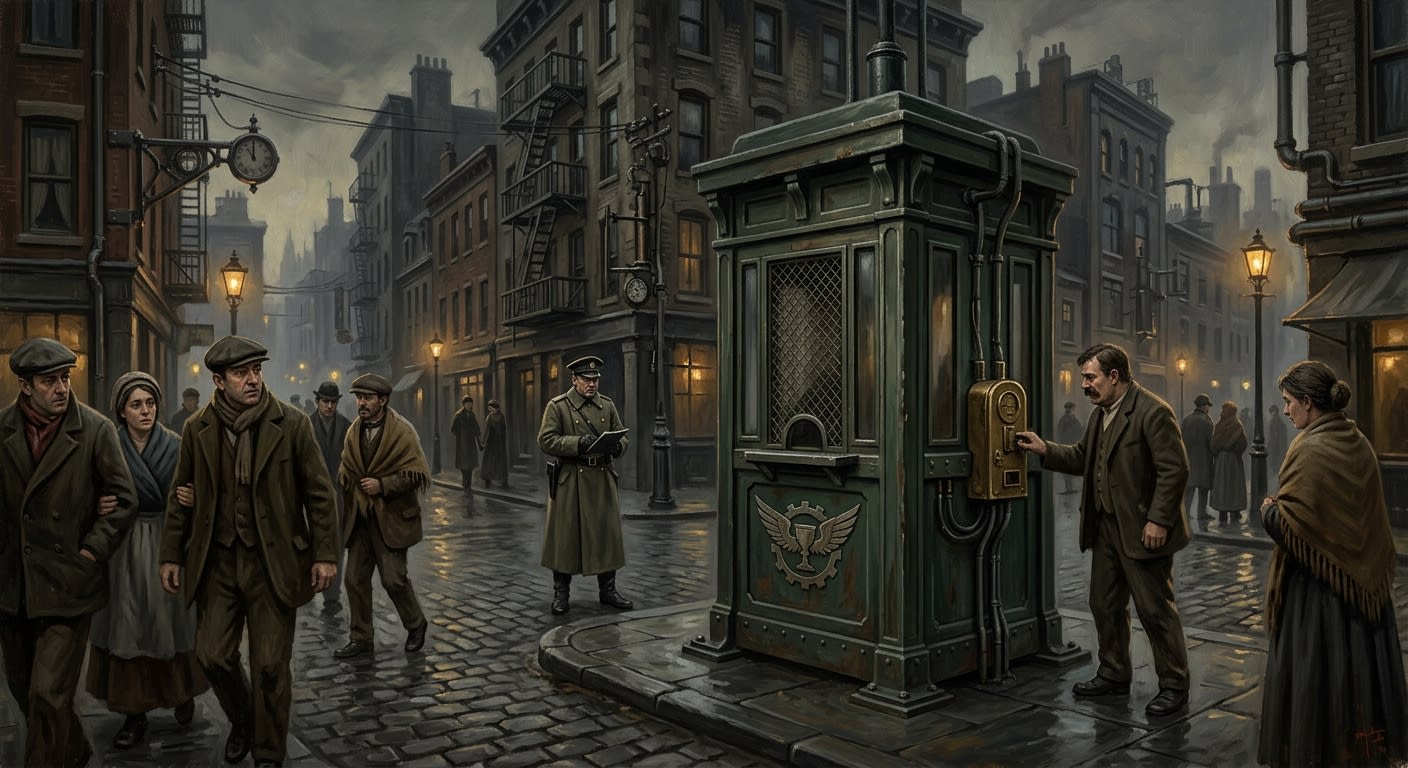
The Booth Proliferation Decree of A.S. 112 was the moment the Bureau of Rites admitted that the Confession Reform of A.S. 104 had escaped the chapel and required architecture. Paragraph forty-seven had authorised lay intake. Eight years later, the city was clogged with penitents, clerks were multiplying in annex rooms, and every parish priest in Europe had discovered the pleasure of delegating the first hour of another man's shame to someone cheaper.
The Decree answered with the simplicity of a nail: one registered confession booth for every three city blocks across all Synod territories.
A wooden box every few streets. A grille. A shutter. A stool. A stamp set. A stack of blank receipts counted at dawn and dusk. Brine bucket beneath the shelf. Candle behind dirty glass. The citizen entered the queue with a sin and left with a slip, which is to say he left improved enough for the ration clerk.
#On Why Three Blocks Were Chosen
The theologians claimed three blocks because the number pleases the Triune Order (Unregistered). The city planners claimed three blocks because crowds beyond that distance formed unregulated confession eddies around bakeries, wells, and tavern doors. The Bureau of Records claimed three blocks because district maps could be divided without redrafting the parish books. The Bureau of Tithes claimed three blocks because fee collection, when projected across Strasbourg, Cologne, Vienna, Brest, and the forward depots, produced figures that made even senior assessors blink.
All four explanations were sealed. The fiscal one received the shortest circulation.
Before A.S. 112, confession gathered where fear gathered: after sermons, before ration distributions, beside Mercy Ward doors, along permit lanes, under rain awnings, at the gates of Bastion-Brest, and in the side chapels where priests looked increasingly like men besieged by their own doctrine. Booths existed already, irregularly, locally, ugly little conveniences tolerated by Rites and watched by Purity. The Decree took the convenience and sanctified it with geometry.
The surveyors walked with chain, chalk, and catechism. Three blocks. Chalk cross. Three blocks. Chalk cross. Where the cross fell, carpenters followed. Where carpenters followed, clerks arrived. Where clerks arrived, queues formed. By winter, a citizen in any obedient district could commit a minor sin, confess it, pay, and receive proof of processing without walking far enough to reconsider the usefulness of sin.
#On Construction, Cartage, and Damp Wood
The first booths were made badly because speed is the Bureau's oldest sacrament after denial. Pine planks, oak shutters when the district could afford them, iron grilles from confiscated shop screens, little brass hooks for receipt bundles, small shelves for the rubric card and candle. Rites issued dimensions. Records issued serial plates. Purity issued inspection authority. Tithes issued fee schedules. The Bureau of Doctrine issued a sentence about confession being the city's bath, and every carpenter in three provinces repeated it while hammering boxes that smelled like wet coffins.
The fixed booth was only the beginning. The Decree authorised mobile booths on carts for market days, plague lanes, evacuation roads, and districts whose sin flow exceeded installed capacity. Field booths followed in the forward trenches: collapsible screens, mud legs, waxed receipt sacks, stamp kits chained to the clerk's belt. Shipboard booths entered pilgrim vessels and convoy chapels, especially in the southern routes tied to Marseille, Thessaloniki, and the Reliquary Flotilla.
CARPENTER'S DELIVERY ROLL, STRASBOURG NORTH WARD, A.S. 112: Thirty-two booths delivered. Five returned for warped shutters. One returned for speaking after installation. Instruction: plane the hinge, rescrub with brine, notify Rites only if speech repeats in Latin.
Brine entered the ritual later as practice before law. Damp wood absorbs breath. Breath carries rot. Rot becomes smell. Smell becomes rumour. Brine reduced all four and gave the booth its modern tang: salt, ink, old fear, cheap incense, and the faint odour of a city being preserved in its own obedient fluid.
Early ward circulars described the booth interior as “welcoming.”
Withdrawn. The authorised description is “sufficiently enclosed for candour.” The old word encouraged lingering, which damaged throughput.
#On Counting the Boxes
The Decree created a census problem so lovely that Records still pretends to enjoy it. By A.S. 130, the first continental count listed fourteen thousand active booths. The figure included fixed booths, mobile carts attached to licensed districts, field booths in garrison chapels, and a disputed category called temporary confession furniture, which Records later abolished by renaming it.
Fourteen thousand boxes. Fourteen thousand serial plates. Fourteen thousand stamp inventories. Fourteen thousand brine schedules. Fourteen thousand little mouths through which Europe muttered itself into the files.
A.S. 201 estimates stand at twenty-two thousand. Records calls the number “ongoing enumeration,” since “we have lost count of the sacred boxes” sounded poor in committee. The figure includes cart booths, trench booths, shipboard booths, annex booths, ration-hall confession corners granted provisional standing, and the two hundred and fourteen double-rowed Confessional Lanes at Bastion-Brest, where confession functions less as contrition than as a crossing toll with prayers attached.
Each booth required a clerk or rota of clerks. The low ranks swelled: Receipt Runners, day clerks, Night Clerks, Booth Supervisors, District Confession Registrars. The Dry-Ink cult gained its audience. Booth contamination acquired names. Dry-handed veterans became objects of pity, fear, and promotion. The street learned the new convenience quickly. It always does. Give a citizen a box that can ruin him and he will ask its opening hours.
#On Riot Prevention and Riot Manufacture
Rites sold the Decree as relief. Doctrine sold it as purification. Purity saw early detection. Records saw intake. Tithes saw coin. The street saw a queue it could reach before curfew.
The result did reduce certain public pressures. Panic-confession before feasts became distributed. Parish crowds thinned. Priests recovered enough dignity to complain about other matters. Drift metrics improved because the data arrived in cleaner shapes. The Codex Doubt Auditors later owed much of their branch's success to the regularised confession abstracts that booth density produced.
The same boxes manufactured new angers. A booth every three blocks meant a denial every three blocks. A missing stamp could now be detected faster. A clerk's enemy lived close enough to recognise his gait. Bribes shrank, multiplied, and became ordinary as candle wax. A city that confesses everywhere also learns where every refusal occurred.
The Decree did not make citizens pure. It made impurity legible at walking distance. That was better, from the Bureau's view, because purity is a theological aspiration, while legibility can be audited.
#On the Present Grid
As of A.S. 201, the booth grid remains one of the Synod's quiet organs. It is less celebrated than the Sagittal Line, less musical than the Bureau of Bells, less theatrical than Purity's tribunals, and more intimate than any of them. The Line holds back the Enemy. The booth receives the citizen. Both are fortifications. One faces east. One faces inward.
Children learn the booth before they learn the tribunal. Lovers check stamp dates before marriage petitions. Merchants budget wash money. Soldiers confess before leave. Sick men clutch receipts at Mercy Ward doors. Ship captains keep a booth nailed beside the chapel cupboard and pray the voyage ends before the absolution slips expire. At Brest, the Confessional Lanes breathe all day in two rows, shutters opening and closing like eyelids on a bridge that cannot sleep.
The Decree's greatness lies in its vulgarity. It did not ask Europe to love confession. It made confession convenient, compulsory, local, billable, auditable, and damp.
A.S. 130 census commentary praised the “complete enumeration” of confession booths.
Revised after mobile carts, trench screens, shipboard boxes, and three entire districts of unregistered parish annexes entered the audit. Approved phrase: “continentally adequate coverage.” Coverage, like mercy, is easier to approve when nobody asks where it ends.