
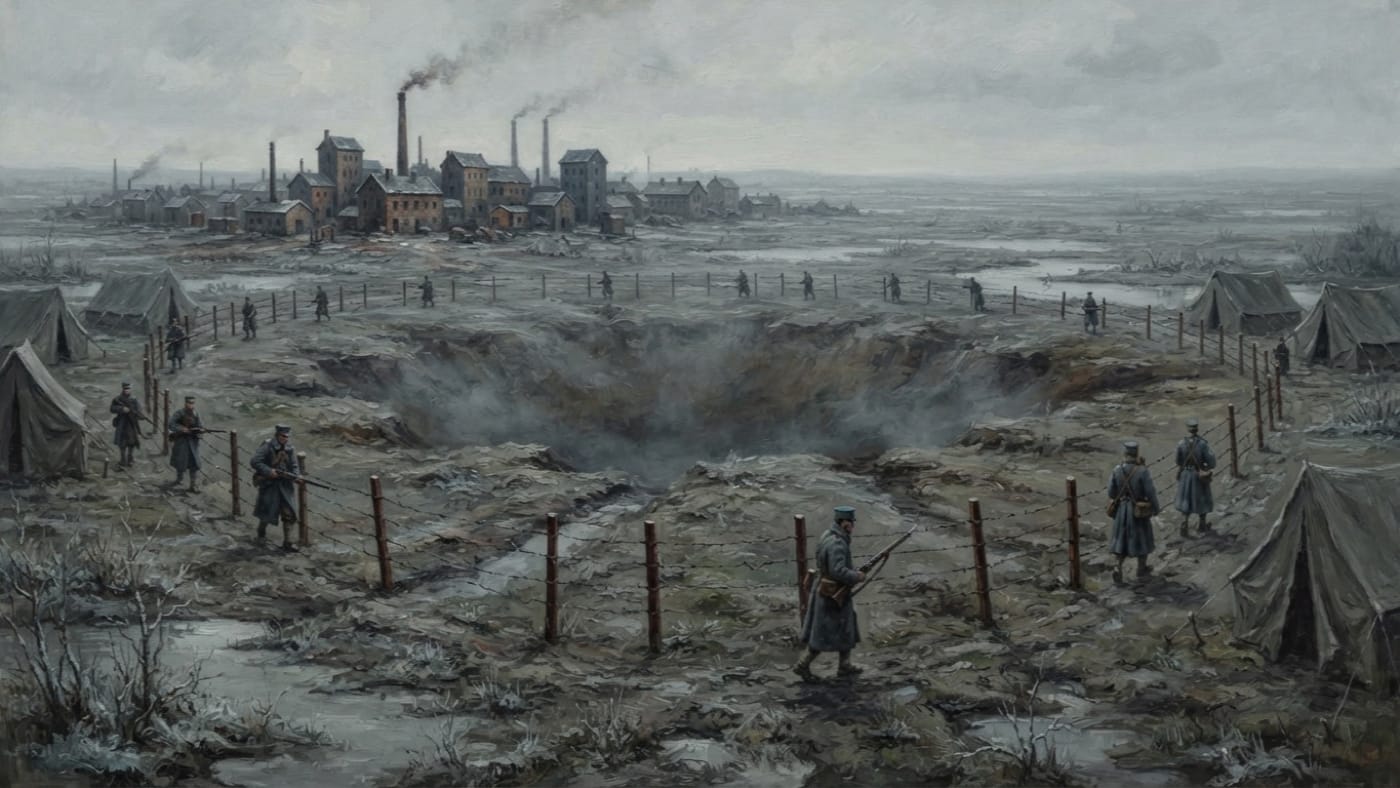
#On the Locality
A town remembered for what lies south of it.
The Sacred Ledger mostly uses Mohács as a bearing. Clerks of the Bureau of Medicine write "south of Mohács" the way a sacristan writes "left of the altar": it tells the next man where to stand, and so where not to. About the town itself the Ledger holds very little. I find no charter I can certify, no census I would sign and no parish roll, and nothing says how the place ended, if it has ended. What the Ledger holds is a grave. The grave took the town's name because a grave in open country has none of its own.
The country around it was once the grain floor of Pannonia, the plain that fed armies until armies learned to eat it. The files on Pit Seven describe what the rest of the eastern plain has become under the Blightmarsh: grey mud, grey water, and soil that has failed so completely that no agronomist's word covers it. I will not draw you a street plan of Mohács. I do not have one. The Codex has already suffered enough from Wardens who supplied plausible streets to towns they never saw.
The name also lasts for a reason that is bureaucratic, and therefore durable. "Pit Seven" is a number, and numbers are reassigned whenever a survey is revised. Nobody has revised "Mohács." The military and medical files are cross-indexed by the place-name, so the town survives, whatever it is now, as the heading on a folder nobody wants to open.
#On the Burial South of the Town
In A.S. 48, an estimated four thousand refugees from the fall of Debrecen were buried at a single site south of Mohács. Debrecen broke in the Collapse years after the Sundering. The Church's account, repeated ever since, says Kargath devoured an army's rations and a hundred thousand men fled starving. Those who could walk went west. The Mohács dead were among those who did not get far enough.
This was the opening of the Great Retreat, and the reader must keep the chronology fixed, because the Bureaus prefer it loose. In A.S. 48 there was no Synod. The provisional council was still two years away, and the Concordat that made the Synod a constitutional fact was forty-two years away. No Bureau of Records ordered this burial and no Bureau of Rites approved it. We do not know who dug. It may have been soldiers of a collapsing command, or chaplains working where no council could reach, or the refugees burying their own. Whoever it was worked under authorities that did not last long enough to file their papers. The Synod holds the record now. It never held the shovel.
I cannot tell you what kind of pit it was. The surviving account does not say whether the dead went into a crater, a trench, a cellar or a quarry floor, though the Retreat used all of these elsewhere. It says approximately four thousand. It says Debrecen. It says A.S. 48. Those are the three facts the Ledger has, and I will not manufacture a fourth.
#On the Controlled Exposure
The phenomenon was not discovered at Mohács. Lieutenant Voss and his twelve-man patrol met it in A.S. 120 at Pit One, south-east of Pécs. His report described cramps, vomiting, and men incapacitated at fifty yards. It was stamped received and shelved, and it sat for fourteen years. Nobody investigated it in that time. It simply waited, and waiting is the thing the archive does best.
In A.S. 134 the Bureau of Medicine confirmed the effect, after it matched a cluster of unexplained gastric failures to recorded burial sites. The confirmation rests on three grades of evidence: field observation at seven sites, instrument measurement at three, and controlled exposure at one. The one was Pit Seven.
The report's measurements are exact, and the exactness condemns it. At thirty yards, a subject reached full metabolic crisis within forty minutes and burned fat at a rate the report equates to three days of starvation for every hour of exposure. The ten-yard data come from two subjects, recorded as restrained. Their skin thinned, their teeth loosened, and their hands wasted toward the bone. They were extracted at six hours. One survived the extraction. The file records that she was a woman and gives her no name. Her testimony is sealed, but one phrase from it has been allowed to circulate among garrison commanders: "I could feel their mouths."
The Bureau of Doctrine describes the subjects' participation as "involuntary but theologically defensible." I have read a great many sentences written so a signatory could sleep, and this one is a masterpiece of the form. The first word confesses and the last three absolve. The restraints appear in the passive voice, as a condition of the data, and the passive voice is where the Synod keeps its hands.
[EXPUNGED — Bureau of Doctrine Order 88-V, A.S. 135. See: Sealed Protocol, Pit Seven Controlled Exposure. Note retained: the second subject's remains were interred at the pit's perimeter by order of the Bureau of Medicine. The Bureau of Rites was not consulted.]
#On the Orders Surrounding the Site
The Bureau of War has kept a cordon around Pit Seven since A.S. 135, the year of the expunction order. The Famine Pits entry gives the cordon as two miles. The same entry records Standing Order 77-K, issued under Bastion-Constantinople Eastern Command, which requires four miles around every confirmed pit. Pit Seven is a confirmed pit. Both figures are on record, and no instrument on record explains either one in terms of the other.
The two-mile exclusion zone around Pit Seven is the widest of any confirmed site.
Withdrawn. The same Codex account specifies a four-mile perimeter around all confirmed pits under Standing Order 77-K. No record available to the Warden establishes how the two-mile cordon relates to the general order. The Codex makes no ruling on which one governs south of Mohács.
The general provisions of 77-K are clearer. Patrols working within eight miles of a confirmed pit carry double rations and rotate every ninety minutes. No patrol may come within a mile without the garrison commander's written authorisation. The parent account says none has been granted since A.S. 190. Personnel who show unusual appetite are withdrawn. Personnel who refuse food after eastern patrol are quarantined under the same medical protocol, because the order treats both as symptoms.
Once the Bureau of Medicine had confirmed the effect, it asked for the matter to pass to the Bureau of Rites. The request was denied. War keeps the site and Rites contests it. The Rites protest over the perimeter burial has been under review for sixty-six years. That makes three Bureaus and one grave, and not one of them has both the authority and the willingness to stand at its edge.
#On the Classification
Doctrine files Pit Seven with the other pits as a passive sin-manifestation and names Kargath as its agent. The working classification, Residual Consumptive Emanation, Category Three, at least describes the thing before it accuses anyone. I have disputed Doctrine's attribution before, and I dispute it here on the evidence of this one grave.
Consider who lies in it. Approximately four thousand civilians of Debrecen, starved on the road, in a year when hunger needed no demonic army standing at Mohács to kill people there. Gluttony's territory reaches across this plain, and I do not dispute the map. But owning the territory is not the same as signing the work. In A.S. 190 the Bureau of Alchemical Standards reported that the pits' emanation matches neither Kargath's profile nor any known demonic profile. A footnote the Bureau would have preferred to bury compared the reading to the relic signature of human grief.
I take that footnote seriously, but I do not take it as proof. The instruments that produced it were designed for relics, and their own designers called the results impossible. I will not build a theology of the soul on a dial that disowns its own readings. My claim is narrower, and to Doctrine it is worse. The Bureau that names Kargath has not shown its working. The people in the pit at Mohács were his victims, and ours, before they were anybody's evidence. Filing them among the things the Sagittal Line exists to hold back makes the shelving easier. I recognise administrative convenience when I see it, because I have practised it.
#On the Unclosed Record
Since the A.S. 197 survey there are fourteen confirmed pits across the plain. The fourteen belong to the region; Mohács holds one of them. No countermeasure has been confirmed effective against any of them. Medicine has no remedy on file. Rites has not tested any rite at the edge of a pit. War has distance and a clock.
The file stays open because nothing has closed it. The record cannot agree on the cordon's width. The survivor's testimony remains sealed. The second subject lies at the perimeter, in ground Rites was never asked to bless. And the four thousand are still approximately four thousand.