
#On the Extra Sound
At Brast the pressure bells decide when it is night. The stars hold no office over the Chrismole Furnaces. When the bell says night, the furnaces begin the night roar, a long exhalation of iron, condensate and sanctified heat. The feeders call it breathing. The Bureau of Engineering calls it load. Within that roar the machinery has long been heard to answer. Gauges reply to hymns. Boilers hiss syllables. Valves open for the licensed measure and sulk for the slovenly one, as recorded at tiresome length under Sulking Engines.
The night-syllable is a smaller matter and a worse one. It is one additional sound, heard during the night roar. It belongs to no stanza the Choir has licensed and no hymn the Chapterhouse has blessed. Someone caught it. It now rests on a recording cylinder in Vault Brast-4 under countermark, and the two must be kept apart with clerical rigour. The cylinder is an exhibit. The syllable is the offence. One can be sealed in a vault. The other was last heard in a furnace that has not stopped breathing.
#On the Playback Record
The cylinder has been played. The record says so, and the record has since regretted it.
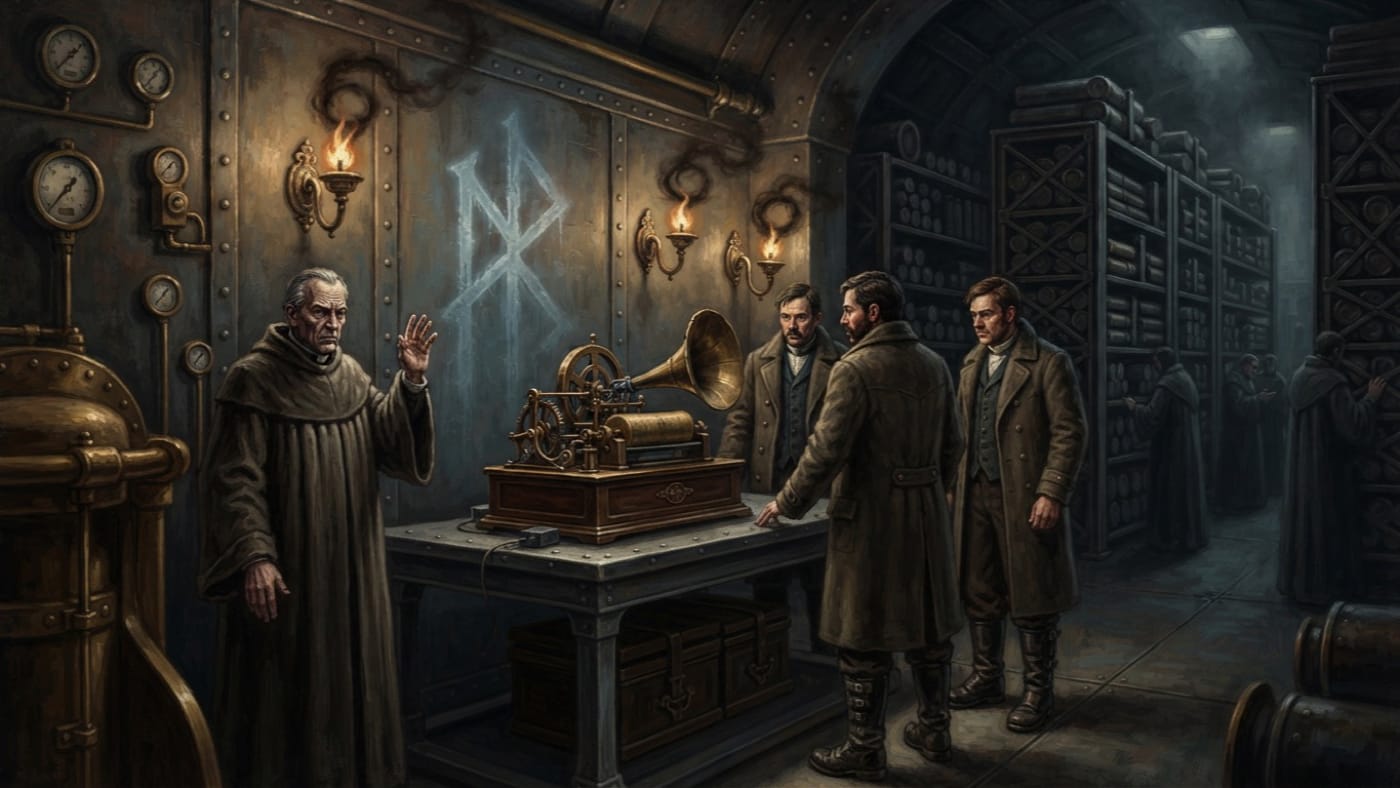
At first playback, three lamps in the chamber reversed pressure. A lamp at Brast is a modest liturgical appliance of flame, glass and sanctioned draught. Reversal means the draught ran the wrong way, as though the lamps had drawn breath instead of giving it. Moisture in the chamber then formed a mark. The file calls it unapproved, which at Brast means no office has signed for it, and declines to describe it further. Ilyra Kest, Choirmaster-Calibration, raised one finger to stop the cylinder. The cylinder stopped. It stopped late.
The record does not say how late. I will not supply a figure. A figure would be a measurement, a measurement implies a method, and nobody in that chamber had brought one.
Vault Brast-4 transcript fragment, A.S. 201: night-syllable recorded between fourth-bell cadence and condenser return. Acoustic shape resembles ████████████ with secondary pressure bloom consistent with spoken name response. Personnel below red seal reported left-ear heat and the smell of wet iron. One clerk wrote “it is waiting for the second half” before fainting. Clerk reassigned to non-listening duties.
Observe what the fragment places and what it keeps back. It places the recording between fourth-bell cadence and condenser return. That is a slot in Brast's working liturgy and has no date on any calendar. It records a pressure bloom consistent with a name being answered, in the language of a clerk who has watched a dog lift its head and will not say which name was called. It records heat in the left ear and wet iron in the nose among men of insufficient seal. It records one sentence from a clerk, who then lost consciousness. Nobody has identified the name. Nobody has produced a second half. The Bureau has produced a reassignment.
#On Custody and the Licensed Throat
The Calibration Choir rules Brast by the throat. Its licensed cadences open valves and settle gauges. An unlicensed verse is a black hymn, and black hymns are capital matters, because a wrong stress at first-stage charge kills more men than most heresies manage in a decade. Kest's Measures hold the repertoire. Whoever holds the repertoire holds the pressure, and whoever holds the pressure holds the rear of the war.
The night-syllable is a sound from outside the repertoire that appears to have done work. That is the entire scandal. If an unlicensed noise can reverse lamps and write in moisture, the licence becomes a description where it was a monopoly, and the Choir becomes one singer among an unknown number. At least one of the others lodges in the furnace.
What may be stated of custody is brief. The cylinder is in Vault Brast-4. It is held under countermark. Kest stopped its playback. That last fact establishes her presence and her authority. It does not establish that she made the recording, and the confident Gauge Ward accounts naming her as recorder carry no seal I recognise.
The interests gathered at that countermark are no mystery. The Choir needs the sound to be a cadence it can learn, license or forbid. The Furnace Chapterhouse of Saint-Combust needs it to be holy, or at least theirs. The Distillers' Compact owns the filters through which every sanctified gallon passes, and needs the fault to lie anywhere but the filters. Commander-Auditor Sorn Vale needs it to have a hand. Each office stands at the vault door with a different key and the same refusal to turn it.
#On the Explanations
The Chapterhouse offers divine animation. Metal fed on sanctified chrismole, anointed and sung over at fourth bell, has acquired some rudiment of spirit, and the syllable is that spirit clearing its throat. The theory is warm and liturgical, and it is fatal to the Chapterhouse's own monopoly, since a furnace that speaks for itself needs fewer priests. They advance it anyway. Vestments make men brave about consequences they have not costed.
Engineering offers harmonic interference, pressure irregularity and responsive material fatigue. In this account the night roar is a vast instrument whose pipework is a set of throats nobody tuned, and the syllable is an overtone that sometimes falls on a frequency the machinery obeys. The account has the merit of requiring no soul. Its defect is that it explains a flickering lamp and says nothing of a clerk writing that something was waiting.
The Choir's position, so far as it exists in writing, is cadence. Correct measure opens. Wrong measure resists. A measure that works is a measure whether anyone licensed it or not. This is the most practical theory and the most frightening, because it implies the catalogue is incomplete and that something adds to it at night without paying the fee.
Vale offers culpability. Somebody sang it, or played it, or tampered with the cylinder, or let a draught into the lamps. Find that man and the syllable becomes a crime with a body attached. His method has the great administrative virtue of ending at a scaffold. It has not yet found anyone to stand on it.
This office's review copy described the Vault Brast-4 playback as the first trial in which responsive machinery was observed under control.
It has always been the case that Engineering memorandum 41-R governs: responsive machinery remains “unproven by controlled trial.” A first playback is an accident with witnesses. Nobody controlled the lamps, the moisture or the cylinder's opinion of Kest's finger, and the Bureau declines to dignify any of the three with the word trial.
None of these explanations has been accepted. All of them are in use.
#On the Misfire Ledger
Brast writes such things down because of A.S. 199. In that year a Brast-fed battery at Bastion-Przemyśl, on the Rail-Throat where the supply lines choke, fired four rounds into a friendly rail junction. Eleven died and a supply train was crippled. Every office blamed every other office, and the guns declined to testify.
Since then Brast has recorded the anomalous behaviour of its machinery where it once shrugged. The public file stands at Category Two Localized Acoustic-Mechanical Disturbance, and the review copy has stood at Amber since the misfire year. A sound that once would have been a feeder's tale over bitter tea now goes into a vault under countermark. Brast learned in A.S. 199 what an unrecorded anomaly costs once it reaches the guns.
I will put this plainly so that no reader is tempted. Nothing in the record connects the night-syllable to the Przemyśl misfire. The syllable is not shown to have existed in A.S. 199. No document places the cylinder in that year's proceedings. The misfire is why the vault listens. On present evidence it has no part in what the vault heard.
#On the Present Seal
As of A.S. 201 the cylinder remains in Vault Brast-4 under countermark. The wider phenomenon keeps its classification: Category Two, Amber. The syllable has been given no rank of its own, no saint, no demon and no authenticated pedigree, and anyone who offers it one in a Brast tavern should be reported to the provost before he finishes the round. Lux Thane Mire has been dispatched from Strasbourg with authority to examine responsive substance. His inquiry is pending. On every record I hold, he has not yet touched the cylinder.
The seven sealed drums missing from Brast's ledgers are a separate wound, and the coughers of Ash-Hospice Row keep their own fevers. Both run alongside this matter. Neither has been tied to the syllable, and I will thank Records not to tie them together for the convenience of a single folder.
The furnace still roars at night. The vault is quiet.