
#On the Chamber That Returned the Note
The North Annex Hush is the founding story most often repeated among the Silentists, and I file it as theirs. It concerns a branding sitting in a repaired chamber of Strasbourg in A.S. 118, which the old reckoning calls 1828. The school recites it to apprentices in a fixed order. The Codex holds no throat ledger, discipline register or witness deposition of its own to set beside that recitation, and I will not pretend to have handled papers I have not handled. What follows is the account as the school keeps it, with the Bureau's corrections where the Bureau has bothered to make them.
The account does not say which building held the North Annex. It was not the Iron Chapel where Saint Orla died, and it was not East Hall. Strasbourg is full of buildings with a north side, and none of them has volunteered.
The word that matters is repaired. New mortar sits against old cracks, and a mended room carries sound by rules the masons never wrote on their invoice. For this reason Writ 14-C places room tuning first among the six stages of the rite. The singer tests the stone and establishes a baseline before the condemned is brought in. A room that has not been tested is a tribunal sitting without a clerk. It is just as dangerous and less flattering to the institution.
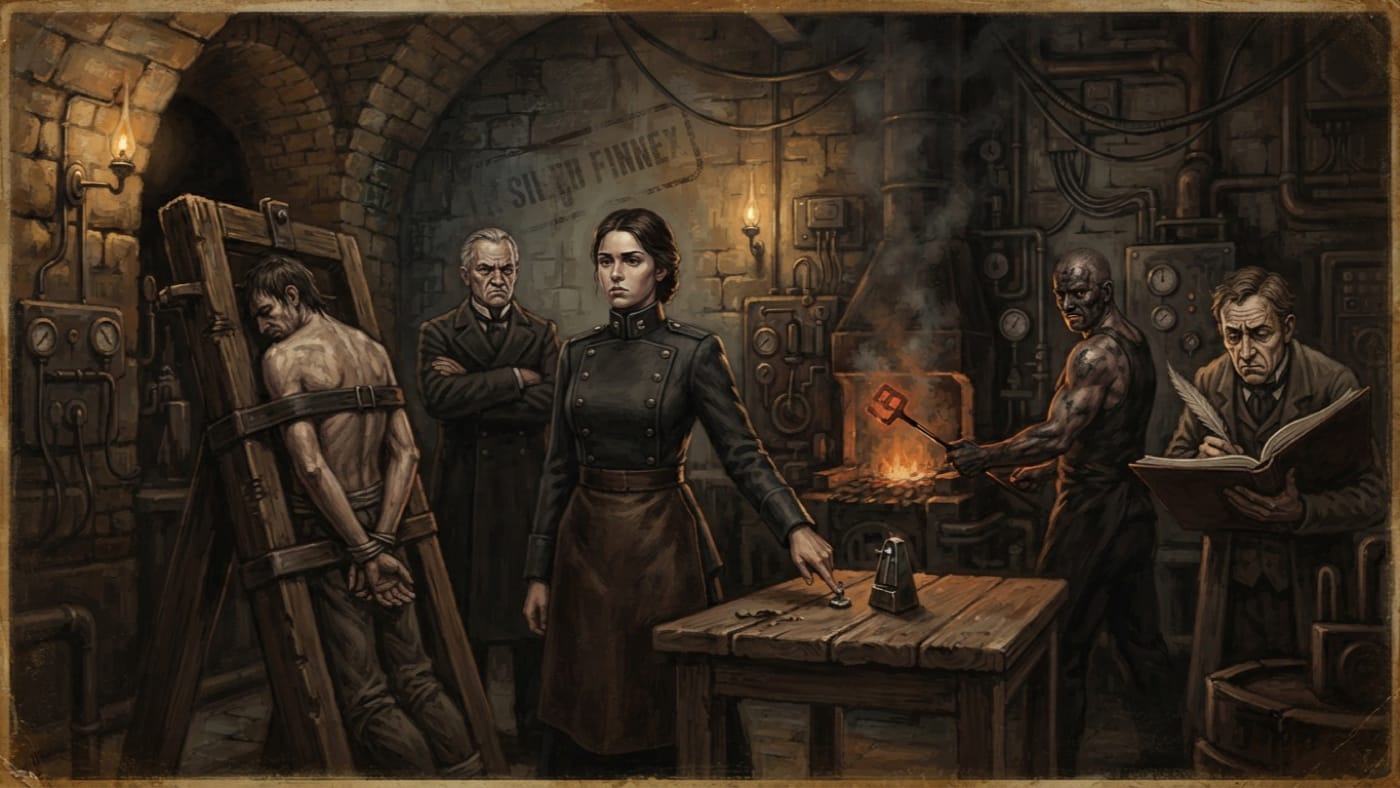
The recorded personnel are few: a young Iron Choir Brand-Singer named Irena Vos, a senior Cantor whose name the account leaves out, a Brand-Smith, a scribe, and the condemned. Vos's age, birthplace and training house were never entered, and the condemned were never named.
#On the Cadence Withheld
Vos struck the room tone. The stone returned the note before her fork stopped trembling.
Every Silentist novice can recite that sentence, and the order of events is the whole of its doctrine. The question was still ringing in the singer's hand when the room answered it. A chamber has no licence to reply before it has been addressed. The account does not say that the stone spoke, or that it sang words, or that anyone recognised a voice in it. It returned the note, and it did so too early.
The senior Cantor ordered the rite to proceed. The condemned were waiting, the irons were heating, and a docket does not wait on echoes.
Vos closed her mouth. She set the bell-hour token on the table. She tapped the cadence with one finger.
The Brand-Smith cursed. That was reasonable of him. His craft is landing red iron on the beat, so that each scar on the body matches its line of confession, and he had been told without warning to take the beat from a fingertip instead of a hymn. The scribe complained, as scribes do when a procedure leaves the form already ruled on the page. Those two objections are the entire recorded opposition. The account gives Vos no speech at all.
Three subjects were certified. Certification means that the iron landed, the confessions were entered and the Ledger was satisfied. It does not mean release, and it does not mean the treatment was painless. The certificates give no charges, injuries or later fates. The iron hissed as it always does. The condemned breathed as men always breathe in those rooms, too fast, and nothing steadied them except the tapping of one finger on wood.
What the Silentists celebrate is a smaller fact than mercy: once the reduction began, the chamber made no further recorded response. The account does not describe her Closing Tone, and I decline to compose one for her.
#On the Reprimand and the Duty Roster
The Bureau of Purity reprimanded Vos for unauthorised procedural reduction.
That was correct. Annex II of the Writ permits an "authorised minimal substitute" for the Opening Hymn, and it requires written cause, a witness countersignature and a throat-review notation for any deviation. Permission for a class of substitute does not make every substitution in the field authorised, just as a licence to carry a blade does not license every cut. The reprimand, as the school transmits it, does not say which of the three requirements she failed. I leave that empty. An empty space in a register is evidence. If I wrote something into it, that would be forgery.
Then she was assigned to two more unstable rooms. Then four.
Neither record withdrew the other. No commendation appears, and no promotion. The reprimand stayed in the discipline file, and the assignments went into the duty roster, and the files were kept by different clerks in different rooms. Each clerk did his work correctly. Purity condemned the method on one page and requested it on another, and felt no discomfort, because a Bureau feels nothing until two of its own papers are placed on the same table.
Apprentices began copying her hand-tap notation. The Silentists treat this as the true beginning of their school, and I do not quarrel with them on it. The copying explains why her name is cited as founder. It does not make her the author of every gesture, drill and precaution the school later attached to that name.
#On the Voice Orison Declared Broken
The Bureau of Orison and Song has a professional grievance here, and it is sincere. Orison exists because song is the instrument of the rite. A singer who keeps the rite running without song threatens the whole basis of Orison's existence, which is worse than an insult to it. So Orison's pamphleteers produced a more comfortable Irena Vos: a psalmist whose voice failed under pressure, who could not hold the note, and who turned her infirmity into doctrine. In that version the rival school becomes a clinic, and Orison gets to be the physician.
Orison pamphlets describe Irena Vos as a failed psalmist whose voice cracked under pressure.
Withdrawn. The published correction cites Purity throat ledgers that record her voice as serviceable for nine further years after the North Annex. She withheld it by choice. Orison considers this a graver offence than incapacity, and on that point alone Orison is correct.
Nine serviceable years prove that she had the instrument she declined to play, and nothing more. They do not make her mute for life. They do not give a date for her retirement or her death. Purity measures throats only by their usefulness to the iron, and once the throat had no further use the ledger had nothing more to enter.
#On the Precedent the School Kept
The Silentists keep two pedigrees and are careful not to mix them. For legal descent they cite the Writ 14-C settlement of A.S. 104, the document that formalised the Brand-Singer corps fourteen years before the North Annex. For practical authority they cite A.S. 118 and a woman with one finger on a table. Archivists are taught the first story. Apprentices learn the second, and they remember it.
They also claim Saint Orla, through her final command: Do not answer it. The words are Orla's, spoken in the Strasbourg Iron Chapel in A.S. 104, and the Closing Tone that grew from that rite was later hardened under Standing Order 22-S. Vos inherited a doctrine of silence she did not write. No record puts the two women in the same room or the same correspondence. The school hangs the saint's command beside the singer's act and lets novices draw the connection themselves.
The underlying phenomenon is still disputed between offices. Doctrine speaks of residual liturgical resonance, Orison of acoustic reflection, Purity of anomaly, and the singers themselves of echo weather. Doctrine has not ruled on what answered in the North Annex, and I will not assign it a demon, a mason's error or a miracle.
The mature school grew around the incident and partly away from it: breath counts in place of the Opening Hymn, slate taps for stage cues, loose metal wrapped in cloth or removed before the condemned enters. These are later practices. Placing them in the North Annex would flatter the founder in order to flatter the school. Silentist minimal tone still keeps the timing, still governs the inscription and still produces a certificate. The machinery of confession goes on with its music turned down.
Rival schools treat the precedent with suspicion. Mercy Tone distrusts a cadence that gives a failing body nothing to hold. Judgment Tone complains that tapping slows the docket whenever the smith is mediocre. After the East Hall response of A.S. 144, twenty-six years later and in a different chamber, Master Cantor Vell lowered his volume for three months. Silentist pamphlets called this vindication. Vell converted to nothing. He borrowed a reduction for a season and kept every school as a tool in his own hand.
Purity tolerates the Silentists because they file fewer anomaly reports. A shorter report is administratively convenient. It does not prove that silence removes the danger, and it does not prove that every quiet room was reported accurately.