
#On the Issued Cadence
The bell-hour metronome token is issued to the Iron Choir Brand-Singers with the rest of their working kit. That kit is a throat-mask against soot, a pitch-fork tuning rod, a hymn slate of approved verses and wax plugs for the silence afterward. Of the five, the token is the least loved and the most obeyed. The rod gives the note and the slate gives the words. The token gives the time. In the penitence halls of the Bureau of Purity, time decides whether the chamber produces a confession or a mess.
The profession's own register describes it in six words: keeps cadence; proves compliance. That is two functions and one semicolon, about the ratio of text to consequence the Bureau likes. I will not publish how the proof is taken, recorded or examined. Any clerk who wants to counterfeit it can do his own research. It is enough to say that a Singer who kept the token's cadence is presumed to have kept protocol. A Singer who did not must explain the lapse to someone holding a pen.
The name has attracted claimants. The Office of Bells observes that "bell-hour" is its word, and the Bureau of Orison and Song says every licensed rhythm in the Church descends from its choirs. The ledger shows who issues the token. It does not say who makes it, and in my experience a silent ledger is usually silent on purpose. Purity owns the token in practice, the same way it owns Saint Orla.
#On the Iron Chapel
A rite begins before anyone sings. The Singer sets the tuning rod and the token metronome together to establish the room tone. The rod fixes pitch against the stone and the token fixes the pace everyone will keep. This division matters. The token hears nothing and knows nothing about the room. It will keep perfect time in a chamber whose north wall was patched that morning, and it will go on keeping it while the plaster starts to hum. Orla's final rite in Strasbourg showed exactly how much a steady cadence is worth in a room that has decided to answer. The approved register dates that rite to A.S. 104, though some calendars dispute the year.
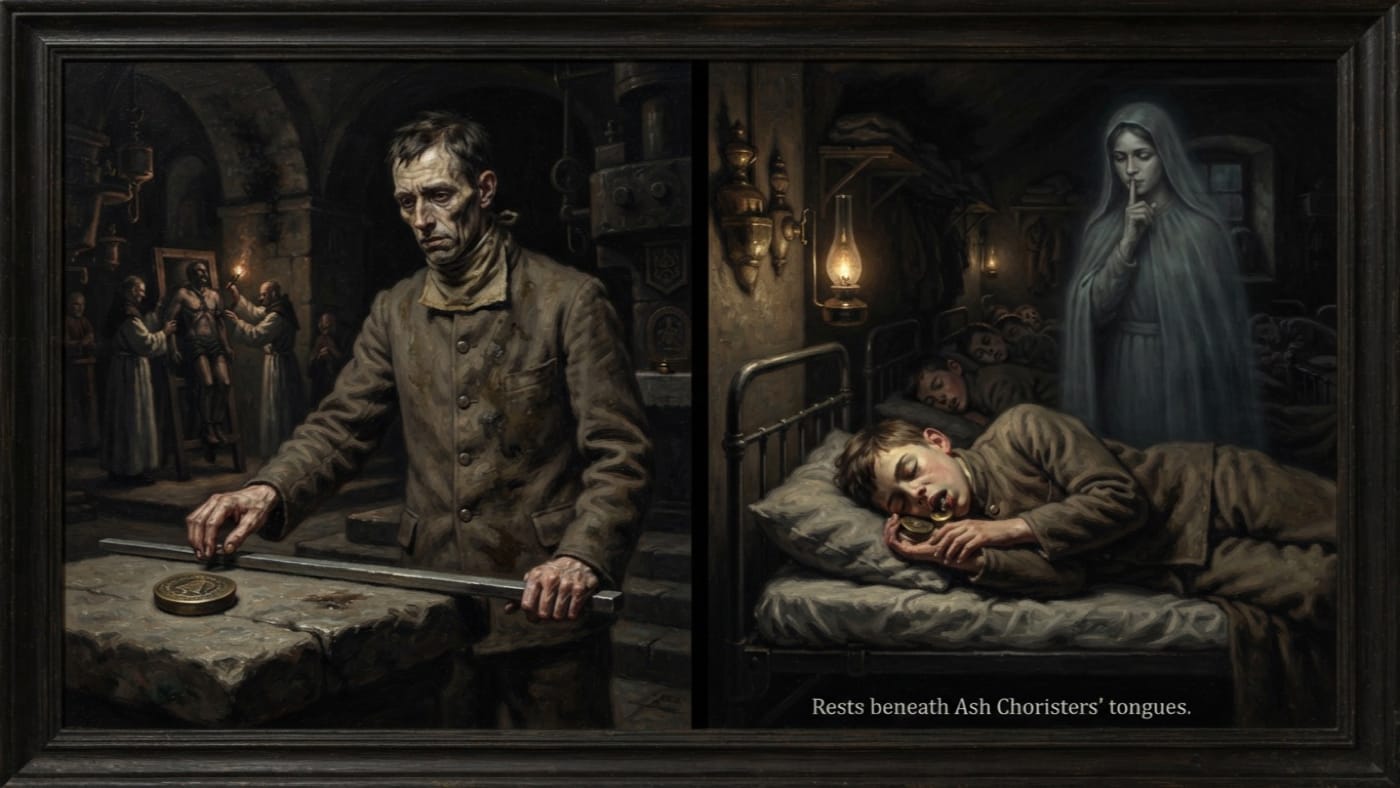
The Opening Hymn follows, and its purpose is to steady the breathing of the condemned. After it come the stage cues. Each part of the written confession has its own note pattern, and each cue tells the Brand-Smith when to lift the iron. The iron lands on the cadence. That is the whole reason for the token. The scars must line up with the text, so that a man's back reads in the same order as his charge sheet. If the Singer drifts, the Brand-Smith lands early, the brand no longer matches its clause, and the scribe at the lectern asks the most feared question in the profession: say that again?
Then the Closing Tone: three descending notes followed by fourteen heartbeats of silence, as Standing Order 22-S later wrote down from Orla's practice. The fourteen are counted in heartbeats. Novices who try to count the silence on the token get corrected, sometimes with the tuning rod. The heart was issued by the Creator. The token came from a quartermaster, and the Order does not confuse the two.
When the silence ends, the Singer reports any pitch anomalies and the scribe certifies completion. The certificate names the Singer. It does not name the token, which has never been asked to sign for anything.
#On the Bell beneath the Tongue
The Ash Chorister is the entry rank. The novice holds the drone while the Brand-Singer leads the cues, learns breath pacing from the ribs outward, and discovers early that the most useful thing a young voice can do is stay exactly where it was put. The token belongs to the working hours of that training. The profession's own custom has also carried it into the night.
Ash Choristers sleep with the bell-hour metronome token beneath the tongue. The purpose they give is to "train silence." Nobody enforces the practice, because nobody needs to. A novice who has held a drone through a full bell-hour of screaming on the other side of the wall does not need a regulation to want the cadence somewhere close in the dark. Under the tongue is about as close as it can be kept.
Choristers keep the token through the night in tender imitation of Saint Orla, whose compassion never slept.
Corrected under Purity Circular 14-C/9, which replaced compassion with steadiness in every approved imitation of the saint. Read: Choristers keep the token through the night in steady imitation of Saint Orla's control. This corrects my own sentence. Doctrine noticed it before the ink was dry and so did I, and in future I will not allow sentiment into a tract about equipment.
Then come the dreams. Choristers who keep the token overnight report a woman in grey who tells them to breathe through stone. The report is consistent enough for the Directorate to file it and too consistent for anyone to find it comfortable. Orla's approved icons dress her in an iron-grey mantle. Her last surviving command, Do not answer it, has made her the patron of anyone who has to go on breathing in a room that will not stay quiet.
The Bureau of Doctrine has declined to certify that the woman is Orla. It has declined, just as carefully, to deny it. A cult that might be a visitation keeps better attendance than one that is only a symptom. I record the dreams as the Choristers report them. Nothing in the file shows that the token calls her, or that Orla ever carried one. The icons give her a pitch-fork, and the earliest chapel paintings give her a psalm slate. Whatever the grey woman is, the novices meet her with a small issued object pressed against the soft floor of the mouth, and they wake still holding it.
#On the Diagnosis and the Pension
Here the trouble moves from the chapel to the counting-house.
The Bureau of Medicine calls the night phenomenon Bell-sickness. The profession's own ledger lists bell-sickness among its physical hazards as tempo hallucinations. The recognised stress signs are humming in sleep, counting steps in bell-time, flinching at harmony and touching the throat at the sound of a name. Medicine's view is that a novice who dreams in cadence has been injured by work, the same way a Brand-Smith's forearm is injured by heat.
The Bureau of Doctrine calls the same phenomenon occupational devotion. On that view, a novice who dreams of the saint while holding the instrument of her discipline has been blessed by work. The dream is piety that happens to arrive while the novice is asleep.
Both bureaus can point to the same sleeping body. The disagreement lasts because the classification decides pension eligibility. One reading of the Chorister's nights opens the pension ledger and the other closes it. I will not print which does which, because that answer tends to change whenever the ledger runs short. The Singer's body keeps humming whatever the file says.
The profession has its own grim name for the end of the road, and it is fitting. A worn-out Singer is said to become a human metronome, with no music left, only control. Medicine would list that as a symptom and Doctrine as sanctity. A tribunal prefect would call it a Singer who has become perfectly reliable, which to a prefect is a compliment.
#On the Schools and Present Application
Every faction in the corps claims Orla, and each one uses the token differently. Mercy Tone keeps slow, steady hymns to preserve the life on the table, so its singers value the token for the patience it enforces. Judgment Tone sharpens its cadences to hurry the confession along, so its singers value the token for the speed it allows. The Silentists take the position furthest from music. In their view any singing risks drawing demon attention, so they push for minimal tone and more metronome. They quote the saint's final words at every hearing. A cadence kept without a voice, they argue, gives the room nothing to answer. That is a theory, and theories stay in my pending tray. The profession knows where many of its worn-out Singers end up, though. Some give up sound altogether and join the Silentists, and they bring their tokens with them.
The authority behind all this is civic. Every sector of the Line lives by its peals. The Bell Codex, ratified in A.S. 115, fixes the current standard of the bells, and the bell-hour schedule is written into every penitence hall's list of inputs. The token takes that public time into a private room, and then into a private mouth. I know of no other issued object that brings the discipline of the bells that far into a single body.
Its present use is the same as always. The token establishes room tone with the rod, keeps the iron on the text, stands witness to compliance and waits out the fourteen heartbeats it has no part in counting. At night it is back under the tongues of novices who have not yet been told their dreams are under review.
The token is approved, issued and in service, and its classification is still pending.