
#On the Refusal to Sing
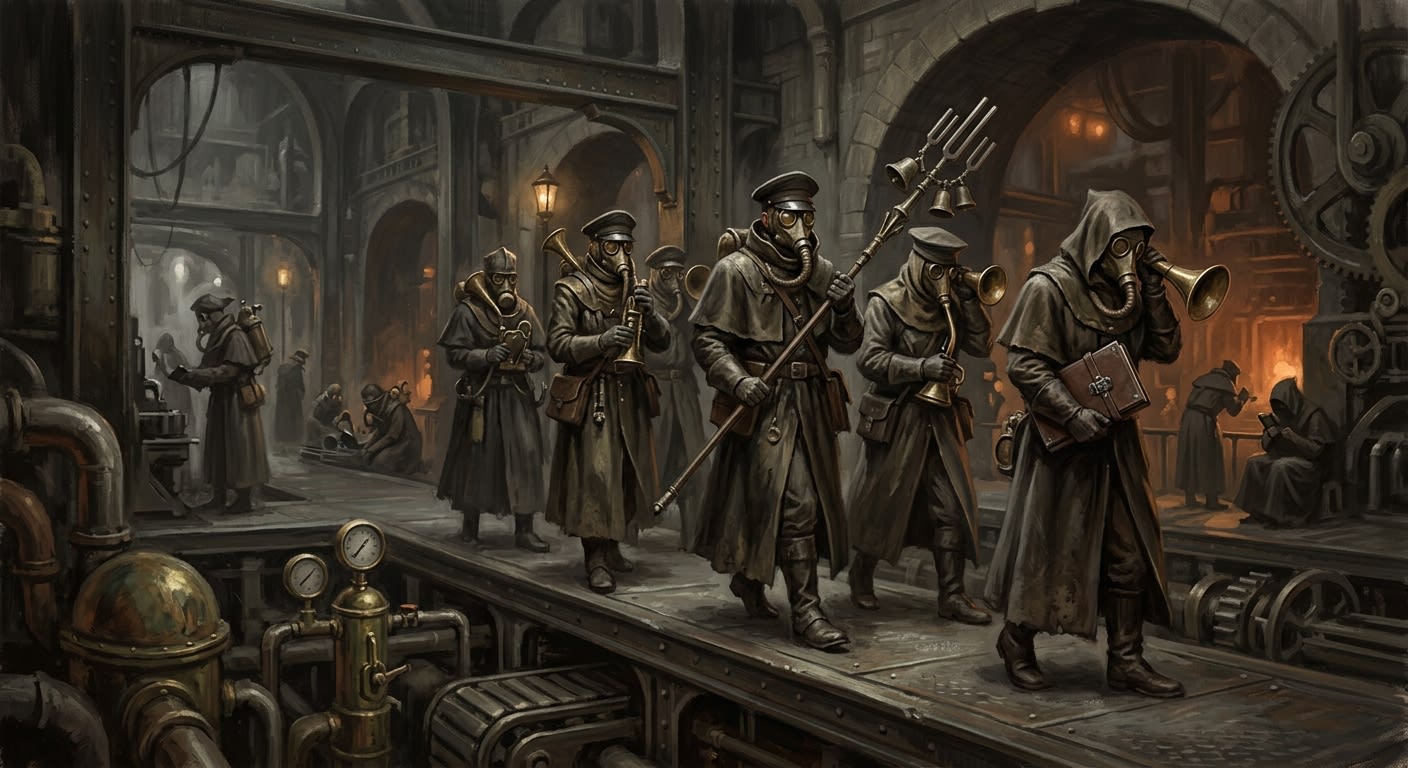
The Silentists are the smallest and least beloved school of the Iron Choir Brand-Singers, a profession already so steeped in distrust that becoming its least beloved faction requires effort, conviction, and the sort of personal charm usually found in damp chalk.
Their doctrine is severe: every sanctioned note risks reply. Sound enters the penitence hall, touches stone, touches iron, touches pain, and comes back altered. The Bureau of Orison and Song calls this acoustics. The Silentists call it invitation. Purity, which owns the rooms and dislikes both explanations, classifies the dispute as “technical.” When a Bureau says technical, it means the bodies have not yet stacked high enough for theology.
The school advocates minimal tone: metronome tick, whispered cadence, breath mark, finger-tap against slate, the smallest sound that still permits a Brand-Smith to land the iron and a scribe to certify the confession. They do not abolish the rite. They reduce the acoustic surface by which something in the chamber might take hold.
#On the First Hush
The Silentists claim descent from the same A.S. 104 settlement that formalised the Brand-Singer corps under Writ 14-C, though their true power came later, after rooms began answering with sufficient regularity to embarrass men who had previously called such answers “bad masonry.” Early Purity records mention “low application singers,” “hush-cadence personnel,” and “Orison failures,” the last phrase revealing more bile than scholarship.
The founding story most often repeated among Silentists concerns the North Annex Hush of A.S. 118. A young singer named Irena Vos, assigned to a repaired chamber in Strasbourg, struck the room tone and heard the stone return the note before her fork stopped trembling. The senior Cantor ordered the rite to proceed. Vos closed her mouth, set the bell-hour token on the table, and tapped the cadence with one finger. The Brand-Smith cursed. The scribe complained. The room stayed quiet. Three subjects were certified. No wall answered.
Orison pamphlets describe Irena Vos as a failed psalmist whose voice cracked under pressure.
Corrected. Purity throat ledgers record her voice as serviceable for nine further years. She stopped singing by choice, a condition Orison finds more offensive than incapacity.
Vos was reprimanded for unauthorised procedural reduction. Then she was quietly assigned to two more unstable rooms. Then four. Then apprentices began copying her hand-tap notation. The Synod does not need to admire a method to use it. Admiration is for statues and fools.
#On Technique and the Discipline of Less
Silentist practice begins before the condemned enters. The singer maps the room without song: three taps of the tuning rod, a pause, one breath against the teeth, another pause. Cracks are marked. Bucket rims are damped with cloth. Loose iron is removed. Candle brackets are tightened. A room with rattling metal is a choir waiting to betray its conductor.
The rite proceeds by subtraction. The Opening Hymn becomes a breath count. The stage cue becomes a finger against slate. Identity is marked by two taps; charge by three; recantation by a held hand; sentencing by the metronome token placed upright beside the scribe's ink. The Lictors dislike this because it deprives them of the grandeur they believe punishment owes them. Lictors are simple men. Give them a blade, a belt, and an audience, and they begin composing opera in their heads.
The difficulty is precision. Mercy Tone can carry a body with a long drone. Judgment Tone can corner it with sharp cadence. Silentism offers almost nothing to hold onto. The condemned hears breathing, metal, and the tiny tick by which law advances. Panic spreads into the spaces music would have filled. A poor Silentist produces chaos. A great Silentist makes the chamber so bare that even terror feels obliged to lower its voice.
Training breaks singers of theatrical habits. Candidates sit in smoke rooms and are forbidden to hum. They learn to cue with knuckle, breath, eyelid, shoulder. They must keep tempo while auditors sing behind them, while Ash Choristers (Unregistered) produce deliberate wrong intervals, while a confessor-booth clerk reads family names in the next room. The first failure is sound. The second is anger. The third is explaining oneself.
#On Orla, Vell, and the Stolen Command
The Silentists claim Saint Orla through her final sentence: “Do not answer it.” Mercy Tone claims her breath. Judgment Tone claims the clean landing of the iron. The Silentists claim the refusal. Of the three thefts, theirs is the most austere and the most annoying at dinner.
Their icons of Orla face the wall. This violates popular devotional taste and satisfies Silentist theology: the saint listens better when she is not asked to perform. Candidates touch ribs, throat, and slate, then remain silent until the assigned chamber receives them. Orison calls this mutilated liturgy. Purity calls it permissible if recorded. The saint, sensibly, remains dead.
Master Cantor Vell despised the Silentists in public, calling them “men afraid of their own instrument.” Silentists preserve the insult with pride, as though fear of an instrument that can open a room to voices without owners were a defect. After the A.S. 144 East Hall response, Vell reduced tone volume for three months. Silentist pamphlets cite this as vindication. Vell left no pamphlet in reply, which was almost certainly his cruelest possible answer.
Silentist tract The Holy Hush (Unregistered) states that Vell “converted to minimal tone after East Hall.”
Withdrawn. Vell converted to nothing. He lowered volume, corrected timing, and continued treating schools as tools beneath his hand. A master may borrow a knife without joining the cutlers' guild.
#On Their Enemies and Uses
Orison hates the Silentists because they are singers who make a virtue of withholding song. This is like a butcher praising fasting, a mason praising rain, or a theologian praising a blank page. Professionally obscene. Orison auditors attend Silentist examinations with the pinched faces of men forced to inspect their own irrelevance.
Mercy Tone distrusts them because silence can let a failing body collapse before the confession lengthens. Judgment Tone mocks them because minimal cadence slows the docket whenever the Brand-Smith lacks skill. Brand-Smiths themselves divide sharply: the finest love Silentist cueing, since every tap is clean and every movement intentional; the mediocre demand louder singers and then blame acoustics for their crooked irons.
ACOUSTIC INCIDENT SUMMARY — WEST CELLAR ROOMS (Unregistered), A.S. 166 Full hymn application in repaired chamber produced ███████████████ second voice, ███████████████ reversed cadence, and ███████████████ inscription drift across three subjects. Subsequent Silentist retry produced certification with no response. Official conclusion: ███████████████ comparative data insufficient. Unofficial instruction: send hush-men first.
Purity tolerates the school for one reason: anomaly reports. Silentists produce fewer of them. Fewer reports mean fewer sealed inquiries, fewer cross-Bureau humiliations, fewer moments in which Doctrine must decide whether a room singing back is demonology, architecture, or an administrative metaphor with teeth. A quiet rite may be ugly. A loud scandal is worse.
#On the Cost of Becoming Quiet
Silentist bodies wear differently. Their cords scar less than Judgment singers and less dramatically than Mercy singers, but their jaws lock, their breath shortens, their fingers develop tremors from constant cueing. They become intolerant of needless sound. Cutlery irritates them. Children terrify them. Bells, even properly licensed bells, make them count exits.
Bell-sickness among Silentists is a private plague. Mercy singers hear borrowed lungs. Judgment singers hear slammed dockets. Silentists hear the sound just before sound begins: the room drawing itself into readiness, the breath behind stone, the third voice waiting for permission. They stop speaking names. They burn used hymn slates. They sit through meals with one hand on the table, feeling for vibration. Their spouses, if they possess spouses and the spouse possesses uncommon patience, learn to announce themselves by touching the doorframe once.
The school's corruption is also quiet. A Silentist can hide a missed confession in absence. A swallowed cue can spare a name. A delayed tap can ruin an inscription without leaving a wrong note for auditors to prosecute. Mercy bribes are sweet. Judgment bribes are official. Silentist bribes are nearly invisible: a pause, a skipped mark, a silence in which a condemned man keeps one secret intact.
#On the Present Hush
As of A.S. 201, Silentists are assigned to repaired chambers, suspected echo rooms, high-anomaly tribunals, and those portions of the Iron Choir whose cages have begun answering in intervals the road wardens cannot explain. They remain few because most singers would rather ruin their throats than discipline their vanity, and because Orison uses every recruitment hearing to warn candidates that the Silentist path leads to “musical sterility,” a phrase that has done more for Silentist prestige than any sermon could.
Their enemies call them cowards. Their files call them useful. Their own notebooks contain almost no adjectives.
The rite begins. The room waits. The iron heats. The condemned breathes too quickly. The Silentist raises one finger, and all of Strasbourg, for one blessed administrative instant, shuts its mouth.