
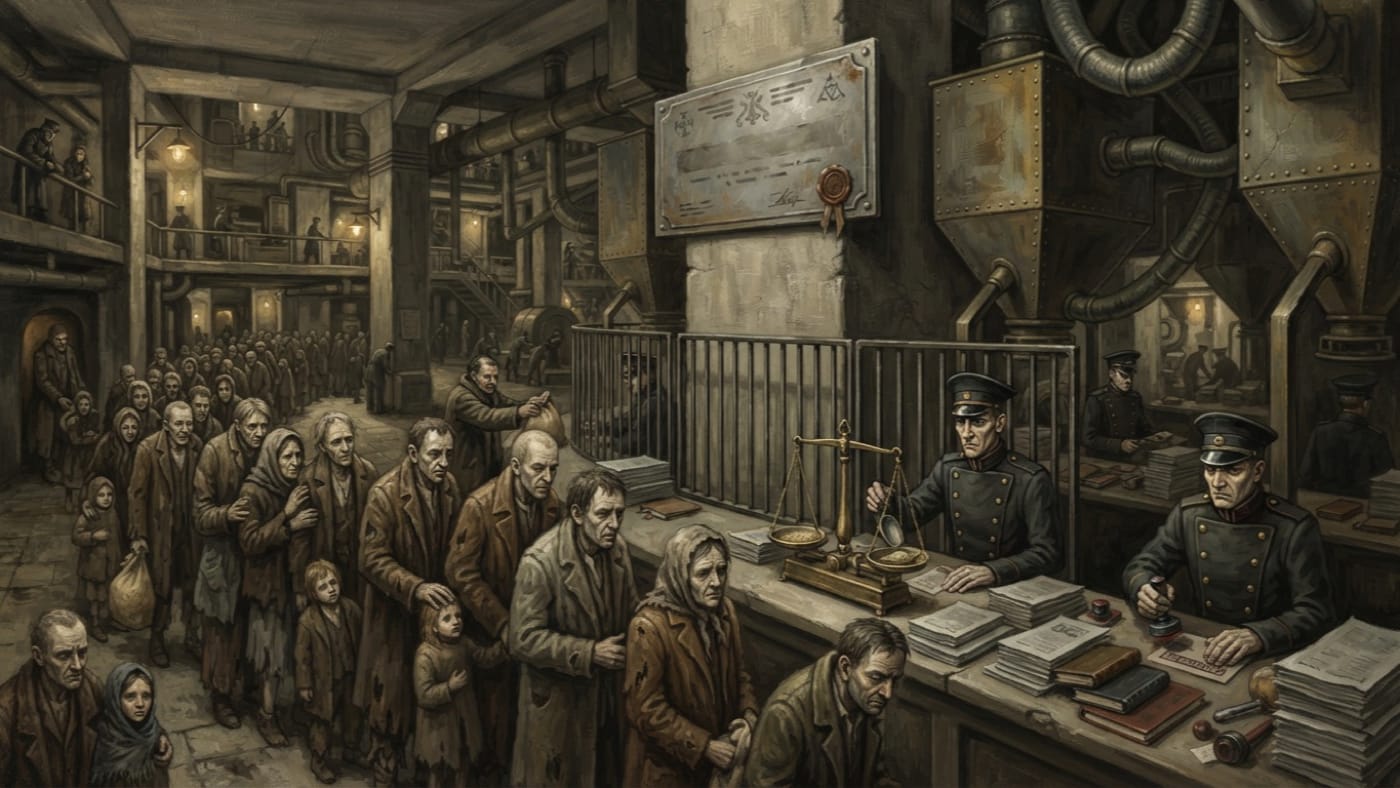
#On the Acceptable Ward
The Bureau of Doctrine's archive holds one sheet from the Office of Ration Compliance, and I have read it more often than any encyclical issued in my lifetime. It is a training note. It carries no date, no director's name and no house seal that the Bureau can match against its registers. It is three lines long. I copied it into my survey of the Quota Men, and it remains the most honest page of administrative theology I have catalogued. I have also catalogued the Purity catechisms.
Its first line defines the acceptable ward: orderly complaint.
Consider what a lesser office would have written. It would have asked for contentment, or silence, or thanksgiving in the approved form. The Office of Ration Compliance asks for none of these. It asks that the ward grumble in line, grumble at the counter, grumble on the way home with its half-loaf under its coat, and come back next week to grumble again. A ward that complains still has the breath to complain. It still trusts the counter enough to stand in front of it, and it still has enough bread in the cupboard to choose words over stones.
A silent queue proves only that nobody in it is speaking. The dead keep very good order.
#On the Measures and the Books
Compliance has to be seen before it can be counted, and a ration district is seen chiefly through paper. The lawful allotment arrives with a manifest, and the manifest becomes a granary entry. The entry is broken into chits. These are soft grey slips that pass from clerk to queue captain to household and come back damp, creased and smelling of the palm that clutched them through a two-hour wait. Each chit should meet a signature and each sack should meet a seal. Each loss should meet a spoilage line, written in a hand steady enough to suggest the clerk was not frightened when he wrote it.
The First Ration Reforms standardised the chit. The ration discipline that my Quota survey assigns to A.S. 104 made inspection predictable. Both were triumphs of legibility, and both showed every thief in the Grain Keeper trade exactly what a clean district looks like.
Audit teams across the ration apparatus keep a liturgy of their own. They weigh the bins and test the grain. They match chits to signatures and check the seals for wear and for warm-wax repair. They question the queue captains separately so that their stories may quarrel. The Tithe Assessor is graded by a similar catechism: high collections, accurate receipts, low riot incidence, and factories still turning at the end of the quarter.
Mark the gap the paper cannot close. A ledger records what was issued. It cannot record what was eaten. A short distance separates the scale pan from the stomach, and in that distance lies the whole of the Office's art and the whole of the heretic's opportunity.
#On the Useful Offender
The Quota Man is the inspector's favourite criminal. The training note admits as much in its third line: observe, tax indirectly, preserve deniability.
He steals modestly. He repairs broken scales before he hides a single sack, because a crooked scale draws auditors and an honest one draws nobody. His public ledger is exquisite. His second book, kept in a cellar or in his skull, balances just as well and tells a different story. Meal goes to a widow before dawn. A patrol sergeant takes bread instead of coin. A baker turns barley into alms loaves. A measure goes to the fever-house that the lawful allotment forgot. He keeps his caches in threes and seeds sacrificial bins for inspectors to find and feel pleased about. By his faction's own custom he lets one small fraud surface each quarter. The auditor goes home with evidence on his saddle and no appetite for the cellar.
His titles of Scale Clerk, Cache Runner and Cellar Warden belong to his trade. No record shows the Office commissioning a single one. I advise its clerks to remember this when a Cellar Warden calls them colleagues.
Remove such a man abruptly and watch the arithmetic. On the first night the fever-house goes without its broth. The patrol is no longer paid in bread, so it begins taking bread. The baker shutters his shop. The widows who were fed before dawn now join the lawful queue, but that queue was sized for a ward someone was already feeding in secret, and it cannot carry them. By the second week the complaint is no longer orderly.
Tolerance of this kind is a habit of convenience. It grants no licence. A Quota Man who mistakes the one for the other is hanged by the same clerks who taxed him the month before.
He differs from his kin in useful ways. A Mercy Keeper empties the bin for the child in front of her and leaves the ward to the winter. A Hunger Broker fills the bin and fits the ward with a collar. The Quota Man opens the bin halfway, keeps back the reserve and writes it up as damp.
#On the Competing Authorities
The note does not say whom the Office answers to. I will draw no chart for an animal whose skeleton I have never seen. I can describe only the hands that reach into the same granary.
Tithes wants the levy collected and the bread handed out, and it has studied the Quota Men closely enough to copy their methods. Purity wants an offender it can prosecute. That needs evidence, and the evidence needs a fraud large enough to seize and small enough to explain. Shadows watches for the morning a cellar ledger becomes a local government and stops bothering to wear the lawful ledger as a mask. Records holds the paper that all three will one day want either burned or produced. The Bureau of War claims first call on the depots behind the Sagittal Line, where a soldier's ration is a sacrament and a civilian's is a sermon on patience. In the queues themselves, Street-Vicars punch purity tokens and hand out correction slips. A hungry woman must recite her creed correctly before her chit is honoured, and the queue grows longer while she does.
My own Bureau interprets. It has the lightest hand, and it signs last.
Purity Field Circular A.S. 199: "Quota Men represent mere theft under bureaucratic cover."
Amended for internal use in the Doctrine survey of the Quota Men: parallel ration governance under criminal custody. Public phrasing remains "mere theft." Whatever the date of the Office of Ration Compliance's training note, its author never believed the struck sentence.
#On Complaint, Abundance and Gratitude
The note lists its three forbidden conditions and says nothing more about them. What follows is my own reading.
Silent collapse is the obvious terror. A ward that stops complaining has either stopped believing the counter will answer or stopped being able to stand. Either way it has slipped out of the Office's sight. Its grievances go somewhere: to a Hunger Broker's back room, to a cellar door, to the cemetery. None of those places files a return.
Vocal abundance is subtler and worse. Suppose a ward boasts of full bellies on an allotment that cannot fill them. It has announced, loudly and in public, that someone other than the lawful granary is feeding it. Abundance is the one mistake the Quota Man cannot be forgiven, because it lets the street hear the second book.
Unauthorised gratitude is the theological wound. Thanks offered at the counter belong to the Creator and to His Church, passed on through the clerk who stamps the chit. Thanks whispered at a cellar door belong to whoever opened it. Gratitude is allegiance before it is anything else. A widow who blesses the man who brought her meal before dawn has already chosen her government, though she would weep to hear it said.
The Office's ideal ward, then, is hungry by a precise and supervised amount. It is hungry enough to queue, fed enough to complain, and grateful only through approved channels. The grain is damp and the chits are sweaty. The bread falls short by a measure nobody writes down twice.
#On the Present Application
This survey is filed in A.S. 201 and describes the Office as this year finds it: one sheet of paper, and the conditions that sheet expects. The condemned Quota Men keep the scales true and the cellars stocked in the Zone 2 ration districts around Strasbourg. They do the same in the Rhine granary wards, the forward supply cities and the family depots behind the Line. The Office observes them. Tithes takes its share through channels nobody names, and Purity takes its quarterly fraud. The queues complain in good order.
None of these arrangements is lawful. Every one of them is fed.
I have been able to verify no charter, no director and no headquarters for the Office. What it does have is three lines describing the condition of every ward it would like to keep. That condition depends on men the Office is obliged to condemn. It also depends on a granary door that must never stand open long enough for the city to see how little lies behind it.