

I've read the continuity rules, the style briefs, the Forge-Beasts erratum and the supporting lore, and I'm writing the article now.
#On an Instrument Without a Birthday
This survey is compiled in A.S. 201 for the Codex. It examines one Ordnance instrument as it now stands in the record. It does not date that instrument's issue, its revision or the field losses that forced the revision. All three dates are missing. I have looked for them with the diligence of a man who expected to find them and be praised for it. The archive declined. The praise is therefore postponed.
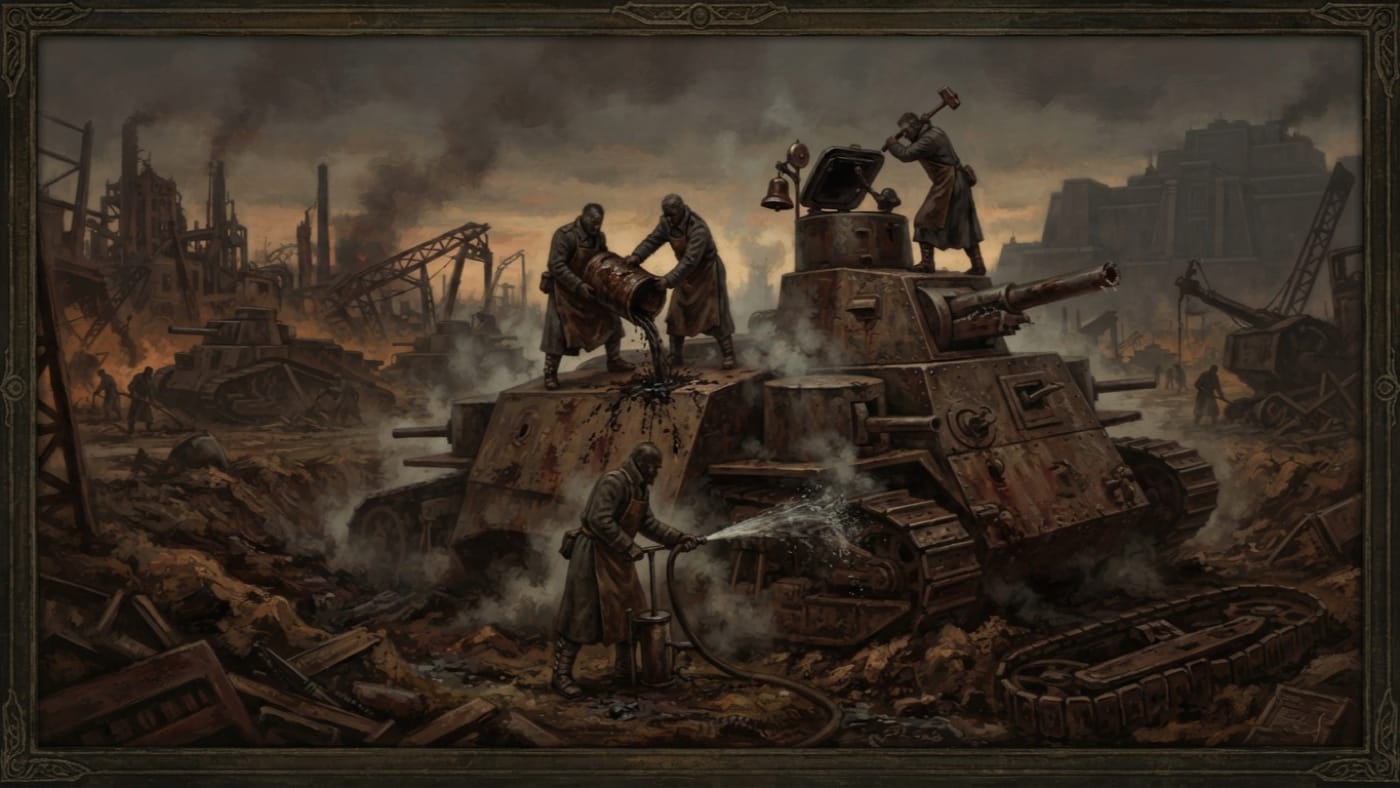
What survives is enough for doctrine. Ordnance Circular 88-B governs what a retreating Synodal unit must do to a disabled engine before leaving it on ground the enemy may soon hold. Against Maldrake, that ground is generous to the Enemy. A tank left in Thracian slag is unlikely to stay a tank. Wrath may take it, crew and all, and send it back as a Forge-Beast: captured iron with an appetite, sometimes with its own crew melted into the levers and still keen on gunnery.
The circular exists to cut off that supply. Its history consists of one embarrassing sentence, three returning engines and a much longer sentence written afterward by people who had stopped trusting adjectives.
#On the Clause That Was
The earlier wording is preserved because the later wording makes no sense without it. It belongs to history now. Anyone still citing it in the field is citing a corpse.
Ordnance Circular 88-B directs that “all disabled engines are to be rendered unusable before withdrawal where feasible.”
Superseded. The phrase above is the circular's former standard and has no operative force. It was clarified after three engines rendered unusable under it returned as Forge-Beasts. Current denial requires total destruction, brine saturation, bell-silencing and confirmation that no crew remains fused to a functional command surface.
Study the dead clause the way a confessor studies a convenient alibi. “Disabled” assumes the engine is already broken. “Rendered unusable” assumes everyone agrees what use means. “Before withdrawal” lets the time between order and retreat shrink to nothing. Then “where feasible” waves the whole sentence through. It is the canonical escape hatch of the Church's administrative prose. Every company commander under fire can decide in good conscience that something is not feasible, and most of them are right. The clause was not written in malice. It was written by an Ordnance mind for an Ordnance enemy: a human quartermaster on the far side of the wire who needs a working breech, four wheels and a sound boiler before he can steal anything worth stealing.
Maldrake is no quartermaster.
#On the Three That Came Back
The correction rests on a single fact, and it carries the whole load. Three engines that had been rendered unusable came back as Forge-Beasts. Their breeches had been sealed, their wheels removed, their boilers punctured. By the old standard those engines had been properly denied. The work was done, and possibly done well. Someone spent sweat and maybe lives to seal those breeches, and Wrath took the machines anyway.
The record does not name the three engines. It gives no year, no place and no battery. It does not say which measure was applied to which engine, whether one engine received all three or each received one, or whether the returns came close together or years apart. I report these gaps plainly. The A.S. 194 recovery failure filed under the parent bestiary is a separate document with its own redactions. Nothing in the record makes it one of the three, and I will not drag it into this one to fill a page.
The lesson needs none of those particulars. A sealed breech stops shot only when the gun needs shot. The parent record says gun-beasts fire from empty feeds, using rage packed into impact. A missing wheel stops travel only when the vehicle needs wheels. The Iron Wastes supply legs instead: corpse-bundles hardened into pistons, recoil arms riveted on as limbs. A punctured boiler stops a machine that runs on steam, and Wrath supplies its own heat. The erratum's verdict is short: “unusable” by Synod standards stays usable by Wrath if impact, heat or hatred can be pulled out of it.
The old clause measured denial by the machine's function. The new directive measures it by what is left once function no longer matters. That was the lesson, and it was expensive.
#On the Four Requirements
The current directive names four requirements. I list them and describe the danger each one answers. I do not invent an order for them, a specification, a sequence of steps or an exemption the record does not hold.
Total destruction. The demand moves from disabling the engine to destroying it outright. The circular does not define “total” in any text I can reproduce, and I will not make up a charge weight or a scatter radius to sound well read. The intent is plain. Wrath used what disablement left behind, so destruction must leave less.
Brine saturation. Elsewhere in the Forge-Beast record, brine shells cool and crack corrupted plate. The circular asks for saturation, which is more than a splash. It treats heat as the thing being denied. That matches every field report of how these beasts are made. The source says nothing on quantity or method.
Bell-silencing. This requirement is the most opaque, and I will not pretend otherwise. Some Forge-Beasts carry slag-throated bells that mock Bell metal and break prayer. The parent record also lists bell saturation among the countermeasures. Which bell 88-B means to silence, and how, the available text does not say. I note the gap and move on.
Confirmation of the crew. The final requirement is the hardest to read aloud. It does not assume every abandoned engine holds a fused crew. The parent record states that a Forge-Beast can function without crew-captives. The circular asks for confirmation that no crew remains fused to a functional command surface. The words are chosen with care: a crew member who is fused, at a control surface that still works. The concern is the memory a crewed beast brings back: the drill, the traverse rhythm, the officer's voice. A crewed beast comes home with its manual already inside it.
This survey's working notes treated the A.S. 201 countermeasure extract as the text of Ordnance Circular 88-B.
Corrected. The parent bestiary's A.S. 201 countermeasure extract (destroy before capture, destroy at range under bell cover, cool the core, confirm cold), with its prohibitions on recovery without witness and on naming fused crew, belongs to the wider Forge-Beast doctrine. It shares a purpose with 88-B. It has not been shown to be 88-B's text, and nobody should quote it as the circular.
#On the Distance Between Paper and Slag
The parent account gives three numbers that every Ordnance lecturer should have to recite with his hat off. On nine occasions the Bureau of Engineering asked that captured heavy materiel be destroyed before Maldrake could corrupt it. The Bureau of War approved all nine. Front-line units complied four times. I attribute those figures to that account. I do not know their dates or the officers who signed them, and the record does not tie them to this circular's issue or revision. They are offered as climate, not as the circular's case file.
Climate is enough. Destroying a disabled siege engine under fire takes explosives, time, access and men. The new standard asks for more of each than the old one did. Where a section once sealed a breech and pulled wheel pins, it must now achieve total destruction, saturate with brine, silence bells and confirm the state of whoever is left inside, all on ground that Hellbow cohorts are already searching for courage to hit. The order states the result it wants and says nothing about how to get it. It does not say how a section under slag-bow fire finds enough brine to soak a hull. It does not say who climbs to the control nest to confirm a crew. It does not say what happens when the man at the levers is breathing.
The old clause's laxity was not stupidity. It was mercy, of the bad sort. “Where feasible” let a commander keep his men alive and his conscience nearly clean. The new standard takes that mercy away and puts in its place an outcome nobody can verify from a distance. Commanders still prefer recovery to denial, as the parent account admits, because recovery promises the engine back and the crew back. It promises the next battle. In Thrace, delay turns recovery into a gift for pyre-smiths, and every hour a disabled engine waits for a rescue team gives Maldrake another hour to claim it.
#On the Present Application
As of this A.S. 201 compilation, Forge-Beasts remain an active hostile class across Thrace, the Iron Wastes and the approaches to Bastion-Constantinople. The clarified denial standard is the standard in force. The where-feasible clause is a museum of good intentions, and this survey has no museum to send it to.
What remains unknown stays unknown here. The issue year, the clarification year, the drafting office beyond Ordnance's general concern, the full operative text, the identities of the three engines and the place they returned all lie outside the record. Ordnance can ask the Creator for a better filing system. In the meantime the Great Deceiver keeps salvaging the old one.