

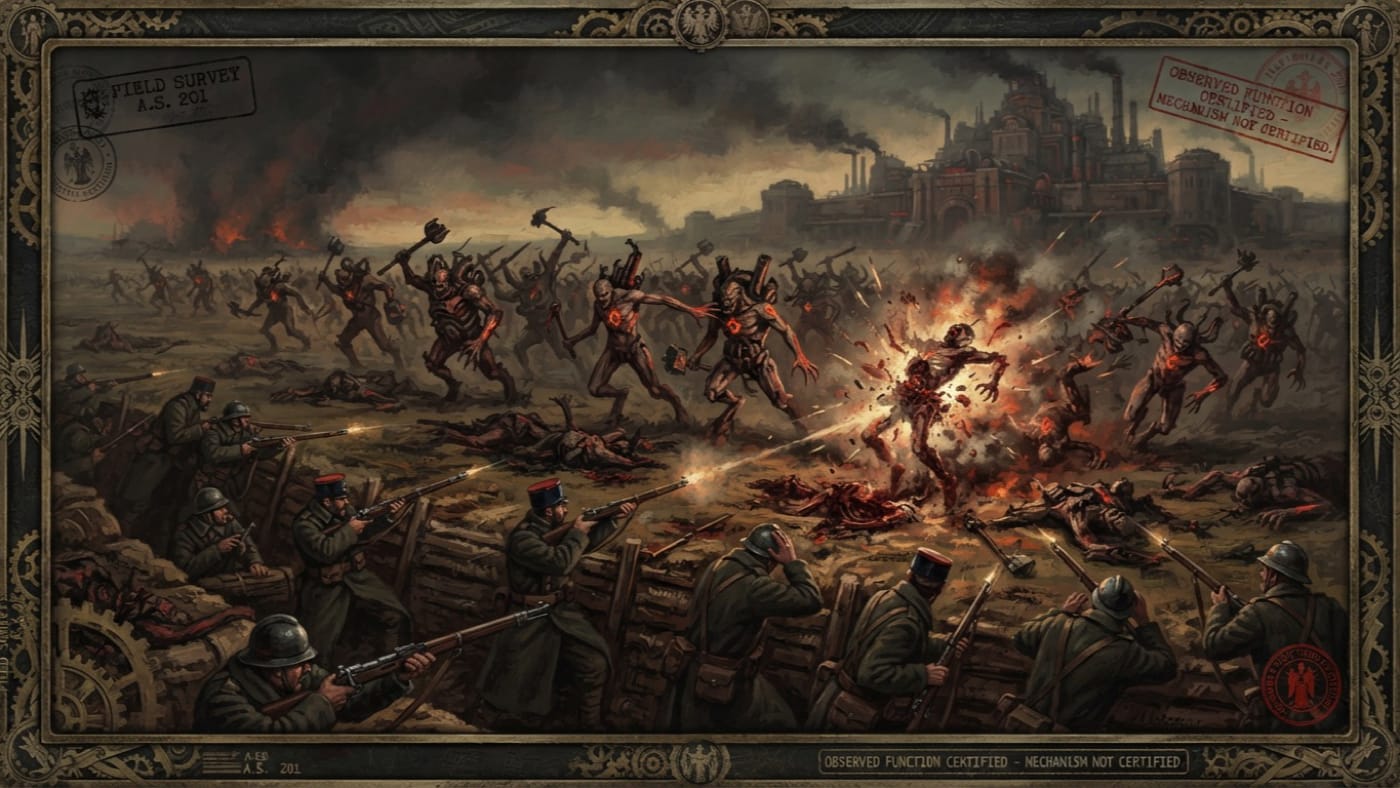
Current field survey — A.S. 201. This dates the dossier, not the class's creation or first appearance.
#Designation and Service
Filed under Wrath, Support. The second word is the one that kills you.
The pyre-smiths are demons in the host of Maldrake the Wrathforged, Sin-General of Wrath, and the troop rolls list them in a support capacity. I copy that classification exactly as given. Soldiers have read the word "support" and relaxed, and the Bureau of Records has later had to enter them in the Book of Departures.
The pyre-smith is seldom the demon that reaches your trench. It is the demon that has made the one reaching your trench worse. It brands its allies with burning runes, and when a branded ally is slain, that ally detonates in fire. The rest of this entry follows from those two sentences. A soldier facing Wrath across the Thracian Plain who remembers nothing else here will have remembered enough.
#The Burning Brand
What the Church knows of the brand is what can be observed from the distance a sensible man would choose. The pyre-smith sets a burning rune on a fellow demon of the Wrath host, and the marked demon goes on as before. It marches and it fights. It carries its maul or its slag-bow or whatever its maker gave it into the line, and nothing in its conduct announces that it has been altered.
Then it is killed, and the brand finishes the work.
The troop entry says the branded ally detonates "in gory fire" when slain. Hold the events in the order the source gives them, because the order is the danger. The brand comes first. Then the demon serves, for however long it lasts. Then it dies. Then fire comes out of the body, among whoever stands nearest.
The source names a single trigger, and that trigger is death. In the trenches men talk about smiths who set off their brands from afar and branded things that choose their own moment. The entry supports none of it. Older and looser writing speaks of Maldrake's brethren branded "until they burst in martyr's fire," and preachers who liked the sound of the phrase have put it in sermons. The narrower entry governs. A soldier who believes the brand answers the smith's will spends his attention watching the smith. A soldier who knows the trigger watches the thing he is about to kill.
How the rune does this, the Church does not know. The Bureau of Records holds no folio on the grammar of the runes and no account of how long a brand takes to set. It also has no answer to whether a brand outlives the smith who made it. These are open lines in the Ledger, and I leave them open. An archivist who fills a blank column with a guess has committed forgery, and I have sent better men than myself to the Paper Mines for less.
What is certain is enough. The pyre-smith takes the soldiers Maldrake already has and makes each one a weapon twice over: once while it lives, and once at the moment it dies.
#Among the Advancing Host
Maldrake does not press Bastion-Constantinople without pause, as Kargath does from his marshes. He comes in campaigns. When he comes, he comes down the Thracian Plain, the forward approach north of the city, where the ground is flat enough for formations in mass. Behind the Plain lies the deeper forge-country of the Iron Wastes. They are different places, though the ash of one settles on the other. A cartographer who merges them will be corrected.
Older geographic accounts placed the Wrath front against "Bastion-Lorraine, western anchor of the Line."
There is no such posting. Bastion-Lorraine is a superseded name. The fortress facing Maldrake is Bastion-Constantinople, southern anchor of the north–south Sagittal Line, and the pyre-smiths come against it out of Thrace. The Bureau of Records keeps the older accounts as an example of what maps do when nobody checks them.
The pyre-smiths take the field in that host beside the Hellbow Legion, whose archers loose bolts of molten slag, and below the Flameheart Colossus, which needs help from nobody. Marshal Vaubret, who holds the Thracian theater, speaks in his briefings of a "pyre-division" moving among the enemy ranks. I record the word as he used it and nothing more. I give no strength, no fixed attachment and no order of march, because the Bureau of War has certified none and the enemy has not been kind enough to keep one.
What can be said is that the arrangement is deliberate. Wrath is violent; it is not stupid. Maldrake's forces move with direction and use tactics. A host that brings demons whose whole office is preparing other demons is a host that has thought about what its dead will do. Under Maldrake, even rage keeps accounts, and the pyre-smiths are among its bookkeepers.
#The Danger After the Kill
Every recruit is taught that the dangerous enemy is the living one. Against a branded host the lesson needs an amendment, and the Bureau of War has never been quick with amendments.
What follows is deduction from the stated function, set down by a man at a desk. It is not the record of any action I am prepared to cite.
Close fighting becomes a wager. The bayonet that kills a branded demon brings the man holding it within reach of what that death releases. The demon he is grappling with is most dangerous at the moment it stops being dangerous by any ordinary measure. A trench that holds against a branded rush may find that holding it has delivered fire into the trench.
Approaching the fallen changes as well. After a Wrath assault, the field of enemy dead is ground the garrison must eventually cross, clear, search and bury. Nothing visible at a distance tells the clearing party which of those bodies carried a brand, or whether it has already gone off. The Church does not know whether a brand can survive its bearer's death unspent. The prudent man assumes the worst, and his sergeant assumes it for him.
At that moment the pyre-smith wins nothing by its own strength. It did its work earlier, somewhere behind the line of contact, on a body that has since walked forward. The killing of the branded demon is ours. The fire that follows belongs to the smith.
#On Synodal Handling
The Bureau of War has issued no manual specific to the pyre-smiths, and I will not pretend that one exists. Sensible conduct follows from the facts. Keep distance where distance can be kept. Kill at range where range is available. Do not let an advance run headlong into a field of fresh enemy dead. None of this is a guaranteed defense. No rite of the Church is known to quench a brand, and no ritual for disarming one has been sealed. Someone will offer to sell you such a ritual. Decline.
What the Synod does have is its general discipline against Wrath. That means rigid command and no violence without orders. It also means the Bureau of Doctrine's teaching of cool hatred, under which the faithful soldier kills the demon because duty requires it and not because he wants to. Against the pyre-smiths that teaching pays for itself. The man who charges a branded enemy in a fury dies in the enemy's fire. The man who waits, counts and fires from the parapet lives to be bored by the next sermon.
My office does not let me stop there. The Church asks its soldiers to kill coolly, and the pyre-smith makes sure that a hot kill is punished at once and in kind. The enemy, in short, enforces our doctrine more reliably than our chaplains do. A Church that relies on Hell to teach its soldiers temperance keeps a ledger I would rather not audit. The Bureau of Doctrine has classified the matter as an edifying parallel. I drafted the classification. The other wording on offer was worse.
#Disposition
The pyre-smiths remain in Maldrake's service, and they take the field against Constantinople whenever he campaigns. Doctrine files every demon on the far side of the Line as the work of the Great Deceiver, and the pyre-smiths are entered in this Codex as support demons of the Wrath host. Their anatomy is not certified, and neither is their number. Their method is certified as far as the brand, the death and the fire, and no further.
A soldier who has read this far knows what to do with a branded enemy. He kills it from as far away as the Bureau of War can arrange.
Then he waits for it to finish dying.