
#On the Iberian Roads
"The Peregrine Brotherhood operated the Iberian coastal routes." — Bureau of Pilgrimage, founding account
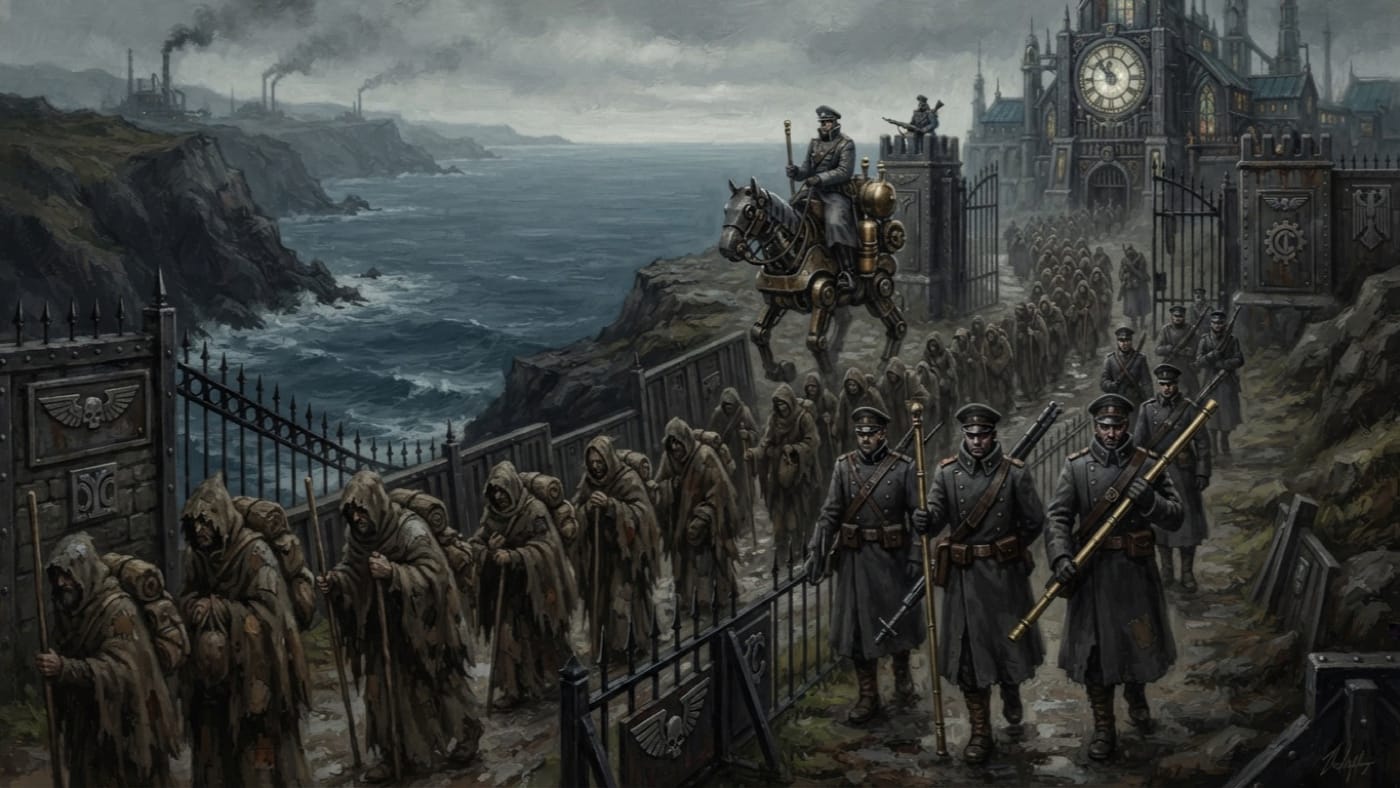
The Peregrine Brotherhood was a private pilgrimage guild, one of eight. It governed passage along the Iberian coast until the Harmonized Routes Edict ended its independence in A.S. 123. The Edict's account says the Brotherhood controlled much of that coast. I draw the reader's attention to the verb. It controlled passage. It crowned no kings, held no courts and garrisoned no cities, though by the end it could have frightened several men who did.
It held the road between the harbours and the shrines, and it held the armed men who walked beside the pilgrims on that road. A pilgrim who came ashore on that coast with a vow and a bad back had to go inland somehow. The Brotherhood had decided, well before he landed, how he would go, in whose company and at what price. The founding account of the Bureau of Pilgrimage calls the eight guilds self-appointed, self-financed and spectacularly territorial. The victor wrote that document. I have read it many times and never found an error in it worth correcting.
No file I have consulted gives the Brotherhood's founding year, its founder or the name of its last master. I decline to supply them. A dissolved guild is owed its date of dissolution, and I am not inclined to give it more.
By A.S. 120 its escorts had grown so numerous that the Bureau's account compares them to a private army. The Edict, which prefers a sneer to a statistic, says they could trouble a minor prince. Neither document counts them, ranks them, names a captain or credits them with a battle, and I will do none of those things either. Armed men on a road need no muster-roll to be dangerous. They have only to stand still in it.
#On Protection and Passage
An escort is a curious thing to buy. The pilgrim pays to be protected on the road, and the men protecting him are the most dangerous thing on it. Whoever commands the escort can halt the column, slow it to a crawl, steer it toward an inn kept by his cousin, or step aside at a bend and let the hill-thieves do their work. The fee buys the absence of that last possibility, and every pilgrim who ever paid it understood the purchase.
The general habits of the private guilds are well attested. They took tolls at narrow places. They marshalled processions for their own convenience, hired out escorts, brokered lodging, and sold a place near a crowded shrine to whoever could afford the nearness. The surviving account does not say which of these the Brotherhood sold, at what tariff or from which hostels. I will not draw up a rate card for a dead guild. The record says it held a coast and kept an escort the size of an army, and that is enough. Such a guild has no need to publish a tariff, because the pilgrim's purse sets it.
None of that money passed through any ledger the Church could audit. It went to the guild coffer. No appeal ran to a Synodal court, and no receipt was reconciled against the Creed. The Brotherhood took from the faithful on its own authority and kept what it took. I call that robbery, and I say so with some heat, because the Church now takes from the same faithful on the same coast by the same principle, and my whole profession consists of explaining the difference.
#On the Santiago Processions
The faithful would have remained manageable if they had stayed at home. In A.S. 120 they stopped staying at home. After the Miracle of the Danube's Turning at Belgrade, which the Bureau of Doctrine proclaimed a vindication of faith, the Church took to the roads in tens of thousands. Every guild's takings rose faster than its capacity to keep order.
The Riots of Santiago followed in A.S. 121. Three guilds brought processions to the shrine-city of Santiago de Compostela on the same feast day: the Peregrine Brotherhood, the Confraternity of Saint Edras and the Tongues of the Blessed Way. Each claimed the right to collect. The pilgrims paid one guild and then a second, and when a third demanded its fee the marshals drew staves. Forty-one died. The shrine was damaged.
Partisans of each guild still blame the other two. The record does not divide the forty-one among the processions, and I will not divide them on its behalf. It names no Brotherhood marshal as a killer and no Brotherhood captain as the man who gave an order. The guilt is held in common. This suited Strasbourg very well, since Strasbourg meant to sentence them in common.
The Bureau of Purity reported that the affair "reflected poorly on the organisational capacity of the private devotional sector." That sentence was the entire indictment. It charges a sector, and a decree can abolish a sector in a way it can never quite abolish three quarrelling guilds.
The Brotherhood's contribution at Santiago was its size. A riot of pilgrims stops when the pilgrims run out of breath. A riot of escorts stops when someone with authority orders it to stop, and on that feast day three guilds had armed men in the streets and none of them had authority over the others. On the coast, the Brotherhood's private army had made it rich. At the shrine, it made the Synod's case.
#On the Summons to Strasbourg
In A.S. 123 the eight masters were summoned to Concordat Hall in Strasbourg. They came expecting to negotiate. The Edict gave them absorption or dissolution, and before they left the hall the independent authority of all eight guilds had ended. The Bureau of Pilgrimage received its monopoly over the holy roads under the same instrument.
The masters went three ways. Three signed and were made route inspectors at waystations so remote that exile came with a desk. Three refused and were walled alive into the foundations of the new southern headquarters at Marseille. The building still groans, and the Bureau still files the noise as settlement. Two fled to England, where the British Crown sheltered them, as it shelters anything that might one day embarrass Strasbourg.
The files I have read do not say which of these became of the Brotherhood's master. Antiquarians have asked me, and so has one Iberian canon who should have known better, whether the man who commanded an escort fit to trouble princes ended up in the Marseille masonry. A tidy story wants him there. The record wants nothing at all. He may have signed, or sailed, or he may be holding up a stair. The Brotherhood ended exactly as the other seven did, whatever became of him, and I will not wall a man in for the convenience of a narrative.
What the Brotherhood lost is plain. It entered the hall as an authority that decided who passed along its coast, in whose company and at what price. It left as a former claimant to roads now under the Bureau's jurisdiction. Under the Edict no escort could carry staff or blade without a Bureau token, and no token was ever issued in the Brotherhood's name.
The Harmonized Routes, by which the Peregrine Brotherhood and seven other guilds were folded into a single Synodal monopoly, date to A.S. 238.
CORRECTED. That year has not yet occurred. Older summaries that print A.S. 38 are equally wrong. The Edict was ratified in A.S. 123 at Concordat Hall, Strasbourg. That year marks the end of the Brotherhood's independent authority and is not to be cited as its founding, which no consulted file records. — Bureau of Records.
#On the Name After Harmonization
The Edict created the Peregrine Wardens as the Bureau's armed enforcers. They patrol the roads the Brotherhood used to hold, carry seals and staves, and walk beside the pilgrim columns. Half the taverns of Iberia have concluded from this that the Wardens are the Brotherhood in new coats. No record I have consulted says the Brotherhood became the Wardens, supplied their first men or lent them the word. Peregrine means pilgrim. The Bureau had no need to borrow it from anyone.
The Peregrine Cartel is a worse confusion. It was a pilgrim-insurance racket on the same coast with the same appetites, and the Bureau dissolved it during the A.S. 193 Peregrine Jubilee. It shared the name, the coast and the trade, and no record shows that it descended from the Brotherhood. A pilgrim-fleecer on the Iberian coast needs no pedigree. The coast produces them unaided.
As of A.S. 201 the Brotherhood has no chapter, no master and no claim. No file I have consulted records a revival, secret or otherwise, and I will not start one by speculating. The coast still has escorts, and they carry Bureau tokens. The pilgrim still pays to pass, the fee still rises at the narrow places, and the money now goes into a ledger the Church can read.
The Brotherhood took from pilgrims on the Iberian coast for its own coffer. The Bureau charges the same pilgrims on the same coast for the Church's. I approved the second arrangement in writing, under seal.