
#On the Rhineland Approaches
"The Guild of the Golden Sole held the Rhineland approaches." — Harmonized Routes Edict, register of the summoned guilds
The Guild of the Golden Sole was a private pilgrimage authority, one of eight, and it governed passage on the Rhineland approaches until A.S. 123. That year the Harmonized Routes Edict ended its independence at a table in Strasbourg. That is the whole of its legal biography. Its life before the table is undated and unsealed, and it interests mainly the people who collect lost causes and the people who sell them back.
No foundation year for the Golden Sole survives in any file I have been permitted to read, and I am permitted to read most of them. I will not supply one. A cleric who invents a founding date for a dissolved guild is doing the guild a courtesy it has not earned, and I do not extend courtesies to the dissolved.
What the register does give is territory. The Golden Sole controlled the approaches: the roads by which the faithful of the western heartland came toward their shrines, and the points along those roads where a man could be stopped, counted, delayed and made to pay. It did not own the Rhineland, administer its cities or command a single fortified wall. Its whole power was the right to stand where a road narrowed and decide who passed. In the present century the Bureau of Pilgrimage exercises that power from Strasbourg to the Aegean under a single seal. The Golden Sole exercised it over one region, under its own seal, and answered to nobody.
#On Private Road Authority
Before the Edict, the roads of the Church were divided among eight guilds. The Bureau's own founding account calls them self-appointed, self-financed and spectacularly territorial. It is a hostile document written by the victor about the vanquished, and I endorse every word of it.
The register names the others where they were worth naming. The Confraternity of Saint Edras held the Carpathian passes. The Peregrine Brotherhood worked the Iberian coast and kept enough armed escorts to trouble a minor prince. The Brotherhood of the Blessed Foot ran the Flemish traffic. The Tongues of the Blessed Way worked the Santiago roads. Three smaller fraternities are left unnamed in the Edict account, and I will not christen them now to make the count look tidy.
Any guild that held a road could sell tolls, marshal processions, hire out escorts, broker lodging and arrange a pilgrim's place at a crowded shrine. Which of these services the Golden Sole sold, at what price and under which officers, the surviving account does not say. The principle needs no particulars. Devotion moves in crowds, crowds move by road, and a road has a narrowest point. Whoever holds that point holds the purse of everyone who has to pass it.
So private road authority was taxation without a ledger. The fee went into a guild coffer. No appeal ran to any court of the Synod, no receipt was entered in any register the Bureau of Records could audit, and no account was reconciled against the Creed. A pilgrim robbed by the Golden Sole had been robbed outside the law. A pilgrim charged by the Bureau today has been charged inside it. The difference matters a great deal to me and not at all to the pilgrim.
#On the Precedent of Santiago
The roads would have stayed divided if the faithful had stayed home. In A.S. 120 they did not. After the Miracle of the Danube's Turning at Belgrade, the Church started walking in tens of thousands, and every guild with a toll-post found its revenue rising faster than its ability to keep order.
In A.S. 121 came the Riots of Santiago. The Peregrine Brotherhood, the Confraternity of Saint Edras and the Tongues of the Blessed Way brought processions to the shrine-city on the same feast day, and each claimed the right to collect. Pilgrims were charged twice, then a third time. Forty-one died. The shrine was damaged. The Bureau of Purity reported that the affair "reflected poorly on the organisational capacity of the private devotional sector."
The Golden Sole does not appear among the three. I do not claim it was elsewhere that day. I claim only that the register does not put it at Santiago, and the Edict never needed it to. The Synod's lawyers did not prosecute three guilds for a riot. They convicted a whole category of authority on the evidence of one feast day, and every holder of a private road became answerable for Santiago by sharing a class with the men who caused it. Canon law calls this precedent. Guild-masters called it injustice, briefly.
#On the Signature at Strasbourg
In A.S. 123 the eight masters were summoned to Concordat Hall in Strasbourg. They arrived expecting a negotiation. They were given an Edict.
It offered absorption or dissolution. Three masters signed, surrendered their independent authority to the new Bureau and were appointed route inspectors. Three refused, and were walled alive into the foundations of the new southern headquarters at Marseille, where the building still groans in damp weather and the Bureau still files the noise as settlement. Two fled to England. The British Crown gave them asylum, as it gives asylum to anything that might one day embarrass Strasbourg.
The master of the Golden Sole signed. We know this from where he was sent, which is the only proof the Bureau ever troubles to give. He did not go into the Marseille masonry, and he did not take ship for Dover. He put his name to the instrument that abolished his guild and received in exchange a post in the institution that had abolished it.
There is a lesson in this for every regional power that mistakes custom for sovereignty. The Synod does not always destroy what it absorbs. When it can, it keeps the competent man and dissolves only his independence, so that his knowledge of roads, tolls and crowds goes on working for the Bureau. What the signing master lost was the right to answer to no one. He kept his life, his skills and a salary, and he was sent where none of them mattered much.
The Harmonized Routes, by which the Bureau of Pilgrimage absorbed the eight private guilds, date to A.S. 238.
CORRECTED. That year has not yet happened. The Edict was ratified in A.S. 123 at Concordat Hall, Strasbourg. Earlier surveys of the Holy Bureaus that print A.S. 238 or A.S. 38 are to be corrected in the margin and not reprinted. Neither figure is to be used to supply the guild's missing foundation date. — Bureau of Records.
#On the Carpathian Posting
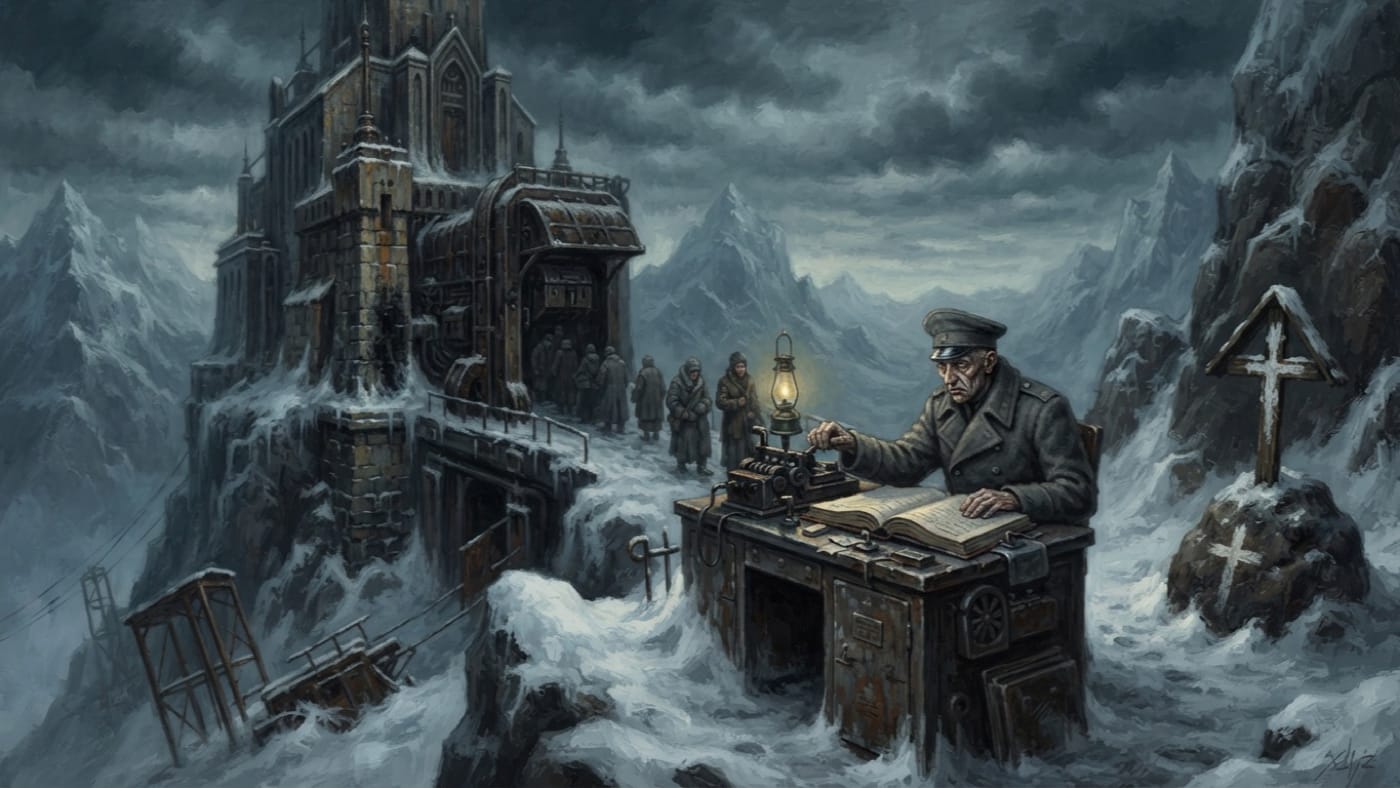
The master of the Golden Sole spent his remaining years at a mountain relay station above the Carpathian snow-line. The nearest settlement was a goat-farm. The nearest shrine was a boulder with a cross painted on it.
I find the arrangement elegant. A man who had controlled the approaches to the Rhineland shrines, with their crowds and their collection points, was set to inspect a waystation whose congregation could be counted on one hand and whose shrine was a rock. He kept his office in name. He could check papers, enter traffic in a ledger and send his returns down the mountain. What he lost was anything worth checking. The Bureau did not punish him with a wall. It punished him with an inspector's desk and almost no traffic.
The geography adds a second cruelty, and I doubt it was an accident. The Carpathian passes had been the sphere of the Confraternity of Saint Edras, one of the guilds at Santiago. The Rhineland master ended his career on a rival's former ground, doing the Bureau's paperwork in mountains that had once paid tolls to someone else. Every pilgrim who reached his station did so under a Bureau token, on a Bureau road, and saw a Bureau inspector at the desk. Neither guild had any standing left there.
The record does not give the rest. His name is sealed or lost, and I have not been asked to find out which. The station is not identified. I will not place it on the Reliquary Switchbacks or beside any named bastion just because a reader would like a map. How long he served, how old he was, when and how he died and what he thought of the goats are not recorded. The posting is documented. He is not.
#On the Superseded Guild
The Guild of the Golden Sole held no independent authority after A.S. 123. Its former roads belong to the licensed system of the Bureau of Pilgrimage, one of the Holy Bureaus. Route-Stampers sit where its collectors stood, Peregrine Wardens patrol what its escorts once claimed, and every pilgrim on the Rhineland approaches carries a token bearing the Bureau's sigil and no other.
No consulted record shows a surviving chapter, a secret successor, a hereditary inspectorate, a preserved guildhall or a relic of the order. I have not searched every archive in the Church and do not intend to. The files I have read close the guild in A.S. 123, and a closed file needs no mourners.
The old tolls are gone. Only the collectors have changed.