
#On the Survey and the Order
This entry is a survey, made in A.S. 201 (1911 CE), of the one account of the Pressburg Mutiny the Ledger still keeps. That account sits inside the Reform file of the Cadence Reforms. The Codex has since retold it under Pressburg and again under the Canticle of Restraint. Three retellings of one report are still one witness. Anyone who counts them as three should not be trusted with a tithe ledger.
The place is easy. Pressburg is the war-books' name for Bratislava: one city on the Danube, between Vienna-Ruins upriver and Budapest down. A shrine-barge lay on station near it. The date is harder. The Reforms are securely dated to A.S. 95, or 1805 CE. The mutiny happened on whatever day the order came aboard that barge, and the account gives no day, no month and no year. A lazy clerk would stamp the quarrel with the decree's number and call that diligence. This office leaves the space blank. That takes more discipline.
#On Choir Authority
Early shrine-barges shook themselves apart. Guns fired off each other's beat, recoil came out of turn, and the deck plates paid for the captains' tempers. After enough recorded desynchronisations the Synod gave the timing of battery discharge to the choir. A brass metronome bell set the beat and the choir sang to it. The guns fired on the choir's measure, or they did not fire.
That settlement split authority on deck three ways. The Ordnance Deacon held the seal that authorised a volley. The Battery Steward commanded the gun crews. During the active sequence the Cadence Caller held the moment of discharge. Every Shrine-Deck Crew still works inside that division, and every gunner has cursed it at the rail at least once.
The Pressburg gunners cursed it first and loudest. The Reform account lists their objections in their own order: singers had soft hands, choir stalls did not know recoil, and no woman in a hymn collar would tell a mortar captain when to fire. The first two are a tradesman's grumbles. A man who has scoured a hot breech may be forgiven some contempt for those who never have. The third is the old pride that has been burying armies since the Creator first let men carry iron, and it put the two honest objections in front of it for cover.
The conductor on duty was Sister Margit of the Fourth Hymnal. The account gives her that name and that office. It gives her nothing more, and it does not say whether the Fourth Hymnal was a book, a choir or a house of sisters.
#On the Powder Sanctum
The crew's plan was simple, and that is the most that can be said for it. They meant to seize the shot stores and force the old drill back onto the deck. Fire would go by eye, by temper and by the captain's word, and the choir would go back to singing at embarkations. Shot taken from the magazine without the measure gets loaded without the measure. Whoever held the stores held the guns.
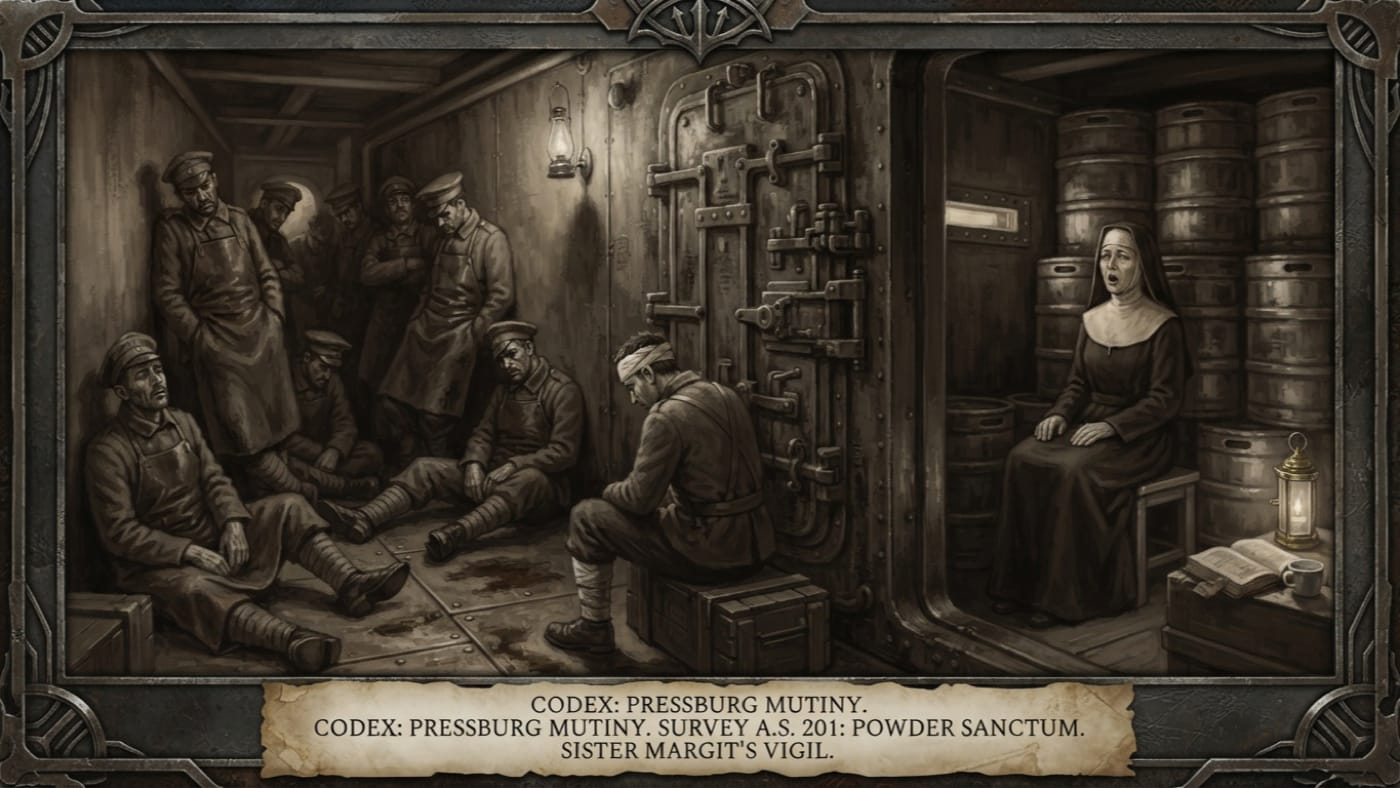
So they moved against Sister Margit, and the powder sanctum was where the matter turned. Here the account loses its footing. One sentence puts the gunners inside the sanctum. A later one puts them outside a locked door with Margit behind it. The text gives no struggle, ruse or expulsion between the two, only the space between two lines. I have read the passage more often than it deserves, and it has not grown a middle. The Ledger keeps both sentences and adds nothing to join them.
What comes after the gap is plain. Margit locked herself inside with the powder kegs and sat on them. She sang the Canticle of Restraint, and she kept singing it for eleven hours. The report allows her water, a stool and what it calls an "uncooperative calm." It seats her on the kegs and gives her a stool in the same breath. Whether she moved from one to the other in the eighth hour, the auditors may decide at their leisure.
The file says nothing of the Canticle itself. It records no composer, no words, no notation and no date of composition. Singing a hymn does not make the singer its author, and I will not write a verse to please the curious. Pilgrims who came to this entry hoping to learn the tune may apply to whoever taught it to her, if that person existed and will answer.
Outside the door the crew went through every exercise open to men whose plan has failed in its first hour. They shouted. They argued with one another. They threatened, then prayed, then cursed, and then started over. The account records no shot fired, no bargain through the keyhole and no threat from Margit against the magazine. Gunners know powder better than they know anything holy, and they knew exactly which door they were shouting at.
#On Surrender and Grievance
They surrendered. The report gives the cause as acoustic exhaustion, and I accept the phrase exactly as written. It describes men worn out by listening. Any pilgrim pamphlet that turns it into a miracle, a weapon or a binding of the will has done so without the Ledger's leave. The Creator may have had views on the afternoon. The account does not record them.
The crew then did the thing that lifts this affair from a scuffle on a barge to an entry in the Codex. They had refused the authority of a choir. Now they appealed to the Bureau that had put the choir in charge, and they filed a formal grievance. Its ground was "unreasonable vocal endurance."
The grievance admits the order. It admits the locked door and the eleven hours. Its only objection is that a singer should not have been able to manage them. The Bureau of War has seldom received so complete a confession from a battery, and it denied the grievance.
The account calls these men only the gun crew. They were mutineers for the length of one quarrel and one complaint. The Ledger knows of no brotherhood, banner or later company of Mutineers, and anyone who has sold a pilgrim a Mutineers' medal has sold him tin.
A pious later account credits Bureau of Oaths negotiators with settling the Pressburg Mutiny by sworn compromise.
Struck. The Reform account states that no Oaths delegation was present and that no compromise took place. The crew surrendered to a locked door and a conductor who would not stop singing. The oath-clerks may file a grievance of their own. The form is now well known.
#On Commendation and Initiative
The Reform account then reports what became of everyone, and I give its particulars on its authority alone. The gun captains were reassigned. Two went to static wall batteries, where the stone does not move and the choir is a long way off. One spent eight years escorting soup carts for the Bureau of Mercy. These are the captains the account chose to mention. They make no roster, and they tell us nothing of how many men served the guns.
Sister Margit received a commendation under the seal of the Bureau of Orison. She received a private warning for excessive initiative with it.
Both papers were correct. The first thanked her for holding a magazine on the Church's behalf. The second reminded her whose magazine it was. A conductor who keeps time is an instrument of Synodal order. A conductor who has learned she can lock a door against a gun crew raises a question. The Bureau settles such questions in private and in writing, before anyone can ask them aloud.
#On the Precedent
The Reforms were already law when the order reached that barge, and Pressburg invented none of them. What it supplied was proof. The Reform file cites the affair as the point at which the arrangement set hard. The Cadence Caller stood between gallery and battery, the Battery Steward commanded inside the measure, the Ordnance Deacon kept the seal, and the bell ruled over all three. War and the choir authorities have each claimed the credit ever since. The Bureau of Engineering had been saying the same thing in recoil tables for years. It received no commendation and expected none.
The Pilgrim's Ladder Commission of A.S. 110 later carried choir-timed fire onto the rails. The Processional Arsenal then made it so ordinary that crews no longer remember what it replaced. Nothing in the file says the Canticle of Restraint went along with them.
Petitioners confuse two other matters with this one, and both get the same answer. The Siege of Pressburg belongs to the Ledger-Bindings: an undated exemplum of deserters walked back into the line by their own signatures. Nothing makes those deserters the same men as these gunners, and Margit bound no one with ink. Nor was she Saint Orla the Brass-Throated, who sang the Canticle of Measured Fire through a burning deck so that a battery could keep firing on the toll. Orla kept a battery firing, and Margit kept a magazine shut.