
#On the Name and the River
"The Hymn directs the Barrel; the Barrel defends the Hymn." — Bureau of War, Standing Order 44-C
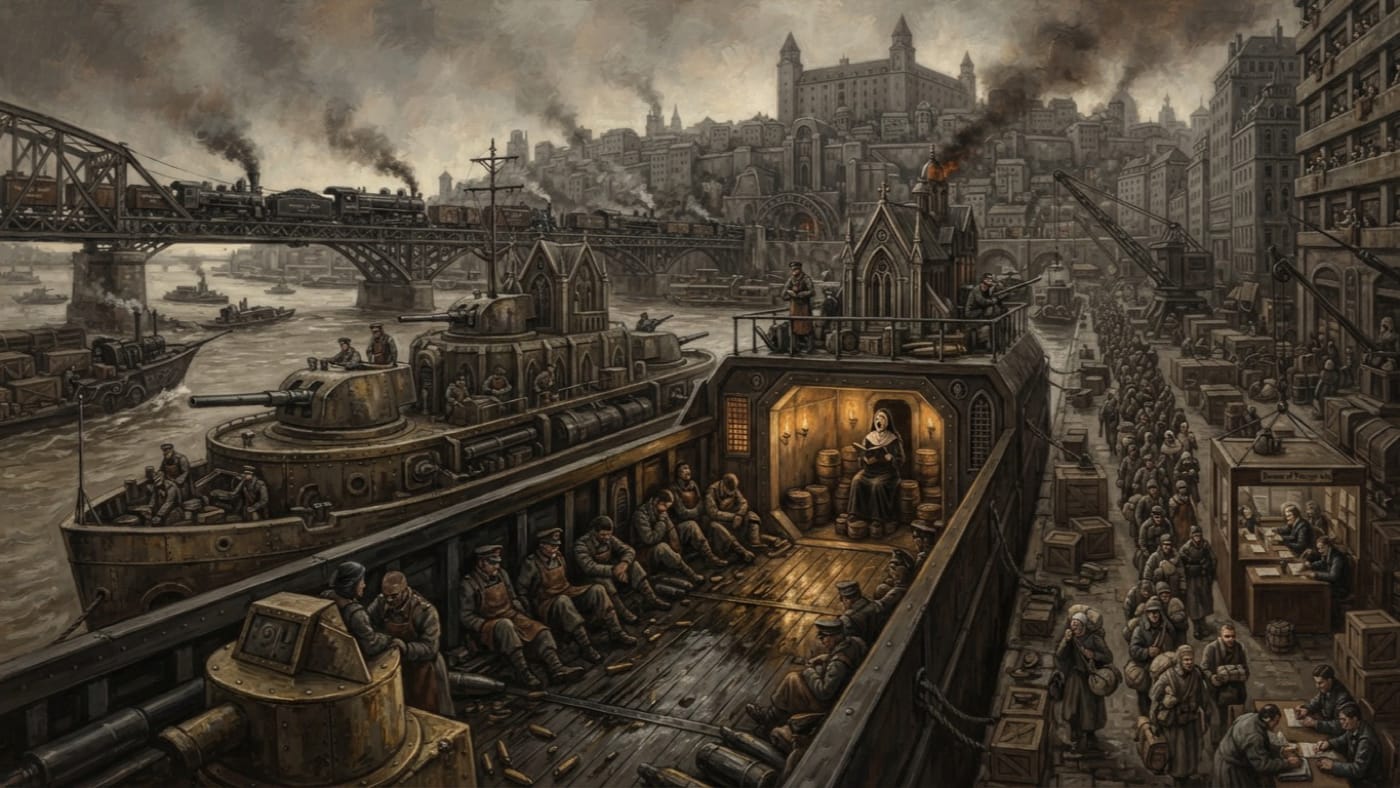
Pressburg is Bratislava. The Bureau of War has never quite forgiven the fact, and the reader shall not be spared it either. There is one city at forty-eight degrees north and seventeen east, set on the Danube between Vienna-Ruins upriver and Budapest down, in the Forward Heartlands west of the Sagittal Line. Its post-bags, parish rolls and quarantine notices call it Bratislava. Its older military papers call it Pressburg, and so do the muster-books, the ordnance returns, the disciplinary filings and the doctrinal exempla of the Church. No decree of renaming has ever been produced to settle the matter, and none was ever needed. A garrison clerk writes the name his predecessor wrote. That is the whole law on the subject.
This entry keeps the military name and sticks to the military business. Readers who want markets, parishes and the civil survey will find them under Bratislava, the senior file and the larger one. What follows is the river as the Bureau of War sees it: a crossing to hold, a queue to clear, and a reach of water where a shrine-barge once lay at its station while its own gunners laid siege to its own magazine.
#On the Crossing
The Central Corridor runs from Munich through Vienna-Ruins and Pressburg to Budapest. From Budapest it feeds the Carpathian and Danubian forward works. Its administrative settlement belongs to A.S. 90, or 1800 CE, the year of the Concordat. At that settlement Pressburg was given four duties at once. It became a secondary rail junction, a Danube crossing, an overflow node for whatever supply Vienna cannot hold, and a major checkpoint of the Bureau of Passage. It is not a bastion and was never counted among the seven. Nothing here faces the Enemy across wire. What it faces is freight.
Freight arrives without mercy. Shell crates come off the rail wagons and go down to the barges, or come off the barges and go up to the wagons, depending on which timetable is lying that week. Ration tins, lamp-oil, boot-leather and bales of field dressings wait under tarpaulin in the overflow yards because the sheds upriver are full of pilgrims. Soldiers in transit queue at the Passage tables beside carters, market women and families with bundled bedding, and every one of them, saint or sutler, waits for the same stamp. The quarantine sheds stand apart from the queue, where the Passage clerks can watch them and no one else has to.
The current registry gives about one hundred and eighty thousand residents. That count describes the present city. It says nothing about the town that once listened to a woman sing from the hold of a barge for eleven hours.
#On the Measure
The shrine-platforms learned the necessity of timing by shaking themselves apart. The Reform account blames a series of recoil desynchronisations: guns firing off one another's beat until a barge tore at its own frame in the middle of a volley. The cure ratified under the Cadence Reforms of A.S. 95 (1805 CE) gave the choir authority over battery discharge. The brass metronome bell set the beat, the choir sang to it, and the guns fired on the choir's measure.
This divided the deck three ways, and every Shrine-Deck Crew still lives inside that division. The Ordnance Deacon's seal authorises a volley. The Battery Steward commands the gun crews. The Cadence Caller decides the moment of discharge. The Steward kept his men and lost the moment. Gunners who had fired by eye, by temper and by long habit were now told to wait on a bell that, according to the Bureau of Tithes, cost four Crowns and six pennies.
They waited on wet planks that hummed with every discharge. Incense and hot oil thickened the air, the ward-rings were chalk and ash paste renewed on hands and knees, soot crusted every surface, and spent brass rolled underfoot. Each man had his waxed ear-cloth, and each shot went into the ledger before the barrel cooled.
#On the Mutiny
The order reached a shrine-barge stationed near Pressburg in the reform period. The preserved account gives no day and no month, and this office will supply neither. The gun crew refused choir control and moved against the conductor on duty, Sister Margit of the Fourth Hymnal.
She took the powder sanctum. She sat down on the powder kegs. She sang the Canticle of Restraint, and she went on singing it for eleven hours.
The account first has the gunners inside the sanctum. A few lines later it has them outside her locked door. It does not explain how they got from one place to the other, and I shall not invent the stair. What matters is that by the decisive hours the powder compartment was hers, the gunners had nowhere better to stand, and the song did not stop. The account records no shot fired and no man lost. It records the length of the song and the condition of the men who had to hear it. They surrendered, in the account's own phrase, from sheer acoustic exhaustion.
The record makes her a conductor, and nothing grander. Nothing in it shows that she wrote the Canticle, founded a house or entered any calendar of saints. Its composer, its score and its date are not established. Readers who confuse her with Saint Orla the Brass-Throated, who sang the Canticle of Measured Fire on a burning deck, should take up the matter with their own carelessness.
The mutineers then filed a formal grievance. Men who had rejected the authority of a choir took their complaint to the same Bureau authority that had empowered the choir, and the complaint they lodged was "unreasonable vocal endurance." The word unreasonable is the masterpiece of that filing. They did not claim she was wrong or that the order was unjust. They claimed she had sung longer than a gun crew could be fairly expected to bear, which is the closest thing to a confession the Bureau of War has ever received from a battery. The grievance was denied. The Reform files cite the affair as proof that the order was sound. The Bureau of War and the choir authorities have each taken credit for it ever since, and neither of them sat on the kegs.
An earlier edition stated that the Pressburg mutiny was resolved through diplomatic intervention by the Bureau of Oaths.
No Bureau of Oaths intervention occurred. Sister Margit held the powder sanctum and sang the Canticle of Restraint for eleven hours, and the mutineers surrendered. Their later grievance of "unreasonable vocal endurance" was denied.
#On the Signatures
The Church's catechists know Pressburg for another reason. Among the sanctioned Ledger-Bindings, Doctrine records that at the Siege of Pressburg deserters found themselves walking back into the line against their will, their own signatures dragging their feet like shackles. Doctrine calls this "the triumph of paperwork over chaos."
That is the whole exemplum. It gives no year for the siege and names no attacker, no commander and no duration. It does not say how the signatures worked, and this office will not invent a method. Nor is the siege the barge affair under another name. Nothing makes those deserters the same men as the gunners. Sister Margit bound no one with ink. She sang, and that is a separate miracle, or a separate stubbornness, filed in a separate drawer.
#On the Present Traffic
In A.S. 201 (1911 CE) the corridor survey reports Pressburg under strain, which is the corridor's ordinary condition. Trains stand at the junction waiting for paths east. Barges wait for crossing windows. The quarantine sheds hold more than they were built for, and the Passage tables work in shifts that still do not empty the line by nightfall. The Bureau of Engineering wants the yards widened, the Bureau of War wants them cleared, and the residents want to cross their own river without showing papers to a stranger. Only the first two complaints are filed in triplicate.
Shrine-platforms still pass on the Danube, the heirs of that barge, and since the Pilgrim's Ladder and the Processional Arsenal came into service they pass in heavier forms. Their crews come ashore black-handed and half deaf, chewing wax, flinching at the church bells. The town cheers the salute and curses the smoke on its washing. A Deck-Rat with eleven hours of liberty spends it in the Passage queue.