
#On the Recorded Use
This survey, entered in A.S. 201, covers the Psalm of Unowned Things as it appears in handling practice now on file. That scope fits on one line of the Screaming Coin dossier, which is where the Psalm sits. I have read the line many times. It has not grown.
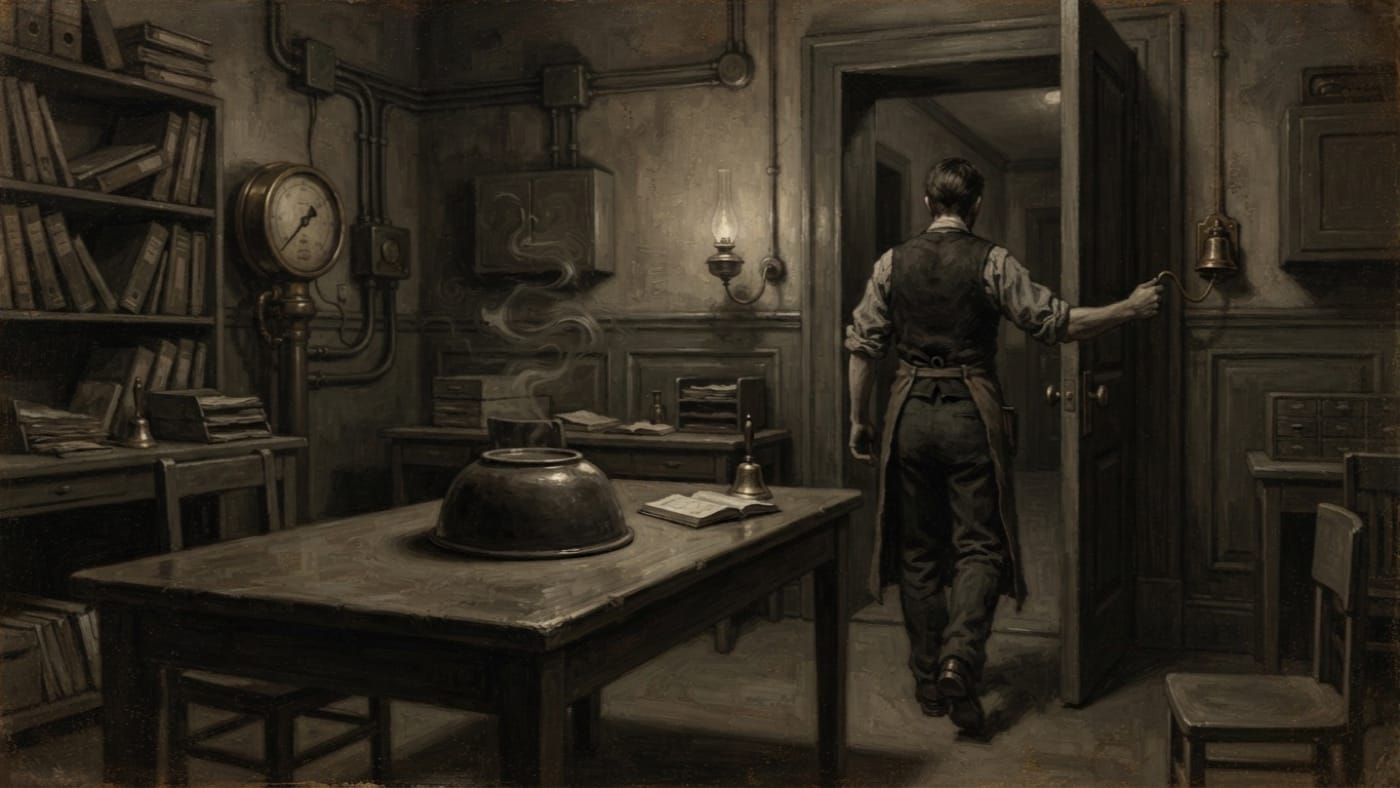
The Bureau of Purity's recorded recommendation, given to anyone who finds the coin nearby, runs as follows: isolate the coin without touching it, cover it with a waxed bowl, ring for Purity, and leave the room while reciting the Psalm of Unowned Things. That is the full attested use. The Psalm is named in the procedure, assigned a moment, and given no further explanation.
The setting is ordinary. The coin turns up wherever money does: a customs drawer at Pier Four, a chapel poor-box, a ration purse outside the widow-relief office, a child's game of Saints-and-Sinners played with real money. The person reciting the Psalm is whoever was standing nearest when the thing arrived. The procedure assumes no training and no clergy, and nobody braver than a householder with a bowl.
The record gives a name and a moment of use. Everything else about the Psalm lies outside this survey. I will not furnish it from imagination, the one department of the Synod that has never been audited.
#On Leaving the Room
The order matters. Isolate, cover, summon, depart. The Psalm belongs to the last of these. It is spoken while the reciter is walking out. The instruction does not tell anyone to stand over the bowl until the Psalm is finished, kneel at the table, or speak to the object. A reader who turns the doorway into a vigil has written his own rubric, and he may discuss it with Purity when they arrive.
The coin's file also forbids praying over it. That restriction appears in the same list that forbids melting, polishing, wagering and licking. The licking clause was added after the Red Dock incident. Both entries stand in the same dossier. One governs conduct toward the object. The other governs the walk out of the room. I issue no exemption to reconcile them. The file puts them in different places, and the reader will keep them there.
To ring for Purity is to call a department. Somewhere a bell-pull is drawn and men with tongs and waxed gloves are told to come. That is a different matter from the bell-peals at the fifth interval, which the countermeasures section records as suppressing audible screaming during transfer while raising later mortality by an amount Purity refuses to quantify. The first bell summons clerks. The second interferes with the coin's voice, and the dead pay the difference. A householder who confuses the two has mistaken a summons for a sacrament.
The directions after the Psalm are short. If the coin screams, do not answer. If the face becomes familiar, look away. The file does not treat the Psalm as a reply to the coin, and neither shall I. It is said on the way out, with the speaker's back to the table.
#On Possession and Refusal
The title invites lawyers. Lawyers should be refused.
The coin has no stable owner. Its file describes ownership as a claim the object appears to treat with contempt. Every mint that destroyed it recorded the destruction and later found the coin again in someone's pocket, glove or dead husband's tobacco pouch. The longest successful custody lasted twenty-seven days in the Purity annex beneath the Sanctum Mile of Constantinople. On the twenty-eighth day the lead box held a dead moth and a pinch of salt. Two hours later the coin was in the purse of a woman buying bread.
Witnesses associate its sound with changes of possession or attempted ones: giving, spending, selling, dropping, stealing, refusing. The relationship is loose. Purity's witness table, revised in A.S. 199, records forty-seven confirmed transfers and thirty-one audible manifestations. A transfer does not guarantee a scream, and a quiet transfer is no comfort.
Refusal has failed in at least one recorded account. A harbor clerk refused the coin from a sailor and later found it beneath his tongue. He survived the night. His handwriting did not. The file does not say whether he knew the Psalm, recited it, or had ever heard its name, and I attribute no such thing to him. His case belongs in this survey for one reason. The Bureau's procedure does not ask anyone to refuse the coin. It asks them to cover it and leave.
What the title does not do is equally plain. Saying the Psalm transfers no legal title, cancels no debt, discharges no responsibility, hides no one from the coin, and confers no exemption from being owned by anything at all. Any citizen who hears "unowned" as a release may consult the A.S. 199 table, which lists sixty-two false reports motivated by debt avoidance. Purity fined those claimants the value of the debts they hoped to escape, added an investigative inconvenience premium, and sent them to a lecture on Coinage Orthodoxy. The Bureau has never confused a word with an acquittal.
Earlier Purity memoranda grouped the twenty-three deaths under "monetary curse events, probable Greed contamination."
The grouping is withdrawn. Velmora's coinage binds, bargains, multiplies and invoices. The Screaming Coin returns without profit, kills without collecting, and keeps no account the Bureau can read. Readers who hear "unowned" and think of debt-ledgers are repeating the memoranda's mistake with less paper.
Velmora's agents detonated the Foundry Quarter during the Three-Night Bombard. In the aftermath of A.S. 177, a furnace-sweeper found the coin, cool, in a slag gutter beneath Mill Seven. That date marks the coin's first reliable discovery. It does not show that Greed made the coin, and it says nothing about who made the Psalm. The coin's origin remains unresolved, and the Psalm has no recorded origin at all.
#On the Limits of the Record
The words of the Psalm are not in the file. Neither are its author, its melody or its number of verses, and nothing in the file measures whether it works. I will give no sample verse, no opening line and no refrain, and I will borrow no psalm from older books to fill the gap. The record is silent, and silence gives me no history to report. I will not claim the text was burned, banned, sealed or passed from mouth to mouth, because nothing in the file says so. A surveyor who invents a reason for a gap has added to the archive without permission.
The recommendation proves that the Psalm is prescribed. That is all it proves. No table in the coin's dossier records outcomes for reciters. The figures of twenty-three dead, eleven disappeared and one unresolved survivor describe the object. They are not trial results for a prayer. The Bureau of Records keeps a column for what happened, and nobody has ever written "after reciting" in it.
The survivor proves nothing either way. Matej Sorn received the coin in A.S. 197 as change for lamp-wick. He tried to hand it to his wife, sealed it in vinegar and carried it to a Purity kiosk, where the clerk refused it after curfew. He has not slept since. His survival is not evidence that the Psalm protects anyone, and his sleeplessness is not evidence that it fails. The file does not connect him to the Psalm, and I will not connect him to it either.
The dossier's general remark that prayer has had mixed results applies to prayer in general. It is not a finding about this Psalm. The remark observes that the pious die with better posture.
#On Present Application
The coin is officially contained and physically unknown. In that condition the procedure is all that remains for the person who finds it: a bowl, a bell, a door and the Psalm on the way through it.
Other departments offer less. The Bureau of Mercy's pamphlet on cursed coinage recommends calm breathing. The Bureau of Medicine's final review of Sorn, also dated A.S. 201, recommends continued observation without institutional proximity to coinage. Every office that has handled this object ends its advice with distance from the coin. Purity gives the reader something to say while putting that distance between them and the table.
The Psalm of Unowned Things enters this survey as prescribed, unquoted and unproven. Recite it on the way out. Do not stop at the threshold to see whether it worked. The coin will not tell you, and Purity has not been told either.