
#On the Chain Before Release
Within the profession of the Dead-Goods Tariffer there is a party of clerks who hold that a body may leave the counter only after every link binding it to a name has been tested, witnessed, sealed and entered. Their colleagues call them Pure Chain. They keep no hall, publish no roll and obey no master beyond the ordinary ladder of the tariff-chapel. Pure Chain began as a habit of the hand. It became an opinion, and the opinion has learned to stop traffic.
Their present quarrel is with the Lime Yards of Marrowgate. Pure Chain clerks accuse the Yards of accepting bodies too quickly. It is a narrow charge, which makes it dangerous. The kilns may burn, the bone-lime may set, and the whitewash may go on keeping the clean corridors legible. Their complaint concerns the moment a salvage tag reaches the breaking tables before the chain behind it has closed.
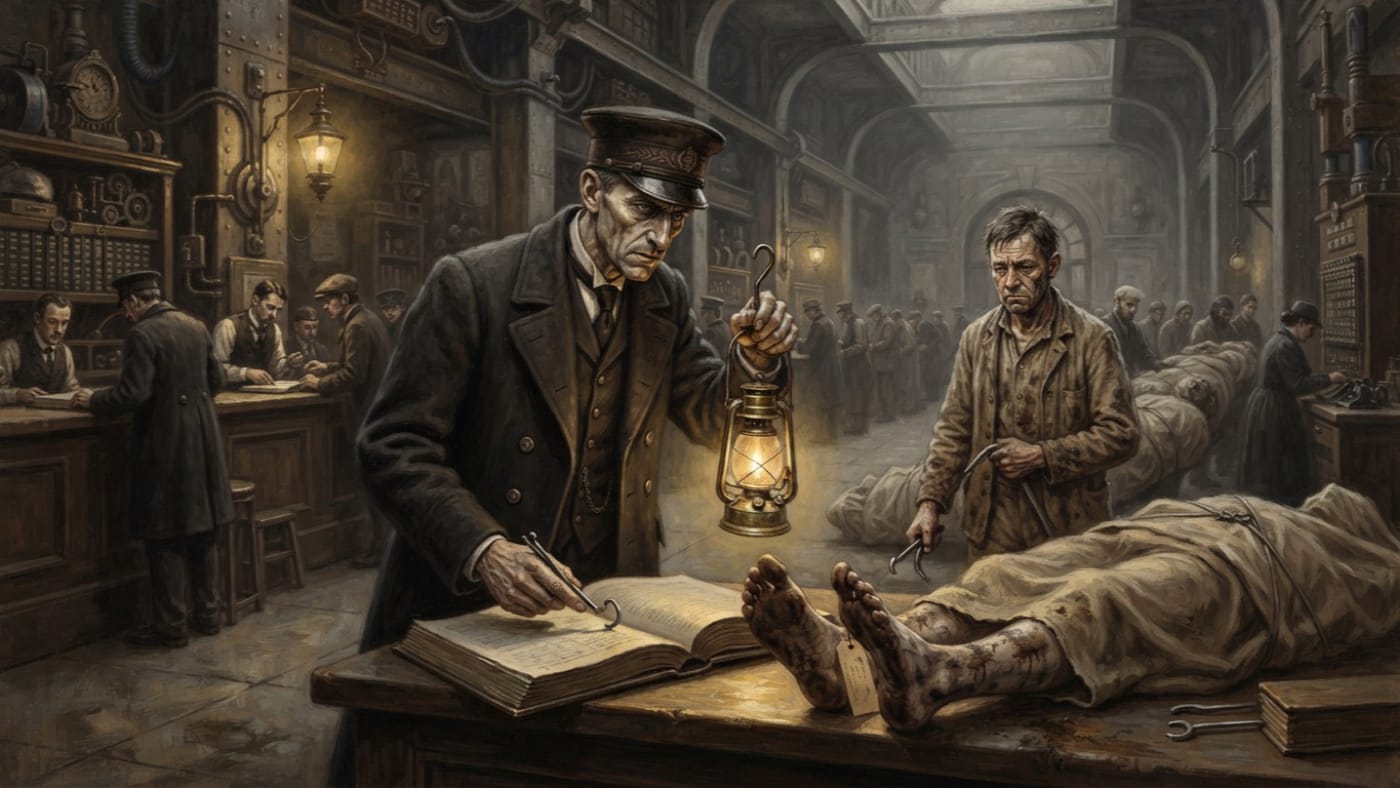
At the mortuary counter the dispute looks simple. The queue lengthens. A porter shifts his grip on a stained canvas bundle. The clerk lowers the yellow lamp a second time.
#On What Must Be Verified
Pure Chain invented no part of the procedure. Every licensed Tariffer works the same sequence: intake and tag match, classification, purity inspection, assessment of tariff and required rites, clearance or hold, routing and ledger reconciliation. Pure Chain's offence is to perform all seven at the speed the seven require.
Intake begins with paper: the death tag, the kin claim, the convoy manifest and, wherever sanctity is alleged, the relic certificate. A tag that does not match its body is the oldest fraud in the hall. Its descendants are more inventive. Split tags carry an official mark and a hidden alternate for the smuggler's road. Bought kin proxies are paid mourners who claim remains they never knew in order to move skulls their buyers want. Forged provenance turns a common femur into a saint's, and a patron's purse turns a relic-grade skull into décor.
The tools answer these frauds one at a time. Calipers measure tooth wear against the region the manifest claims. The scale sets weight against count, and two clerks count every skull because the profession learned long ago that a man counting alone is a man with an opportunity. Wax chemistry and tag fibres are examined for forgery. The hooked stylus enters the result without touching skin. Then comes the lamp, which looks for what the lime may be hiding, since over-liming has long been the preferred way to make contaminated remains look merely dusty.
None of it is infallible. Lamps have passed remains that woke afterward, and calipers can be lied to by a skilled dentist. Pure Chain argues that each check is unreliable alone, so no check can be spared.
The procedure has an ancestry its practitioners remember. In A.S. 78, unsealed pits along the Rhine corridor began making sounds at night. Records classified the phenomenon as "post-interment atmospheric settling." The offices the Synod would later file as the Bureaus of Records, Rites and Tithes answered with the Joint Classification Mandate. From then on, nothing could be interred, transported, processed or displayed without a stamped clearance from a licensed tariff-chapel clerk. The First Ossuary Panic made the Tariffer a profession. Pure Chain makes no claim to have been born that year. It claims to recall the noise.
Working tariff-hall usage sorts remains as "burial," "transfer," "ornamental," "industrial" and "contaminated."
Corrected to the Mandate's five categories: Burial, Transport, Salvage, Ornamental, Contaminated. "Industrial" and "transfer" survive as counter slang. In a ledger they are an invitation to audit.
#On the Bodies That Wait
A hold costs the dead nothing. The living pay for it.
Families in Synod lands wait weeks for permission to bury. Many keep the remains at home and prop them in a corner, where they wait for the stamp alongside everyone else. Bays fill. Quarantine space runs short. Rot sets its own schedule and ignores the chapel's. The profession's own idioms admit the danger: a hold is a curse; stamp it or bury it. These sayings are older than Pure Chain, and they do not flatter it.
The Mercy Stamp clerks press the point with real force. A body cleared today does not spend another night spreading infection through a tenement stairwell. A clean corridor kept clear of corpse-carts protects more lives than a perfect ledger. In their view, speed is a sanitary measure and delay is a contagion with a seal on it.
Pure Chain answers that a paid tariff is not proof of a clean body. A cleared cart admitted through Prefect Salvius's sanitation cordon is not proof either, and neither is a set of Marrowgate health papers. Those papers pass the living through the white lines. They have never certified the dead. The profession's own red line is absolute here. Knowingly stamping unclean remains is treated as spiritual treason, and a full bay is no defence.
The thoroughness can also be sold, and every clerk knows it. A hold placed for verification looks exactly like a hold placed for payment. The street says a Tariffer can delay your burial until you rot twice. Auditors examine holds before anything else and ask why each delay occurred, because so many delays are bought. Many Pure Chain clerks have never taken a wax stick for a lowered lamp. Some have. Their scruple and their extortion use the same stamp, and grieving families cannot tell them apart.
#On the Yards and the Gray Winter
The Yards are where an error becomes permanent. A misclassified body in a cemetery can be exhumed, re-tagged and returned to its kin with an apology and a fee. A misclassified body in the kilns becomes bone-lime, whitewash, road powder or ash-credit. It goes into a ward wall or a culvert seal, or onto the white line that tells a widow where she may walk. Calcination cannot be appealed. This is the core of Pure Chain's position: identity checks matter most just before reduction, because afterwards nothing remains to check.
The Saint-Bone Melting Acts of A.S. 96 widened the licensed reuse of remains, and the Yards grew with them. The decisive test came in A.S. 157. During the Gray Clearance of the Plague Winter, the five categories collapsed in practice into two decisions, Cleared and Held. At Marrowgate, by the Yards' own account, Cleared meant the Yards. The kilns burned through the frost. Workers slept beside the slake pits. Children learned to recognise family ash by barrel mark, because face, name and parish had been outpaced by throughput.
Pure Chain clerks cite that winter as proof of what happens when emergency handling displaces the full sequence. Mercy Stamp clerks cite the same winter, the frost and the bays, as proof that the city would otherwise have rotted where it stood. Both use the same barrels as evidence.
The Yards have appetites of their own. Kilnmaster Hark keeps a fire schedule that needs feeding. Forewoman Rute collects bone rent. The Bone-Lime Consortium profits by volume, as any polite arrangement of foremen, factors and prelates naturally would. No ledger shows the Consortium owning or directing either faction, and it has never needed to. A kiln does not lobby. It cools, and the cooling is argument enough.
#On Morin and the Correcting Wind
Both factions pray to Saint Morin of the Sealed Mouth, whose icon is a skull with wax in its teeth. A Pure Chain clerk reads the wax as silence that holds until verification. A Mercy Stamp clerk reads it as the patience the dead are owed while the living are spared. Morin does not adjudicate. Saints rarely accept jurisdiction over budget disputes.
The Marrowwind has been less discreet. In A.S. 194, the sealed intake records of White Ward Seven filled with lime dust and rewrote their patient lists correctly. Death marks changed and discharge stamps reversed. That was the wind's first uncontested classification, and incidents have increased every year since. Its observable features are a dry chalk gust, whispers and ledger corrections that later prove accurate. Doctrine files it as a Category Two Localized Atmospheric-Scribal Anomaly. Its agency is uncertified, and so is its allegiance.
Some Pure Chain clerks say the wind proves the chain was broken somewhere upstream. Their colleagues reply that a wind which corrects ledgers after the fact is no endorsement of slower ledgers. Both arguments rest on the same embarrassment. Something without a licence is auditing Marrowgate more accurately than the licensed staff.
#On Present Practice
As of A.S. 201, the dispute is decided one counter at a time. In the same hall, a Pure Chain clerk and a Mercy Stamp clerk will wash in the same limewater, recite the same start-of-shift words — Count clean. Stamp clean. Sleep clean. — and reach opposite verdicts on the same bundle before noon. The faction has no founding date, no recorded leader and no list of members. It has a lamp held low and a queue that hates it.
The Pure Chain charge against the Lime Yards stands unresolved. It also stands unanswered, which is not the same thing. The kilns stay lit.