
#On the Pits That Objected
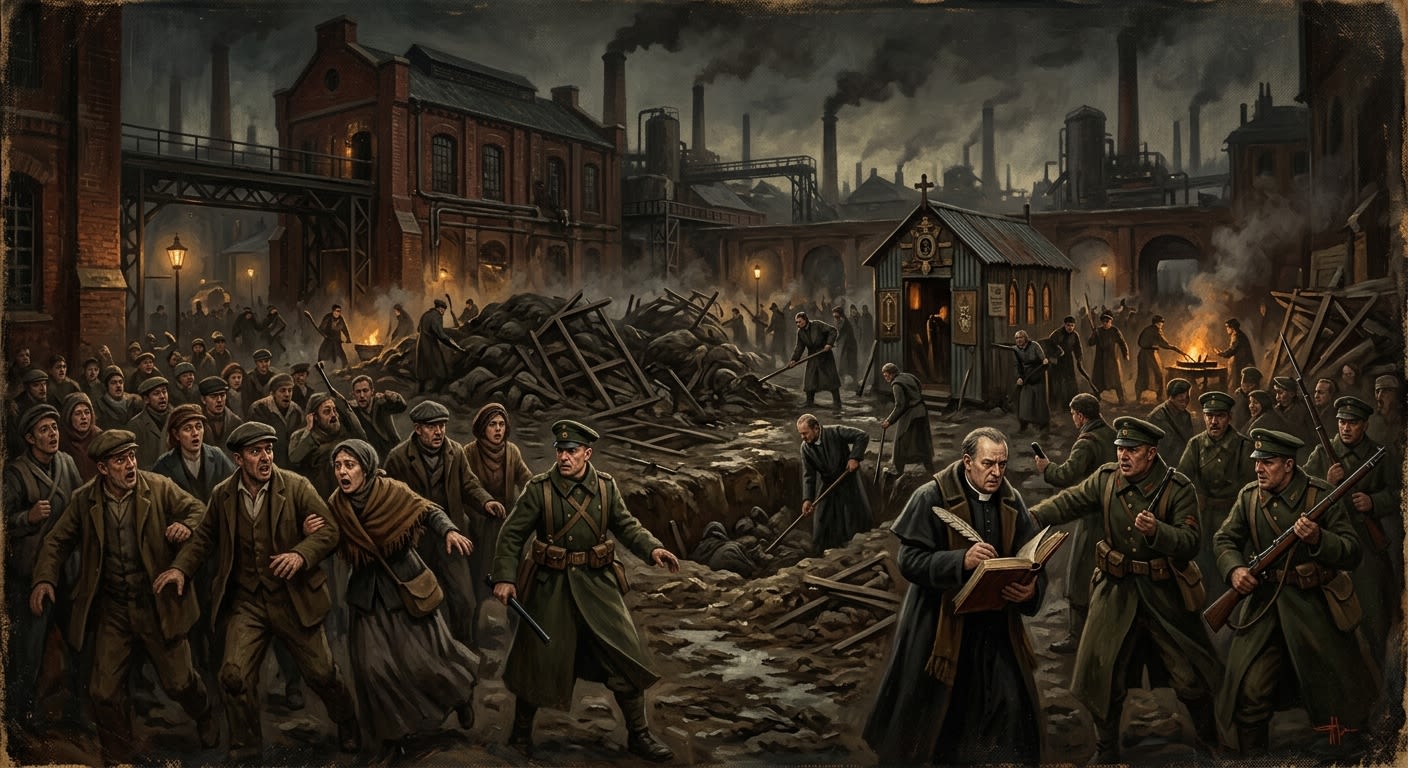
The First Ossuary Panic began along the Rhine corridor in A.S. 78, when unsealed burial pits, hurriedly dug during the tail of the Ossuary Overflow Winters and fed by the same plague year that produced the Lull of Names, began producing sounds after dark. The Bureau of Records classified the phenomenon as post-interment atmospheric settling. This phrase has survived every later review because cowardice, once written in a sufficiently clean hand, becomes archival furniture.
The diggers called it screaming.
The distinction matters only to those who were not sleeping within earshot. Along the Marrowgate road, the pits had been cut into clay too wet for dignity and too crowded for sequence. The dead entered them by cart, by sheet, by crate, by shovel, by family bundle, by military lot, by anonymous sack, by portions. Lime was thrown. Names were promised. Rites were abbreviated. Tags froze, tore, blackened, fell away, or were stolen for resale by boys with quicker fingers than consciences. At night the pits shifted. Air moved through ribs, jaw-hollows, wrapped throats, broken sternums, and the little tunnels dug by rats fattened beyond natural optimism. The earth made a noise like a choir denied language.
No single village owns the Panic, though Marrowgate has tried to monopolise it with the graceless determination common to towns that smell of lime and opportunity. The first complaints came from pit-keepers between the Rhine road and the inland casualty sheds: night voices under boards; knocking from sealed heaps; children's names called by no visible throat; a buried officer reciting ration numbers; a widow's husband asking for the wrong wife. The local watch beat the ground with pike shafts. The ground answered.
By third week, men refused pit duty without lantern escorts. By fourth, families began stealing relatives back from common pits before the voices could begin. By fifth, grave brokers were selling private silence charms, false Rites strips, hot wax, lamb bones passed as saints' knuckles, and little plugs for skull teeth. Panic, like commerce, dislikes vacancy.
Earlier dead had made administrative claims. The Sundering had already taught Europe that a corpse is rarely finished merely because it has stopped arguing. But the First Ossuary Panic was the first inland mortuary crisis to fuse sound, plague, overcrowding, tax loss, relic ambiguity, and public disorder into one problem sufficiently vulgar that three Bureaus were forced to stand in the same mud.
#On the Winters Before the Panic
The Panic rose from three winters of crowded shelves, bowed racks, sealed ratios, emergency pits, and that magnificent administrative superstition by which every office believes the next office will solve the smell. Nothing is a Rationalist concept and cannot be trusted.
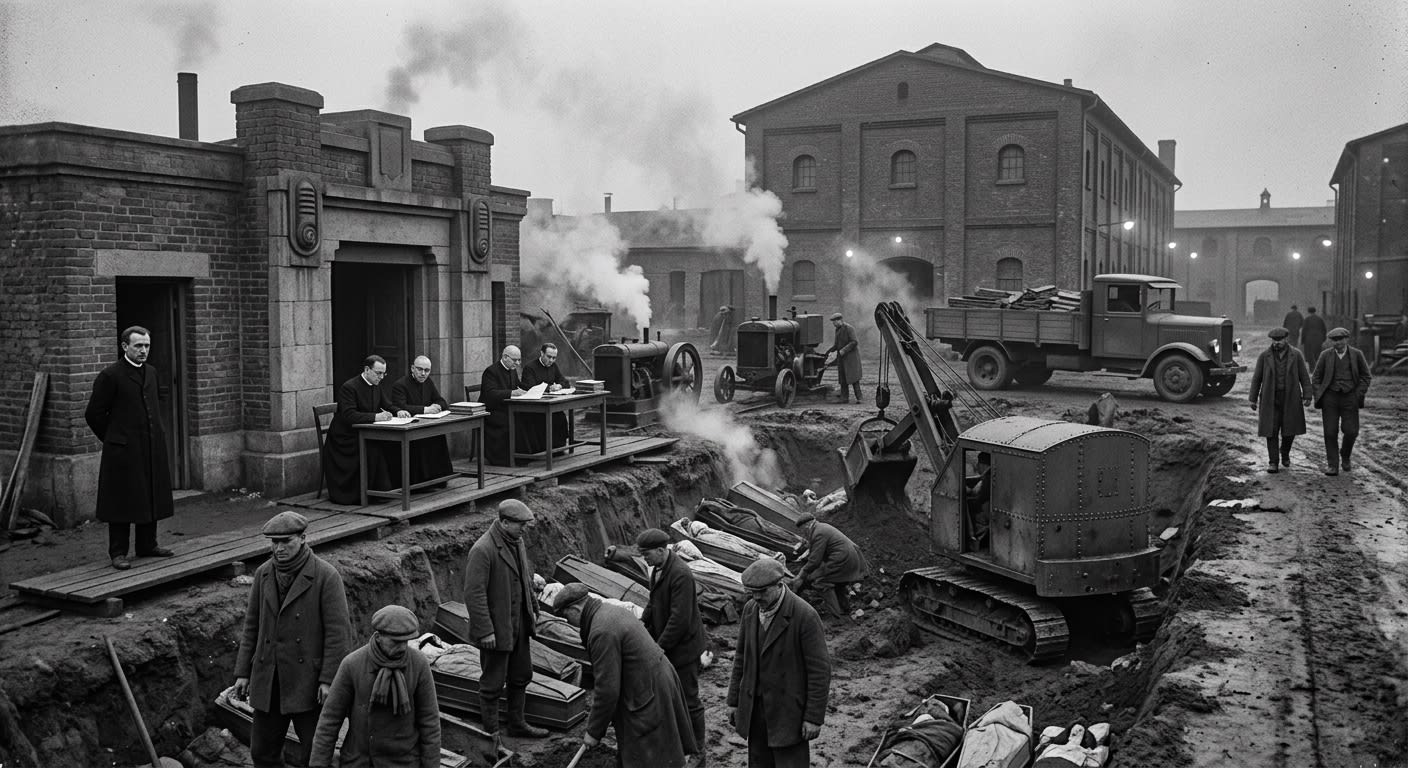
The Ossuary Overflow Winters of A.S. 73–76 filled forward ossuaries past capacity. Great Retreat dead, convoy dead, trench dead, plague dead, winter dead, unnamed fragments, tagged lots, disputed saint-bits, contaminated cloth bundles, and politically inconvenient bodies arrived faster than chapels, racks, pits, and clerks could absorb them. Records forbade comparison between the dead and the living because the comparison had begun to flatter the dead. Rites demanded sequence. War demanded clearance. Tithes demanded valuation. Engineering, with its usual appetite for other people's bones, noted that walls required material.
Emergency pits became policy by exhaustion. A pit is the confession of a failed shelf. It accepts what the shelf cannot display, hides what the chapel cannot bless, and teaches the clerk the vile consolation that soil is cheaper than carpentry. Along the Rhine corridor, pits were dug in frozen ground, thawed ground, cart-yard ground, chapel-margin ground, and once through the floor of an abandoned cooperage whose owner had died protesting that barrels were for wine, not widows.
Many pits were sealed improperly because improper sealing is what happens when twenty carts arrive before Compline and the man with the wax stamp has fever. Lime was insufficient. Tags were partial. Rites were shortened to gestures. Families bribed attendants to place kin near the top. Soldiers dumped field lots under wrong chapel marks. Relic-suspect fragments entered common burial. Contaminated bodies entered clean ground. Clean bodies entered contaminated ground. A few living men entered by error and stopped being living before anyone admitted the paperwork problem.
By A.S. 78 the corridor was a mouthful of badly chewed death. The Great Plague added volume. Fever carts came south and west from the infirmary belt, carrying bodies whose names had vanished in the Lull. The dead now exceeded storage and invaded grammar. A man without a name cannot be mourned properly; a bone without a category cannot be taxed properly; a pit without clearance cannot be trusted to stay quiet.
Earlier Marrowgate commemorative broadsheets claim the First Ossuary Panic began in a single pit beneath the later Tariff-Chapel of Saint Morin (Unregistered).
Corrected. The Panic was corridor-wide. Marrowgate supplied the loudest witnesses, the quickest monetisation, and the most durable saint. Origin is a stricter word, though merchants have built careers on the confusion.
#On the Sounds Below
The Bureau's first inquiry distinguished four kinds of sound. This is why the Synod survives: other regimes hear screaming and run; we classify the scream by function.
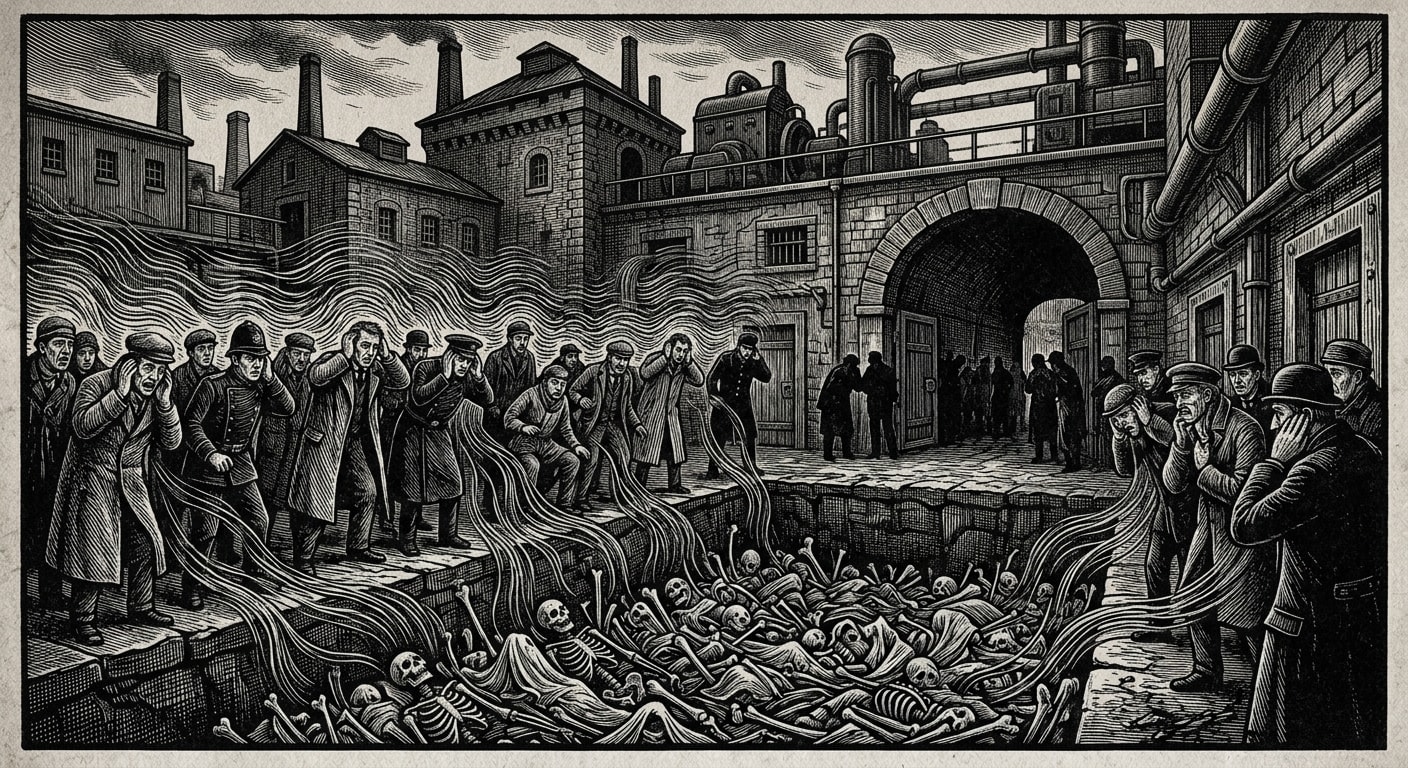
The first kind was settling: bone, cloth, trapped air, lime pockets, plank collapse, water seepage. Records clung to this category with both hands because it permitted memos without exorcists. The second was mnemonic sound: voices repeating names, numbers, last orders, debt claims, ration sequences, half-prayers, and, in three reported cases, insults aimed at persons still living and close enough to hear. The third was liturgical disorder: buried fragments producing antiphonal murmurs, unauthorised psalm cadence, Mass responses without priest, and one pit near Rheinscarp that answered every shovel-thump with Et cum spiritu tuo until the diggers threw their tools in the ditch.
The fourth category was suppressed.
JOINT INSPECTION NOTE — RHINE CORRIDOR, A.S. 78 Category Four sound: █████████████████ Associated signs: teeth moving under wax; child voices from adult lots; names of inspectors spoken before arrival. Instruction: do not repeat phrases heard from sealed pits unless recorded by authorised clerk behind cloth screen. Disposition of first three recorders: █████████
Whether the pits were haunted, infected, demon-touched, acoustically unfortunate, bureaucratically offended, or merely full of dead people who had been mishandled beyond even death's patience remains a question the Bureaus have answered in five mutually incompatible ways. Doctrine favours moral unrest. Records favours settling plus witness contamination. Rites favours incomplete sequence. Tithes favours unassessed value seeking recognition, which is the most Tithes explanation imaginable. Purity, arriving late and smelling opportunity, favours external taint.
The people favoured dread. They heard husbands, sons, children, creditors, confessors, enemies, and names that had not been spoken since childhood. They heard pits counting themselves. They heard boards tap from beneath after the nails had been inspected. One watchman at the Marrowgate west field reported a voice calling the serial number of his baptismal certificate, which he did not know and Records later confirmed. He entered a monastery, lasted eleven days, and returned to pit duty because monasteries make a man sit with his thoughts and the dead, at least, keep intervals.
Rats fled some pits. Dogs lay down facing others. Lanterns burned green over one ditch and refused to light over another. A digger named Otwald struck a plank, heard his own funeral read in his mother's voice, and cut off two fingers so he would be reassigned from shovel work to tag-sorting. Mercy recorded this as self-injury. Records recorded it as personnel redistribution. Otwald survived to eighty and never passed a cemetery without counting his fingers.
#On the Day the Queue Broke
The Panic became capital-P Panic on the morning of 17 Frostwane A.S. 78, when a burial queue outside a temporary tariff table at Marrowgate refused to move after the third cart began answering the clerk.
The table had been set under an awning between a lime shed and a chapel wall. Twenty-seven families waited with shrouds, crates, tagged bundles, and one sealed officer's coffin bearing three conflicting seals. The clerk, a Records man named Halbrecht Sorn, asked for household names. The third cart repeated them back from inside its stacked dead, in the clerk's own voice, but with the names corrected.
A woman fainted. Two guards ran. A boy laughed and was slapped by everyone near enough. Sorn attempted to proceed, because Records men are trained to continue through cannon fire, plague cough, priestly complaint, and evidence. He asked for the next tag. The cart supplied the tag number before the family did. Then it supplied the name of a child not on the manifest. The child's mother, present in the queue and holding another bundle, began screaming that the name belonged to the infant she had buried privately three nights prior to avoid common pit fees.
The queue broke toward the pits. Families dragged bodies away from clerks. Others threw bodies at clerks, a theological manoeuvre of admirable directness. Grave brokers tried to protect inventory. Guards tried to restore order and discovered that a musket is less persuasive when pointed at mourners holding their dead. Someone overturned the lime barrels. White dust turned the crowd into ghosts before any ghost had been formally authenticated.
Sorn remained at the table and stamped three forms during the riot. I cherish him for this. Then the awning collapsed under a man climbing the chapel wall, and the seal press broke his wrist.
By noon, the panic had spread down the corridor by runner, rumour, cart, and that other swift engine, price. Burial fees tripled. Private wax sold out. Chapel bells rang without common instruction because each parish wanted to declare authority before its neighbour. Two pits were opened by families. One yielded the expected dead. The other yielded seven extra skulls, all with teeth packed in grey clay. That image gave Morin's cult its mouth before Morin had been agreed upon.
#On the Joint Classification Mandate (Unregistered)
The Joint Classification Mandate followed with the speed of frightened offices discovering mutual liability. Records, Rites, and Tithes issued it under emergency authority before the mud dried on the Marrowgate queue. War endorsed it because unprocessed bodies blocked roads. Mercy endorsed it because plague wards needed exits. Purity appended warnings. Relics objected that saint-suspect fragments required separate custody, then signed after inserting three paragraphs and one insult disguised as a definition.
The Mandate's central command was brutally simple: no remains may be interred, transported, processed, displayed, rendered, sold, housed, exchanged, or piously retained without stamped clearance from a licensed tariff-chapel clerk. The dead had become controlled goods. The grave had become a permit.
The five categories are still taught to children in some mortuary towns before they learn the full Creed, an order of education I find defensible. Burial meant ordinary interment after identity and rites clearance. Transport meant remains approved for movement to chapel, family, ossuary, front, or kiln. Salvage meant usable bone, ash, relic-adjacent matter, marrow, or structural fragments fit for sanctioned extraction. Ornamental meant skulls, femurs, knuckles, and display matter fit for domestic, civic, or aristocratic vanity under tax. Contaminated meant do not touch, do not kiss, do not steal, do not sell to nobles, do not pretend the green glow is sentimental.
A.S. 78 public notices omitted the word “Ornamental” and claimed all decorative handling was forbidden.
Corrected. Decorative handling was taxable. Prohibition arrived only where taxation failed or where Purity could prove the ornament had begun whispering during supper.
The Mandate invented the Dead-Goods Tariffer in practice, though the title took a little longer to harden. At first they were Remains Classification Clerks, Mortuary Tariff Officers, Ossuary Customs Men, Bone-Desk Witnesses, and, in the markets, grief leeches. Their desk tools became liturgical objects: seal press, bone calipers, weight scales, lime measures, purity lamp, hooked ledger stylus, wax cord, tariff codex. Their workplace became the tariff-chapel, that cold little sacrament in which family grief meets a schedule of fees and leaves lighter.
The Panic survived the Mandate, but became manageable, which is better than peace and more honest than comfort.
#On Saint Morin's Sealed Mouth
Saint Morin enters the file as all useful saints enter: late, disputed, and immediately necessary. The Marrowgate tradition places him in the first week after the Mandate, a lay intake-hauler carrying skulls from a flooded pit to the first tariff-chapel without answering the voices that called him by name. At dawn his mouth sealed itself with grey wax. He wrote No bone uncounted on the chapel slate and died before anyone could ask questions that would have spoiled the iconography.
The Rheinscarp tradition gives him a later tariff dispute and better posture. The Strasbourg correction makes him composite, which means probable and dull. The Panic does not require a single Morin. It requires a mouth sealed against the dead, a skull made obedient by wax, a patron who teaches clerks that pity must not interrupt classification.
Morin's icon answered the Panic's chief terror. If the pits screamed, seal the mouth. If skulls chattered, wax the teeth. If relatives heard names, make the clerk louder. The image spread from Marrowgate intake bays to lime yards, ossuary counters, tariff-chapels, and private desks of Tariffers who needed something holier than fatigue to keep their hands moving.
His sentence—No bone uncounted—became the profession's vow and the Panic's most durable correction. It is carved above intake arches, stamped on clearance slips, muttered before opening crates, scratched into the underside of seal presses, and used by senior Tariffers to frighten apprentices who think the dead are quiet because they have never worked after midnight.
The Bureau of Rites tolerates him. Relics refuses principal authentication. Records finds him operationally useful. Tithes adores him privately and denies adoration publicly because a saint who makes grief taxable is a little too frank even for Tithes.
#On Marrowgate and the Lime Yards
Marrowgate profited from catastrophe with the nimble piety of a town born beside wagons. Its location made it inevitable: inland medical port, casualty-processing hub, convergence of three wagon roads and a rail spur, lime yards near enough to smell, ossuary routes near enough to corrupt every child before Confirmation. The Panic gave Marrowgate its permanent vocation. Other towns buried. Marrowgate processed.
The Lime Yards expanded after the Panic because the Mandate required places where clearance could become action. Bodies marked Salvage needed reduction. Contaminated remains needed controlled burning, sealing, or disappearance under names so bland they make the teeth ache. Transport lots needed re-tagging. Burial lots needed proper sequence. Ornamental lots needed cleaning, grading, polishing, sealing, taxation, and the particular moral laundering by which a dead man's skull becomes suitable for a magistrate's mantelpiece.
The Yards began as pit practice and became an industry. Kilnmen learned bone-lime moods. Tariffers learned which families would pay to keep a jaw intact. Rites learned which abbreviations would pass inspection. Records learned to number fragments without encouraging them to answer. Tithes learned that grief, properly channelled, produces revenue with fewer guards than grain.
The Marrowwind, a later atmospheric witness of lime, ash, and disputed voices, belongs to another file, though its genealogy runs through the Panic's throat. Citizens claim that on hard frosts the wind carries teeth-clicks from the first pits. Records denies this. Records also renews window seals before frost. I admire consistency wherever I can find it.
#On the Dead-Goods Tariffer
The Dead-Goods Tariffer is the Panic made into a person. He sits at the boundary where corpse, relic, commodity, evidence, ornament, infection, and family memory arrive in the same crate and demand different treatment. He decides what the dead become. Burial, Transport, Salvage, Ornamental, Contaminated. Five words, five doors in the mortuary mind.
His licence descends from the A.S. 78 Mandate. His patron is Morin. His desk is a tariff-chapel. His enemies are rot, bribery, pity, audit, Purity, syndicates, family hands reaching over the counter, noble buyers with scented gloves, and the dead themselves when they decline category. His active number as of A.S. 201 is given around 2,400, with a 311-person discrepancy under review since A.S. 199. This discrepancy is either bad accounting, ghost employment, cartel padding, or the Bureau's way of admitting that some clerks remain on payroll after death because the queue still moves.
The Tariffer's great discipline is not hardness. Hardness is easy and common among fools. His discipline is sequence. He must not comfort before classification, must not price before purity, must not release before stamp, must not allow a family's need to outrun the chain. A daughter's sob is a fact, but so is a contaminated jaw. Facts have order. The Tariffer preserves it with calipers.
The profession's corruption began immediately, as all living professions do. Fast clearance for coin. Burial delays to force fees. Ornamental downgrades for friends. Contaminated marks used to seize rival goods. Mercy stamps sold under the table. Private night processing for families with names worth protecting. Yet even corrupt Tariffers maintained the core achievement: the pits stopped speaking loudly enough to riot.
#On the Families Who Heard Too Much
No article on the Panic may remain entirely among offices, galling as this concession is to prose. The families mattered because they heard the sounds before the Bureaus admitted an event. Mothers, widowers, brothers, daughters, creditors, debtors, deserted wives, legitimate sons, illegitimate sons, plague-nurses, gravediggers, and corpse thieves stood nearest the pits and supplied the first witness chain.
Their testimony is wretched reading. A mother hears two children singing under separate pits though both had been buried in one sheet. A deserter's father hears the boy begging to be listed as soldier rather than coward. Three widows hear the same husband from the same ditch and begin a legal dispute so violent that Tithes had to establish temporary marital precedence rules. A butcher hears his dead apprentice name a hidden knife, finds it, and is later hanged with it. A girl hears her mother asking for water from beneath lime and spends six nights pouring cups into the ground until the pit collapses under her knees.
A popular Marrowgate play depicts the Panic as a night of heroic citizens demanding Bureau intervention.
Corrected. Many citizens demanded intervention. Many also stole bodies, forged tags, bribed watchmen, attacked clerks, sold wax charms, and dug into contaminated ground with kitchen tools. Grief is holy only after editing.
The Synod honours witness while correcting behaviour. This is the foundation of civilisation. A woman may testify that a pit called her husband by the name only she used in bed; she may not exhume him with a soup ladle and carry him through a market in two baskets. A father may insist the buried child is misnamed; he may not strike the tariff clerk with the child's femur. Boundaries distinguish devotion from nuisance.
Still, the families forced the issue. Offices can ignore smell. They cannot ignore a crowd carrying its dead back from the pits and dumping them on chapel thresholds. The Panic became law because grief stopped queueing politely.
#On Later Revisions and Present Doctrine
The A.S. 78 Mandate was revised in A.S. 104, A.S. 134, A.S. 187, and A.S. 199. Each revision testifies to a later embarrassment. The A.S. 104 revision harmonised tariff-chapel language after Confession Reform taught the Bureaus that deathbed information and corpse handling belonged to the same chain of custody. The A.S. 134 revision followed ossuary breach fears and tightened mouth-seal witness rules. The A.S. 187 revision addressed forged ornamental permits, noble bone fashions, and a dinner service in Mainz whose soup bowls were later identified as twelve unrelated martyrs. The A.S. 199 revision updated speaking-remains procedure, though Records insists the update was preventative.
Present doctrine classifies the First Ossuary Panic as a mortuary-administrative calamity, a burial-chain failure, an inter-Bureau correction event, and a licensure origin. It denies haunting, demon incursion, popular uprising, and miracle, in descending order of credibility. The Bureau has not asked my opinion, which is how I know it fears efficiency.
At Marrowgate, the tariff-chapel still renews its first frost ritual. Clerks touch grey wax to their lips before the morning queue. Skull trays are turned mouth-down until assessed. The old pit-field is paved, then repaved, then blessed, then repaved again because the stones settle unevenly every winter in patterns that resemble filing columns. Children dare one another to press ears to the wall. Sensible children charge admission.
In the Lime Yards, kilnmen still leave one shovel upright on Panic Eve. Records calls it superstition. Rites calls it harmless observance. Tithes tried to tax the shovel and retreated after three assessors heard their mothers call from the ash bins. This story is not in the official file, which increases its charm.
The Panic's true monument is the clearance slip. Every burial permit, every transport tag, every salvage order, every ornamental tariff, every contaminated hold descends from those pits and their impolite refusal to be storage. The dead spoke. The Synod answered with a form.
#On the Present Quiet
As of A.S. 201, the Rhine corridor pits are officially quiet. Official quiet has a particular sound: clerks speaking loudly, wax seals renewed on schedule, lamps burning late, dogs discouraged from lingering, and local children cuffed away from grates before they can learn profitable folklore. Marrowgate's intake bays process remains with admirable coldness. The Dead-Goods Tariffers sit beneath Morin's sealed skull and turn grief into category at a pace that would make lesser angels nauseous.
The old pits remain under paving, chapel, lime shed, tariff office, counting room, poorhouse wall, and three streets whose names have changed too often. Maps disagree because agreement would require excavation. Excavation would require clearance. Clearance would require a Tariffer. The Tariffer would require a category. The category might object.
The Bureau of Records inspects the corridor each hard frost. Inspectors carry cloth screens, wax plugs, long-handled seal irons, duplicate ledgers, and strict instructions not to answer if called by name from below paving. They return with reports whose first line is always the same: No actionable sound recorded. I admire the adjective. Actionable is the little hinge by which terror becomes tolerable.
At the Tariff-Chapel of Saint Morin, the intake arch bears the profession's sentence in bone-lime mortar: The grave is a permit. Below it, in letters small enough that only clerks, children, and the condemned notice, another hand has scratched: The permit hears you.