
#On the Final Service
The Pyres of Benediction have no single address. The name covers every chartered yard in the Church where the Ashbinders burn the faithful dead under their Compact, from the cathedral yards of the Heartlands to the landings where barges from the front tie up. A widow in one diocese and a foreman in another both say "the Pyres" and mean different chimneys. The Bureau finds this convenient. One name and one doctrine cover a great many invoices.
The doctrine comes first, since the family is paying for it. The Synod holds that death completes the oath of loyalty each soul owes to the Synod and the Creator from its first breath, and that the emptied body goes on serving. Doctrine teaches that Heaven has reclaimed its servant. I teach the same thing in this Age, with better diction. At the fire, that teaching acquires a fuel account.
Nothing goes to the fire before the Rite of Passing is finished. The Bureau of Mercy keeps the bedside. Clerks and kin gather round the dying, the Creed is spoken into the ear, and the body is laid out so the neighbours can witness that none departed unshriven. Then come the bells, the incense, and the proclamation of entry into eternal service. A clerk writes the departure into the Book of Departures. Then the door opens and the Guild comes in out of the weather.
#On the Procession and the Fire
At the threshold the Guild receives three things: the body, a slip from the Bureau of Records confirming that the name has been entered, and the fee. Records keeps its own business apart. It carries the name into the Great Ledger of Souls, closes the tithe account and seals the confession file, whether or not the body has been burned yet. So there are two books. The Book of Departures records that a soul has gone, and the Great Ledger closes its accounts. Clergy confuse the two at every second funeral. I have stopped correcting them in public. They are always grateful and they never improve.
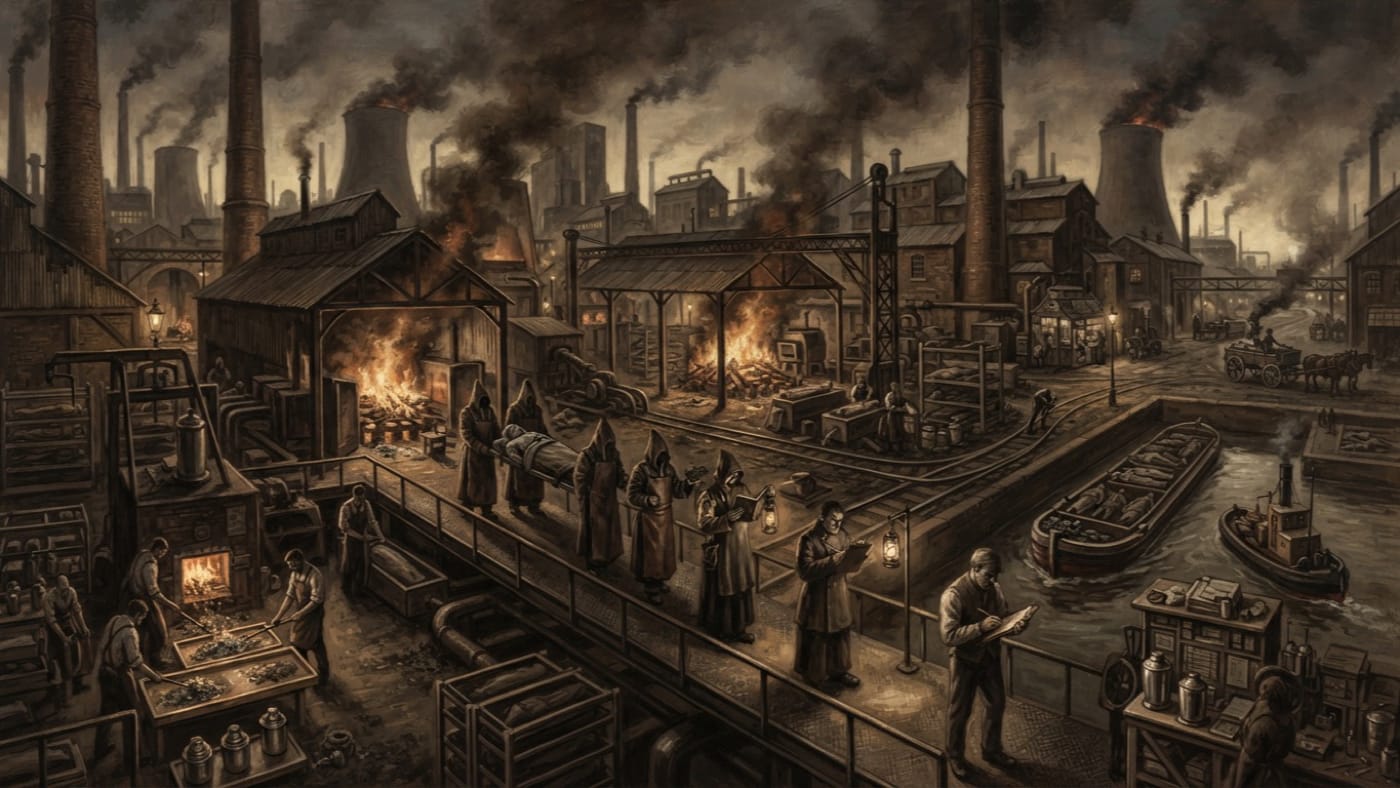
The procession follows the guild's published practice. Hooded bearers carry the bier. A cantor walks ahead, and a tally-clerk walks behind with a board, a pencil and an expression of liturgical patience. The Bureau of Rites decides what may be sung on the road and at the fire. The Office of the Last Watch, a sub-bureau of Records, watches the handovers: where the house gives up the body, where the yard accepts it, and where the ash leaves under seal. It owns none of these moments and gets blamed for all of them.
At the yard the body goes behind an iron screen. The screen spares the bereaved the sight of the work, and it spares the workers the opinions of the bereaved. The cantor begins the Hymn of Return while the stokers feed timber and pitch. The tally-clerk writes down each bundle, each measure and each quarter-hour of flame, and the tally later goes to Records beside the name. So much wood is what a soul costs, at the end.
I have stood at these screens. The good yards are quiet. Men who have done the work for twenty years move without hurry and without waste. The cantor does not drop a verse, and the stokers bow their heads at the name even when forty more names are due before supper. I distrust the Guild's prices. I do not distrust those men.
#On the Division of Ash
Once the screen is cold, the sorters take over. They draw the ash out with long-handled combs onto brass trays, weigh it on guild scales and pour it into sealed urns. The equipment varies from yard to yard, and a frontier landing has none of a cathedral yard's brass. The rule is the same everywhere: every measure goes somewhere, and where it goes is written down.
The guild separates named ash from bulk ash. Named ash comes from a single body and is sealed while the family watches. Bulk ash is gathered from the communal pyres and the paupers' burns. Between them they fill three destinations.
The first is mortar. Ash goes into the mortar of new sanctuaries, so the faithful who once prayed under a roof now help hold one up. The second is the field. Ash is scattered over ploughland to "fertilize the harvest of Heaven." That is the Bureau's phrase, and a good one; I would have charged for it. The third is rare and dear: the reliquary icon, named ash pressed with wax into a small panel and returned to the household under the name. Such an icon keeps a memory. It does not make a saint, and the Bureau of Relics says so to every family that asks and to several that do not.
Another share goes to the pressers who supply ash-oil for the lanterns of the Festival of Departed Flames, when the names of the year's dead are read aloud. The guild does not say how the oil is made. Rites has never asked, because it pays by the cask.
Bone is a separate matter. The fragments the fire leaves are not ash, and they go to the ossuaries. When skulls and claimed bone enter an ossuary, the Ritual Bone-Stampers seal them and enter them in the ledger. The urn on a mantelpiece gets no bone-stamp. It gets a certificate, which is cheaper to forge.
#On the Price of Benediction
Every stage has its fee. Procession, hymn, burning, sorting, urn and certificate are billed separately, and the Bureau of Tithes follows each charge with the tenderness of a man counting his own children. Rites renewed the Compact in A.S. 92 and revised it in A.S. 187, and under it the guild must burn the poor as well. It does so, and it bills the parish. A family that pays for the hymn hears all of it. A family that does not hears as much as the cantor thinks sufficient.
When the yards are full, a "devotional surcharge" moves a named burn up the queue, and everyone else waits in the cold-rooms. I have heard this called simony at the gate and prudence in the counting-house. Both were correct.
The certificate is where the money meets the fear. For a month's bread, a widow buys a paper attesting that the ash in her urn is her husband's. It says he was received, burned, weighed and entered under his own name, and that nobody could borrow him to square somebody else's arithmetic. Against this stands the counterfeiter, who presses hearth-sweepings and kiln lime into an icon and sells it to a mother as her son. The guild condemns the practice in the strongest terms. It also issues the only certificate competent to expose it.
#On the Account That Remains Open
The pyres are the rule, but the rule does not cover everyone.
Those who die in rebellion are denied ash and flame. Their bodies go unburnt into pits outside the walls, which the Synod considers instructive for the living. In the ossuary districts and certain frontier works, bone is kept rather than burned, and the dead are built into the walls with their stamps on them. The war graves, the plague trenches and the famine pits hold dead who never had a procession at all.
The Codex entry on the Ashbinders states that "every soul who dies under the Synod passes through their hands."
This Errata amends: most do. The Synod's own law of the condemned denies rebels ash and flame, and the ossuaries hold bone the guild either handed over or never received. The monopoly covers cremation. It has never covered every death.
The Bureau of Rites records a difference between these classes of dead. Its monitoring shows fewer post-mortem atmospheric disturbances where the dead are named at the fire, burned in order and sorted to a known place. It shows more where they are burned in heaps, sung over carelessly or kept out of the yard altogether. Rites credits the Hymn where the yards are quiet and blames the Great Deceiver where they are not. The sorters credit the scales. Nobody has shown what the fire actually does, and doctrine claims more for it than any yard can show. Fire ends a body. The Bureau has not asked whether it ends anything else.
I will record one case, from a yard I shall not name. The day's tally listed thirty-one bodies received. The fuel account matched thirty-one burns, and the sorters weighed and sealed thirty-one measures of ash. When the Book of Departures was checked afterwards, it held thirty names for that day and that parish. The clerk checked three times. That night, according to the yard's own logbook, the stokers asked for the screen to be relit. The logbook gives no reason. The fuel was charged.
#On the Present Return
The war keeps supplying the yards, and so do the foundries. Front-line dead come back by barge and cart, and a mine collapse delivers a whole shift at once. Rites' monitoring shows manifestation frequency rising across every zone it watches since about A.S. 198. The Bureaus dispute the cause with the energy they usually save for budgets.
The guild's answer is the reduced-rate bulk burn: one pyre, a shortened hymn, a group tally and a single certificate for many bodies. Tithes admires it. The monitoring stations do not, and their figures are worst where bulk burns have spread. Rites asks for more thorough work, with more cantors and fuller tallies. Tithes has put a price on the request. The two Bureaus are in correspondence.
My own arrangements are on file with the guild: named rate, full hymn, a cantor of my choosing, and written instructions for the sorter to weigh me twice. I have read the yard logs. I would rather be overcharged than miscounted.