
#On the Observance
"Speak the name. The clerk will count the speaking."
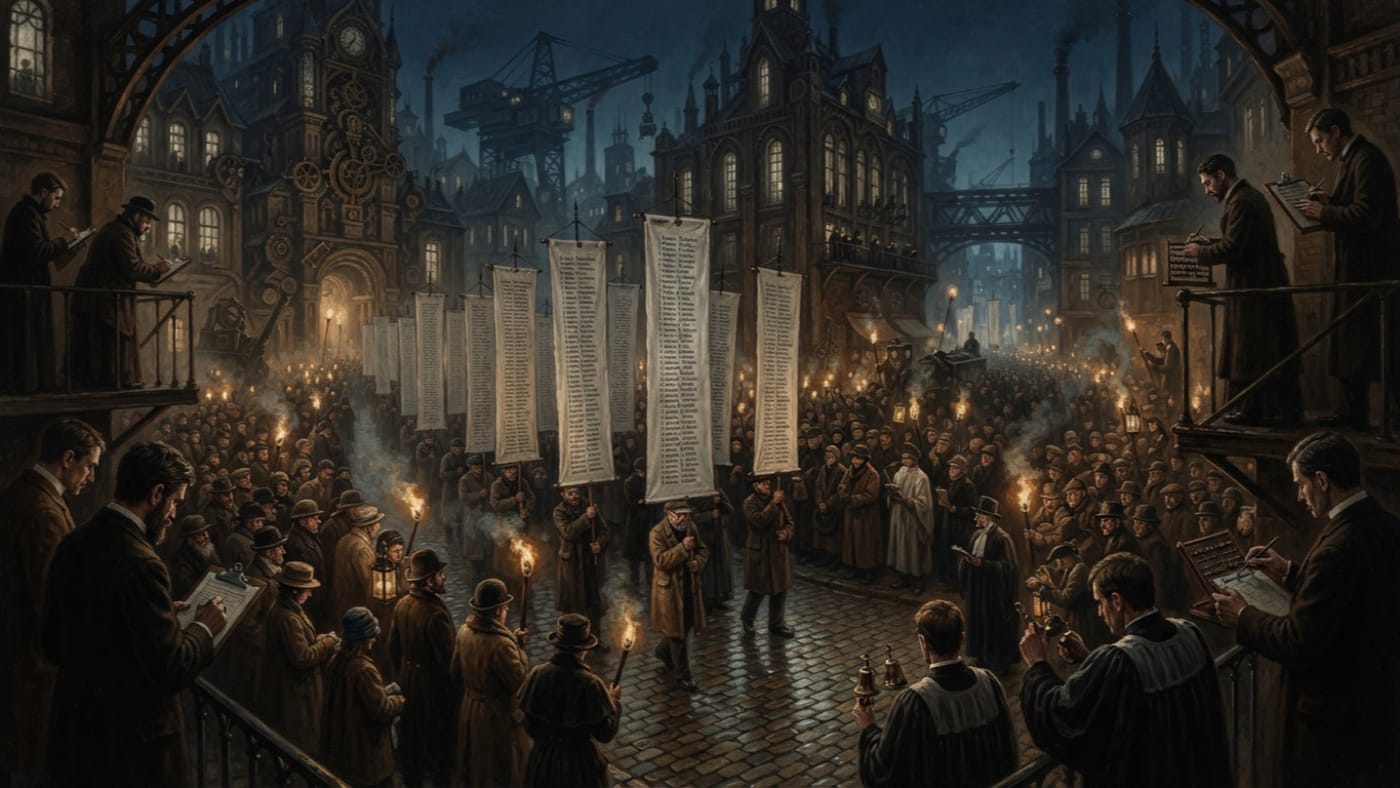
Each autumn the faithful of the Synod's dominion gather after dark. They light their torches and lanterns and read the names of the dead aloud. That is the whole of the Festival of Departed Flames. Everything else is administration.
The festival stands on the Sanctioned Register of the Bureau of Festivals alongside the great feasts. It was ratified by the Bureau of Doctrine and stamped with the Seventh Seal. Attendance is compulsory. An absence is entered in the Great Ledger of Souls beside the absentee's own name, in the ink from which that name will one day be read. I find the arrangement tidy. The absentees find it otherwise.
The reader will ask when the custom began. The Register does not say. The Bureau keeps the festival's ratification under the Seventh Seal and its origins under nothing at all. I will not invent a founding year just because the reader would sleep better with one. Parishes read out their dead long before there were Bureaus to schedule them. The Synod found the habit already burning and did what it does with any fire it finds in a private hearth. It issued a permit.
This survey records the observance as it stands in A.S. 201.
#On the Names and the Procession
"Ink first. Flame second. Grief at the discretion of the Chorus-Master."
The names come from the Bureau of Records. It compiles each parish's list, and it logs every name read. The faithful already fear the Book of Departures, and the proverbs warn them that to die unwritten is the worst dishonour. The festival answers a different dread. A name in the Book has been filed. A name in the procession is heard.
The Bureau of Festivals says the dead are thereby registered twice, once in the Great Ledger and once in flame. The Bureau of Records keeps exactly one ledger and resents any suggestion of a second. It has asked me to note that the flame is a figure of speech. Noted.
The lists are carried on banners of white linen, the names inked in black ash. They go upright through the streets, the way relics go, just as slowly, and with the same care that the hem never touches the stones. I have seen grown porters weep under a banner pole. A reliquary bone carries no name. The linen carries hundreds.
The torches and lanterns go around the banners. The lanterns burn ash-oil supplied by the Ashbinders. Their grip on the funeral trade of the Heartlands is older than half the Bureaus, and they sell the oil to the bereaved at a markup I would call usurious if usury were not licensed. The Ashbinders do not publish what the oil contains. Nor will they say whether a given lantern holds anything of the person whose name is read beside it, and the families have learned not to ask. They buy the oil and they carry it. The guild already invoices the procession, the pyre and the hymn, and it saw no reason to stop short of the lamp.
#On the Administration of Mourning
"Grief is a public office. Its holders serve without stipend."
Two Bureaus claim the festival, and both are right, which in the Synod is the most dangerous condition a document can be in.
The Bureau of Festivals holds the calendar and the conduct of public observance. It places the festival on the Register. It licenses the Chorus-Masters, who keep the reading to its script with their cue bells, and it posts the Attendance Auditors who count the crowd. The Bureau of Rites holds the liturgy: the words said over the names, the form of the chant, and the official account of what the fire is for. Festivals schedules the mourning and Rites consecrates it. The Bureau of Bells, which nobody consulted, wants it known that the cue bells are flat.
"The Bureau of Rites administers the festival." — this Codex, The Dead, A.S. 201.
The Bureau of Rites governs the festival's liturgy. The Bureau of Festivals governs its place on the Sanctioned Register, its conductors and its attendance. Both Bureaus read the earlier sentence and both wrote to me. I filed the two letters together, which neither Bureau will forgive.
The Bureau of Festivals calls this the tenderest observance in its calendar. By its own measure it is, because fewer Auditors stand at the Festival of Departed Flames than at any feast where the crowd is expected to smile. Fewer is still a number above none. The Auditors stand in the shadow beyond the torchlight with their slates and counting frames. They score the weeping the way they score the cheering on happier nights. A crowd that grieves past the Bureau's parameters is still classified and still reported, and the Bureau of Purity still keeps Lictors for the classifications it dislikes.
Last autumn I stood beside one of them. A woman near the banner was weeping for her son, killed at Bastion-Irongate. The Auditor timed her: forty-seven seconds, he wrote, within parameters. She never saw him write it. I did. She kept weeping after he had stopped counting, which the form makes no provision for. He did not amend the figure.
#On the Fraying of Voices
"Fatigue explains everything to those who require it to."
The reading is long. In the great cathedral squares it runs deep into the night, the lists passing from reader to reader as each voice gives out. Somewhere around the third hour, the voices begin to go wrong.
This is documented. Readers stumble over names they have pronounced correctly all evening. Syllables appear that are on no page. A reader stops mid-list, at no comma, holds a pause longer than breathing needs, then goes on as though nothing happened. The Chorus-Masters ring their bells and the reading continues.
The Bureau's explanation is fatigue, and fatigue is real. I have watched clerks fall asleep standing over lesser documents. I record the explanation. I also record that it was given before anyone examined the readers.
What follows is stranger. The Bureau of Rites monitors the realm through the bell-resonance stations of the Bureau of the Hourglass. By that monitoring, recorded post-mortem disturbance across the monitored zones falls in the weeks after the festival. The Bureau of Rites credits the decline to divine benevolence and accepts it gratefully.
In The Dead I wrote down what I believed the dead want. I still believe it, and the Ledger files it as opinion. The figures stand as figures. The quiet follows the reading, and the Bureau has never asked why. The answer it already has is pleasant, and the question would not be.
Nobody promises the bereaved anything. The woman at the banner was told that her son rests in the Creator's keeping. That was true before the festival and remained true after it. No one heard him answer, and no one was meant to.
#On the Present Observance
"Read faster."
The lists grow. Since about A.S. 198 the Bureau of Rites has recorded rising disturbance in every monitored zone. The sermons blame the Great Deceiver; the memoranda blame a shortage of manpower. Each autumn the festival must answer for more dead, from the Line, from the foundries, and from the long grey attrition the Synod calls service. The banners get heavier every year. Every year the readers reach the third hour with more of the list still in their hands.
This is the largest operation the Bureau of Records runs outside the annual census. The lists must be compiled, copied, inked onto linen, sent to every parish that keeps the observance, and logged again when they come back. Records does all of this with an efficiency I would praise if it ever stretched to a second bench.
This winter in Strasbourg, as every winter, the Bureaus will argue over whose seal goes first on next year's notice. The Ashbinders will raise the price of oil. In the autumn the faithful will stand in the cold under the linen and speak the names. Records will log every one of them, the Auditors will time the weeping, and I will sit on the bench.