
#On the Office's Charge
The Office of the Last Watch is a sub-bureau of the Bureau of Records. Its commission takes up one line of the Synod's register of lesser organs: it oversees cemeteries, funerals, and exhumations, and it ensures that the dead remain properly obedient. That is three nouns and an adverb. The adverb does most of the work and draws no salary.
According to the Office, the charter behind that line has been lost, rewritten, lost again, and finally declared self-evident. The Bureaucratic Synod treats any document this way once its original wording threatens to become inconvenient. I give the account as the Office gives it, on the Office's authority and under the Office's seal. Nobody has shown me a founding year. Nobody has named a founder. The Office keeps the Church's dead in good order and keeps its own beginnings in a drawer it has misplaced with great care.
#On Receiving and Placing the Dead
A death in the Church passes through more hands than a tithe-chit, and few of those hands belong to the Office. The Bureau of Mercy performs the Rite of Passing at the bedside: the Creed in the right ear, then the bell, the witnesses, and the stamp. A clerk enters the departure in the Book of Departures beneath the cathedral vault. Records carries the name into the Great Ledger of Souls, closes the tithe account, and seals the confession file. These are two separate books. Half the clergy of the Heartlands confuse them weekly, and the other half profit from the confusion. The Bureau of Rites governs what may be sung, said, or burned. The Ashbinders carry the flesh to the Pyres of Benediction under a monopoly older and fatter than most bureaus, and they bill separately for the hymn.
What, then, does the Last Watch do? It watches the joints: where the Rite ends and the ledger begins, where the pyre gives back its ash and the ossuary takes in its bone, where an allocator assigns a niche and a stamper is sent to seal it. Its authority sits in the gaps between other offices' authorities. That position makes it indispensable and almost impossible to blame.
The Ash-Glyph Marshworks gives the work a visible shape. Charnel barges come down from the front. The Synod's Mortuary Cartography Office stakes the burial grids in lime and wet ash and keeps its maps under its own seal, and the lantern guilds hold to their own compact. The papers I have seen do not say whether these bodies answer to the Last Watch or merely fear it. Either way, the grids show what oversight looks like when it works. Every body is a coordinate, every coordinate a ruled line, and every line a sentence somebody will be held to.
#On Opening a Grave
Funerals are the Office's public face. Exhumation is its private conscience, and the Office scrubs both with equal care.
Graves are opened for reasons the living find sufficient. A wall is extended and the niches behind it have to be emptied. Floodwater lifts a grave-field into the drainage. An allocator needs dry ground for the living and finds it occupied. A relic moves from one custodian to another, and its bones must travel with their papers. Each disturbance carries a cost the Office knows well and never prices. Disturbed remains are among the most reliable causes of the post-mortem disturbances that Rites still files as Category Unassigned.
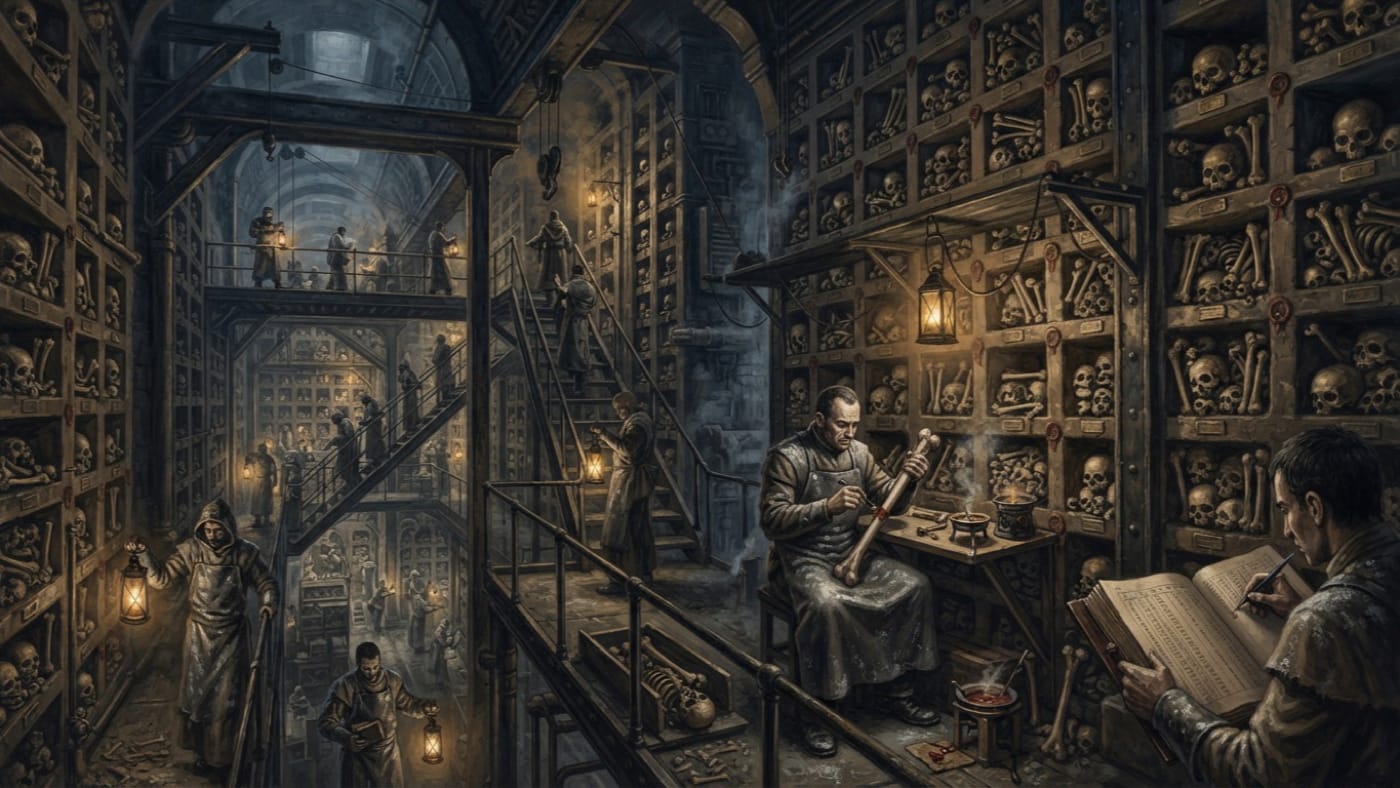
After an opening comes a second funeral, held entirely in ink. The Bone-Stampers issue a re-sealing notice for each disturbed lot. Each bone is tested again for resonance, cleaned, set on its proper axis, stamped afresh, notched with a new code for district, date, and chamber, and entered at its new location. The old entry is struck through. The ledger has to know where every femur sleeps, because a femur the ledger loses may start answering for itself.
I do not claim the Office has codified this into a single numbered ordinance. I describe what its workers do, night after night. They have learned that an exhumed bone has forgotten its manners, and that the cure is to repeat everything the bone has forgotten.
#On the Hands Employed
The Office does its business with other people's knuckles. The sequence is fixed. First comes the resonance check with tuning fork or tap-rod. Then the bone is cleaned and oriented, since a bone set on the wrong axis counts as open. Warmed wax goes on, and a district-coded stamp head is pressed at the set force for the set duration. Then the ink line and the notch, the ledger entry, and placement in the approved pattern. The stamper speaks the Force-Count aloud so that cadence and pressure keep time together. A Wax-Runner learns it on cracked femurs. A Bone-Stamper lives by it. A Seal-Warden can hear it from three paces and tell, from where the breath falls, whether the worker still means it.
The kit is small, and the workers' lungs fill with it: wax wafers, ink brine, slates, tongs, hooded lanterns, and leather aprons grey with marrow dust. In time comes the cough the infirmaries call Bone-Lung.
Count, location, anomaly: the columns fill, the totals tally, the superintendent sleeps. A district whose ledgers close complete each night is a district maintained.
The trade has always known better, and since A.S. 199 the Office has known it too. Its private training note lists the signs of the Hollowing: a shortened cadence, a weaker seal bite, repetition without spoken correction, a refusal to report warmth. A Records sub-vault table from the same year set seal degradation against years of service and suppressed anomaly reports. It was marked for circulation within this Office only, with an instruction to avoid the word belief. The figures were withheld from me. I report the instruction, which says enough on its own.
The approved remedy is rotation every three years: Bastion-Brest to Strasbourg, Strasbourg to Bastion-Constantinople, and on to the next set of strange corridors. It helps for a season, until the strange corridors become familiar. Rotation has one further virtue that the Bureau never advertises: no hollowed stamper stays in one district long enough to be blamed for its dead. When a chamber stirs beyond what ordinary hands can manage, the Office sends for the Quiet Hands, the senior rise-response specialists whose seals hold where younger seals fail. Nobody can tell me why their seals hold. The stampers have a theory that depletion passes through such people and leaves them clear. It is a trade theory, and I file it as one.
A district whose ledgers close complete each night is a district maintained.
Withdrawn. A complete ledger proves the clerk's diligence with a pen. It proves nothing about the bite of the wax, the axis of the skull, or the cadence of the count. Records' own comparisons found the handsomest ledgers in the corridors that most needed resealing. The sentence has been moved to the auditors' training manual, where it will do the least harm and win the most applause.
#On Making the Numbers Agree
Beside the Office's honest labour runs the Ledger of Unmarked Graves. Its clerks keep strict numerical parity between recorded deaths and sanctified burials. In the Rhineland the Ledger is updated weekly and assigns deaths to parishes in arrears. When the totals refuse to agree, the clerks supply the difference from debtor families or from plague pits, wherever bodies are cheapest and questions fewest. Whole cemeteries have woken to find fresh, nameless occupants in plots the Ledger had reserved for them.
The auditor's case is elegant. A diocese whose dead balance is a diocese at peace. Parity soothes the inspector, the bishop, the Bureau of Tithes, and the Office's own quarterly return.
The dead are harder to soothe. A substitute fills a column, but it carries no part of the name whose record went missing. Nothing in the Bureau's monitoring suggests the missing person settles because a stranger now lies in the right plot. Put plainly, a falsified total leaves the lost person unacknowledged and files the substitute under a code that belongs to someone else. The Office calls this balance. I call it two omissions under one stamp.
I do not say that every clerk of the Last Watch has signed a requisition for a debtor's son. I say that the Office receives the totals and certifies the parity, and it never asks which pit supplied the parity. I once wrote a joke about being falsely dead on parchment, and Records adopted it as a motto. My own hands carry some of this dust as well.
#On the Present Watch
As of A.S. 201, the demands on the Office exceed anything its lost charter could have pictured. Rites has recorded a sustained rise in manifestations since about A.S. 198. Its classification memorandum of A.S. 199 recommended a longer bell-schedule and twice the stamp allocation. The Bureau of Bells has the schedule and the Office has the allocation, but neither has the stampers to use it. Front-line carts arrive faster than wax can be warmed. Masks come late and corridors run overfull. A worker who sealed the children of one district is rotated to another and seals theirs.
The rules on naming contradict one another, and the Office keeps all of them. Festival readers speak the names of the dead aloud, and the corridors grow quieter for weeks afterwards. A stamper must never hear a name spoken while the wax is hot. At the Marshworks, no dead name may be said over open water. Those are three rules for three rooms. The Office has reconciled none of them, and I decline to do its reconciling.
Every night, at some corridor mouth, a mother asks a stamper to seal one small skull out of turn so that a priest will bury it. The quota is spent and the audit patrol is on its way. I am told that most stampers seal it anyway. I have never asked how the ledger records it, and I will not ask now.