
#On Quarantine's Charge
In the Synodal tongue, "quarantine" is a noun pretending to be a room. It names the fenced pier, the isolation ward and the vinegar smoke rolled over an arriving hull. It also names the act by which a person is placed behind those things and kept there. The first meaning is medicine. The second is custody. The Bureau prefers that the reader never notice where one meaning becomes the other, and I have been paid for many years to keep that join well waxed.
In Thessaloniki the need is real, and it smells real. The port is the Aegean throat through which the southern war swallows grain, powder, rope and men. Ships arrive from coves where marsh fever sits in the bilge. Refugees arrive from burned farms and from shores where the soil has learned salt. Mold lung, salt-rot infections and the plague the Line most fears all travel well in damp holds and crowded sleeping rows. A fever that reaches a convoy reaches a trench. A trench that sickens can be broken. On this point the harbor clerks, the garrison and I agree, which happens about as often as an eclipse.
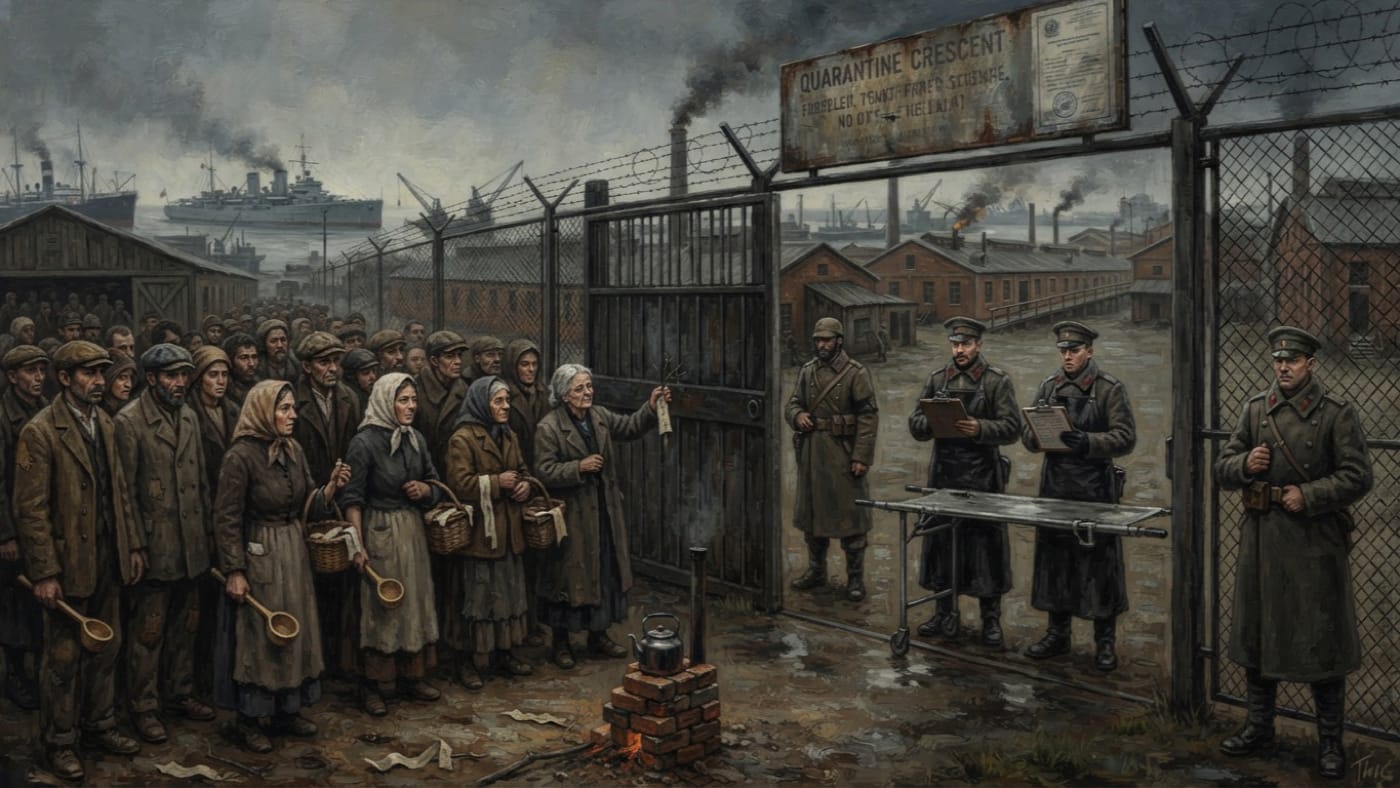
The office charged with stopping it is the Quarantine Collegium. Its public commission is short enough to paint over a gate: keep plague from the Line. It holds the wards of Quarantine Crescent, between the Chainward Quays and Drowned Row. It commands fumigation crews and corpse wagons, and it issues medical stamps. When the Bureau decides the Collegium's origin, I will be informed, and I will inform you that it was always so.
#On Holds and Release
Arrivals first meet Quarantine as weather. Salt flags go up when an emergency cordon is declared. Crews in tarred aprons row out and fog the hull with vinegar and incense until the gulls leave in disgust. Crew and passengers come ashore onto fenced piers, pass through the Arrival Confession Booths, and enter the waiting pens of the Crescent. There the carbolic does its honest best against the vomit and seldom wins.
Then comes the hold, the period during which a person is kept to see whether the fever declares itself. Orderlies watch skin, breath and heat. The dead go to the wagons, the sick go to the wards, and the merely suspected wait. This is the medical part. Much of it is done well by people who boil linen in water that rings in their teeth and are paid in ration chits for the privilege.
Release is where medicine meets the ledger. The Quarantine Release Seal has two components. One is a medical attestation that the body is fit to pass. The other is a doctrinal attestation that the soul has been heard. Neither suffices alone. A sailor who coughs nothing may still lack a confession receipt. A widow whose receipt is pristine may still run a fever. Each half of the seal can be withheld for the other half's reasons, and every clerk in the Crescent knows which half to blame.
The harbor sells its corruptions openly. Quarantine "shortening" may be purchased. Locals count an exemption as wealth, alongside a warm berth and a docking window. Releases happen at midday, in public, and the public may draw its own conclusions about who walks out. When a hold has outlived any fever, the clerks write quarantine extension. In Thessalonikan official dialect this means prison with better fumigation.
#On Fever and the Listening Patient
The Crescent's physicians face a difficulty that no medical faculty prepared them for: Thessaloniki is a harbor where children sing in their sleep. The city has recorded sleepers who answer something below the water since the Drowned Choir file of A.S. 121, and with fresh horror since the Crying Choir incident of A.S. 145. Fever brings delirium, and delirium brings murmuring. The orderly at the bedside in the third watch must decide which is which, and holds a degree in neither.
The Crescent keeps Listening Rooms and a Quiet Annex for patients whose distress is reported as acoustic. I will not describe their procedures, because the Collegium has not described them to me in any form I would sign. I note only two things. A bed in the Annex stands inside the same fence as a bed for marsh fever. The stamp that tells the two apart is applied by tired people.
Sleep-singing has never been shown to spread like fever. Fever has never been shown to invite the Choir. Purity observers in the Crescent tend to treat the singing as heresy and the fever as evidence. Physicians tend to treat both with broth and cold cloths. The patient, who wanted only to be well, finds the ailment classified three ways before breakfast.
#On the Shed Gate
The Refugee Sheds lie beneath Bellhouse Heights, near the Crescent. They are near enough that a stretcher can cross the distance in the time a clerk needs to fill out one form. That nearness produced the principal case of this tract.
The record of Aunt Velka's dealings with Quarantine is consistent to the point of liturgy. Quarantine arrives with stretchers, and Velka asks for names. Quarantine produces forms, and Velka asks for mothers. Quarantine threatens custody, and thirty women stand between the stretchers and the sleeping rows. The official notation then reads "access difficulty due to temporary congestion." I admire that phrase the way one admires a good forger.
Her questions deserve attention because they are the ones the forms leave out. A name ties a body to a family, and a mother ties a family to a claim. A child carried across the Crescent fence without either enters a ledger in which Records alone decides who that child was. Velka's basket of cloth strips is the Sheds' rival to that ledger. Its strips are marked by family, death, ship, village and tongue. A child removed before she has recorded them risks being returned to no one.
The sharpest instance falls in the Silence of Thessaloniki, the three-night failure of the bells that began on 14 Ashmonth, A.S. 198. Velka divided the nights into throat-shifts to hold the communal hum against the under-song. The Shed night list for the third watch records twelve persons restrained from the waterline. It separately records three children found in the shallows at dawn, all three of whom lived. The same list records a Quarantine request denied at the Shed gate by civilian obstruction. It also records a charge of interference with emergency medical custody, not pursued because crowd density was unfavorable.
The list does not say whom the request named, and it does not need to. On a night when the hum needed every waking throat, any stretcher at that gate proposed to carry someone out of the singing and into a fenced ward where nobody hummed at all. I do not doubt the forms were correct.
Velka is no enemy of medicine, which disappoints anyone hoping for a simple heresy to try. She permits Warden-Physic Iri to treat fever. She admits treatment and refuses removal. Her oral code puts it in a single line: no official past the stove-line without witness. A physician who comes to the patient may stay. A stretcher that comes for the patient must first answer to the mother.
The denial of A.S. 198 granted the Sheds no immunity. It is a recorded local confrontation that the Collegium lost on the night it happened. The next request will meet the same women, or it will not.
Harbor summaries describe the Shed response during the Silence as "spontaneous civilian devotional resilience."
Corrected, in agreement with the Velka dossier. The response was organized. Quarantine staff holding valid forms resisted it at the gate. It was called spontaneous afterward because spontaneous devotion requires no one to answer for a denied custody request.
#On Divided Authority
A body held in Thessaloniki belongs to several masters at once. The Bureau of Mercy claims it as a patient. Records claims its name, and can "pause" that name in the ledger so that no office will serve it. Purity claims what it says, especially what it says asleep. The Collegium claims the bed, the hold and the seal. The family claims the person, and writes its claim on cloth.
Each claimant is reasonable on its own terms. Together they leave the patient fed by one office, named by another and suspected by a third, with no release until all of them agree. In the Crescent, Sister Jova is known for her kindness, and the local file treats this as suspicious. That assessment tells you less about Jova than about the file. Iri is reckoned practical. Inside such a structure, practicality means knowing which stamp to ask for first.
The family pays in the only coin it has, which is attendance. Women stand at gates. Elders memorize names. Men with dock lungs learn which clerk signs before noon. No ledger records any of this as labor, though all of it is labor.
#On Present Application
As of A.S. 201, the Collegium continues its work, and much of that work is necessary. Fever ships still arrive, and marsh fever still rises in the low wards after rain. Since the Silence the bells have rung in exchanged voices. Since A.S. 199 the Sheds have hummed with a second line, and the annual Night of Quiet Bells has been kept every year from then on. Each change gives Quarantine a new category in which to file a sleeper.
Strasbourg's external audit is expected to ask whether the refugee hum is doctrinally supervised. It will presumably ask as well whom Quarantine holds, and why. I have prepared answers to both questions. I am not permitted to print them.
What the sea means by its singing remains unresolved, and so does the question of whether a fenced ward invites the song or starves it. The Collegium has filed no finding on either point, and neither have I.