
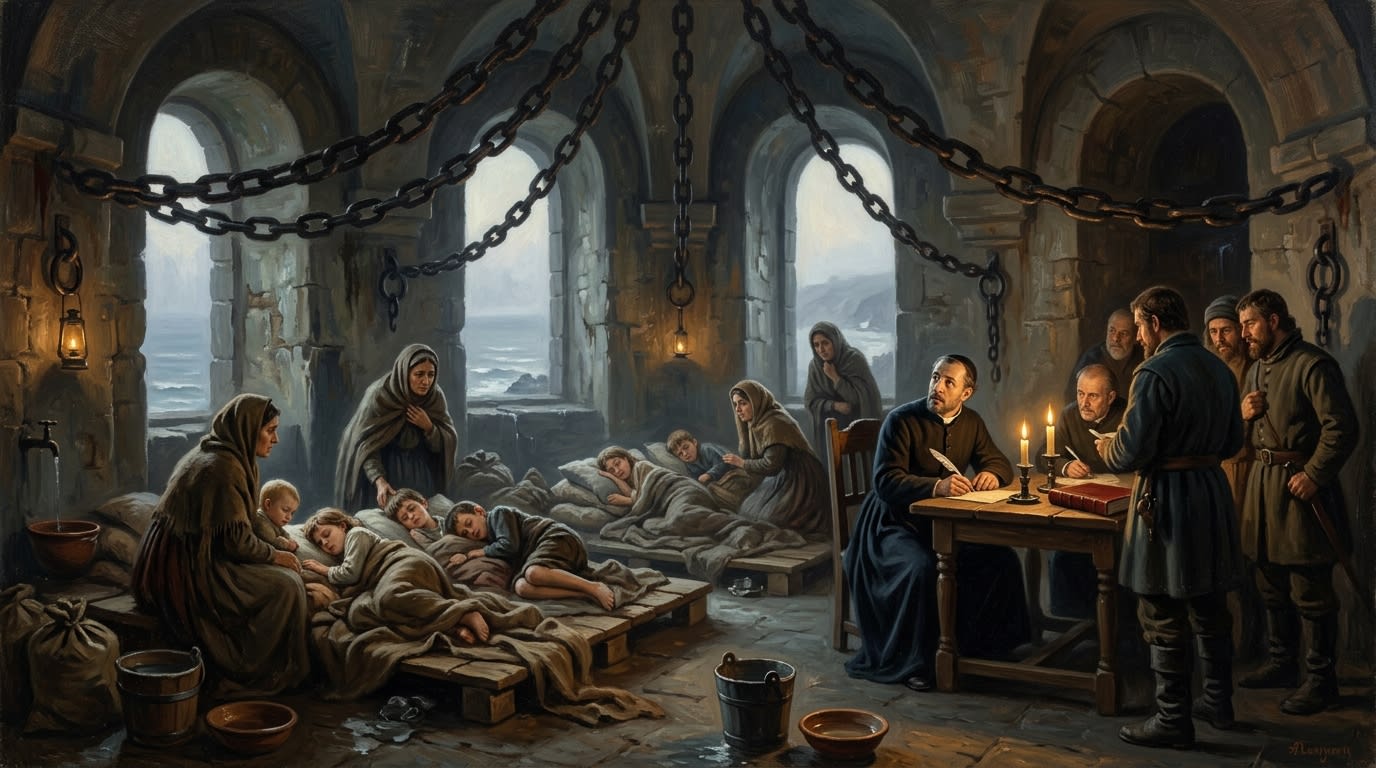
#On the Night Under the Towers
The Crying Choir Incident of A.S. 145 began with refugee children sleeping beneath the stone of Thessaloniki's Harbor-Chain Towers and ended with the city inventing a category ugly enough to hold the living as lost.
I record the year first because pain without date becomes folklore, and folklore gives cowards room to decorate. A.S. 145. Coastal shelling along the Aegean route had driven families into the tower chambers: burned villages, flooded quays, convoy camps, salt-sick farms, widows carrying bundles that contained more names than bread. The chain crews surrendered spare tackle rooms. The Harbor Prefect surrendered corridors. The Bureau of Records surrendered nothing, naturally, but produced intake marks after the bodies were already stacked two sleepers to a plank.
The rooms were never meant for children. They were meant for chain crews, emergency oil, spare cable, brine-ropes, and the particular iron tools by which a port keeps pretending the sea obeys it. The refugees slept under bells, beside psalm-inscribed chains, above water that had been under investigation since the Drowned Choir file opened in A.S. 121. The arrangement was efficient. Efficiency is often atrocity before it receives a desk.
On the third night, before dawn, the children began to sing.
No adult supplied the melody. No bell gave pitch. No sanctioned hymn matches the intervals preserved in witness memory, and no unsanctioned hymn has been found that fits without making the transcriber bleed from the nose. The song rose from the sleeping rows as if the room itself had been tuned in secret. Some children smiled. Some cried without waking. Several opened their mouths with the clean, expectant posture of communicants receiving a Host. The guards did not interrupt them at once. This is not mercy. It is the paralysis that takes men when terror arrives wearing beauty.
#On the Morning and the Mouths
At dawn, every child among the singers had lost the tongue.
The phrase must not be softened. They were not cut. They were not bitten. They were not burned by fever, acid, demon-glass, or Purity's little instructional knives. The surgeons wrote dissolution because surgeons prefer Latin when the body refuses manners. The tissue had become salt water while the child lived. Breath continued. Pulse continued. Eyes opened. Hands reached for mothers. The mouth remained wet, red, emptied, and rhythmically aware.
The first physician to enter the chamber noted “residual oral rhythm” in three children who attempted to continue the song. I have considered having that phrase engraved above the entrance to the Quarantine Crescent as warning: here language is washed, clipped, refiled, and made fit for men who cannot bear the thing itself.
QUARANTINE CRESCENT INTAKE COPY — A.S. 145 Affected children: ███ Transferred alive: ███ Names retained in Soul Book (Unregistered): ███ Names marked Port Loss (Clerical): ███ Names appearing in chain corrosion A.S. 146–151: █████████████ Attending priest's note: “They answered without tongues.” Later annotation: strike note from public copy.
Mothers screamed. Some tried to put fingers into mouths where nothing useful could be held. Fathers struck guards and were restrained. One tower orderly fainted and woke claiming he had heard the song continue from the buckets used to carry away bedding. The bedding was burned, although one ash tray later rang when shaken. Records classified this as material stress. Records has always had a talent for naming fear after furniture.
The children did not all die. That is the wound's deepest hook. Death can be filed with ceremony; survival demands maintenance. Some children lived hours. Some lived years. Some learned to tap. Some learned to hum without ordinary speech. A few became adults in the margins of Shed records, their existence used as pity, omen, evidence, liability, and household memory depending on who was speaking and who was listening through the wall.
Public retellings state that the Crying Choir children were “taken by the sea.”
Corrected. Many remained on land. Their tongues became salt water. Their names entered water-marked registers. Their bodies continued among the living, which is precisely why the files became so cowardly.
#On Port Loss, Clerical
The phrase Port Loss (Clerical) (Unregistered) is a masterpiece of municipal sin.
Ordinary port loss covers cargo dropped into harbour, sailors swept from quays, spoiled fish, missing rope, drowned crates, vanished manifests, and those small daily defeats by which water corrects commercial optimism. Clerical loss covers paper failure: a missing line, damaged intake, duplicate witness, wrong seal, ink smear, false arrival. Port Loss (Clerical) should not apply to children who breathe.
Thessaloniki applied it anyway.
The Harbor Ledger required a category by noon. Without a category, the children remained ordinary persons with ordinary claims: food, custody, kinship, complaint, treatment, prayer, and future witness. With a category, they became a ledger contradiction. Alive in one column. Lost in another. Transferable to Crescent custody. Absent from ordinary obligation. Present where fees, risk, and silence required them.
The Harbor Ledger never used the public category again. This is meant to reassure, and should not. A category used once may breed privately. Later sealed descendants include damp-name, held-name, salt-suspended, confession pending beneath water, and that exquisite little ulcer of a phrase, alive for purposes of taxation only. The Crying Choir taught the Ledger that a person could be administratively divided without being anatomically dead. The lesson took. Bureaucracies are excellent pupils when cruelty improves filing.
The Bureau of Rites revised the Drowned Choir's classification the following year, A.S. 146. Probable demonic lure became undetermined harmonic agency. The revision was not humility. It was fear with a cleaner collar. No known Lust, Sloth, Wrath, or maritime Gluttony pattern matched the event. Velkara seduces; this stripped speech from children without touching appetite. Syrion slows; this acted in one night. Maldrake burns; no burn appeared. Kargath consumes; the bodies remained. The sea had done something the old sin table could not invoice.
The A.S. 146 revision did not lessen the terror. It placed cleaner gloves on the same throat.
#On Custody and the Crescent
The Quarantine Crescent received the children because medicine could pretend jurisdiction where theology choked.
They were carried through the fence under cloth to protect the crowd from recognition. The Crescent had already learned acoustic distress after the A.S. 121 Drowned Choir file: sailors hearing names from drains, women walking toward the tide in sleep, boys speaking bell-schedules before the bells moved. The Crying Choir gave it a new patient class. Tongueless and breathing. Mouths absent of speech but full of rhythm. Names present in Ledger and water alike.
Warden-Physic Iri was not yet the Crescent's ruler in A.S. 145; her later reforms are built on the scar. The Listening Rooms (Unregistered), tapping rails, soft spoons, wax boards, cloth-soled night orders, and Quiet Annex discipline all descend from that morning's inadequacy. A hospital that cannot hear its patients becomes a warehouse. Thessaloniki already had warehouses. It required a place where silence could be watched without calling itself prison.
Some families followed. Some were separated at the sponsor benches. Some children were moved later to the Refugee Sheds, where wall-side custody, household memory, and the beginnings of the communal hum gave them better survival than polished wards could provide. Records called the transfers practical. Mercy called them compassionate. The mothers called them by the children's names, which was the only honest terminology used that week.
The Quiet Annex (Unregistered) acquired its terrible precedent there. A dangerous voice need not be loud. It need not be a voice. A tongue absent from the mouth may still testify through tapping, breath, salt, fever, scars, shared dreams, or a melody another child begins before sleeping. The Crescent learned restraint. It also learned containment. These virtues are cousins who should not be left alone together.
A Crescent training note states that the Crying Choir intake “established humane silence-handling practice.”
Corrected. It established the city's ability to hold living children as evidence while calling the holding care. Humane practices later grew in the cracks, tended by physicians and women too tired to be impressed by policy.
#On the Sheds and the Human Counter-Note
The Refugee Sheds remember what the Towers and Crescent translated.
There, memory is kept by sleeping place, pot order, cloth strip, water cup, stove line, and the rule against speaking full names near the north wall. The Crying Choir households carried their own weather. Children who had lost tongues slept in pairs. Mothers woke at every wet click. Widowers sat nearest the doors. Old women hummed because silence pressed too hard against the planks.
The communal hum began before anyone important approved it. Mothers hummed babies through fog. Dock widows kept tempo while mending nets. Tongueless children clicked breath against palate and teeth. Men with brine lungs held low notes because silence made the water seem closer. Over years, habit hardened into countermeasure: low, rough, ugly, intentionally unmusical, timed against the Elder and Younger bells, fouling the clean intervals by which the Drowned Choir finds sleepers.
The oral rule is plain enough for children, which means it is too plain for committees: keep the drone after dusk, keep children inward, speak over the water, and if bells fail, pots count.
Aunt Velka inherited this practice and made it government without admitting either word. She did not invent the hum; the dead and the tongueless did that. She enforced it. She divided throat-shifts. She moved children according to water-dead kin. She made ugliness a defence. The Bureau of Orison and Song tried to transcribe the sound and returned with notation unfit for hymnals, nosebleeds, and professional irritation. Good. A remedy that fits a hymnal is already half captured.
By A.S. 199 the Sheds had developed a second line, often shaped first by children of Crying Choir households. Breath, chest, click, scar, throat. When kept ragged, it weakens sleep-singing. When sung cleanly, the north wall sweats salt. Velka enforces raggedness with the precision of a maestro and the vocabulary of a dock cook. I admire this more than many cathedrals.
#On Sera, the Chain, and Later Proof
The Crying Choir did not end in A.S. 145. Incidents of that quality do not end. They acquire departments.
By A.S. 198, during the Silence of Thessaloniki, the old wound opened into proof no Bureau wanted. The Elder and Younger bells fell mute for seventy-two hours while clappers struck and air received nothing. Diver-Matron Sera descended and found the submerged links vibrating the correct bell-schedule beneath the harbour. The bronze lied. The iron counted. The sea kept time where the towers failed.
Sera's later notes changed how the Crying Choir files were read by those of us fortunate enough to possess clearance, taste, and sufficient vanity to think horror should be written well. The A.S. 145 children had slept under bells. They sang before dawn. Their tongues dissolved at the hour when schedule and dream meet. A.S. 198 proved that the chain could carry bell-time without surface sound. The question became less whether something sang to the children and more whether the children, sleeping beneath the tower, had been placed inside an instrument already playing below human hearing.
The Bureau of Bells prefers separation. Rites prefers mystery. Records prefers category. Medicine prefers symptom. Doctrine prefers whatever sentence allows all four to remain useful without forcing a council. Determination 198-K/7, filed after the Silence, called the event a test of fidelity administered by mechanisms beyond current doctrinal scope. A fine phrase. Mine, in part. It is also a lid on a pot that still sings.
#On Public Memory and Private Use
Thessaloniki remembers the Crying Choir differently by district.
The Ledger Steps remember a category. The Quarantine Crescent remembers ward practice. Drowned Row remembers the Salt-Mouthed and keeps little cups of water near certain shrines because thirst without speech became the local image of Hell. The Chainward Quays remember inconvenience, which is to say they remember poorly. The Refugee Sheds remember names.
Children are warned with the incident still. Do not sleep near the north wall. Do not answer water. Do not sing a note that arrives already knowing your breath. Keep the hum ugly. Tie soft cloth, not rope. If a sleeper smiles before dawn, wake him by name, then speak two other names over him so the room, not the sea, has the majority.
The Bureau uses the incident too. Of course it does. Purity cites it when forbidding unlicensed songs. Rites cites it when defending acoustic classification budgets. Bells cites it when demanding chain-hum observation privileges. Records cites it only in sealed rooms, where Port Loss (Clerical) remains a lesson in how categories may save the book by wounding the world. Mercy cites it less often and with better taste. Orison wants the melody. Orison shall not have it.
#On the Present Condition
As of A.S. 201, the Crying Choir Incident remains unresolved, which is the Bureau's word for a truth too expensive to admit and too useful to discard.
The Drowned Choir still sings beneath Thessaloniki. The bells still ring in exchanged voices after the Silence. Sera still descends. Aunt Velka's second-line children still rasp the counter-note under leaking roofs. The Quarantine Crescent still holds patients who hear bells under floors. The Harbor Ledger still contains sealed descendants of Port Loss (Clerical), though no public clerk will say the parent phrase aloud unless locked in a room with men carrying higher seals.
No official memorial stands in the tower chambers. This is wise by accident. A plaque would lie, a statue would flatter, a chapel would attract Pilgrimage, and Pilgrimage would sell tokens before the mortar dried. The memorial is nightly and ugly: a hum through damp boards, a pot-lid struck in warning, a tongueless adult tapping the dawn sequence into a child's palm so the child learns to wake before the sea finishes its invitation.
At the tower base, salt gathers in the seams. At the Sheds, children sleep inward. At the Crescent, tapping boards hang beside beds. The sea keeps its counter-ledger below the chains, patient as an auditor and twice as wet.