
#On the Station of the Queue-Saint
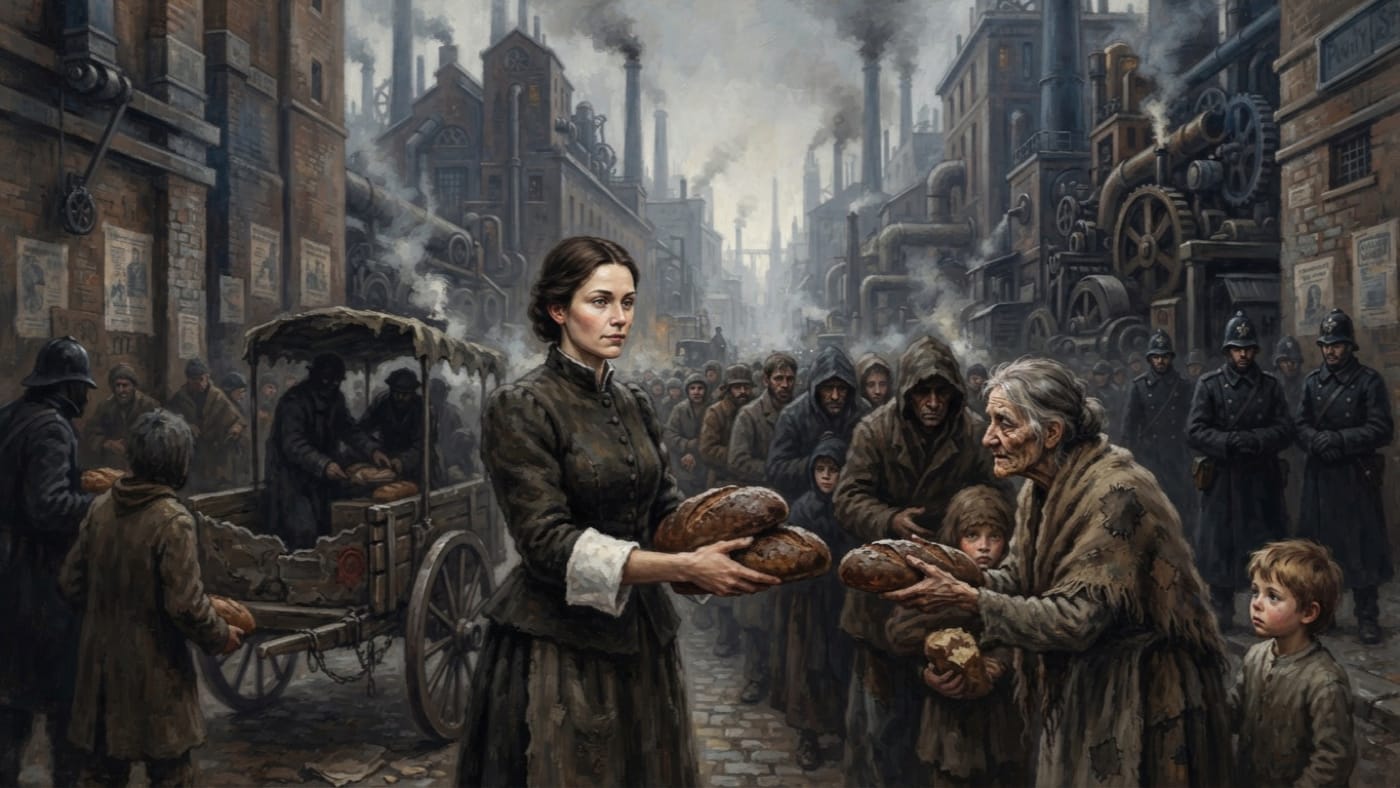
The Queue-Saint is the face the Black Ledger lends its theft. The rest of the operation prefers cellars and back offices. The Runner keeps to the edge of the line, the Seal-Swapper works in an annexe with a wax-scraper and a borrowed lamp, and the Ledgerwright keeps a list nobody else is allowed to see. The Queue-Saint works in daylight at the front of the queue, with both hands visible and bread in each.
The Queue-Saint holds a middle rank in the cabal, beside the Cutpurse and the Seal-Swapper and below the Ledgerwright, who decides where mercy goes and whom it will later cost. The rank is a function. It is not a rung that every thief must climb. Men and women both hold it. The role belongs most fully to the Theatres, the faction that holds that a crime nobody witnesses has been wasted.
The title needs immediate correction. "Saint" here is a street compliment and a criminal epithet, and it is no more than that. No tribunal of the Church has examined a Queue-Saint's life, and no ration line has produced a miracle the Bureau of Doctrine would put its name to. There is no order, rule, chapter or habit. There is only a person with clean cuffs who knows when to raise a loaf.
#On the Craft of Visible Restraint
The Queue-Saint's discipline is restraint. Weeping is easy and any drunk can manage it. Stopping before the weeping turns into a spectacle takes years of practice.
The cabal teaches the craft by apprenticeship and correction, and by beatings when necessary. There is no academy. Its elements are posture, timing, diction and the length of a touch. A hand rests on an old woman's shoulder and is withdrawn before anyone could call it ownership. The voice has to reach the back of a ration line over boots and bells without falling into the cadence of a warden reading the posted deficit, because a crowd that has queued since Lauds can hear the Bureau's diction in a single syllable and will stop listening. The clothes have to look worn and the gift has to look generous, since a benefactor who looks rich is either a merchant or a trap.
Then there are the cuffs. Black Ledger operatives wear no jewellery and keep their cuffs clean, and among their own kind that absence is the identifying mark. Many wash their hands in dirty water before a shift so that the skin does not shine in a crowd. Each sleeve carries a black thread stitched inside it as the cabal's sign. A Queue-Saint does not display it. The thread exists for the operation's eyes. The queue sees only linen that has somehow stayed white through a hungry week, and that alone suggests discipline, which a starving district easily takes for virtue.
The exit is the final element and the hardest. Gratitude lasts about as long as a loaf. After that it turns into questions: where the bread came from, who the benefactor is, whether there will be more on Thursday. A good Queue-Saint is gone before the first question is spoken. A poor one stays to be thanked.
The poor do not require innocence from a benefactor. They know the bread was stolen, and they can see that the tenderness is rehearsed. They eat it anyway, which is the only rational course, and they remember who handed it to them.
#On the Machinery Behind the Loaf
The bread is real, and that is the cabal's first principle and its most dangerous. Someone stole the cart, someone forged the permission or altered the manifest, and someone swapped the seal so that a Tithes consignment could cross two streets unchallenged. The Queue-Saint does none of this and should not know the details. A face that has handled a wax-scraper eventually shows it.
The operation's own vocabulary breaks the work into stages: select, lift, convert, perform, bind, silence. Only performance belongs to the Queue-Saint. Runners watch the queue, carry goods and note which households wept and which only ate. The Theatres also field Bell-Timers, Crowd-Witnesses and Lament-Speakers. The surviving files give their names and almost nothing about how they are recruited or how many attend any given action. Behind them the Ledgerwright records every beneficiary. Each loaf becomes an entry, and each entry is later collected as a favour, a key, a name or a silence. The cabal sums this up in two maxims: A gift is a hook, and gifts must be visible, debts invisible.
The Accountants object to the arrangement on grounds of exposure, and they argue it well. They say a debt can be administered while affection cannot. A household that owes quietly can be collected, but a district that loves a particular face will follow it, protect it and give evidence about it, and in the end the evidence reaches Shadows. Each public performance burns a route and puts a witness to work.
The Knives settle what the argument leaves unsettled. They guard the Queue-Saint during a give and deal with the witnesses afterwards.
Two professional taboos govern the performance. A Queue-Saint must not take from a widow in public, and no one may be killed during charity theatre. Neither rule shows that the network is merciful, because the same people hold a Quiet Knife in reserve and will use it after dark. These are rules of reputation. If someone kills during a public give, the street stops believing, and a street that has stopped believing has no use for bread with a story attached.
#On Ghent, A.S. 193
The clearest surviving case is the bread-cart action in the Ghent dock quarter in A.S. 193. It is a documented instance of the role at work. It does not mark the role's origin, which no file establishes.
The action lasted eight minutes. Shadows reconstructed it afterwards from nine depositions, four hostile statements and a child's drawing. Some of these accounts overlap, and none of them was written by anyone who saw everything. Whatever we know of the eight minutes has passed through a Bureau office first.
The cart was taken two streets from the ration office. The seal was broken and then shown to the crowd. Displaying it accused the office and authenticated the bread at the same moment: this was Tithes flour, and it had been taken from the people who had held it back.
The order of distribution was the argument. The first loaf went to a widow whose husband had been executed under a counterfeit debt notice. The second went to a dock-worker with two sons at Bastion-Brest, a man who had already given the Line more than any ledger could repay. The third went to a child. A grievance, a sacrifice and an innocent, in that order: the sequence turned three loaves into an indictment the whole queue could follow without being able to read.
By the fourth minute the crowd was chanting the Bureau's own ration formula back at the wardens with one word changed. The depositions agree that a word was changed. The record I have been given does not say which word, and I will not supply one.
The drawing was found tucked into a catechism primer. It shows a woman with long hands giving out bread and a white-cloaked officer drawn without eyes. It establishes that one child saw a woman and remembered her. A child's drawing does not authenticate a face, a height or a sleeve. On that evidence, artists have since painted the Ghent Queue-Saint with a confidence the file cannot support.
Queue-Saint: distributor of stolen food. See early Purity manuals.
That distributor-only classification has already been corrected in the entry on the Theatres. Ghent remains the case that best shows why. The bread fed a few dozen people. The order in which it was given taught a quarter.
#On the Bureau's Reply
The Bureau's concern was never the missing bread alone. A Tithes cart can be replaced. What cannot be replaced is the authority of the licensed hand, because once a quarter has seen assistance arrive without a stamp, every stamp afterwards looks like an obstruction.
The Purity advisory follows the logic of its office: seize the bread, seize the speaker, and seize the witnesses who wept first. Witnesses are then pressed in the usual ways. Some are reclassified as unreliable, and others are visited by men who ask about their families. Where possible, the Bureau of Records keeps the drawings and burns the primers.
Silence did not work. After the Marseille action of A.S. 197, the Bureau of Doctrine ordered immediate authorised narration, so that the official account reaches the street while the crowd is still chewing. After a major raid the wardens now bring licensed Mercy bread and hand it out through Mercy clerks. Bureau homilists add that illegal loaves carry spiritual debt. That is the Bureau's own claim, and I enter it here as the Bureau's claim.
I have watched a Mercy clerk at work after a raid. He stood where the Queue-Saint had stood. He raised the loaf to the height the Queue-Saint had raised it. He had been told to keep his cuffs clean.
#On the Limits of the Role
A Queue-Saint is only as good as the people behind them. If the seal is botched, the cart is stopped before it reaches the queue. If the Bell-Timer misjudges, the patrol arrives in the middle of a give, the line breaks into a stampede, and the people who were to be fed are trampled instead. If the Knives are late, the witnesses talk. If the Ledgerwright collects too hard, the next queue remembers who sent the collectors.
The cabal's word for failure is saint-slip. It means the moment a face that has been thanked too often becomes a face that has been described too precisely. When that happens the performer is retired, sold to Shadows or removed, and the Theatres send a new face to the same corner. The Ledger can lose a Queue-Saint far more easily than it can lose the crowd's habit of looking for one.