
#On the Second Book
The Accountants are the Black Ledger faction that understands generosity as a form of capture. This makes them contemptible, efficient, and dangerously close to respectable.
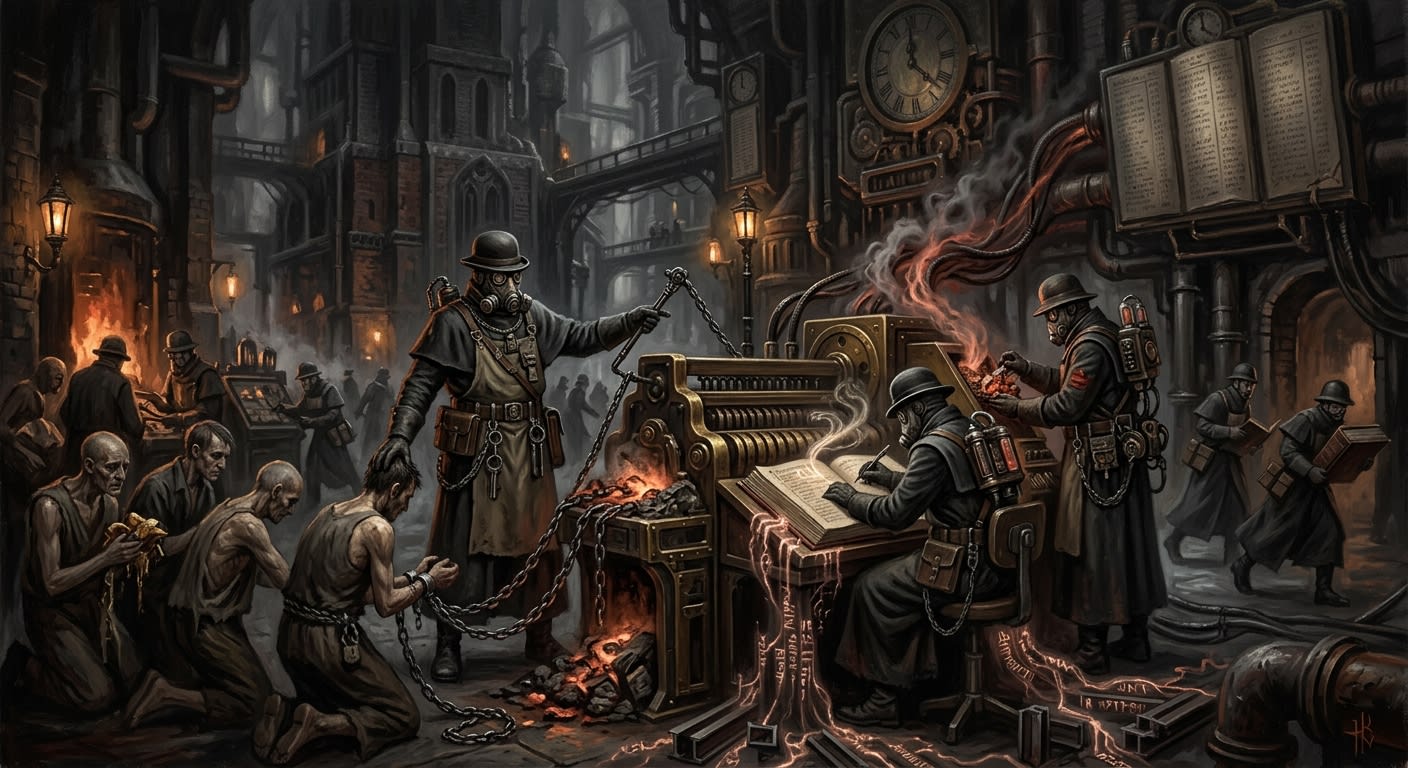
The Theatres want applause. The Knives want silence. The Accountants want balance. They keep the second book: the hidden register beneath every loaf, forged pass, borrowed cellar, smuggled child, missing name, and widow's exemption. The first book says bread was given. The second book says who saw, who ate, who owed, who thanked too loudly, who failed to thank, who can be trusted with a packet, who can be trusted with a corpse, and who must never again be allowed near a question from Purity.
The Accountants' doctrine is insultingly simple: gratitude is capital. Loyalty is infrastructure. Every gift creates a debt to be collected. A loaf becomes silence. A stamped permit becomes a stairwell. A rescued brother becomes a Runner next winter. The poor call this help because help arrived wearing bread. The Accountants call it purchase, because they are less sentimental than the poor and more honest than the priests who overcharge them.
#On the Ledgerwrights
A Ledgerwright is more than a criminal clerk. A criminal clerk records theft. A Ledgerwright manufactures jurisdiction from appetite. He knows that a family fed in famine week will hide a fugitive in plague month, that a widow whose tithe was reduced by illegal hand will misremember three faces before a tribunal, that a boy whose sister was carried out of a levy queue will run messages until his feet bleed and call the bleeding loyalty.
The best Ledgerwrights never touch coin in public. They sit above bakeries, behind laundries, in cellar offices beneath cooper sheds, inside funeral-stair cupboards, and anywhere else the Bureau has decided honest people are too dull to inspect. Their tools are school slates, ash-wrapped chit bundles, coded prayer cards, false widow lists, and the black-thread sleeve-sign by which the Ledger recognises itself while denying it has insignia.
Earlier Purity teaching sheets described Ledgerwrights as thieves' bookkeepers.
Corrected. A bookkeeper preserves accounts. A Ledgerwright makes persons into accounts. The distinction is the difference between stolen flour and a district that refuses to testify.
Their arithmetic is intimate. It does not count only Crowns, ration ounces, seals, or bell-hours. It counts shame, hunger, fear, kinship, funeral debt, household pride, parish resentment, militia boredom, and the exact age at which a child becomes both useful and disposable. It is obscene arithmetic. It is also arithmetic. We must not flatter ourselves by calling an enemy stupid because he is wicked. Wickedness often keeps better books.
#On Debt Without Seal
The Bureau of Oaths believes obligation begins with witnessed speech, stamped record, and ratified consequence. The Accountants believe obligation begins when the child stops crying because stolen bread has reached his mouth. One theology has wax. The other has witnesses who cannot afford virtue.
A Ledger gift is never naked. It arrives with a witness, a remembered phrase, a location, a usable fact. The widow of Strasbourg receives three Crowns through a baker's wife; the Ledgerwright notes her eldest son's apprenticeship, the landlord's arrears, the dead husband's military unit, the parish confessor's drinking hour. A dock-worker in Marseille receives a counter-stamp; the second book notes which quay he guards, which cousin works Tithes intake, and whether his left knee slows him under pursuit. A Keska furnace family accepts flour during the eleven months of administrative absence; the book records cellar access, shift rotation, and the names the children answer to when frightened.
EXTRACT — HINTERMARK SECOND BOOK, RECOVERED FRAGMENT, A.S. 199 WIDOW R.: two loaves; son keeps west stair; speaks under pressure after third bell only. FURNACE MASTER K.: third crate; wife loyal; clerk doubtful; ash cough severe. BOY “LITTLE MATINS”: ran packet; paid in soup; mother unaware; █████████████████████████████████████ ANNOTATION IN RED: DO NOT SPEND HIM YET.
This is why Accountants scorn the Theatres. Applause is volatile. Memory sings, exaggerates, gets drunk, makes heroes out of fools, and teaches children to draw. Debt is quieter. Debt has dates. Debt knows where the cellar key hangs.
#On the Quarrel With Theatre and Knife
The quarrel among the three Ledger factions is not philosophical ornament. It is operational weather.
Theatres want public charity performances: bell-timed bread, clean cuffs, weeping mothers, Queue-Saints with faces borrowed from altar paintings. Accountants permit such spectacles only when the second book will profit. A bread-drop that recruits two streets is acceptable; a bread-drop that turns a district romantic is a liability. Love does not obey invoices. Crowds in love improvise. Accountants hate improvisation for the same reason priests hate unscheduled miracles: both ruin calendars.
The Knives are useful and vulgar. They collect what ledgers cannot. They settle accounts that have begun to speak. An Accountant will argue for three pages that a witness should be relocated, pressured, ruined, starved, redeemed, watched, or married into dependence. A Knife will ask which alley. One sees why they win votes.
The Accountants' ideal cell is neither adored nor feared. It is needed. Needed things are defended by people who resent them, and resentment is more stable than love. Love confesses under torture because love has poetry in it. Resentment bargains, calculates, survives, and returns to the cellar after curfew because the flour is there.
#On the Bureau's Gutter-Mirror
The Synod hates the Accountants with special intimacy. The Theatres mock our processions. The Knives mock our punishments. The Accountants mock our essence.
They have built a counter-bureaucracy in gutter materials: ration counter-stamps instead of authorised seals, widow lists instead of parish rolls, second books instead of Tithes ledgers, cellar offices instead of registry halls, debt-clerks instead of sworn notaries. They do not overthrow Order. They imitate it in cheaper ink and sell the imitation to the hungry. That is the insult. That is also the threat.
This Codex previously grouped the Accountants under ordinary criminal finance.
Withdrawn. Ordinary criminal finance asks how much money can be extracted from a person. Accountant doctrine asks how much person can be extracted from a gift. The former is robbery. The latter is administration.
The Bureau response remains divided. Purity wants raids. Shadows wants penetration. Tithes wants the money back and preferably no report acknowledging how much was lost. Records wants the second books, which proves Records has taste. Doctrine wants the public taught that unlawful charity stains the soul. The hungry want supper.
The Accountants will not be broken by arresting a clerk above a bakery. Clerks are replaceable. Books are copied. Debts migrate from paper into memory and from memory into habit. Break the second book in one district and three widows reconstruct it by supper, not because they love the Ledger, but because they know who owes flour, who owes silence, and who owes the life of a son.