
#On Problems Removed Once
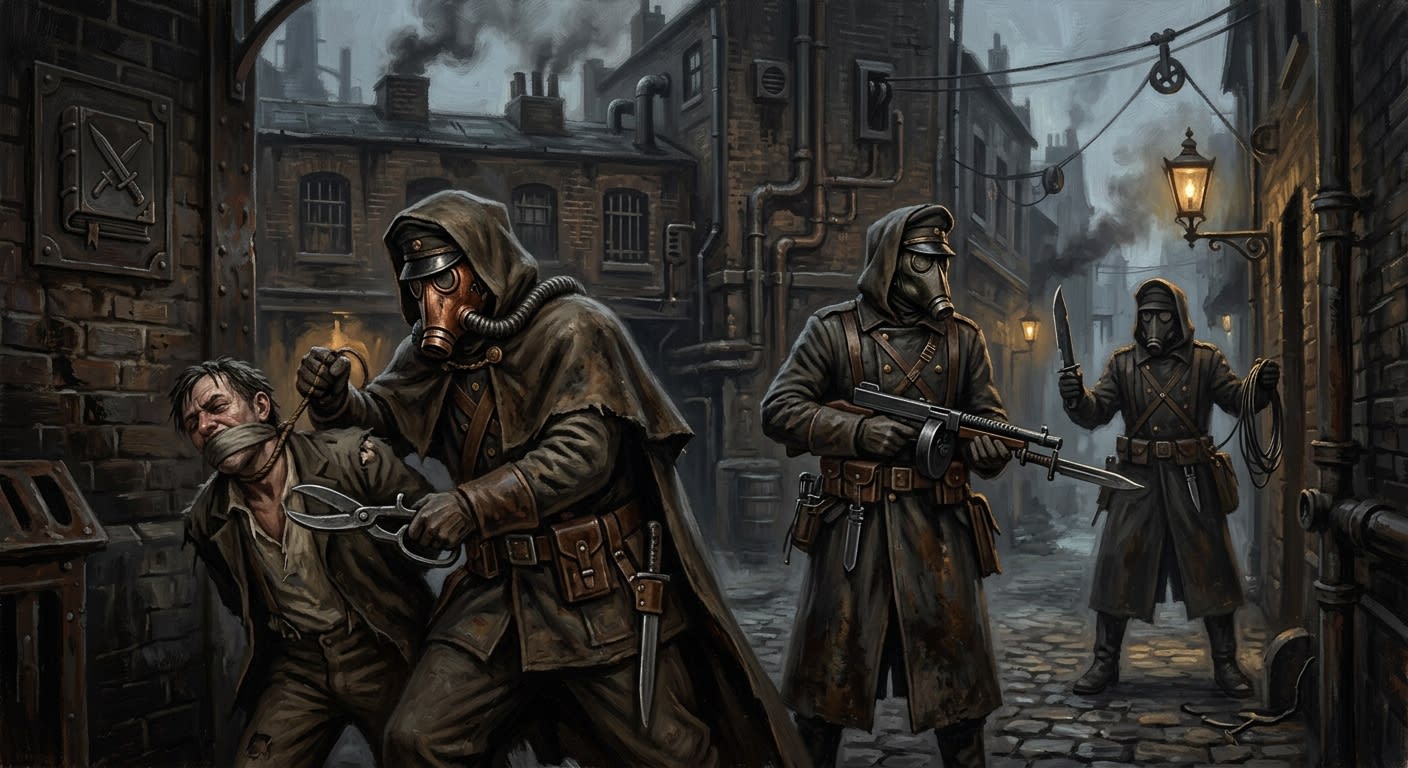
The Knives are the Black Ledger faction that regards repetition as incompetence. A problem, once identified, should not be identified twice.
This is their entire theology, if one may profane theology by applying it to men who pray with permit cord and sharpened kitchen steel. The Theatres stage mercy where crowds can see it. The Accountants record mercy until it becomes a leash. The Knives arrive when the leash frays, when the witness panics, when the Runner boasts, when the widow considers Purity, when the debt in the second book develops a mouth.
The Black Ledger calls them Quiet Knives when being formal. The adjective is aspirational. Some are quiet. Some are merely successful. All serve the same function: they resolve accounts that have become audible.
#On Quiet Work and Loud Evidence
The Bureau's files on the Knives are exceptionally thin, which is another way of saying exceptionally thick with failure. A captured Cutpurse names a Queue-Saint. A captured Queue-Saint names a Ledgerwright. A captured Ledgerwright names no Knife. This may indicate discipline. It may indicate ignorance. It may indicate that captured Ledgerwrights with names to give do not remain captured long enough for the ink to dry.
The recovered methods form a pattern without forming a manual. Permit cord used at the wrist. Flour in the mouth to mock stolen bread. Bodies placed where industrial accident will be the first official explanation and the last convenient one. In Keska, six corpses were removed from the slag channel after the Administrative Redrawing crisis; Purity classified them as furnace deaths, which insulted furnaces. Furnace accidents do not bind wrists.
Earlier municipal reports described Knife activity as “ordinary reprisal violence.”
Corrected. Ordinary reprisal violence wants fear in the street. Knife violence wants arithmetic restored. The corpse is not the message; the balanced account is the message. The corpse is punctuation.
The Knives' genius lies in sparing use. Too much blood frightens customers, invites raids, and gives Purity captains a story they can explain without embarrassment. Too little blood lets gratitude become opinion. A proper Knife action leaves enough horror to discipline the district and enough ambiguity to keep the Bureau arguing over jurisdiction.
#On the Tribunal That Rarely Lasts
When a Ledger cell quarrels, the three factions sit in judgment over themselves. Theatres argue, Accountants calculate, Knives wait. The tribunal rarely lasts long. The Knives have never lost a vote.
This fact has produced scholarly debate among men with too much lamp-oil and too little exposure to alleys. Does the Knife victory prove ideological dominance, superior intimidation, or procedural corruption? The correct answer is yes. A vote conducted in the presence of the faction that specialises in post-vote correction has a theological clarity that the Bureau of Records would envy if it permitted envy in filing rooms.
INTERCEPT — MARSEILLE DOCK CELL, A.S. 197 Theatre Speaker: “The crowd loves her.” Accountant: “The crowd owes nothing.” Knife: “She named the cellar.” [REMAINDER OF TRANSCRIPT REMOVED UNDER SEAL OBSIDIAN] Postscript recovered from harbour intake docket: one female body, no tongue, hands unmarked, pockets filled with ration chits bearing no valid serial.
The tribunal's purpose is less decision than preservation of the fiction that the Ledger governs itself by counsel. Criminals adore counsel when counsel flatters them. The Synod shares this weakness, though our committees have better chairs.
#On Their Argument With Book and Stage
The Knives dislike the Theatres because performance multiplies witnesses. They dislike the Accountants because accounting multiplies delay. Both dislikes are professional, and professionals cherish their dislikes like relics.
A Theatre operation produces noise: bells, bread, sobbing, slogans, children with drawings, widows with stories, dock-men who will repeat a line because it sounded brave after half a cup of sour gin. A Knife sees a public charity action and counts future liabilities by the dozen. He does not see romance. He sees mouths.
An Accountant operation produces paper: names, obligations, pressure notes, routes, receipts, cross-marks, debts aged by season. A Knife sees the second book and respects it only until the book requires someone living to remember too much. The Accountants say memory is infrastructure. The Knives say infrastructure burns.
The Knives' preferred cell is small, disciplined, afraid of itself, and difficult to love. This is why the Accountants tolerate them and the Theatres need them. A Queue-Saint can make a district cheer. A Ledgerwright can make a district owe. A Knife makes sure the district understands the price of remembering incorrectly.
#On Bureau Recognition and Bureau Shame
The Synod recognises the Knives more readily than it recognises the other Ledger factions. Understanding has little to do with it. Murder comforts bureaucracy. A corpse gives the desk something to stamp.
Theatres force us to answer unlawful tenderness. Accountants force us to confront unlawful administration. Knives allow us to say criminal violence and mean it. Purity captains like them for this reason. A Knife-dominated cell can be raided, displayed, condemned, and cited in a sermon without asking why eight thousand people accept stolen bread or why a shadow ledger governs streets under our bells.
This Codex once advised that Knife-dominated cells were the most dangerous Ledger formation.
Withdrawn. They are the easiest to condemn and the easiest to explain. The most dangerous cell smiles, counts, and cuts in the same afternoon. A cell that only cuts is merely honest about its damnation.
The proper response is not fascination with method. Method is what adolescent inquisitors collect when they mistake horror for knowledge. The proper response is removal of sanctuary, severance of courier routes, seizure of second books, protection of frightened debtors before they become examples, and immediate public narration before the Theatres can canonise the dead.
The Knives remain few, mobile, and difficult to count, because the dead do not file complaints and the living prefer breathing to accuracy. Bureau of Shadows places them within every major Ledger cluster: Strasbourg, Ghent, Marseille, the Constantinople Warrens, Hintermark settlements, Hamburg, Warsaw. The estimate is cautious. Caution is what Shadows calls fear when writing upward.