
#On the Cliff That Smokes Faces
Varna stands on the western Black Sea coast as the Ashen Redoubt, a cliff-fortress built where the Bulgarian shore grows teeth and the water below pretends to be merely water. Varna is a held position, a forward port, a coastal gun platform, a smuggling throat, a tariff chapel with cannons, a bone-kiln parish, a school of starvation, a theatre for demon glass, and a civic proof that a city may survive by learning which horror to invoice first.
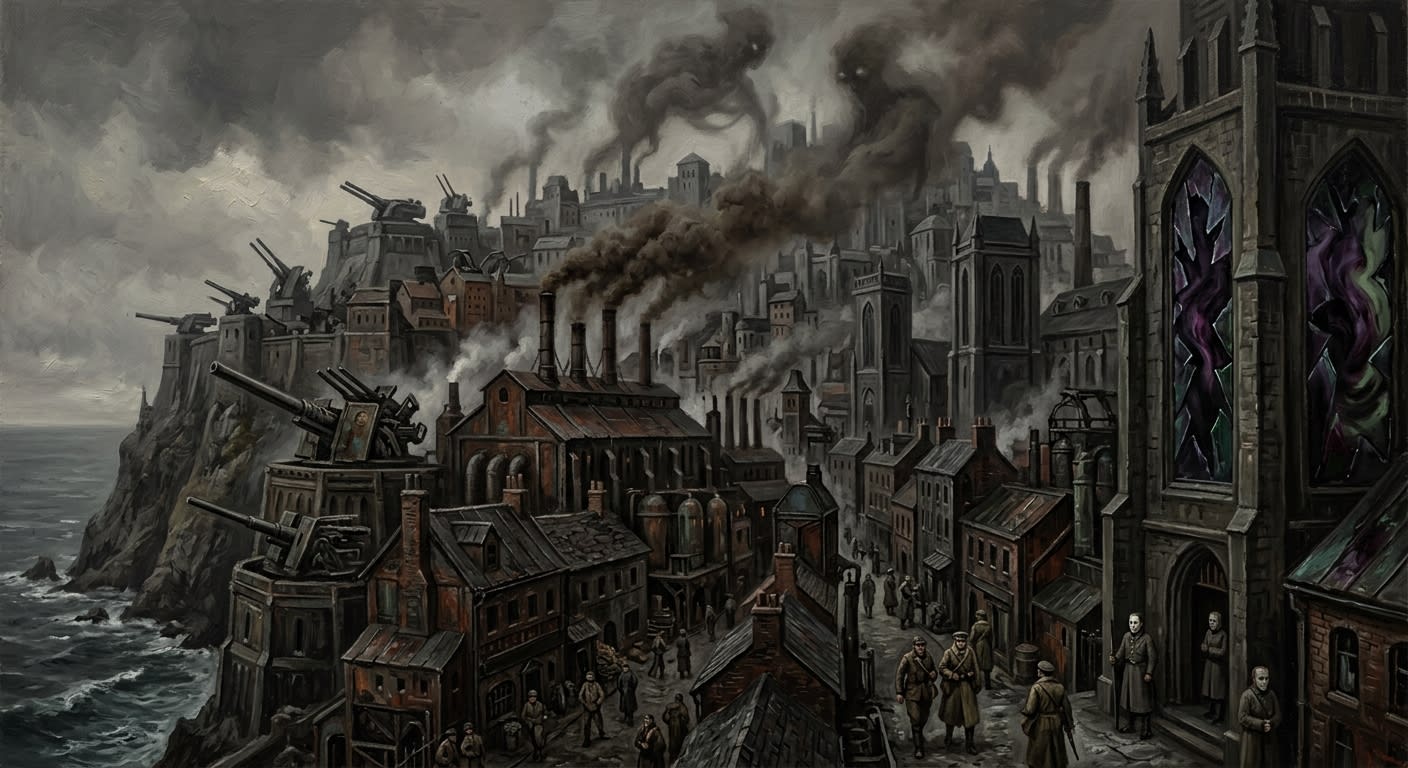
Its cliffs are cut into gun galleries and kiln vents. Smoke rises day and night from the bone-kilns behind the upper battery, pale at dawn, yellow by noon, black when the wind comes east. Refugees swear the smoke carries faces. The Bureau of Engineering calls the faces particulate distortion under stress light. The Bureau of Rites calls them devotional misperception. The children of Varna name them before breakfast and are slapped if they name the same face twice.
The redoubt's guns command the coastal approaches between the Sable Deeps and the southern hinge of Bastion-Constantinople. “Command” here means the guns discourage immediate treachery by ships, fog, pirates, hungry water, and captains who have mistaken weather for permission. The sea has never been commanded by artillery. Artillery merely reminds it that the Synod dislikes being ignored.
Varna's principal batteries are named with the optimism of men who know bronze cannot object: Saint Odran's Upper Teeth, the Lector's Shelf, Mercy Twelve, the Widow's Pair, and Battery Saint Phocas, which points east under a cracked lintel where sailors tuck fish bones before bad weather. The Phocas crews clean their guns with salt cloth and ash oil. The Widow's Pair fire in alternation because firing together once shattered every window in the tariff chapel and caused three clerks to confess to offences no one had yet alleged. Mercy Twelve has not hit its intended target since A.S. 183. It has hit many targets. The Bureau calls this acceptable dispersion.
Every cannon in Varna misfires once each year, always on the same day, always killing a priest. The Bureau has recorded this as recurring mechanical fault with sacramental coincidence. The phrase deserves preservation in a jar. Local gunners mark the date by drawing lots among chaplains, which has been condemned as superstition by three offices and adopted as scheduling by two.
Varna sits outside the Sagittal Line's canonical seven. It is a place important enough to die for and secondary enough to be denied comfort. It competes with Thessaloniki for fuel, clean rope, dry grain, Stainwright labour, reliquary crates, shipwright timber, Purity detachments, and the expensive little indulgence by which Strasbourg remembers a coast exists before the casualty rolls arrive.
#On the Redoubt and Its Harbour Bones
The first cliff works were raised after the Line hardened and the Black Sea became an eastern flank rather than a decorative inconvenience. Varna's old harbour had served merchants, fishermen, pilgrims, tax men, and criminals with the usual distinctions badly observed. By the time the Synod began fixing coastal watch positions in the A.S. 70s, the town had already learned the Black Sea's grammar: never trust a calm tide, never unwrap cargo at noon, never let a stranger name your boat before you do, and never assume a priest can swim.
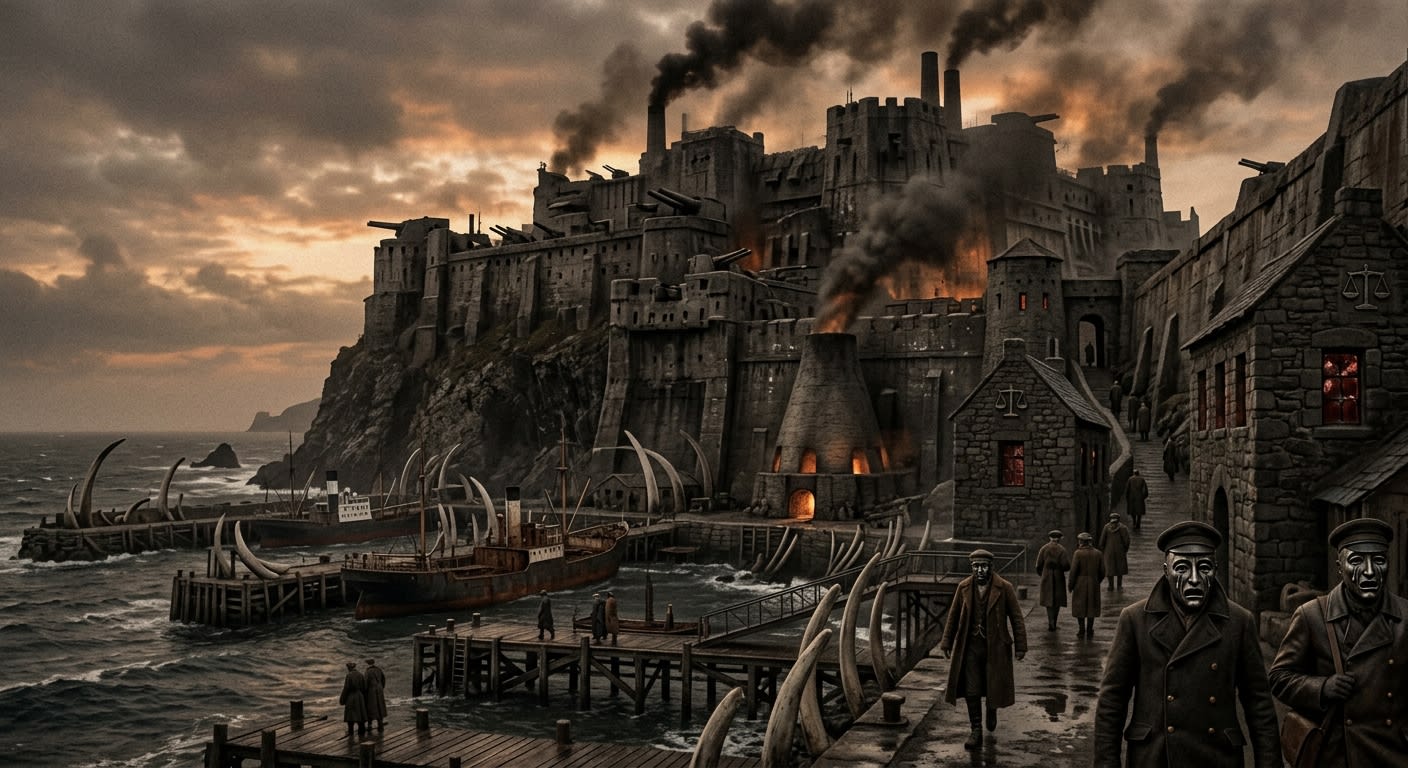
The Ashen Redoubt took its modern shape between watch battery and kiln yard. Guns were dragged up the cliffs in pieces, blessed, cursed, reassembled, and aimed toward water that had been innocent in no one's lifetime. The lower harbour received tariff chapels and quarantine hooks. The upper road acquired bone carts. The middle cliff filled with galleries, storehouses, shot rooms, clerk cells, prayer closets, and that essential organ of every Synod position: a room where all offices may argue while the weather worsens.
The bone-kilns came as practical piety. War produced dead. The marsh routes produced fragments. The Black Sea returned bodies in portions insulting to family registers. Varna burned what could be burned, rendered what could be rendered, sorted saint-bone from common bone when the distinction had papers, and fed bone-lime to coastal works that demanded mortar with a theological appetite. The smoke began showing faces soon after. It may have shown them from the start. Early clerks lacked the courage to draw what they saw in margins.
A coastal survey once described the bone-kiln smoke as “morale-supporting devotional atmosphere.”
Corrected after three refugee petitions, two gun-crew refusals, and one child identified his drowned mother in a vent plume above Battery Saint Odran. The atmosphere remains devotional. Morale has withdrawn its endorsement.
Varna's harbour is cut below the redoubt like a bowl placed under a mouth with bad intentions. Piers run narrow. Warehouses stand thick and low against spray. Fish stalls lean under Purity notices. Tariff chapels sit close enough to the water that high tide licks their steps, which the clerks call symbolic and the dockhands call a warning. The stones near the old mirror-market were replaced in A.S. 152. They still sweat salt during spring bell-rain.
To the south lie the coast villages and the routes toward Constantinople's wet hinge. To the west, roads crawl toward the Balkan interior, Sofia, and the Shipka supply shadow. To the north, patrol craft mark water that refuses chart humility. To the east, the sea keeps a black docket of vanished hulls, holy readings, enemy wakes, and songs fishermen refuse to finish in daylight.
#On Bread Visible and Bread Forbidden
Varna's most perfect atrocity occurred in A.S. 129, when a grain fleet entered harbour sound, dry, weighed, witnessed, sealed, and already doomed by proximity to jurisdiction. The cargo should have fed three zones. The people could see it beneath canvas. Children pressed faces against harbour rails and learned that bread may be present without being available.
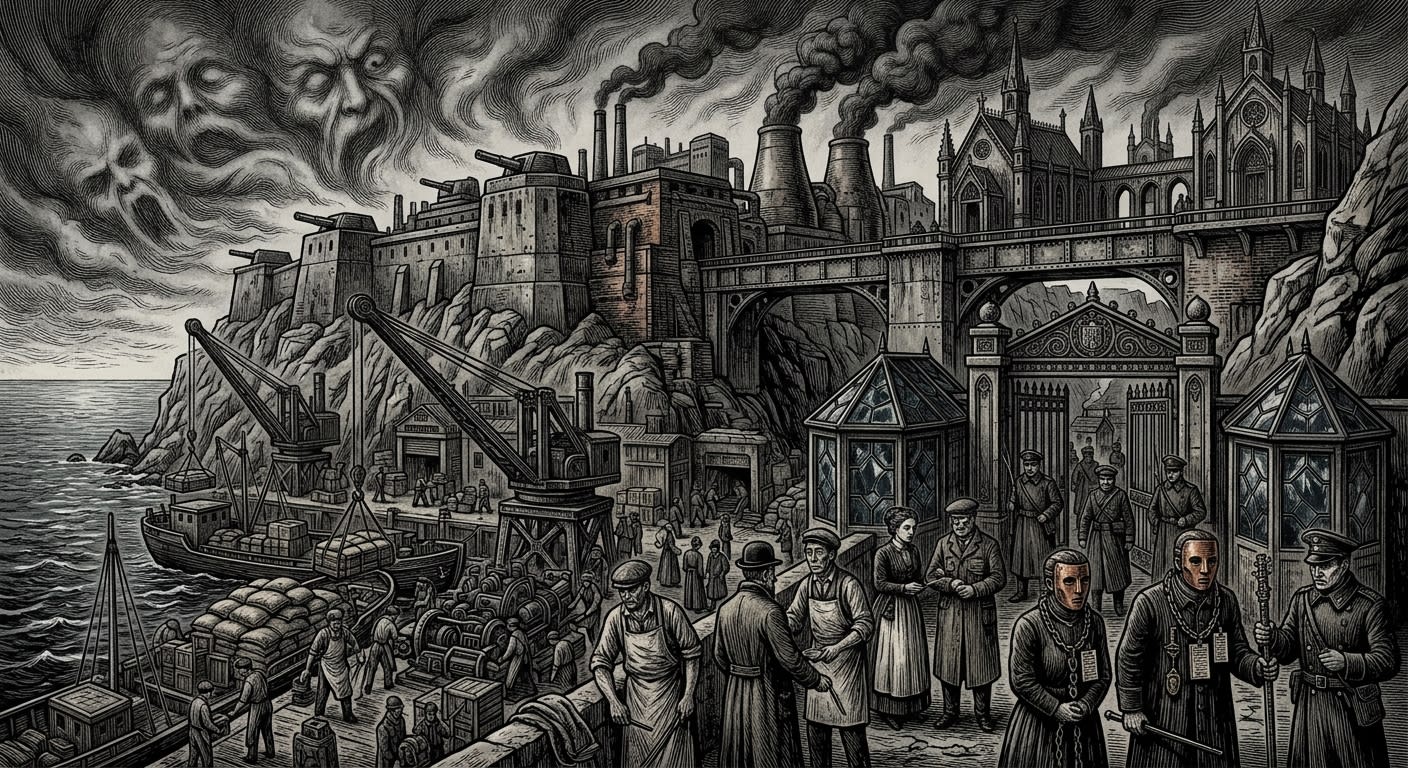
The Ledgers of Varna record the case. The Varna Grain Rot names the smell. Tithes claimed taxable strategic grain. Pilgrimage claimed route-sustaining ration. Settlement claimed emergency civic custody for refugee rolls swollen past printable arithmetic. Commerce claimed procedure, which is to say it claimed the table, the knife, the napkin, and the right to sigh while others bled.
The manifests carried errors fit for a classroom and lethal in a harbour: a colonel's name in three spellings, a parish with rival endings, ration categories sliding between war grain, pilgrim support, and civic sustenance. A clean clerk could have solved the matter with one stamp. Varna had clerks in abundance. Cleanliness varied.
HARBOUR SPOILAGE NOTE — DAY SEVEN, A.S. 129 Lower hold odour confirmed. White bloom on interior sacks. Dock rat found dead near Pier Three, mouth packed with grain dust. Mother's petition received with child present. Child examined cargo through rail gap. Petition returned unstamped due to improper queue origin.
Nineteen days passed. Grain sweated, sweetened, clumped, bloomed, and surrendered its usefulness to heat. The city moved from complaint to arithmetic. By day fourteen, a placard on the harbour gate read: WE CAN SMELL YOUR LAW. This was sedition, hunger, rhetoric, and accurate quality inspection. Purity confiscated the placard. Purity arrived in force on day fifteen. The Bureau of Purity brings correction before bread.
The crowd surged when the holds were opened and the rot became public. Staves answered bodies. Stones answered staves. Rifles concluded the exchange. Some dead fell on the pier. Some entered the harbour. Some were later classified as unverified civilian movement during public disorder, a category invented by a clerk whose soul deserves close examination by tongs.
Records converted deprivation into voluntary holy fast. The phrase “avoidable starvation” was proscribed. Tithes declared all calculations correct. The Litigant houses received partial fees because condemnation is a valid outcome. Varna learned that grain may rot, children may starve, rifles may fire, and the docket may still close with handsome posture.
The harbour still smells wrong in warm weather. Fishermen blame old rot. Clerks blame fish. Mothers blame the benches in the port court, which is the most accurate architecture in the city.
#On Glass, Skeletons, and the Water's Appetite
In A.S. 151, Varna taught the southern ports that Hell should not be sold by the handful. Sailors had begun selling raw demon-glass shards in the harbour as prayer aids. Prayer aids: the little phrase sits in the file wearing a lace collar over a rat bite. Widows, gamblers, penitents, mothers, and boys with coin enough to be damned cheaply bought warm slivers that promised departed faces, tomorrow's weather, hidden sins, or the taxman's soul.
The Bureau of Purity patrol arrived after the market had made blasphemy affordable. A crate stood on the cobbles near the harbour edge. It hummed according to some witnesses and merely waited according to others. Purity ordered it opened, then broken. Force is Purity's native grammar. Subtlety arrives there as a foreign prisoner and rarely survives questioning.
The shards did not scatter. They arranged themselves.
Each fragment caught a piece of the crowd. The crowd leaned forward. The harbour saw itself without meat. The reflections showed living skeletons moving independently of their owners: fingers lifting while fists stayed clenched, ribs turning toward water while faces stared at stone, skulls opening jaws no skin-mouth had opened. A harbour full of citizens watched its own scaffolding receive orders from elsewhere.
Panic began at the lip of the quay. The first reflected skeleton walked into the water. The woman whose bones it wore followed three heartbeats later. A rope seller pulled her back. Her reflection kept walking. He looked down and saw his own skull turn to watch her go. That was enough.
Bodies ran toward exits that jammed, carts that blocked, water that promised escape, and shards that had already given their bones instructions. Hundreds drowned. Purity fired over the crowd, then into it, then denied the second volley until cartridge tallies developed piety. The surviving sailors were hanged before the week closed. The harbour was salted, rung, reconsecrated, and cleaned with the zeal of men scrubbing a stain from the wrong side of cloth.
The Mirror Riot birthed modern shard discipline. Strait-Rats carved the rule into memory: never look into an unwrapped shard at sea. Polishers built a profession on the gap between raw catastrophe and mounted corruption. Saint Varda of the Lead Hands gained her closed-eye cult in lead boxes, ash-grit sacks, and Varna sleeves. Quietists point to Varna and say nothing. Revelators point to Varna and sell better theatre. Bureau-Friends pack decoy crates lively enough to frighten Purity and dull enough to avoid repeating the harbour.
Children in Varna are still slapped for playing skeleton-walk near the quay. The slap is traditional, corrective, and too gentle.
#On the City Between Greed and Pride
Varna belongs to the Black Sea, but sins treat geography as a negotiable instrument. Velmora counts the city through trade. Atheron admires it through theatre. Kargath hungers along the water. Maldrake sends ash by wind and slag by rumour. Varna survives because no single appetite has yet secured exclusive title.
Velmora's touch is old in the counting houses. Her Counting Kingdoms include old Balkan trade cities: Plovdiv, Varna, fragments of Thessalonica. Markets still bustle there in stories brought by refugees and worse, by merchants with clean cuffs. What is traded changes first in vocabulary, then in flesh. Time. Warmth. Memory. Years pledged against future safety. Loyalty mortgaged in slices. Children entered into accounts before they can count their fingers. In Varna, every harbour loan is inspected for Velmoran grammar: interest clauses that breathe, collateral categories that include “future obedience,” repayment dates written in ink that darkens near prayer.
The Hierarchy of Debt does not conquer Varna by banner. It stands behind relief credit after bad weather, widow advances after convoy loss, repair loans after shard raids, kiln compensation after priest deaths, grain notes after the city's own history has made hunger politically fragrant. A family that accepts three mercies may discover the fourth mercy already has a key.
Older coastal briefings classify Varna's debt-cults as ordinary war-profiteering.
Revised. Ordinary profiteers take advantage of hunger. Velmoran instruments teach hunger to sign its grandchildren. The distinction is visible on the third generation's wrists.
Atheron's influence wears brighter clothes. The Golden Masquerade of Varna is the Pride cult the Bureau will discuss in public because masks, balls, staged elevations, civic titles, and gilded mock courts make excellent cautionary plates. Its earliest surviving notices describe pageants in shuttered halls where merchants, officers, and port-court aspirants played at trial and execution beneath gold masks thin enough to cut lips. Converts were flattered into roles. A failed dockmaster became “Admiral of the Higher Tide.” A tariff clerk became “Prefect of Measure Absolute.” A minor officer became “Prince of the North Pier” and ordered six men to kneel before a warehouse door until dawn. Two never stood straight again.
Atheron and Velmora quarrel in Varna by making offers to the same weakness. Pride says: you deserve a higher place. Greed says: you deserve to own the stair. Pride gives a mask and a dais. Greed gives a contract and a key. The victim, being human and administratively fragile, often accepts both and calls the double chain advancement.
The Synod's countermeasures are as mixed as its guilt. Purity raids Masquerade halls because gold masks photograph well in reports. Tithes audits relief ledgers when the ink begins to smell of warm coin. Commerce tests tariff scales for false zero after the Relic Counterfeit Scandal showed Varna's calibration caskets could squeal under the hot needle. True Measure clerks file spoilage risk notices, bribe reports, and suicidal corrections until Records loses them in triplicate. The city does not lack warnings. It lacks offices willing to be warned before the profitable hour.
#On Trade, Smuggling, and the Useful Unclean
Varna's lawful harbour and unlawful harbour occupy the same stones at different bell hours. By day, the tariff chapels weigh grain, salt fish, coal, pilgrim bundles, timber, relic crates, ash-wrapped bones, ammunition, quiet-boxes declared as devotional hardware, and cargo whose labels have been written by men with very steady lies. By night, the same ropes, cranes, boats, alleys, and boys move the items whose legality depends upon which office needs them tomorrow.
Thessaloniki sends maskwright goods and contraband optics northward. The Black Sea Reliquary Flotilla sends quarantine warnings, damaged saints, and chainwrights who drink like men owed apology by water. Constantinople sends requisitions with seals so heavy the paper seems embarrassed. Inland traders bring grain when grain can be spared, which is never when officials say it is. Varna sends back smoked bone-lime, salted fish, glass rumours, debt instruments, dead names, and gunners with ears tuned to waves.
The port's under-trade learned from its catastrophes. Demon glass is wrapped, salted, boxed, lead-kissed, cold-washed, and never smashed in public unless the crate has been selected for theatre. Grain under dispute is watched by dockwives who can smell bloom before tariff clerks can spell it. Relic fragments are needled behind closed screens after the counterfeit panic. Loan papers are read aloud by three people: borrower, witness, and someone too poor to be bribed efficiently.
Varna's dock guilds are not guilds by charter. They are benches, families, knife circles, widow funds, rope partnerships, fish-house fraternities, kiln-yard oath groups, and old smuggling crews who discovered that writing minutes invites taxation. The oldest call themselves the Lead Sleepers, after the men who lay on crates during the first post-Mirror winter so no fool would open them for warmth. Younger crews call themselves gull-names and change them whenever Purity learns the cry. One group near Pier Four keeps a ledger made only of knots. Records has requested custody of it twice. The knots were untied before inspection and retied afterward with additional insults.
The tariff chapels know this, hate this, and depend on this. A clerk may stamp a release, but a dock circle decides which cart rolls first when fog thickens. A Purity captain may order a raid, but rope men decide which mooring line parts at the dramatic hour. A kiln foreman may requisition bones, but fishwives know which recovered dead belong to families who can still pay for names. Official power in Varna is a seal pressed onto wet wood. It leaves a mark. It does not make the wood dry.
The redoubt's soldiers marry into this economy or remain foreigners with rifles. A gunner whose wife sells fish learns which barrels carry glass by smell and which inspectors carry fear by posture. A chapel guard whose brother works the kilns learns that a smoke-face appearing twice in one week means the vent draw has shifted or a saint is irritated; either possibility deserves maintenance. A young officer from Strasbourg learns none of this and writes a report. The report returns with compliments. The officer leaves. The city continues without him, showing admirable restraint.
Pilot-king Nenos spits before saying Varna's name. This is professional punctuation, not insult. Sailors from Thessaloniki, Drowned Row pilots, Strait-Rats, glass runners, and quarantine skiff crews all possess their own Varna gestures: two fingers to the eye, thumb against tooth, rope touched before coin, silence after the name. The city is a lesson passed through hands because mouths near water are not always secure.
Purity pretends to suppress the under-trade. War purchases what survives suppression. Shadows monitors what War purchases. Tithes fines the decoys. Commerce issues revised handling schedules. Doctrine condemns the whole moral arrangement while enjoying the improved casualty ratios. Varna calls this Tuesday.
#On the Present Condition
As of A.S. 201, Varna remains held, armed, hungry, watched, useful, compromised, and ugly in the exact proportions necessary for continued funding. The redoubt guns still command the cliff lanes. The bone-kilns still smoke faces into the morning. The annual cannon misfire still kills a priest, though chaplain rosters now rotate with a sensitivity the Bureau refuses to call fear. The harbour stones still sweat during spring bell-rain. The grain courts still move faster when children gather at the rails. The shard market still exists in every form except the form Purity can conveniently smash.
Kargath's coastal pressure has sharpened since the Black Sea patrols widened. Sealed fish spoil in barrels. Water casks turn sour while remaining stamped. Grain captains report missing weight without breached hold or wet sack. The Bureau of Tithes has many terms for loss. Varna's dockhands use fewer and better ones.
Maldrake's ash arrives when Thracian winds turn, settling on cannon mouths, chapel ledgers, fish scales, and the saint tiles above the kiln doors. The Year of Ash Rain remains the city's private calendar for coughs. Old women still cover bread before bells if the east wind tastes metallic.
Velmoran keys appear in relief ledgers under new names. Atheronic masks reappear after every raid in cheaper gold and better grammar. True Measure Zealots keep double chalk lines at the tariff chapels and are hated with the intensity reserved for useful irritants. Nenos avoids the name. Varda receives lead slivers in workshop cuffs. The harbour children know skeleton-walk, holy-fast rhyme, priest-lot jokes, and three songs about smoke-faces, all forbidden and all accurately remembered.
The city keeps its own private calendar. A.S. 129 is counted in noses: old rot, wet canvas, fly-line, Purity powder. A.S. 151 is counted in hands: eyes covered, rope touched, shard wrapped, child slapped away from the quay. The annual priest-killing is counted by lots drawn in the sacristy behind a locked screen while the public sermon praises voluntary courage. A gunner told me the lot box sounds different when the condemned token is inside. I believe him. Men who listen to cannons know the voice of a box.
Refugees arrive by road and water with sacks, saints, debts, false names, legal names, and children too tired to lie properly. Varna sorts them in three queues: harbour labour, kiln labour, and relocation pending. Relocation pending is a bench under a leaking roof where families wait until their paperwork dries, their sponsor pays, or their usefulness becomes visible to an office with a cart. Some vanish into fish sheds. Some take loan bread. Some join cliff crews. Some are sent inland with tokens that chime badly under rain. The city calls this intake. The refugees call it weather, because weather at least has the courtesy not to request signatures.
There is laughter in Varna, naturally. Grim places laugh or split. Dock boys imitate tariff clerks by arguing over dead gulls: taxable carrion, devotional omen, maritime salvage, or Settlement poultry. Kiln girls draw smoke-faces on walls with soot and give them officials' names. Gunners tell priest-lot jokes so obscene the chaplains pretend deafness until their own number is drawn. Old women at the fish steps sell little lead charms shaped like closed eyes, unofficial Varda tokens, and call them curtain weights when Purity passes. A city under pressure develops comedy the way a wound develops pus. Ugly. Diagnostic. Alive.
Varna has learned nothing pure. Purity is a luxury for inland sermons. Varna has learned sequence: smell first, stamp second; wrap first, preach after; count priests before misfire day; read debts aloud; never stand between a hungry crowd and visible bread; never smash Hell where the public can see the fragments arranging themselves.
The Synod holds Varna because losing it would open the coast, shame the Flotilla, weaken the Constantinople screen, invite Kargathite water nearer the hinge, give Velmora another counting house, and provide Atheron a stage with excellent acoustics. Varna holds the Synod because ports know their own value and invoice accordingly.
Recent morale circulars describe Varna as “steadfast, purified, and reconciled after historic trials.”
Revised for restricted officers. Varna is steadfast because retreat routes are worse. It is purified whenever rain is strong enough to move blood. It is reconciled to nothing except the next bell, the next crate, the next smoke-face, the next official sentence that mistakes survival for consent.