

#On Their Nature
"Ash keeps no muster roll." — Drax, marginal gloss, unfiled
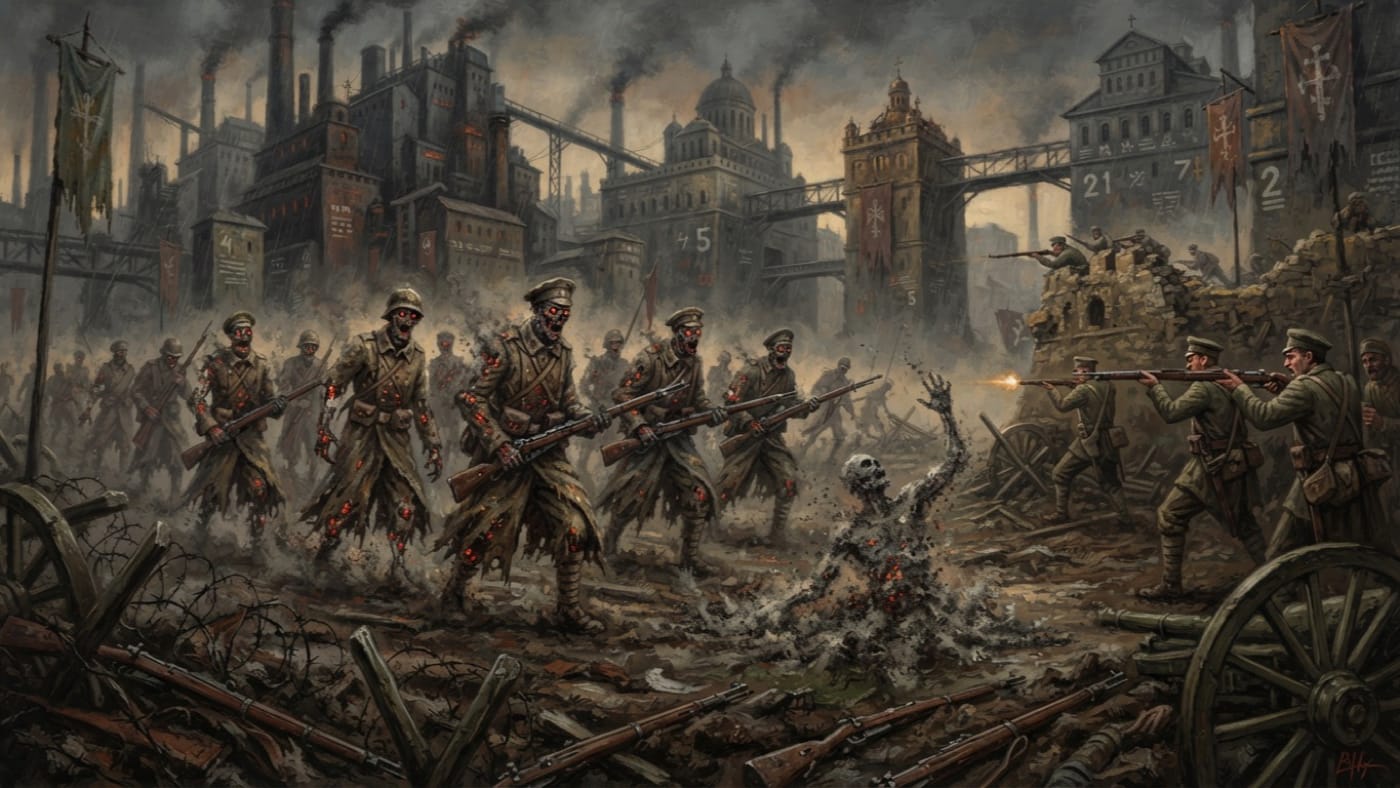
The Raging Dead were warriors who died in battle and whose fury did not die with them. That is the whole definition. The Church has spent a long time failing to improve on it.
Their bodies are ash and ember. The grey residue of a burned thing, with live coals scattered through it, is held in the shape of a fighting man by rage. The rage does the work sinew once did. It keeps the arm fixed to the shoulder and the shoulder fixed to the advance. A living soldier is bound together by tendons and orders. The Raging Dead are bound together by a grievance that has outlived its own particulars.
They have forgotten the cause. The published dossier on Maldrake adds that they have forgotten their names, and I see no reason to quarrel with my own earlier work. Whatever war each of them died in is gone, and so is whatever wrong first set the jaw and closed the fist. The fury remains whole and unanswered, like a petition whose petitioner has died and whose subject the clerks can no longer read.
No source names the armies they served in life. None records a rite of recruitment, an oath, or a moment when any of them chose Wrath. I will not supply one. The Bureau of Purity would like every servant of Wrath to have signed something. So far as the record shows, these simply failed to stop.
#On Their Destruction and Return
They can be destroyed. The source says so plainly, and the plainness is the trap. A Raging Dead warrior can be scattered, its ash thrown across a firing step in a heap no taller than a boot. It can be burned out until its embers go grey. It can be worn down, struck again and again until too little remains to hold a shape. The Church may record each of these as destruction, and it does.
A warrior so scattered is dead in the full canonical sense and may be struck from the reckoning.
A warrior so scattered is dead in the full canonical sense and may be struck from the reckoning.
A warrior so scattered has lost its body. So long as the anger remains, it reforms. The preceding sentence is withdrawn. Any clerk who has already struck a name from the reckoning on its authority is reminded that the Raging Dead have no names to strike.
That is the condition, and the only one on record: while the anger remains. The body is the lesser part of them. Break it and you have broken a vessel. What filled the vessel was never in the ash. Some have been fighting since the Sundering of 1 November A.S. 45, which puts the oldest of them in the field for the better part of a hundred and fifty-six years. I do not claim each one has served that long. Some have, and nobody has produced a way of telling which.
What the record lacks runs longer than what it holds. It does not say how long a scattered warrior takes to stand again, or where it stands, or whether it needs its own ash or makes do with whatever lies nearer. It sets no limit on the number of returns. It names no blow, rite or substance that settles the matter. The Church's general rules on demonic bodies hold that a slain demon does not rise where it fell, and that nobody can confirm it reforms anywhere else. The Raging Dead reform. Doctrine has not reconciled the two statements. I decline to reconcile them on its behalf, because that would require me to know what the Raging Dead are. I know only what they do.
#On Their Place in Wrath's War
They belong to Maldrake, Sin-General of Wrath. His war presses the Thracian Plain north of Bastion-Constantinople, and his territory spreads out through the Iron Wastes of Thrace. He commands a true army, which no other Sin-General can claim. Its trouble has never been recruitment. Its trouble is direction. Without his will, the host would turn on itself, on the ground beneath it, on anything that held still. Unaimed Wrath spends itself on whatever stands nearest.
The Raging Dead are the purest case of that trouble. A living servant of Wrath at least remembers an enemy. These remember none. Their anger has nothing left to fix on, because the object went with the name. Something aims them at the Sagittal Line rather than at the next hill or the next of their own kind, and it is not their own memory. I record the army's need for direction because it is documented. I record no officers, regiments or particular means of aiming the Raging Dead, because none are documented. The Bureau of War's fondness for orders of battle does not oblige me to draw one.
Nor will I assign them to the Hellbow Legion or to any breach of the Line. They fight in Thrace, among Maldrake's servants, against the Church. The record leaves them there.
#On the Other Dead and the Forged
The Church's soldiers call nearly everything in Wrath's host by the first name that comes to hand, and the clerks have inherited the confusion. Some distinctions, then.
Ember-Soldiers keep their charred flesh, and their weapons have grown into their hands. The Raging Dead are ash, and nothing in the source puts a fused blade in their fists. The Hammered were made in the Eternal Forges and never had a human past. The Raging Dead had one and lost it. The Crucible-Born keep their intelligence, their personality and fragments of memory, and they chose their condition. The Raging Dead keep anger and nothing else the record can name. The Ash-Wraiths of the older Lore Book are charred shadows of burned men, and no source makes the two one thing. These are separate entries. A Raging Dead warrior is not known to pass through any of them as a stage.
The Char Fields need more care. On those battlefields the fire never cooled. Figures move through it still fighting engagements that ended long ago, unaware that they are dead and unable to stop. The likeness to the Raging Dead is close enough to tempt any clerk with a quota. Yet neither the dedicated account nor the published dossier says the figures of the Char Fields are the Raging Dead. I note the resemblance and leave the identity unproven. A resemblance justifies opening a folio. It does not justify binding two folios into one.
#On the Church's Measures
The source supports one thing only: their bodies can be broken. Scattering, burning out and wearing down all work, if the body is what you are measuring. The Church has no documented way to end the anger that rebuilds it.
The measures it does have are aimed at the living. The Discipline Protocols forbid any action without orders and any blow without authorisation, on the theory that structure contains rage. In practice structure breeds frustration, and Wrath feeds on frustration. The cooling rituals of cold water, ice and measured breath help with small angers and do nothing for deep ones. Rage fasts impose pacifism and confine those who cannot keep it, and some of those confinements never end. Confession rests on the hope that rage spoken is rage released. It sometimes helps, and sometimes creates new grievances. The Doctrine of Cool Hatred tells the soldier to kill demons out of duty rather than hatred, which is admirable and almost impossible. Those who show the physical marks of Wrath's transformation are executed, and the Church calls it mercy.
None of these is established as a remedy for the Raging Dead. A rage fast cannot be imposed on ash. Nobody hears the confession of a thing that has forgotten what it would confess.
I draw one inference here myself, and Doctrine has not ratified it. The only protection the Church holds against the Raging Dead is the one it already applies to its own soldiers: send them to die cold. The record does not say whether a man who dies cold stays dead. And the order to die that way comes from the same offices that refuse pensions on clerical technicalities, ration bread by quota, and supply the very grievances Maldrake depends on. Wrath's own lore concedes that such grievances are often real. The Church produces them faster than its confessors can hear them.
#On the Record That Remains
Every Raging Dead warrior once had a name, a company and a reason. The reason may have been a good one. Wrath's servants often began with genuine wrongs, and nothing in the record entitles the Church to assume these began otherwise. The names are gone, the companies unknown, the reasons burned to the same grey as everything else. Nobody alive can say whether a given heap of ember fought for the Church or against it before it came to fight for nothing. Doctrine has issued no ruling on what the Creator will make of them, and I am not paid to anticipate the Creator.
The Ledger cannot accommodate them. A death is entered once. A casualty that reforms was either entered falsely the first time or must be entered again with no name to enter it under. Either course offends the clerks. Breaking the body gives the Church a figure but no ending. The figure will be entered, as the Bureau requires. I decline to call it an accounting.