

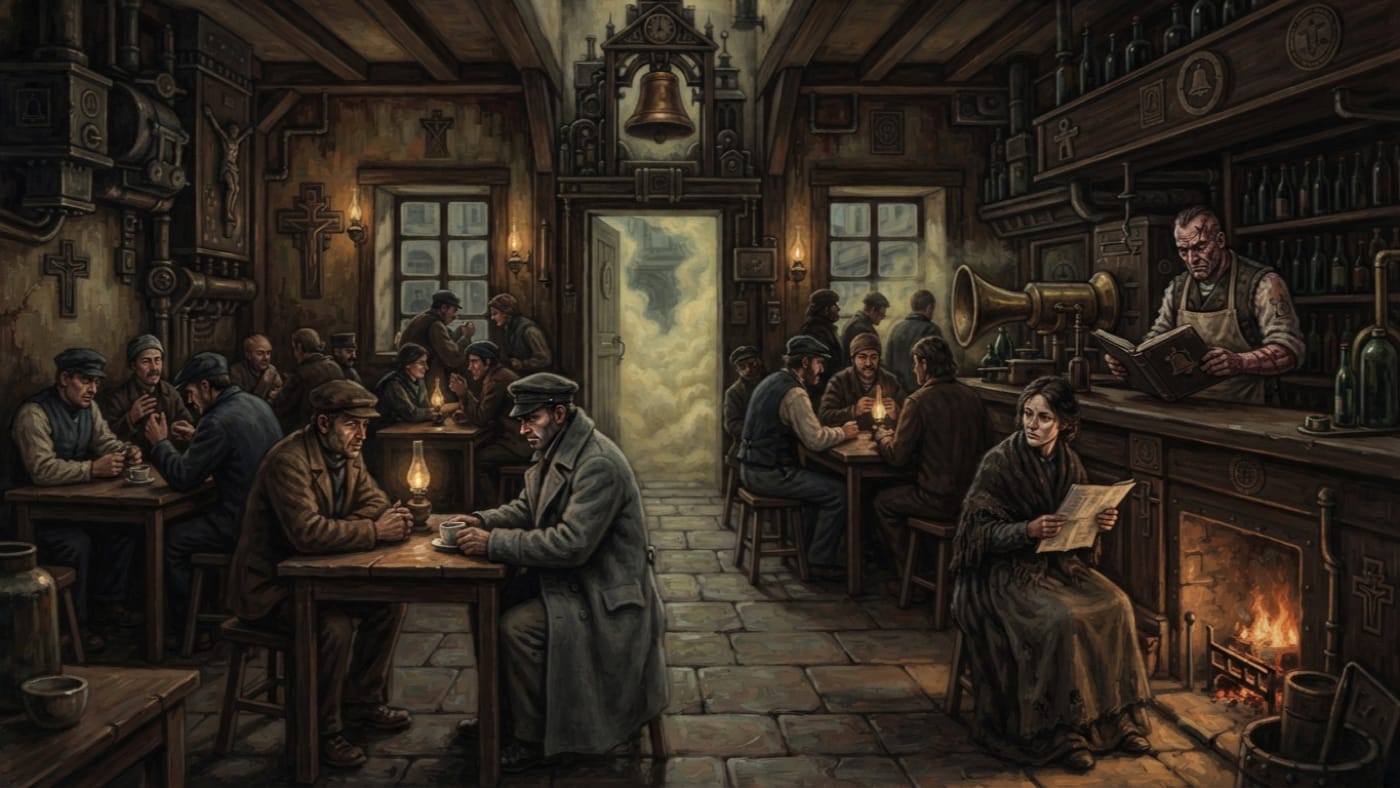
#On the House and Its Quarter
The Red House is a tavern in the River Quarter of Strasbourg. That is the whole of what the Bureau of Records will confirm without a requisition. Who first poured there, who holds the licence now, and why a house should be called red when every other house on the quay is the colour of wet soot are matters for which I can cite no folio. I will not supply them. Some of my colleagues invent where the archive falls silent. I prefer to leave the archive silent and look at its readers.
The River Quarter is where the capital remembers that it stands on a river. Up the hill, the Sanctum Mile conducts the business of Heaven in triplicate, under spires that cast shadows onto other spires. Down here, the Rhine conducts the older business of barrels. Grain comes in from the west and refugees from the east, in proportions the dockmasters prefer not to discuss. Wine, wool, rope and foreign accents come in from everywhere. On the quays the Bureau of Purity stands with its lists, opening bales for heretical books and smuggled relics. By the most charitable estimate it finds one in ten. The merchants budget for the other nine.
A district of that kind needs somewhere to sit down. Sailors want drink, and merchants want a table out of the wind and someone who knows what the tolls will be at the next lock. The priests who minister to both want to be seen ministering. The Red House supplies the table. Its reputation is that information there flows more freely than the wine. That is a slander on the wine, perhaps, in the most charitable reading known to the Bureau, although I have never heard anyone defend the vintage.
#On the Recognizable Strangers
In the margin of the city's own entry I wrote that every spy in Strasbourg drinks at the Red House, that they all know one another, and that they pretend otherwise. The sentence exaggerates, as a margin should. Nobody has taken a census of the city's informers, and anyone attempting one would find his name on it before the ink dried. The figure is wrong. The arrangement it describes is accurate.
Observe the room as any patron could. A man in a grey coat sits at the corner table. He orders a second cup and never touches it. The woman by the hearth knows him well, though not his name. Names are vulgar. She knows his second cup, the hour he arrives, the hour he leaves and the way he turns a coin twice before setting it down. He knows her shawl, her cough, and her habit of reading a shipping manifest upside down so that the people beside her assume she cannot read. Each could pick the other out of a procession of ten thousand. Neither will ever admit it.
Recognizing a face is one thing. Knowing whom that face serves is another, and that knowledge is entered in a ledger with too many columns. The grey coat might report to Purity, to a merchant house, to a cardinal's household, or to the Bureau of Shadows, which does not exist. He might report to all four in rotation, according to the feast calendar. The shawl knows his habits and nothing of his paymaster. He knows exactly as much about hers. Each of them sits in the same room with this mutual, perfect ignorance and orders another round.
No treaty is recorded. No charter of neutrality hangs behind the bar, and nobody has sworn on a relic to keep knives sheathed between the first cup and the last. Nothing has been signed. In this city that may be the most remarkable fact in the entry. I attribute the pretence to professional courtesy, and that courtesy is a strange thing. It is the courtesy of two confessors who have each heard the other's sins through the screen and agree, every morning in the sacristy, to talk about the weather.
#On Custodial Oversight
A room full of practised listeners is still a room, and every room in the capital answers to someone. Every tavern in Strasbourg operates under the surveillance of the Censorium of Taverns. Its inspectors are charged with monitoring drinking songs for heresy and limiting laughter after the ninth hour. Their instrument is the List of Laughters. This ledger is updated nightly and records the chuckle, the guffaw and the chortle with the same indifference a tithe-clerk shows to turnips. A house that exceeds its quota can expect fines, then interrogation of its patrons, and finally closure. The ordinance does not grade sedition by the quality of the joke.
"operates under the surveillance of the Censorium of Taverns"
Under the Bureau's standing correction of terminology, "surveillance" is Rationalist jargon and is to be replaced with "custodial oversight." Read the sentence above, and every sentence like it in this Codex, accordingly. The inspectors are unchanged. So is the ledger. The word has been reassigned.
The River Quarter adds Purity's own presence to the Censorium's. The district's agents are there for the cargo, but a man who spends his day opening bales and smelling for heresy does not stop at the tavern step from delicacy. Whatever arrangement the Red House keeps with its inspectors, if it keeps one, is not public. I have seen no licence, no exemption and no receipt. A sensible reader assumes that the house is watched exactly as closely as every other house, and that it knows this.
Watching a tavern full of watchers produces a curious bookkeeping. The Censorium wants to know whether anyone sang. The patrons want to know who noticed whether anyone sang. Purity wants to know what was carried in under the singing. Each party enters what it saw in its own ledger, in its own hand. None of the ledgers is ever compared, because comparing them would require the Bureaus to admit to one another what they had been doing in a tavern.
#On the Traffic Outside
The Red House would be an ordinary alehouse on a dull street. Its reputation comes from the river. A district that receives foreign goods also receives foreign news: the price of grain at Mainz, rumours of a bastion's rations, word that a Confessor in some southern see has been recalled with a suddenness that interests three Bureaus at once. Sailors carry these things the way they carry lice, without intending to and without being able to stop. Merchants buy and sell them alongside the wool. Refugees bring them up from the eastern docks in the only currency they still own. A tavern near enough to that traffic needs no ambition to become a market. It only has to keep its shutters open.
The Quarter has its famous traders. Captain-Importer Thessaly Vorn deals officially in wine and wool and, by wide report, in a good deal more. She has never been arrested, and Shadows reportedly finds her useful. She does business in the same district. Whether she has ever crossed the threshold of the Red House is not established, and I decline to establish it for her. She has enough people inventing things about her already.
A cynic would observe that a city which knows where its informers drink has saved itself the cost of finding them. A conspicuous meeting place is more convenient to watch than a hundred discreet ones. I am a cynic. The observation is mine. No Bureau has endorsed it, and a Bureau that thought of it first would never say so.
#On the Ninth Peal
At the end of every argument in Strasbourg there is a bell. The Red House sets neither its opening hour nor its closing. No tavern in the capital may. The Bureau of Bells keeps the hours for every house, and at the Ninth Peal curfew falls on the River Quarter as it falls on the Sanctum Mile. Fog is pumped through the streets to kill whatever song has outlasted the bell. To laugh past Ninth is sedition. To drink past Ninth is treason. These rules hold in a cathedral close and in a quayside tavern alike, and the quayside tavern has more to lose.
Running a drinking house under those ordinances is a trade of its own, and the curfew-fog tavern runners who practise it would make passable choirmasters. They space the laughter and stop a chorus as it begins to rise. They seat the room so that no table grows large enough to count as a congregation. They spend the last hour before the bell bringing the noise down by degrees, the way a censer is swung lower as the procession reaches the altar. A house that trades in conversation has more need of these skills than one that trades in drink, because conversation does not stop when the cups are empty.
So the Red House keeps its hours. It opens when it is allowed, fills with strangers who are not strangers, and empties at the Ninth Peal into fog that smells of coal and sanctity. Everyone who leaves knows who was there. Nobody says so on the way out. Tomorrow the grey coat will order his second cup again.