
#On the Curfew Signal
A street before the Ninth is a place. After it, the street is a file.
The Ninth Peal is the dusk curfew signal of the Synod's civic day. Households call it the Ninth Bell, and the Codex entry under that name describes the same signal at the same hour. That entry follows the peal indoors, to the kneeling family, the clerk's inkpot and the Hymn of Closure. I am not going to repeat it. This survey, made in A.S. 201, stays outside on the wet paving, where the peal changes what a walking body means.
Before the Ninth, a woman crossing a ward with a basket is a woman with a basket. After the Ninth she has to account for herself. The basket now needs a purpose, the purpose needs a route, the route needs a lamp, and the lamp needs someone of standing to have seen it. The bell does not forbid her to walk. It makes her walking conditional, and conditions are written down.
The households kneel at their thresholds, confess, and wait for the hymn. Their shutters come down wet from the fog. The street then belongs to the people who are permitted to stay in it.
#On the Authority Behind the Hour
Four authorities stand behind the hour, and lazy clerks treat them as one.
The oldest is custom. Towns rang their own evening bells long before any office came to inspect the ropes. The first Ninth Peal is undated, and I will not give it a birthday to please the almanac trade.
The second is the Office of Bells, constituted in A.S. 52 under the provisional council. It took the scattered ringing into one administration, with charts, keys and calibration logs. It governed the sound itself. It did not yet govern what a citizen had to carry once the sound had died away.
The third is the Curfew Ordinance of Quiet Hours, drafted in A.S. 94 by Vicar-General Anselm Rihn to standardise night administration across the Rhineland. Rihn did not invent the Ninth. He inherited it as he inherited roads, culverts and hungry levies, and he asked of it what he asked of everything he inherited: what it moved, and where. The Ordinance treats the peal as a threshold. Before it lies ordinary traffic. After it begin the regulated conditions of crossings, passes, lamp classes and witness. Rihn wrote for the Rhineland. Other provinces copied him at their own pace and with their own amendments, some of them sensible.
The fourth is the Bell Codex, ratified in A.S. 115, which fixed the present standard for calibration, licensing and the peal order from earlier practice. When the Codex and a local tower disagree about pitch, the Codex wins. When they disagree about which lanes a Warden must close, the matter goes back to the Ordinance, and from there to whichever magistrate is still awake.
#On Passage After the Ninth
Rihn understood that you cannot make a city still. You can only make its movement legible, and the Ordinance does that with paper and oil.
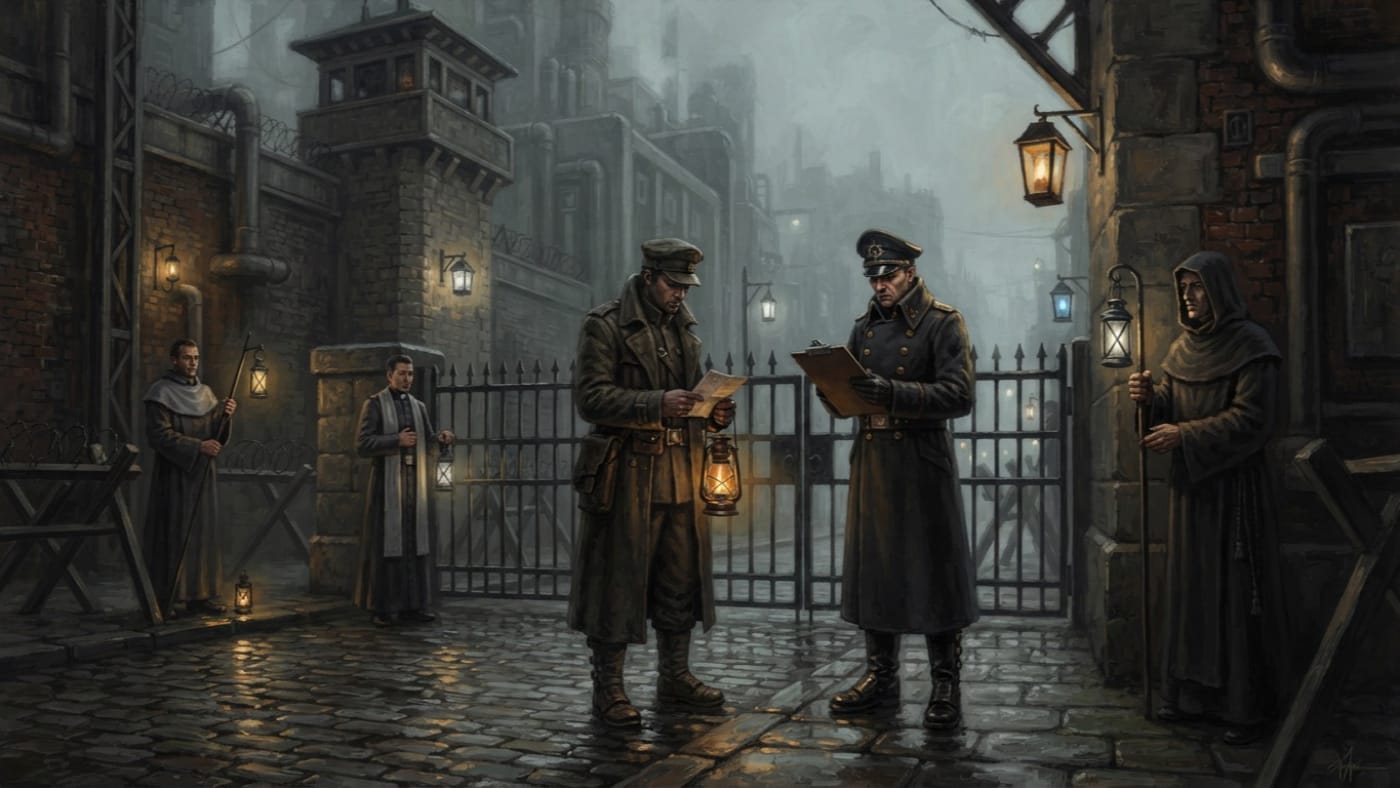
A night pass is a sheet folded in a prescribed way, so that the countersignature sits inside and the route sits outside, where a Warden's thumb lands on it first. It names the bearer, purpose, route, hour, lamp class and expiration. A pass that is properly folded and in date shortens the questioning. A pass that is folded wrong lengthens it. A pass whose countersignature has run in the damp counts as an admission, and the citizen carrying it will be told so at length.
The lamp gives the pass its outward form. Grey for Consolator duty, amber for work exemption, white for mortuary clearance, blue for medical passage. The hard-authority shades are reserved. Hood angle matters, and so does wick height. A lamp carried low suggests concealment and a lamp raised high suggests a signal, so the honest citizen carries his at the height of his belt buckle and sweats.
Crossings are where all of this is examined. The civic Wardens hold the marked choke-points with closure tables, and a closure table is Rihn's thinking in its plainest form: which lanes shut, which stay open for carts and the dead, and which open only to lamps of a given class. A citizen does not choose a route after the Ninth. The table has already chosen it, and the citizen either follows it or explains himself.
Where the Wardens are thin, the Ordinance permits "auxiliary vigil personnel, locally licensed, subject to revocation without notice or appeal." The Lantern Brotherhood was walking the alleys before that clause existed. The clause made it useful to the state and easy to disown. A Brother's hooded ash-oil lantern has no seal of office, yet a citizen stops for it as quickly as for a Warden's lamp, and quicker in the outer wards, where a Warden's complaint is filed and a Brother's is settled on the spot.
The Brotherhood's Triangle of Witness shows the arithmetic of night enforcement. Anchor holds the visible choke-point with a fixed lantern. Blade, a moving pair, does the searching. Echo walks one lane over, out of sight, and writes the report. Three lights give one account, and the account agrees with itself in every particular, because one man wrote it and two men signed it.
The Ordinance also placed Licensed Consolators at the crossings: persons of approved temperament in grey stoles, with stamped lanterns and the fourteen Approved Comforts. They were meant to stand beside the Wardens and lower the temperature of a street that had just been told to stop. They do. They also see who comes back to the same crossing three nights in a row, which mother has no pass, and which Warden drinks before his round. The Lantern Mercy Preachers grew out of that knowledge. They speak the approved phrases, and the phrases serve them well as instructions. After the Ninth the street is restricted, but it is never empty.
#On the Sounds Still Permitted
The Ninth is described as the beginning of quiet. Quiet is a licence, and licences are issued.
When the peal ends, the Orison vents open in the principal cities and curfew fog spreads along the gutters, into the taverns and up the steps of billets. It is damp and it catches in the throat. Shutters sweat under it. A man who tries to sing through it coughs before the second line, and his chorus breaks into hacking. Orison calls it the fog of sanctity. I have breathed it in and will say only that it works. The Bureau publishes no account of what is in it, and nobody who breathes it would describe it as harmless.
The Censorium of Taverns forbids laughter and song after the Ninth. It does not forbid drinking in a licensed room with the shutters muffled, the benches set apart so no crowd can form, and the tunes approved. The Curfew-Fog Tavern Runner earns a living in the space between the prohibition and the licence. He hangs quiet-cloth, keeps a bribe tin, and knows which inspector coughs on the stair. The Synod tolerates him because a room full of murmuring drinkers tells the Lanterns more than an empty one.
Other voices go on with full authority. Confession clerks walk the lanes with ledgers. Consolators speak at the crossings. Echoes write. Up in the towers the Bellwardens keep their logs. They are not civic Wardens and they arrest nobody. They calibrate tension, prepare the curfew sequence from the chart, wear the toll-key chained to the wrist, and record every deviation from the schedule. An emergency peal overrides the Ninth and everything else, and the citizen who hears one after curfew has to decide in the dark whether his pass covers it.
Along the Sagittal Line, which runs from the northern coast down to Bastion-Constantinople, the Bureau of War keeps its own cycle of First, Third, Fifth and Ninth. At the Ninth, fog fills the billets, lamps go out except the sanctioned ones, and the men submit in the prescribed form. Doctrine holds that a front whose Ninth sounds without interruption has not broken. I have taught that sentence to students, and I note here that it is a doctrine about the bell. The Ninth closes the soldier's day exactly as it closes the citizen's. What it proves about the trench beyond that is left to the trench.
#On Interruption and the Corrected Record
The Bureau of Records keeps in its annals an account that its own stamp contradicts.
According to the annals, the Cloister of Concord once suspended the Ninth Peal for one evening so that the city could celebrate the Triune Hearth Compact. The bells were silent. With no signal to mark the change, the queues dissolved, the kitchens spoiled their pots, and the taverns went from song to riot. The suspension ended, and the annals record that the peal was restored.
For this survey the account matters at the crossings. On that evening no pass expired and no lamp-class came into force. Wardens could not close lanes that had never been formally closed. The Brotherhood had no threshold after which a walking body became its business. Every instrument of Rihn's Ordinance waited for a signal that did not come. The account describes a city without a bell, and it also describes a law with nothing to set it going.
The Cloister of Concord once suspended the Ninth Peal for a single evening, and the Ordinance's conditions failed to take effect.
Corrected by Records stamp: "The rumor of a missed Ninth Peal is an invention of Rationalist agitators." The annal and the stamp are both genuine Records documents. Neither gives a year, and neither names an officer. This survey keeps both in the file and has no authority to settle between them.
In the Rhineland the crossings stand as the closure tables set them. Passes are folded with the countersignature inside. Lamps are hooded to class, the Echo's ink is fresh, and the Bellwarden's chain is checked each morning. The citizen hears the peal and works out, on the spot, how far a dated piece of paper will carry him.