
#On the Compact Below the Harbour
“Insufficient membership: the most delicate phrase ever used for a room in which the chairs remember more men than Records admits were seated.” — Lübeck correction slip, unsigned.
The Salters' Compact of Lübeck owned the brine cellars, and by owning the brine cellars it owned patience, winter, rot, fish, meat, barrel-law, ship provisioning, garrison endurance, and the small domestic tyrannies by which an empire survives until spring. Grain has glamour because hunger is theatrical. Salt has power because decay is patient. A sack of wheat may feed a soldier once. Salt keeps him fed when the road freezes, the ration train stalls, and the quartermaster discovers that courage becomes philosophical after the third bowl of thin gruel.
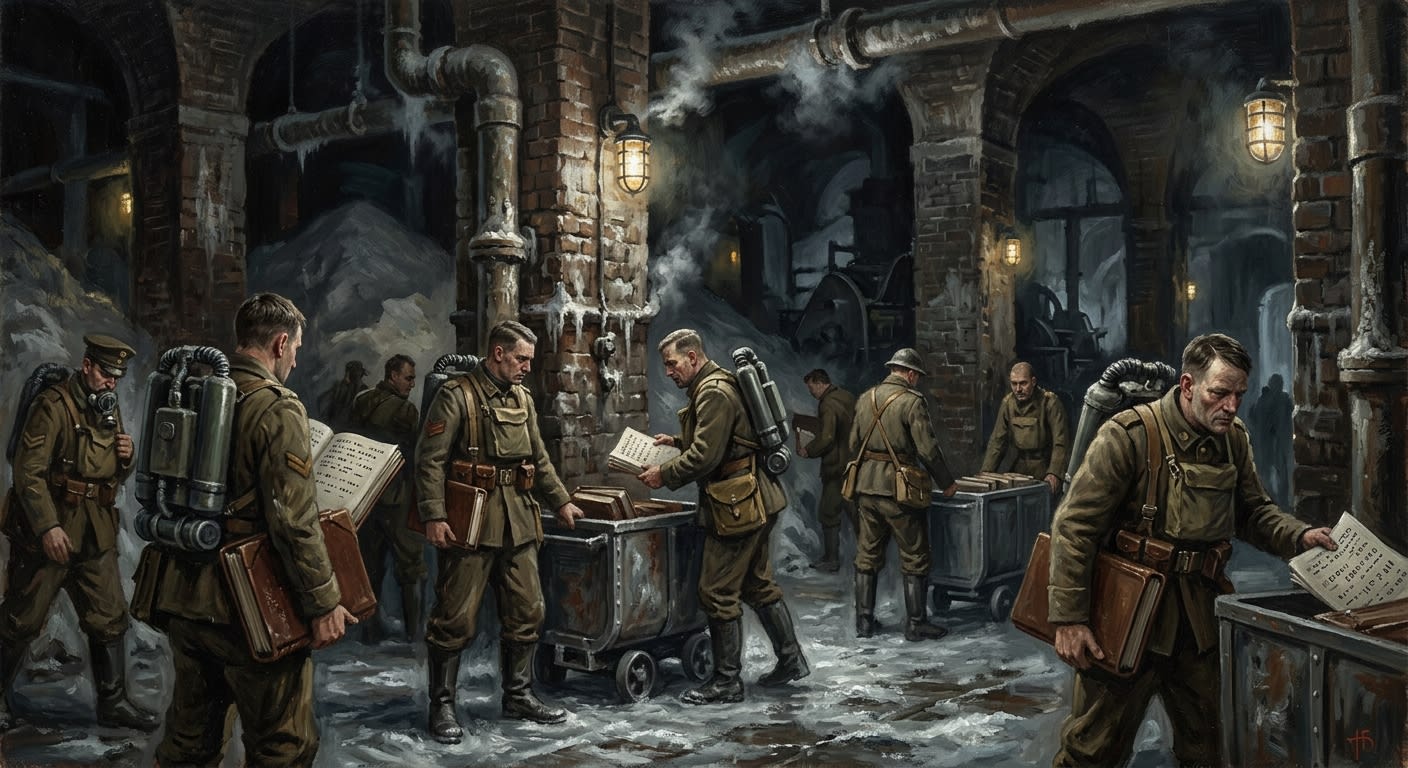
The Compact's halls sat below the old salt exchange, under street level, where the air stung the eyes and every wall seemed to sweat accusation. Its members dressed plainly, spoke softly, and made other merchants look gaudy by comparison, which is a useful trick when one wishes to hide avarice behind mineral austerity. The Grain Merchants were fat; the Coopers were loud; the Salters were dry. Dry men are dangerous. They preserve evidence by instinct.
#On Brine-Cellar Accounts
The Compact's genius lay in its units. Grain can be counted by sack, timber by beam, rope by coil, wax by block, barrels by volume if the cooper is sober and by litigation if he is not. Salt lends itself to better sin. It dissolves. It mixes. It enters fish, meat, hides, hospital poultices, embalming stores, road grit, shrine kitchens, artillery preservative, and the damp seams of every contract whose drafter hopes the Bureau of Tithes is reading too quickly.
The Salters maintained debt accounts in brine-cellar codes: concentrations, curing days, evaporation loss, cask-sweat deductions, tide allowances, spoilage reserves, and the beautiful little category “necessary crystallisation variance,” which could conceal a debt, a payment, a route favour, or the price of a man who needed to disappear before dawn. The cipher was commercial, domestic, and boring enough to pass inspection. Boredom is a vault with softer hinges.
A brine ledger from A.S. 176 records a shipment of Baltic salt reduced by nineteen measures through cellar seepage. The same month, a Warsaw broker's debt vanishes from a separate book. Two weeks later, a convoy exemption appears for three carts bound toward Bastion-Brest, signed by a clerk whose personnel file lists him as recovering from fever in Hamburg. Records called the sequence coincidental. Records loves coincidence. It asks no questions and wears decent shoes.
#On Insufficient Membership
A.S. 180 was the year Lübeck learned that the Bureau of Shadows could perform arithmetic upon civic life and leave the sum walking.
Eleven unmarked Night Wagons departed the harbour between the final peal and the third hour. The harbour-master counted them. Black gauze corrected him by dawn. Within the month, the Grain Merchants' Guild found spiritual renewal, the Coopers discovered contemplative silence, and the Salters' Compact filed voluntary dissolution for “insufficient membership.” This is an elegant claim. If enough members are transferred, retired, frightened, ordained, misplaced, or persuaded to forget their surnames, membership does become insufficient. The statement is fraudulent only in the vulgar sense.
The Salters' file had nineteen voting members at the previous quarter-roll. After the Year of Smoke, four entered private contracts under approved preservation factors, three departed for relatives in Danzig who denied kinship, two were listed as ill, one took monastic vows in a house famous for receiving merchants with full purses and empty confessions, five signed the dissolution instrument, and four appear only as blank spaces in the minute-book where names had been scraped so hard the paper thinned.
The Salters' Compact dissolved due to insufficient membership.
Clarified. The membership became insufficient after interventions whose details are filed under no issuing office. The dissolution reason remains administratively correct, as a severed hand is correctly described as no longer capable of voting.
#On What the Fire Left Salty
The harbour fire consumed forty years of records with the appetite of a trained saint. Shipping manifests, tariff receipts, cargo declarations, tide tables, chandlery invoices: ash by sunrise. The brine-cellar books fared oddly. Some burned. Some were water-damaged. Some were removed before the fire and returned afterward in a different order, an intimacy more insulting than theft.
Shadow inventory fragments suggest the Salters mattered less for volume than for preservation. They preserved goods, debts, and men. Salted fish hid correspondence in belly seams. Salt barrels carried waxed slips below false crust. Hospital salt contracts moved persons under the category of invalid transport. Embalming stores provided cover for sealed bodies whose owners objected, briefly, to the word corpse. The Compact understood that salt changes the legal status of flesh. Fresh meat is ration. Salt meat is supply. A living man in a hospital cart is a person. A sedated man under preservation cloth is cargo with a pulse and a tariff number.
SHADOW EXTRACT — SALT CELLAR ANNEX, A.S. 180 Brine-code ledgers recovered: ██ Hospital transport covers: █████ Preserved correspondence packets: ███ Names converted to cargo status: ███████ Compact members retained for future utility: ███ Instruction: allow trade to continue; confiscate method; do not salt all witnesses.
The instruction explains Lübeck after the Smoke. The Synod did not abolish the salt trade, because the Synod prefers its soldiers alive until scheduled martyrdom. It abolished the Compact's right to remember how the trade had been used. The cellars remained. New lessees arrived. The old hooks stayed in the ceiling. Salt is economical that way: it keeps the room ready.
#On the Approved Preservation Factors
As of A.S. 201, the Salters' cellars are leased to approved preservation factors whose membership changes whenever anyone asks whether they constitute a guild. The question itself produces resignations, appointments, pious reorganisations, and once a feast-day committee with no feast day and no committee after Matins. Records calls this responsiveness. Tithes calls it audit cooperation. Dockworkers call it the same cellar with new boots.
The factors handle fish, salt pork, naval stores, winter brine, hospital preservative, corpse salt for battlefield returns, and the foul little barrels sent east under seals nobody wants to break. Their books are clean enough to frighten honest men. Each ledger contains deliberate stains, correction scratches, and human-looking errors inserted by compliance clerks who understand that perfection attracts Purity and Purity attracts screaming.
The old Compact's methods survive as habits with their teeth filed. Brine concentration codes now appear in approved forms. Tide allowances receive double countersignature. Hospital transport salt is weighed before and after loading, which catches smugglers too stupid to bribe the after-clerk. Shadow auditors visit no office, sign no register, and leave a dryness in the air that clerks describe as “cellar draft.” The clerks are learning. Slowly, which is the only way clerks learn without dying.
#On Salt and Memory
Salt preserves. This is the problem. It preserves meat, fish, hides, wounds, saint-bones, winter stock, and the details men would prefer to rot. The Salters' Compact became intolerable because it applied its trade to memory. It packed debt in brine, cured names under mineral code, kept correspondence from spoiling, and made corruption durable enough to survive ordinary audit. Shadows could forgive theft. Theft has invoices. Durability required correction.
The Synod's verdict is plain. The Salters' Compact was dissolved for insufficient membership following lawful municipal review in the wake of A.S. 180's harbour irregularities. Its remaining assets were leased to compliant preservation factors. Its dangerous methods were confiscated, purified, standardised, and returned to use with better seals. The city eats through winter. The cellars sweat. The old minute-book still shows four scraped places where names have become thin paper.