
#On the Guild Nearest the Weigh-Bridge
“Spiritual renewal is a beautiful phrase for men who have just discovered black gauze at the door.” — correction note, Lübeck municipal appendix, A.S. 194.
The Grain Merchants' Guild of Lübeck was, until A.S. 180, the fattest civic animal in the northern corridor: old Hanseatic appetite under Synod seal, a fraternity of weigh-masters, dock factors, moisture assessors, silo clerks, tithe negotiators, bell-time buyers, and men whose hands were too soft for sacks yet somehow always dusted with flour when inspectors entered the hall. Its guildhouse stood nearest the principal weigh-bridge, because grain that passes over a scale passes first through power. The city pretended this arrangement was convenient. The guild knew better. So did the rats.
Grain gives men courage they have not earned. A cannon may command a wall, a saint may command a chapel, a Hieromnemon may command any room in which the furniture has been properly instructed; grain commands winter. Bastion-Königsberg needs it, Bastion-Brest curses for it, the Bureau of War requisitions it, the Bureau of Tithes prices it, and every clerk between Hamburg and the Polish lowlands performs piety over sacks whose true miracle is that no one has eaten them yet.
#On the Parallel Ledger
The guild's public books were exemplary. This was the first warning. A merchant ledger without grease, panic, erasure, bribery, and at least one humiliating blot from a clerk eating over the page is theatre. The Grain Merchants maintained books so clean that Records auditors mistook cleanliness for obedience, a mistake for which Records has a liturgical fondness.
Behind the public ledgers sat the second books: corridor tallies in private hands, moisture grades adjusted by weather that did not occur, sacks counted twice at the quay and once at the railhead, ration contracts split into chapel repair stock, civilian flour, military reserve, emergency reserve, and that most sacred category, “awaiting verification,” under which all profitable sins prefer to sleep. Grain vanished from taxable manifests and reappeared as mercy shipment, spoilage replacement, shrine allotment, convoy loss, or rat damage. Lübeck's rats, if the books are to be believed, possessed an appetite large enough to threaten the Sagittal Line.
The parallel ledgers hid motion more profitably than coin. The guild could move sacks through the northern corridor in channels the Synod could not distinguish from lawful trade. A wagon carrying wheat for Brest might also carry folded correspondence under waxed sacking, promissory scraps in barrel hoops, or payment notes written as moisture percentages. The code was vulgar, practical, and difficult to prosecute because it looked like commerce. The oldest enemy of bureaucracy is not rebellion. It is paperwork that resembles paperwork.
#On Spiritual Renewal
A.S. 180 brought the Year of Smoke, and the Grain Merchants' Guild discovered the Creator with remarkable speed.
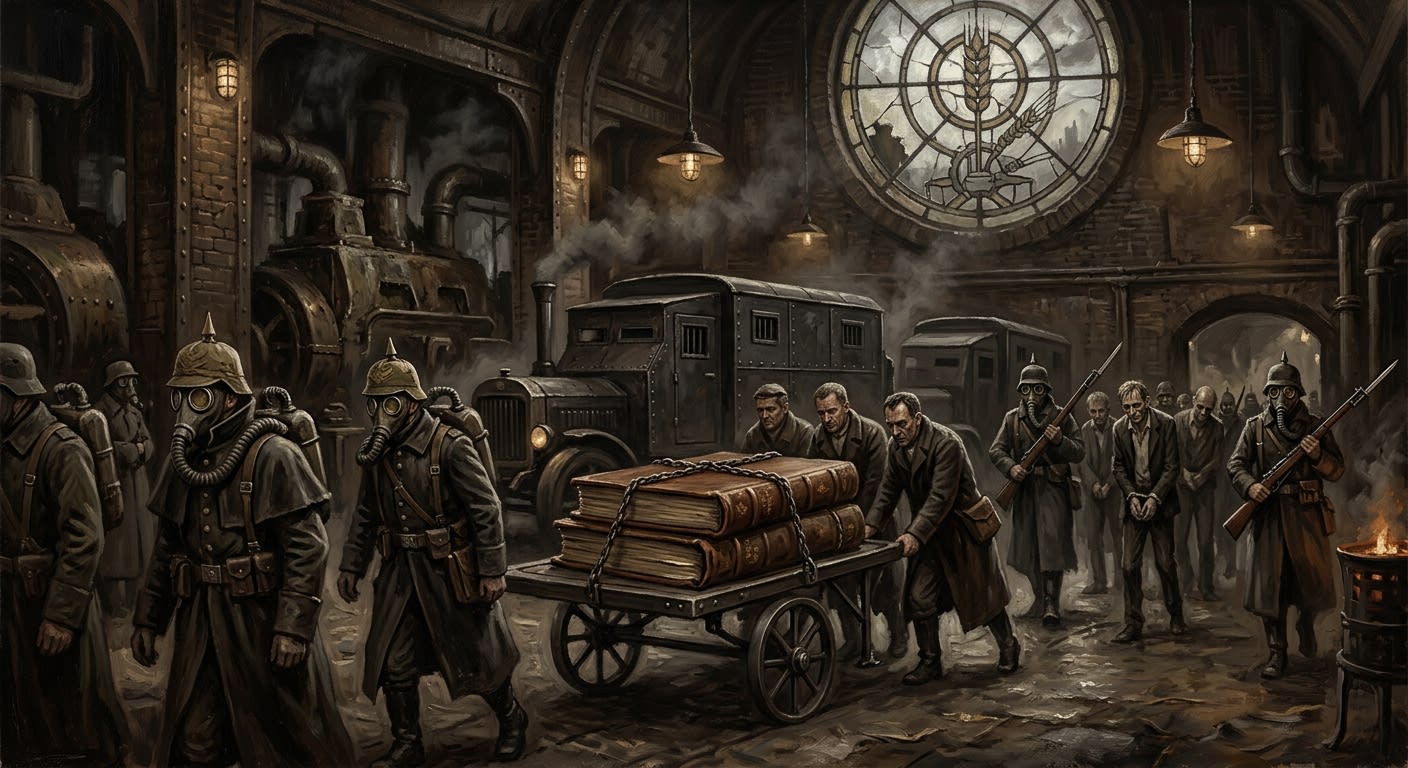
Eleven unmarked Night Wagons left Lübeck harbour on a moonless night. The harbour-master counted them, a clerical act so innocent that it deserved a hymn and so stupid that it earned him a lighthouse. By dawn, men in black gauze had collected his log without receipt. Within the month, the Grain Merchants filed articles of voluntary dissolution citing “spiritual renewal.” The phrase is preserved in Records copy, Tithes copy, municipal copy, and a Shadow inventory that should not exist. Four copies of cowardice, each stamped.
Spiritual renewal, in the guild's usage, meant the hall was opened, the strongbox inventories revised, the senior partners redistributed into private life, supervised piety, illness, travel, and one sudden vocation to a monastery whose abbot writes excellent thank-you letters. The guild banners were taken down before noon. The weigh-bridge remained. Grain still crossed it by evening. This is the difference between a guild and its function: one can be dissolved; the other is hungry and must be fed.
Lübeck's Grain Merchants' Guild dissolved voluntarily following a period of devotional introspection.
Corrected for internal circulation. The devotional introspection consisted of eleven wagons, one confiscated harbour log, black gauze at dawn, forty years of harbour records burned, and a locked office spared because it contained the useful sins. The voluntariness of the dissolution is accepted in the same spirit in which a man accepts the voluntariness of confession after the tongs are heated.
#On What Shadows Kept
The Bureau of Shadows did not burn the Grain Merchants' records blindly. Shadows is many things — illegal, indispensable, theatrically nonexistent, irritatingly stylish — but it is not wasteful. The fire that consumed the harbour's old books spared a locked office belonging to a clerk who had resigned the previous week despite having died in childhood according to later parish rolls. Inside were shipping movements, debt instruments, guild charters, and correspondence with eastern corridor parties already filed under Administrative Dissolution by Purity.
The Grain files mattered because they named dependence. Not treason in its clean sermon-shape, with oaths, daggers, and a villain stupid enough to keep a seal. Dependence. A forward depot taking a late shipment through unlawful credit. A bastion quartermaster accepting untaxed grain because men with empty bellies mutiny before they genuflect. A merchant in Warsaw covering a debt with a route favour. A dissolved eastern contact arranging safe passage for sacks whose labels changed twice before dawn. No single entry was enough to hang Europe. Together they made a rope.
SHADOW EXTRACT — LOCKED OFFICE, LÜBECK, A.S. 180 Grain ledger series recovered: ███ Moisture-code correspondence: █████████ Brest corridor favours: ███ entries Königsberg winter variance: █████ sacks unaccounted under rat damage Names preserved for future use: ███████████████ Instruction: do not prosecute all; revenue collapse unacceptable.
That last instruction is the key. The Synod could not destroy everyone named in the Grain books. Too many were useful, uniformed, ordained, hungry, or rich enough to have cousins in Strasbourg. So Shadows removed the guild and kept the network's throat under its thumb. The trade continued under approved factors, tariff chapels, replacement clerks, and private contracts scrubbed clean enough to make auditors purr. Grain moved. Men ate. Files disappeared.
#On the Successor Factors
By A.S. 201, no Grain Merchants' Guild exists in Lübeck. The old hall is a tariff chapel. Its nave smells of flour, candle-wax, and damp wool. Clerks sit where guild elders once sat, weighing sacks beneath a painted saint whose eyes have been repainted three times to look less accusatory. The principal weigh-bridge still groans. The iron has been replaced twice. The habit has not.
Approved preservation factors now handle the trade. They have no guild charter, no fraternity seal, no feast day, no right of mutual defence, no old songs, and no legal memory. Their membership changes whenever a curious person asks whether they have become a guild in practice. Records calls this adaptive compliance. Tithes calls it improved oversight. The dockworkers call it the same bastards wearing cleaner cuffs.
The parallel ledger has not vanished. It has become smaller, colder, and more obedient. Shadow pressure teaches a city to sin in print the Bureau can read. Every suspicious moisture adjustment now has a plausible devotional surcharge. Every route favour bears a clean auxiliary stamp. Every grain factor knows which discrepancies belong to Tithes, which belong to Records, which belong to Purity, and which belong to no one until a Gauze-Masked Custodian appears beside the scale before dawn.
#On the Moral Arithmetic of Flour
The Grain Merchants' Guild survives as a warning told in counting houses from Hamburg to Warsaw: do not keep two ledgers unless you know which one you want burned. It survives in tariff chapel jokes, in dock dust, in the careful way Lübeck merchants stop talking when wheels pass after curfew. It survives wherever a sack crosses a scale and three men, each serving a different Bureau, write down three compatible falsehoods.
The Synod's moral position is clear. The guild was corrupt, clandestine, overfat, impudent, and caught. Its dissolution restored lawful trade, clarified municipal obedience, strengthened winter provisioning, and encouraged spiritual renewal among commercial persons previously resistant to grace. All statements in the preceding sentence are official. One or two may even be true.