
#On the Loudest Hall in Lübeck
“Contemplative silence, in a cooper, is either death, bribery, or the Bureau of Shadows standing close enough to hear the hoops tighten.” — marginal note on Lübeck dissolutions, A.S. 180.
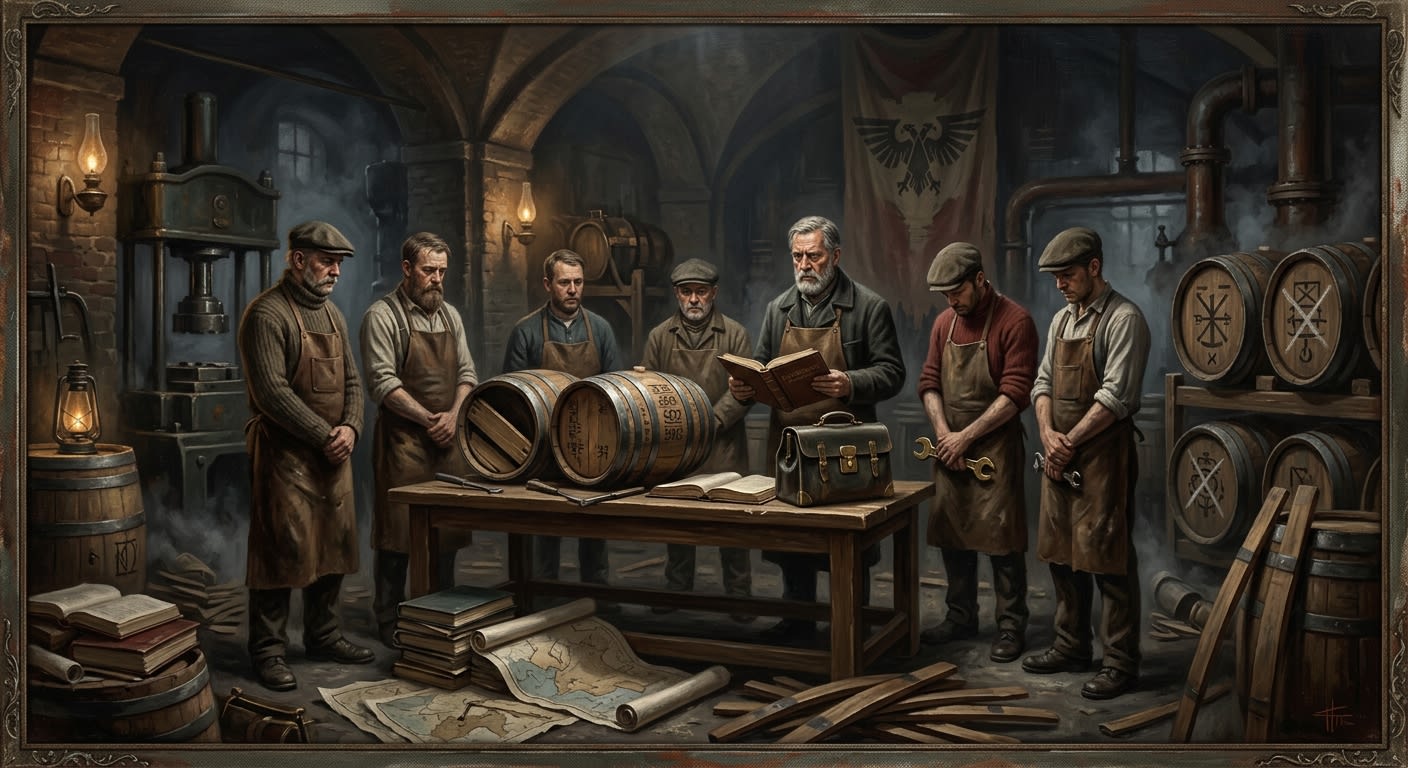
The Coopers' Brotherhood of the Blessed Barrel occupied the loudest hall in Lübeck, a timber-fronted absurdity near the quay where every beam smelt of pitch, old beer, wet oak, and those masculine virtues that flourish only when no woman of sense is present to laugh. Its sign displayed a barrel with a halo. Its members swore by Saint Botulf of the Hooped Cask (Unregistered), a figure unknown to Relics, tolerated by Doctrine, and adored by men who needed divine permission to shout while sober.
The Brotherhood made barrels, or said it did. This distinction matters. A barrel is a container, a measure, a disguise, a promise that volume has agreed to behave. Grain requires sacks, salt requires casks, cod oil requires sealed staves, wax requires lined tubs, relic fragments require containers blessed loudly enough to drown the question of provenance, and contraband requires all of the above with better manners. Lübeck's commerce passed through the cooper's hands because everything that moves must first submit to a shape.
#On Volume and Its Lies
The Grain Merchants lied by weight. The Salters lied by concentration. The Coopers lied by volume, which is the cheeriest of frauds because it can be demonstrated with both arms outstretched and a grin wide enough to hide a tariff clerk.
A legal barrel held what the stamped table said it held. An actual barrel held whatever the cooper, the buyer, the route captain, the dock factor, and the watching saint had agreed to pretend it held. Staves were shaved inside, hoops set false, bottoms doubled, pitch mixed thick enough to hide a seam, sidewalls swollen by steam and dried around cavities no inspector would find without ruining the goods and the invoice. A cask labelled cod-liver oil might carry oil, correspondence, seal plates, rolled vellum, saint-dust, demon-glass wrapped in fish skin, or a man small enough, desperate enough, and quiet enough to learn theology in the dark.
The Brotherhood's barrel counts rarely matched barrel volume. This would have troubled a naïve auditor. Lübeck had few. The counts matched shipping fees, convoy exemptions, brine loss, spoilage claims, and the mysterious arithmetic by which a quay can move more cargo than its manifests admit without sinking into the Baltic from embarrassment.
#On the Brotherhood's Devotions
The Blessed Barrel had a liturgy. Of course it did. Give three tradesmen a monopoly and by dawn they will have a patron saint, a feast day, a song too long for public safety, and a grievance against Rome, Strasbourg, or both. The Brotherhood blessed new staves on the first fog after Michaelmas, poured beer into the first cask of the season “for swelling,” and struck three hoops at midnight whenever a ship survived bad weather. The bells of Bells did not approve. The taverns did.
Their hall was notorious for volume: sound, moral capacity, commercial capacity, and geometry. Men shouted orders, sang barrel-prayers, hammered hoops, rolled casks across plank floors, and argued over whose grandfather had first taught oak to curve. During festivals, gulls avoided the roof. During audits, auditors avoided the threshold unless accompanied by two assistants, one Purity observer, and a man willing to taste anything leaking from a cask.
The Brotherhood cultivated stupidity as a shield. A laughing cooper with pitch on his apron and beer in his beard appears less dangerous than a clerk with clean cuffs. This is prejudice. The clean clerk may ruin you by filing correctly. The cooper may ruin you by placing your sealed writ in the false bottom of a fish barrel bound for Warsaw, then singing loudly while it passes inspection.
The Coopers' Brotherhood is best understood as a jovial craft fraternity with incidental commercial influence.
Corrected. “Jovial” is the word respectable men use when the fraud sings bass. The Brotherhood controlled certified volume across the harbour district, maintained hoop tallies in private marks, and supplied containers to trades already under Shadow attention. Their songs were loud. Their books were quieter.
#On Contemplative Silence
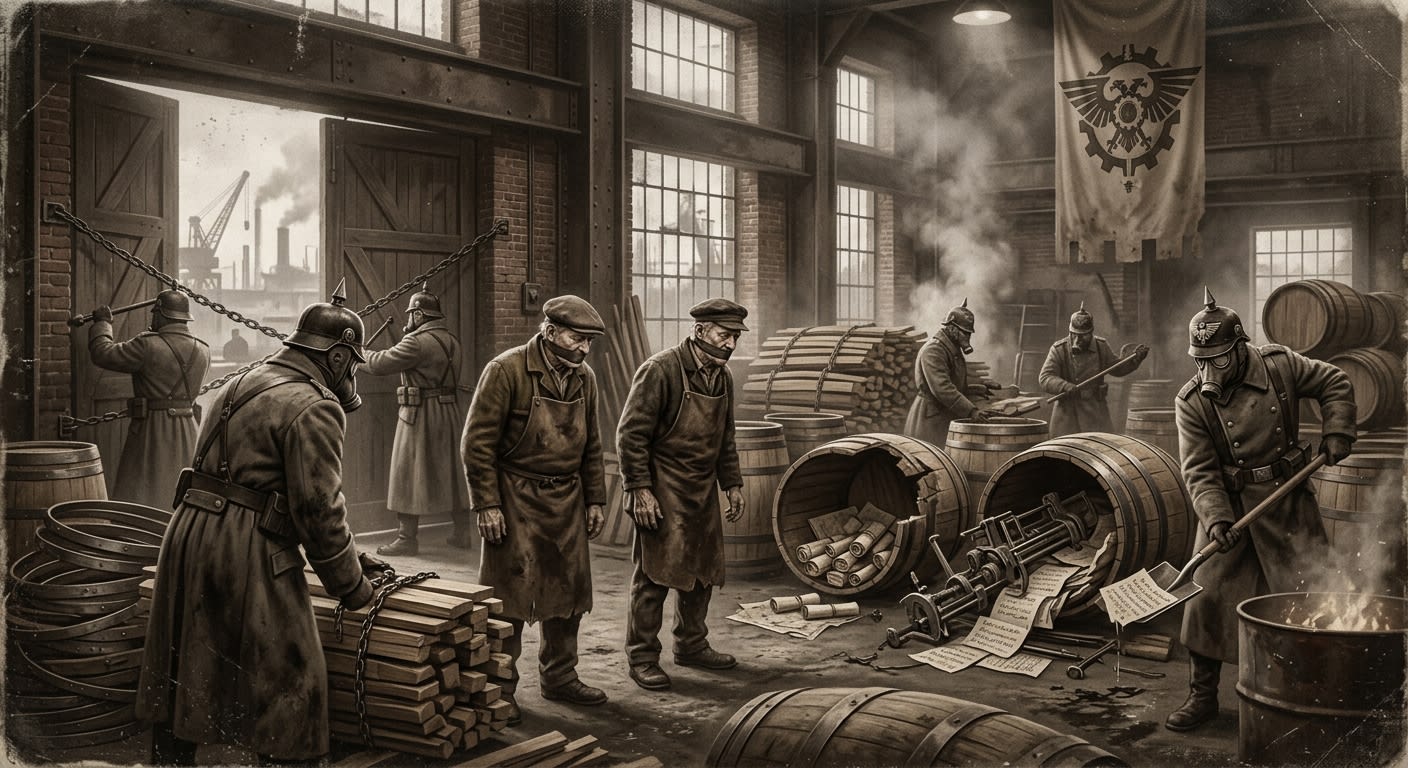
A.S. 180 disciplined Lübeck with admirable selectivity. Eleven unmarked Night Wagons departed the harbour; the harbour-master counted; black gauze collected the count; forty years of records burned; three guilds dissolved before the smell left the quays. The Grain Merchants discovered spiritual renewal. The Salters suffered insufficient membership. The Coopers, those great apostles of noise, filed dissolution papers citing “a desire to pursue contemplative silence.”
Strasbourg received the phrase with decorum. The municipal officers received it with white faces. The taverns received it with the kind of hush one hears after a dropped glass in a room where everyone has been waiting for the first arrest. A cooper choosing silence is like a cannon choosing embroidery. The thing may occur, but only after an event grave enough to make witnesses swallow their jokes.
The Brotherhood's final meeting lasted twenty-two minutes according to the scraped minute-book recovered from a cask-stove ash pan. Seven members attended. Twelve signatures appeared on the dissolution instrument. Three signatories had been listed on a cargo accident roll six months earlier. One signature was a thumbprint in grey wax. The hall bell was removed before noon. By evening, the barrel yard was leased to a school for inspection arithmetic and devotional quiet. Children learned volume there. They did not sing.
#On the Hoops Shadows Kept
The Bureau of Shadows did not care whether Lübeck's barrels were honest in the childish sense. No empire survives by punishing every short cask. Shadows cared about route memory. A hoop mark can record more than capacity: origin, buyer, night route, cargo class, bribed gate, receiving clerk, devotional exemption, and whether the barrel is to be opened with a mallet or a prayer.
The Brotherhood's private marks were cut on the underside of hoops, where salt, pitch, and handling wear made them invisible to inspectors who wished to remain clean. Three shallow notches meant chapel stock. A crescent scar meant the manifest lied by charity. Burned dots meant cargo requiring darkness. A double seam meant the barrel would be weighed twice and opened nowhere. The marks travelled. That was their sin. A barrel made in Lübeck could tell a warehouse in Hamburg, a factor in Kanzleiburg, or a corridor clerk near Bastion-Brest what paper dared not say.
SHADOW EXTRACT — BARREL YARD, LÜBECK, A.S. 180 Hoop-code tablets recovered: ███ False-bottom casks present: ██ Cargo categories concealed: correspondence; seal plates; unregistered persons; █████████ Brotherhood songs containing route counts: █████████████ Instruction: burn chorus sheets; retain master hoop index; replace craftsmen by contract.
That last line is Strasbourg in miniature. Do not destroy the craft. Destroy the fraternity. A barrel-maker is useful; a Brotherhood remembers. A contractor makes containers. A guild makes claims. Claims grow teeth. Teeth require extraction.
#On the School of Quiet Volume
As of A.S. 201, the former Brotherhood hall houses a school for barrel inspection, devotional quiet, and youth arithmetic, exactly as Lübeck's public article states and exactly as no child believes after hearing the old floorboards answer hammer-rhythm in fog. The boys and girls sit beneath pale rafters where festival banners once hung. They learn circumference, capacity, authorised variance, seal placement, hoop integrity, lawful pitch composition, and the doctrine that a container exists to serve truth by limiting what may be carried.
This is very good doctrine for children and impossible doctrine for containers.
The yard still makes barrels through private contracts. The hammers are fewer. Their cadence is regulated by bell-time. Songs are forbidden during instruction hours, non-instruction hours, fog, festivals, rain, and whenever an inspector feels lyrical danger approaching. Apprentices hum anyway. The tune has lost its words, which makes it more dangerous, because a wordless song cannot be prosecuted without embarrassing the prosecutor.
The old hoop marks have been replaced by approved inspection brands. Some are legitimate. Some are old marks in clerical vestments. A thin crescent has become “seasonal swelling notation.” Burned dots have become “pitch-depth verification.” The double seam survives as a “reinforcement for northern weather.” The Brotherhood is dissolved. Its grammar rolls east.
#On the Barrel as Evidence
A barrel is a witness with no tongue and excellent memory. It records the cooper's hand in plane marks, the route in dents, the cargo in smell, the bribe in missing seals, the fear in how quickly men look away from it. The Coopers of Lübeck understood this before the Bureaus did, and for that chronological impertinence they were corrected.
The official verdict is tidy. The Coopers' Brotherhood of the Blessed Barrel dissolved voluntarily in A.S. 180 to pursue contemplative silence after the Year of Smoke. Its assets were reassigned to educational and commercial uses. Its devotional irregularities ceased. Its trade functions continue under contract. Its former members, insofar as they remain members of anything, are private craftsmen, pious retirees, travelling inspectors, or names no longer rubbed deeply enough into the municipal record to trouble the eye.
CURRENT STATUS — COOPERAGE, LÜBECK: Brotherhood dissolved; hall converted to barrel inspection and devotional quiet; yard active under private contract; hoop codes prohibited, absorbed, watched; public doctrine satisfied; private instruction unchanged — listen for tapping.
The Brotherhood's silence is impressive. It fills the old hall, the quay, the barrel yard, the taverns that no longer sing the fourth verse, and the inspection school where children calculate volume beneath rafters that remember better jokes. A silent cooper is still a cooper. A blessed barrel is still hollow. The Bureau knows this. The Bureau listens when it rolls.