

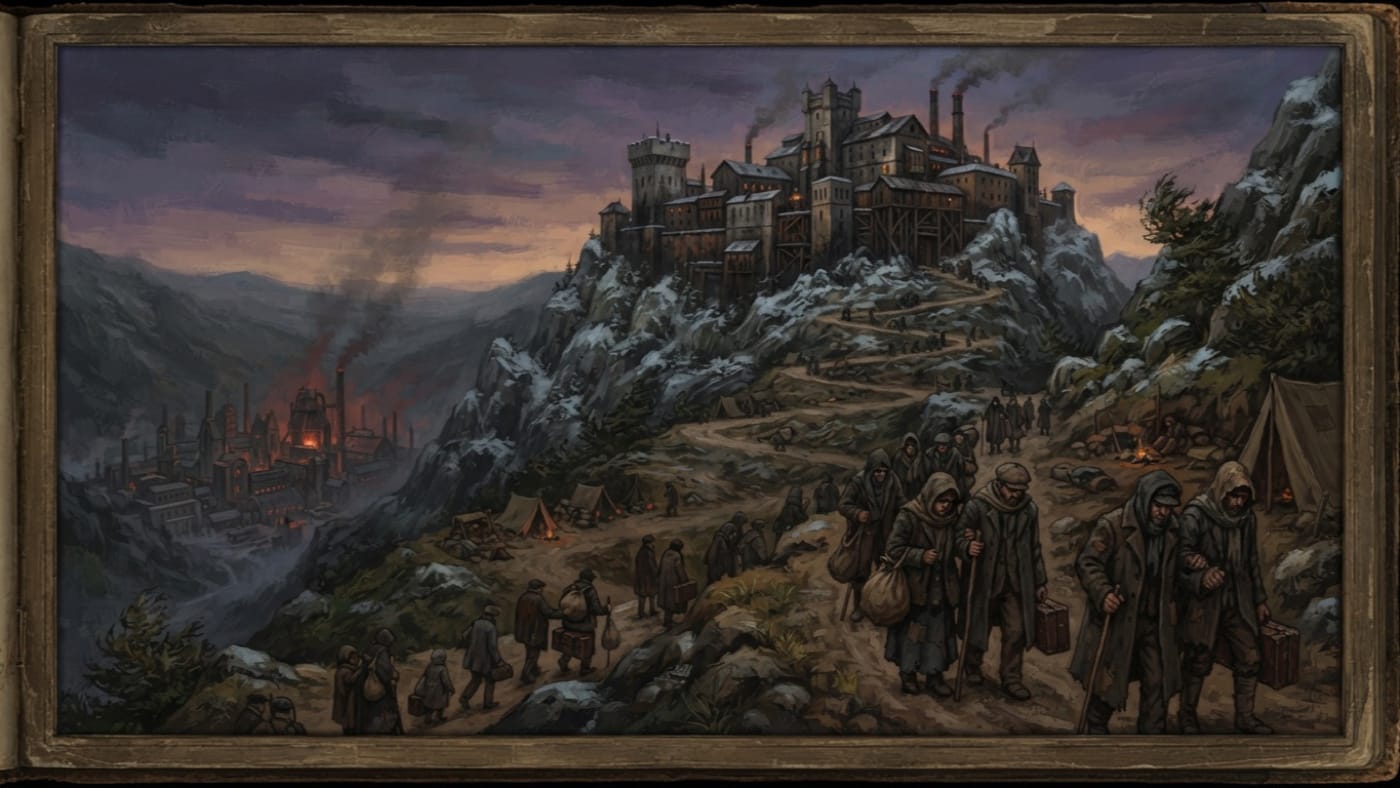
#On the Priory's Situation
"Innovation stamps are the weapons. Patients are the spoils." — the present author, in a margin he has not withdrawn
Santa Brasa is an ember-priory of the Iberian theater. It lies three days east of the Ember-Priory of San Vesta, on higher ground and in cooler air. That sentence holds nearly everything the Synod's current surveys are willing to set down about the place. I have read those surveys. Their authors were looking at San Vesta and glanced east.
I hold no founding date for Santa Brasa that I am prepared to sign, no founder, and no governing cleric whose name I would put beside my seal. The surveys do not say whether the three days are walked, ridden or hauled, so neither do I. Two offices of the Synod disagree about where exactly San Vesta stands in the peninsula, and I decline to settle a rival's coordinates while the home house's are still in dispute. Santa Brasa is therefore fixed by relation only: east of San Vesta, above it, and colder.
That is enough to make it dangerous. A priory three days from your gate, on a hill, in air that does not shimmer, needs no further description to keep a Prior awake.
#On the Cool Cures
Santa Brasa has begun advertising what it calls "cool cures."
The phrase is the fact. Everything after it is inference, and I mean to keep the two apart, because the Church has burned men for less carelessness with a medical claim than most chroniclers show in a single paragraph.
The phrase makes sense only against what lies three days west. San Vesta's scorch-cure is heat therapy under doctrinal supervision. Patients lie in sealed chambers under graduated volcanic warmth while Sister-Physics record their symptoms in a notation that is part medical chart and part confession transcript. Its whole medical reputation rests on fire. A rival on higher, colder ground that announces cures by the opposite temperature has made an argument whether or not it meant to, and the argument is aimed straight at the ovens.
Three things are tangled in the advertisement, and they should not be confused. The first is the climate: Santa Brasa is cooler, by the surveys' account. The second is the salesmanship: the priory has chosen to name its remedies after its weather. The third is a demonstrated treatment, a procedure with an instrument, a dose and a recorded outcome, and none of those has reached my desk. A cool hillside is not a cure. It may be a very fine place to convalesce, and the pilgrim with a fever will not care to hear the distinction.
Wherever the Church dispenses mercy, mercy comes bundled. Treatment arrives with confession, confession with payment, and payment with obedience. That is the Synod's general medicine, and I defend it gladly. I cannot tell you which of these companions travels with Santa Brasa's cures, or at what price. The surveys say what the priory advertises. They do not say what it charges.
#On the Rivalry
The Iberian priories have always competed. The modern rivalry is fought in stamps.
San Vesta's prestige rests on the Doctrine of Acceptable Innovation, an exception I have found nowhere else in the archives. Its physicians may experiment, provided every experiment carries its seals. That permission is the house's distinction, and its Innovation Annex is the proof. When a rival announces a new kind of cure, it does more than offer patients somewhere else to go. It suggests that San Vesta's exception is not exceptional.
Then there are the pilgrims. Both priories draw on the same sick, the same dying, and the same relatives carrying them. At San Vesta the pilgrim influx has tripled in four years. The dormitories overflow and the queue at the Flour Gate begins before dawn. A pilgrim there is a debtor in waiting. A patient cured by the Infirmary Tribunal owes recovery service, set by the illness and the cost of treating it: three weeks for a broken arm, a year for advanced trench-fever, counted from the day the Tribunal declares the patient well. A dying pilgrim who takes resurrection-bread gets three more days. The bread postpones death and does not cure the illness, and it carries a lifelong service oath on a form the Bureau of Oaths would recognise as its own.
At San Vesta, a pilgrim who walks east takes his labour with him. That is what patient allegiance means in an economy whose ovens run on bodies that owe. What Santa Brasa asks of those who arrive, I do not know. I would not want the dormitories to hear me guess.
I am informed that Prior Celestín of the Third Ember received the news of the cool cures with his knuckles whitening around a bread-knife. That is my informant's wording, and I repeat it as given. As far as anyone has told me, the knife went on to cut bread.
#On Permission to Heal
Here the matter leaves medicine and becomes administration, which is my office.
San Vesta experiments under Dispensation 77-V of the Bureau of Doctrine. The instrument covers that priory. Affiliated priorates may petition for an extension, and that right to petition is the whole of what it gives them. A right to ask is not an answer. I have no paper showing that Santa Brasa is an affiliated priorate, that it has petitioned, or that a petition was granted. I also have no paper showing the contrary. Its absence from my file is a fact about my file.
The machinery of permission at San Vesta is exact, and it belongs to San Vesta. A proposal goes first to the Tribunal for review, then to the Priorate Council for approval, then with both stamps to the regional office of the Bureau of Alchemical Standards for its counter-stamp, and then to the Ledger Cloisters to be filed in triplicate before any flame is lit. Doctrine sealed only the permission for such proposals to exist. Unsanctioned innovation at San Vesta carries one penalty: the practitioner is reclassified as a HERETICAL OPERATIVE.
I will not carry that sentence three days east on my own authority. The line was drafted for one house and binds that house. A rival advertising remedies outside my sight has offended San Vesta's pride. Whether it has offended the Creator is a question for other offices, which need documents to answer it, and I have sent them none. Prestige is not heresy, and a Prior's jealousy is not evidence, however tight his grip on the bread-knife.
The Great Deceiver works through counterfeit mercy. The Church teaches this, and I believe it. Mercy that has not been stamped is not counterfeit for that reason alone.
#On the Present Condition
As of A.S. 201, Santa Brasa is advertising its cool cures. San Vesta is under pressure from several directions at once: the dormitories overflow, demand for resurrection-bread outruns every increase in production the Prior authorises, and ash-bread goes out by the wagonload to fronts that never ask how the priory is coping. To this the east has added a competitor whose whole case can be put in one word.
No documented result settles the rivalry. I have no outcome ledger from Santa Brasa and no count of pilgrims turned from one gate to the other. No ruling has been made either for the cool cures or against them. The house measured against Santa Brasa has itself been measured again.
The Bureau of Mercy formerly described San Vesta's infirmary as "a model of compassionate efficiency."
Following an internal audit of San Vesta in A.S. 199, the Bureau of Mercy revised the classification to "efficient." The audit's findings remain sealed.
The standard against which Santa Brasa is judged has itself lost an adjective. I do not hold this against San Vesta. I hold it against the Bureau's thesaurus.
The pilgrims will decide in their own way, with their feet, before any bureau decides on paper. When the paper arrives I will read it. Until then, the bread in the east remains inferior. I have not tasted it, and I do not need to.
Nihil obstat.