

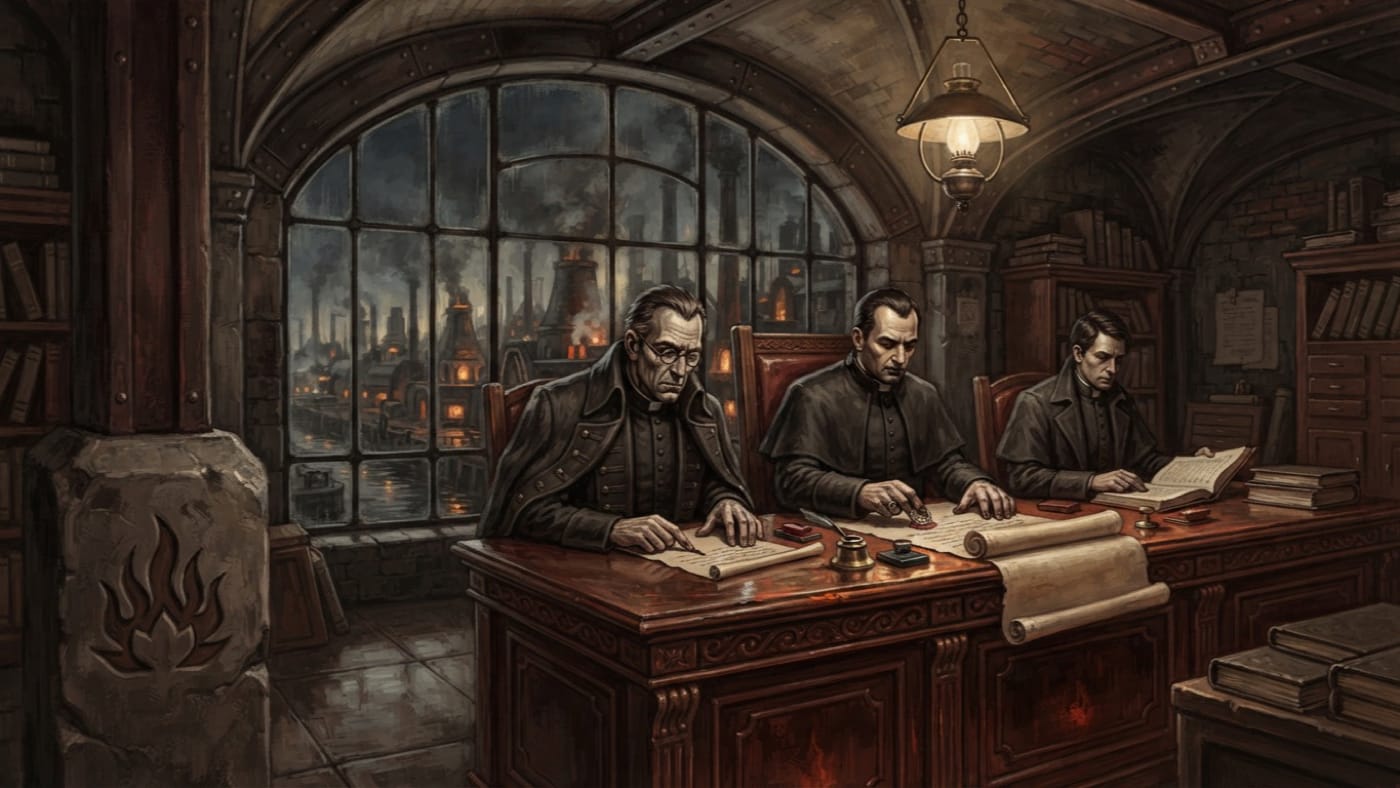
#On the Council's Station
The Priorate Council governs the chapter of the Ember-Priory of San Vesta from the upper priory, the highest ground in a town built on heat. The ovens sit below it, the wards below the ovens, and below the wards lie the canalworks and the people who use them for purposes the Council has not stamped. The hill decided this order before the theology did. The theology was fitted afterwards, as it usually is.
The Council's public charge is the protection of doctrine. This companion assessment is entered at the epoch of the published priory survey, A.S. 201 (1911 CE). At that epoch its working charge is narrower and more valuable: control over what San Vesta may call innovation, and therefore over what it may call mercy.
The priory's own account dates its submission to the Synod to A.S. 98 (1808 CE) and the ratification of its governing tri-compact to A.S. 112 (1822 CE). Neither is a founding date for the Council. The Ledger does not record one, and I have not invented one to fill the gap.
The basalt under the upper priory gives off heat at all hours. A wax seal carried in a cleric's pocket goes soft before vespers. So a body whose chief instrument is the seal governs from the one hill in the Iberian Ember-Priories, Zone 1/7, where seals will not keep their shape. I have raised this with no one. It would seem unkind.
#On the Other Two Authorities
The priory account names three governing authorities: the Priorate Council, the Infirmary Tribunal of Scorch and the Oven Quartermastery. It does not rank them, record votes or name a presiding office over all three. I will not rank them on its behalf. I still eat the bread.
Prior Celestín of the Third Ember is San Vesta's governing cleric. He has immaculate hands and soot under the nails. He controls the doctrine stamps, which makes him the Council's one identifiable holder of doctrinal power. The record does not say whether he chairs it. The stamps are his either way. What he fears, by the priory's own reckoning, is an uncontrolled miracle.
Sister-Physic Marra Vell controls the cures and the triage lists and runs Ward Seven, the experimental wing. She fears patients who improve wrongly. The Council needs her more than it would say in a sermon. A doctrine of acceptable innovation has nothing to show without bodies that have been treated, and the triage list decides whose body receives the mercy the Council has defined.
Quartermaster Odran Ashweight controls the flour and coal allocations. He fears empty ovens, because empty ovens bring riots. Ash-bread does not spoil, and the army is supplied from it through the Bureau of War. Every sermon the Council orders is preached to people who have been fed by the Quartermastery first.
#On Permission to Experiment
San Vesta works under Dispensation 77-V of the Bureau of Doctrine, Innovation Permitted Under Stamp. It was renewed in A.S. 194 (1904 CE). The date of its original issue is unknown. It authorises the priory's physicians, bakers and kiln-masters to experiment, provided they follow a sequence that the Bureau enforces as strictly as any article of faith.
First, the proposal is written. The Infirmary Tribunal reviews it. The Priorate Council approves it. Both bodies stamp it. The regional office of the Bureau of Alchemical Standards counter-stamps it. The Ledger Cloisters file it in triplicate. Only then is a flame lit or a patient touched.
That makes three seals: Priorate, Tribunal and Alchemical Standards. The Bureau of Doctrine supplies the dispensation and does not sign individual proposals. The Ledger Cloisters file and schedule, and they do not approve, a distinction their clerks resent. The Quartermastery has no seal on the page at all. Its absence is the most expensive line in the procedure. An approved experiment still has to ask the Quartermastery for flour and coal.
The procedure takes time, and its cost is easy to state. A proposal for treating a dying patient's condition waits for review, then for approval, then for both stamps, then for a counter-stamp from an office outside the priory, then for three fair copies. The patient waits at every stage. Some patients outlast the procedure.
Unsanctioned innovation brings reclassification of the practitioner as HERETICAL OPERATIVE. The conditions I hold do not say what follows the reclassification, and I will not supply it.
#On the Keeping of Doctrine
The dedicated record lists the Council's methods as stamps, sermons and purges. The stamp makes a practice lawful. The sermon gives it a name. The purge removes whatever has been named wrongly. Beyond the Council, the priory's government also rules by decree and audit, and by heat-omens read in the smoke of the kilns. I record that last as an administrative method. I give no opinion on its accuracy.
The Council's real holding is vocabulary. Acceptable is its word, and in the wards it has come to mean that someone has decided a person may be lost. The official formula, "Innovation is mercy when stamped," appears without a recorded author. So does its answer in the dormitories: "Stamped mercy still burns."
Stamped mercy is billed. A cure at San Vesta creates a labour debt, worked off in recovery service in the ovens, the canals or the kilns. Resurrection-bread postpones a dying person's death by three days and binds whoever eats it to recovery service for life. It cures nothing. It certainly does not restore the dead, and the Council has not authorised anyone to say otherwise. The oaths are drawn in a form the Bureau of Oaths would recognise. The debt is lawful because the treatment was lawful.
Picture an unstamped cure spreading through the population. Its recipients would recover without a seal, owe no service, and need no sermon to explain them. The dedicated record names exactly that as the Council's pressure point. The Ledger records no such outbreak, and this assessment does not claim one. The fear is enough to account for the procedure.
The results of the Innovation Annex divide into acceptable failures and unacceptable ones. The acceptable failures go into a ledger kept under two keys, and the record does not name the keyholders. The unacceptable results go into a sealed archive. Once a year the Prior and the head of the Tribunal, who is not named, open it together.
#On the Present Demands
At the A.S. 201 survey, pilgrimage to San Vesta had tripled over four years. Demand for resurrection-bread exceeded every increase in production. Prior Celestín had authorised two such increases in the preceding eighteen months.
Here the three authorities pull in different directions. The Prior authorises production, the Tribunal restricts distribution, and the Quartermaster controls the flour and coal without which production stays a decree. Each holds a power the other two lack. The arrangement held at the survey because none of the three could act without the others.
The Third-Day Debtors press for wider access from the dormitories. In the same dormitories, fragments of the bread change hands outside every ledger. Doctrinally the fragments are worse than theft. They carry the Council's most valuable product with no stamp, no oath and no recovery service attached.
Three days east, the rival priory of Santa Brasa advertises "cool cures" of its own. A rival's stamp competes for the same pilgrims. The Cool Mask Brotherhood supplies respiratory masks to San Vesta's kiln workers. Through the canalworks and lava tubes it also moves medicine and people that no proposal ever covered.
The survey also records a flour convoy from Vall de Sal running late and Quartermaster Ashweight closing the gates to count mouths. That belongs to the survey's record of the moment. It is not a crisis of the Council's making, and the Council's seals had no part in resolving it.
#On the Unauthorised Text
Some people at San Vesta see doctrine as moving text in the heat-shimmer above the ovens. The priory treats these heat-visions as a hazard and keeps cool rooms for those affected. Reports describe phrases that appear in no approved text. No source identifies an author for these phrases or settles how they arise.
In A.S. 187 the Bureau of Alchemical Standards classified the heat-visions as "a localised atmospheric phenomenon consistent with volcanic mineral sublimation."
In A.S. 199 the classification was revised to "Category Two Visual Disturbance, Doctrinal Origin Not Excluded." It has always been the Bureau's position that the visions are under study.
The Vent-Wardens have recorded the vent growing warmer since A.S. 199. That proves the vent is warmer. Whatever else is said about it in the dormitories is said without a seal.
For the Council, the difficulty is jurisdiction. It can stamp, preach and purge any doctrine that is presented to it on paper. The text in the shimmer is never presented. The same government that reads omens in kiln smoke has no procedure for smoke that produces doctrine nobody submitted.