

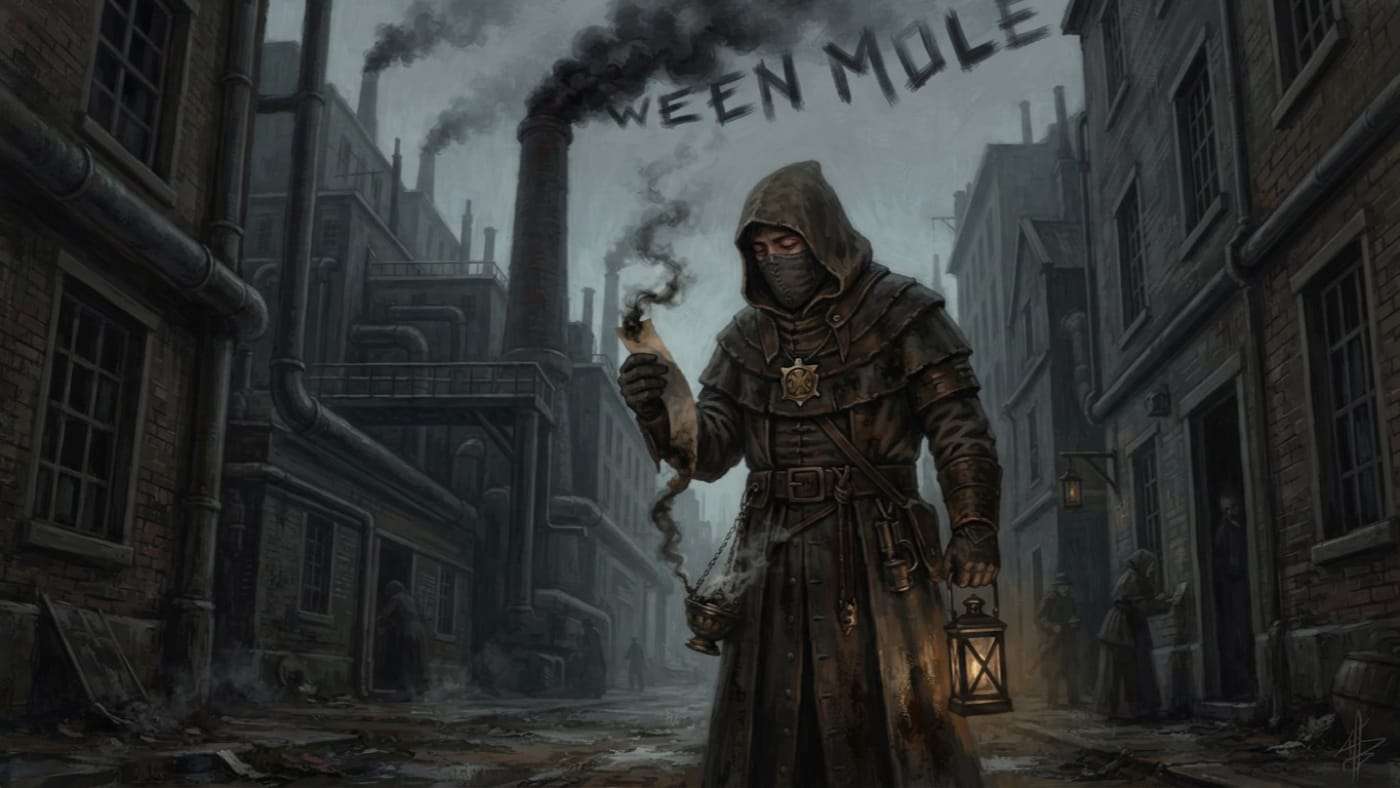
#On the Specialist's Summons
A Purity Fume-Inspector reads air the way a Records clerk reads a tithe roll, looking for what is missing, what is padded and what has been bought. There is diesel tang in a bread queue, tallow where lamp-oil was declared, a chimney breathing too thin for the household's licensed coal. Each wrong smell becomes a sample and each sample a citation. Each citation becomes a line that the Bureau of Purity may tax, seize or forgive as convenience dictates.
The Script-Interpreter is sent for when the air stops behaving like evidence and begins behaving like text.
That is the whole of the summons. It may come from smoke above a furnace ward, a stain in a chimney throat, or a strip of reactive parchment in a field officer's glove. Somewhere in it the grey has taken on strokes, intervals and the posture of a line. Nobody needs to tell the inspector on the street what this does to the evening's quota, because the quota is finished. A Soot-Reader runs for the specialist, and every resident of the lane discovers urgent business behind a shut door.
#On the Ninth Mark and Its Instruments
The Ninth Mark keeps a short ladder. Soot-Readers carry samples, run errands and learn which doors are to be knocked before witnesses arrive. Fume-Inspectors hold field authority, meaning the rights of entry, seizure and citation that the Mark has exercised under Operational Directive 14 since A.S. 143. Air Auditors reconcile quotas and speak to the Bureau of Records in the dialect Records prefers, which is arithmetic with the blood wiped off. Above this ladder stands the Script-Interpreter, commanding the Air Auditors as the Auditors command the street.
Above this ladder stands the Script-Interpreter, commanding the Air Auditors as the Auditors command the street.
Corrected: the profession's own hierarchy lists the Script-Interpreter as elite and specialist, called when smoke forms words. It records no command over Air Auditors and no rule that Auditors are promoted into the office. The interpreter stands beside the ladder. The primers put the office at the top because the woodcut fits better there.
The instruments are the Mark's common issue: the ledger-lantern, the censer-kit, ash vials, wax seals and fume paper, the reactive parchment that answers a passed sample by curling, darkening or blooming. Fume paper is the best witness the Bureau owns. It cannot be bribed with incense bricks, although the glove holding it can. The officers wear half-priestly robes, masks with stitched filters, ash on their cuffs and the brass badge of the Ninth. The room smells of wet soot, bitter incense and hot wax, with the metallic diesel note under all three that no rinse removes from the teeth.
The ordinary procedure is a liturgy of conversion. The inspector surveys the scent, tests it against the paper and the vial, and selects the household that will serve as the lesson. The seizure follows with witnesses and bells, and then the affidavit, and the affidavit is what makes the contraband exist. Copies go to Records. The street says, "If it won't stamp, it won't exist," and the street, for once, has read the regulations correctly.
#On Smoke That Writes
The Lore Book records that black diesel stains chimneys with oily scripture. The field literature is less composed about it. A district's smoke spells, setting patterns into the cloudline. A strip of fume paper blooms into something legible and the whole street goes silent. Inspectors who joke about everything else, including the taste of loyalty and the cost of a clean cuff, do not joke about scripture-smoke. Their saying is that it jokes back. The start-of-shift superstitions forbid a deep breath under a chimney that writes, because the air might remember you.
The trades that make the smoke are no braver. The Black Diesel Distillers keep a working rule: if smoke writes, shut down and do not negotiate with fumes. Their idiom "let it write" means do not stare. Some of them claim such smoke proves the fuel is alive. Purity replies that it proves the fuel is sin. Neither party has produced a filing I would put my seal to.
Routine sampling ends in a vial with a number attached. Smoke that writes ends in a problem for which no form has a column. A tallow violation can be weighed, a diesel rag priced and a household fined into tidy correction. A sentence in the chimney cannot be fined. It asserts something, and the Bureau does not permit air to assert. The Bureau permits air to be found.
I will not record here what any chimney has written. I am also unable to describe how an interpreter reads it, because no method has been entered in any file I am cleared to cite. I have asked, and I received procedure in reply.
#On Sealing and Reporting
Those three words are the entire instruction the profession acknowledges. They contain more theology than most councils have managed in a season, and they contradict one another more efficiently.
Seal belongs to the evidentiary order: wax, witness and the closed vial. It is the inspector's ordinary act turned towards an extraordinary object. Report belongs to the ledger, because a thing unreported is a thing Records will later discover, and Records punishes discovery far more severely than it punishes the thing discovered. Forget belongs to no procedure at all. It cannot be audited, and it cannot be performed by a creature that has eyes and fear. What it demands is the conduct of a person who has forgotten: no repetition in the tavern, no notes in the margin of the duty book, and no glance at the chimney on the next patrol.
The ordinary Ninth Mark produces knowledge so that knowledge can be taxed. The Script-Interpreter is summoned to produce knowledge that must then be enclosed. Records wants every emanation counted. Purity wants this kind shut away. The interpreter is the officer through whom both appetites must pass, and the instruction makes no attempt to reconcile them.
Where the report travels, and what becomes of the sealed material, I am unable to state. The recipient is unrecorded in the sources available to this survey. Clerks with more imagination than clearance have supplied vaults, furnaces and private chancelleries. I have struck all three from my notes.
#On the Saint with Lowered Eyes
The Script-Interpreters keep Saint Vellum-of-Breath as patron, alongside the Fume-Inspectors, Air Auditors, Soot-Readers and confiscation witnesses. Vellum remains administratively devotional and of unproven historical existence. Purity hangs the icon in kit rooms and declines to admit what it means. The general cult teaches the sealed nostril-ring: the holy nose, closed where total detection would freeze a district.
The interpreters' Vellum differs in one particular. The nostril-ring stays, and the eyes are lowered, never raised. Ordinary training cards show the saint gazing upward in rebuke, but the interpreters' icon looks at the floor. In some offices the eyes have been scratched out. No one admits this and no one repairs it. I record that it happens in some offices. It is not a rite, it is not issued from any desk, and I will not dignify it with a meaning that no interpreter has given.
They are said to pray differently from the rest of the Mark. The words have not been supplied to me, and I will not compose them. Doctrine already holds a sufficient quantity of my compositions.
The Ninth Mark's grey candle for Vellum is lit before winter patrols, before audits, and before script-smoke responses. The ring itself is an attribute and an established field habit. No record shows it guarding anyone against written smoke, and the interpreters, who know the evidence better than I do, have not claimed that it does.
#On Present Service
The specialty is maintained because the furnace wards are maintained. In Strasbourg, as in every city that intends to survive January, heat moves along routes the Bureau tolerates. Hidden Pipe-Runners carry it, Distillers brew it and households burn it under a lawful stew-fire. The Diesel Resonance Plumbers tend adjacent fuel works under a separate licence and must not be confused with this office, however loudly the pipes of either trade happen to hum. The whole arrangement depends on air staying evidence, something to be found, priced or passed by.
The Clean-Lung Purists want that air scrubbed. The Twenty-Percenters want it balanced, and the Stagehands want it performed under lantern light for crowds. No record places the Script-Interpreters in any of these factions, and I will not invent a fourth. The interpreter's whole function is the moment when those quarrels go quiet and the lane shuts its doors.
The hazards of the profession are the hazards of the Ninth Mark entire: soot-lung, fume burns, the ink-black cough hidden in a black cloth at the end of the shift, and the spiritual exposure the manuals list without defining. Rumour has assigned the interpreters a further price in blindness, memory or years. The survey finds no record of any such price and enters none. The interpreter returns to a strip of paper that may stay paper, or may begin, in a furnace ward with no wind, to arrange itself.