
#On the Order That Made Air Searchable
Operational Directive 14 was issued in A.S. 143, in the ash-smeared administrative panic following the Year of Ash Rain, when Maldrake’s Thracian furnace weather had made nine months of Europe taste like a chimney, the Ninth Bell Famine had begun its charitable work among the poor, and every city with a stove discovered that warmth had become indistinguishable from evidence.
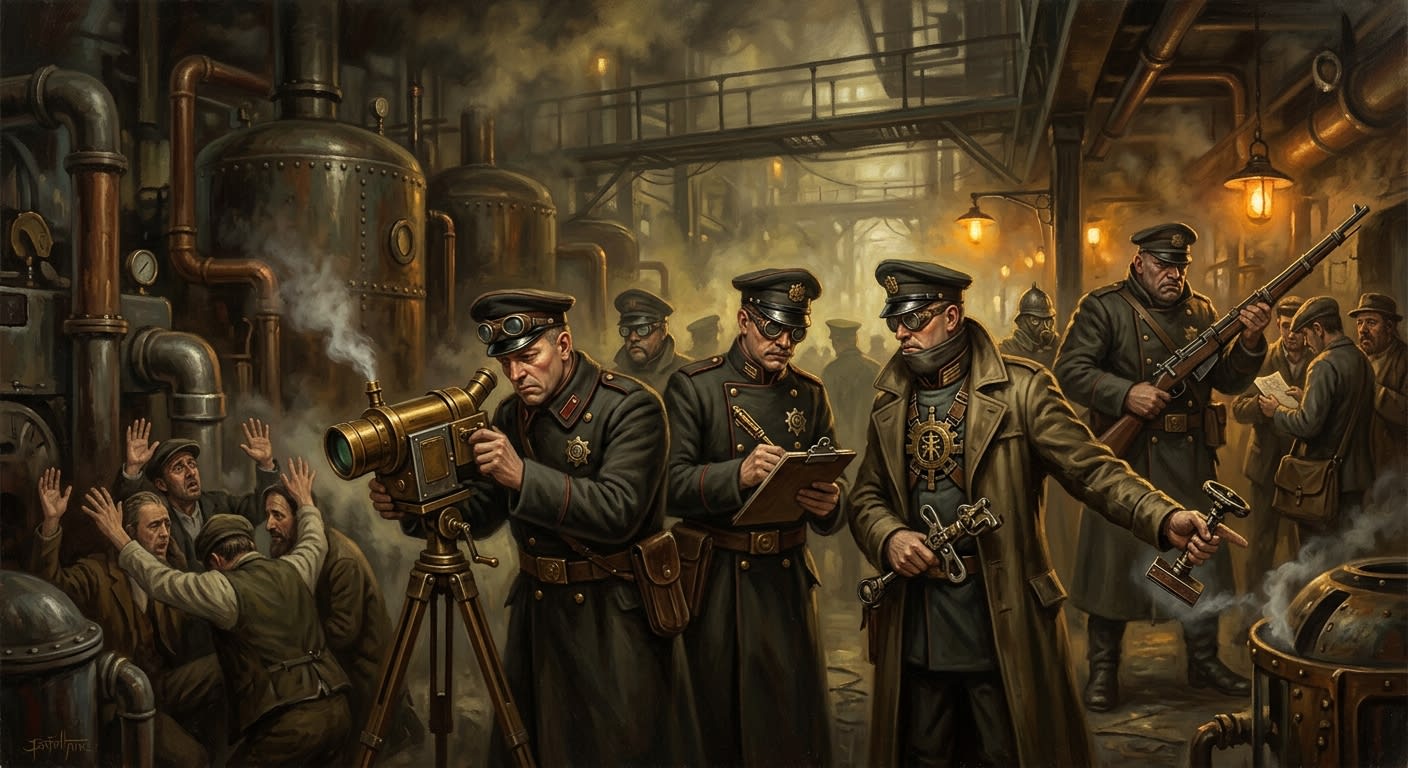
The Directive constituted the Ninth Administrative Subdivision of the Bureau of Purity, later called the Ninth Mark; authorised the field officer now known as the Purity Fume-Inspector; granted right of entry, seizure, citation, atmospheric sampling, door-marking, chimney inspection, fuel confiscation, and emergency block sealing; and gave the Synod the most beautiful power a bureaucracy can possess: the right to accuse the air.
Before Directive 14, foul smoke was a nuisance, a guild matter, a parish quarrel, an Engineering complaint, a War exemption, or a neighbour’s reason to throw stones after Vespers. After Directive 14, foul smoke became a person with papers. It could be named, witnessed, bottled, taxed, denied, and hanged from a doorframe in wax.
The order’s first line survives in Purity training halls, painted above kit racks and misquoted by boys who have never inhaled black diesel: “Where emanation proceeds, authority may enter.” A sentence of admirable ugliness. It says nothing about guilt, intent, need, weather, infant fever, soldier ration, widowhood, or the contemptible little fact that a cold citizen is still, for some purposes, alive. It declares movement from smell to authority. That is enough.
#On the Year That Required It
A.S. 143 gave the Directive its excuse. Ash fell from the east in such quantity that magistrates swept it from courtroom sills before hearing cases about fuel adulteration, which is the sort of symmetry Providence grants when She is feeling vicious. Thracian furnace weather blurred lawful smoke and demonic residue. Black dust collected in cistern lips. Bread ovens tasted of pitch. Processional candles guttered with blue centres. War kitchens burned whatever they could requisition, steal, bless retroactively, or mislabel as “emergency warming substrate.”
The state required distinction. Distinction required instrument. Instrument required office. Office required an enemy. The enemy, by excellent convenience, was already in everyone’s lungs.
The first memoranda came from provincial Purity boards complaining that existing warrants could not reach “scent without visible substance.” Engineering answered with sample notes. Records proposed new evidence boxes. Tithes asked whether seized fuel could be valued at purchase price, market price, or guilt price. Doctrine supplied the word emanation, because smell lacked grandeur and stink was already in popular use.
The anniversary commentary describes Directive 14 as “the matured fruit of atmospheric theology.”
Corrected. It was drafted because ash confused inspectors, famine confused citizens, black diesel confused ledgers, and nobody wished to admit that half the Synod was surviving on fuel the Synod had condemned. Theology arrived with a comb after the fever broke.
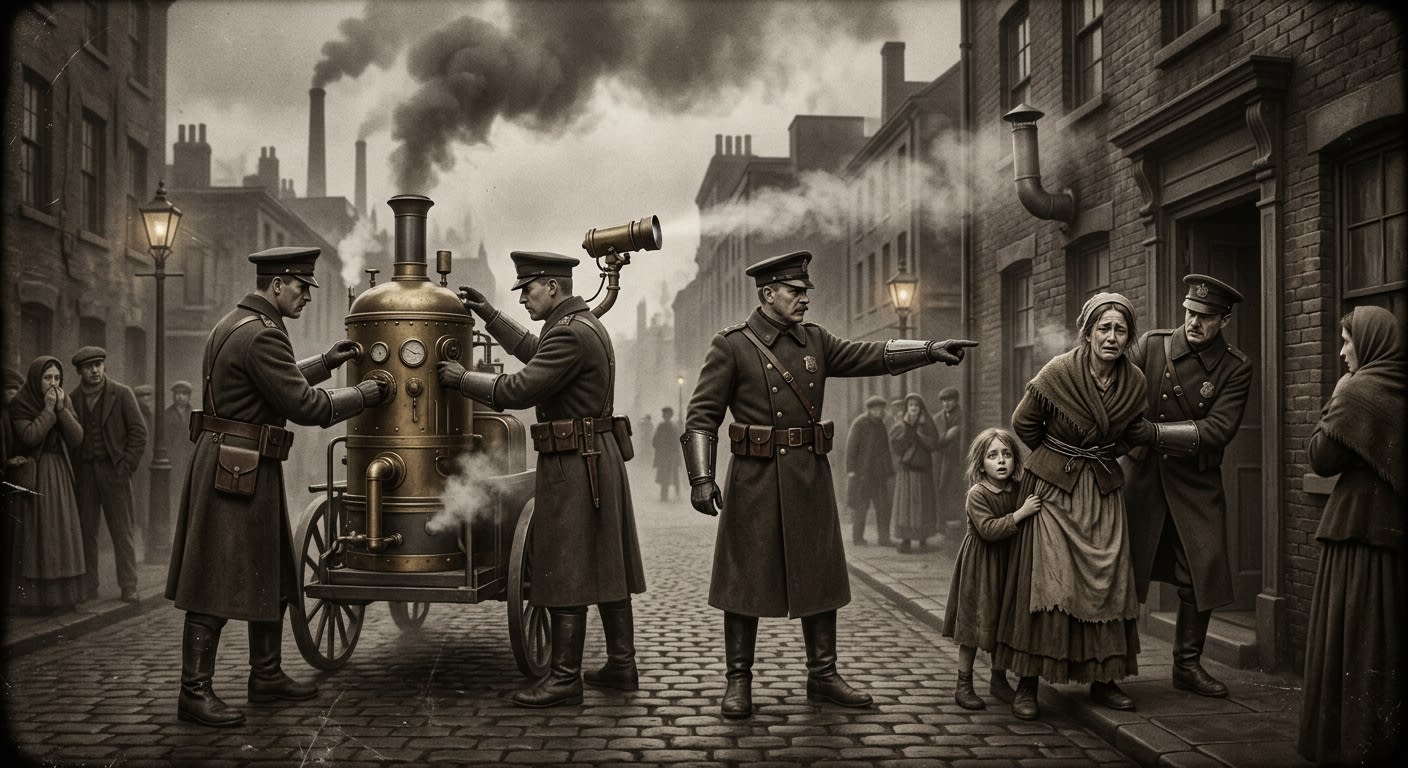
Purity’s pre-Directive officers could enter for contraband objects. They could seize illegal prayer papers, unlicensed relic fragments, false incense, demon-glass tools, and fuel canisters when found. The difficulty was absence. A stove could be emptied before the knock. A rag could be burned. A pipe could be pulled into the wall. The room stayed warm. A chimney retained memory. A child’s sleeve smelled of what the father denied. Directive 14 turned residue into witness.
#On the Fourteen Powers
The Directive is called Fourteen because its ratified text contained fourteen operational powers. Later clerks attempted to claim the number merely followed docket sequence. This was cowardice. The powers are the doctrine; the doctrine is the number; the number is a handle by which field men lift the door off its hinges.
The first three powers grant entry: entry by smell, entry by heat, entry by fume-paper bloom. The old warrant asked what the officer had seen. Directive 14 asks what the air has confessed. If a stairwell carries black diesel, the stairwell has invited the Bureau. If a cellar breathes suspicious warmth, the cellar has testified. If the paper blooms at a threshold, the threshold has signed.
The next four powers grant seizure: of fuel, lamp, wick, stove, pipe, ash, filter cloth, vent lining, chimney scrape, residue vessel, and any devotional article contaminated by unlawful combustion. The list became longer in practice because objects near smoke acquire civic ambition. A saint’s hollow head used to hide whale oil is no longer merely a devotional fraud. It is an atmospheric accomplice.
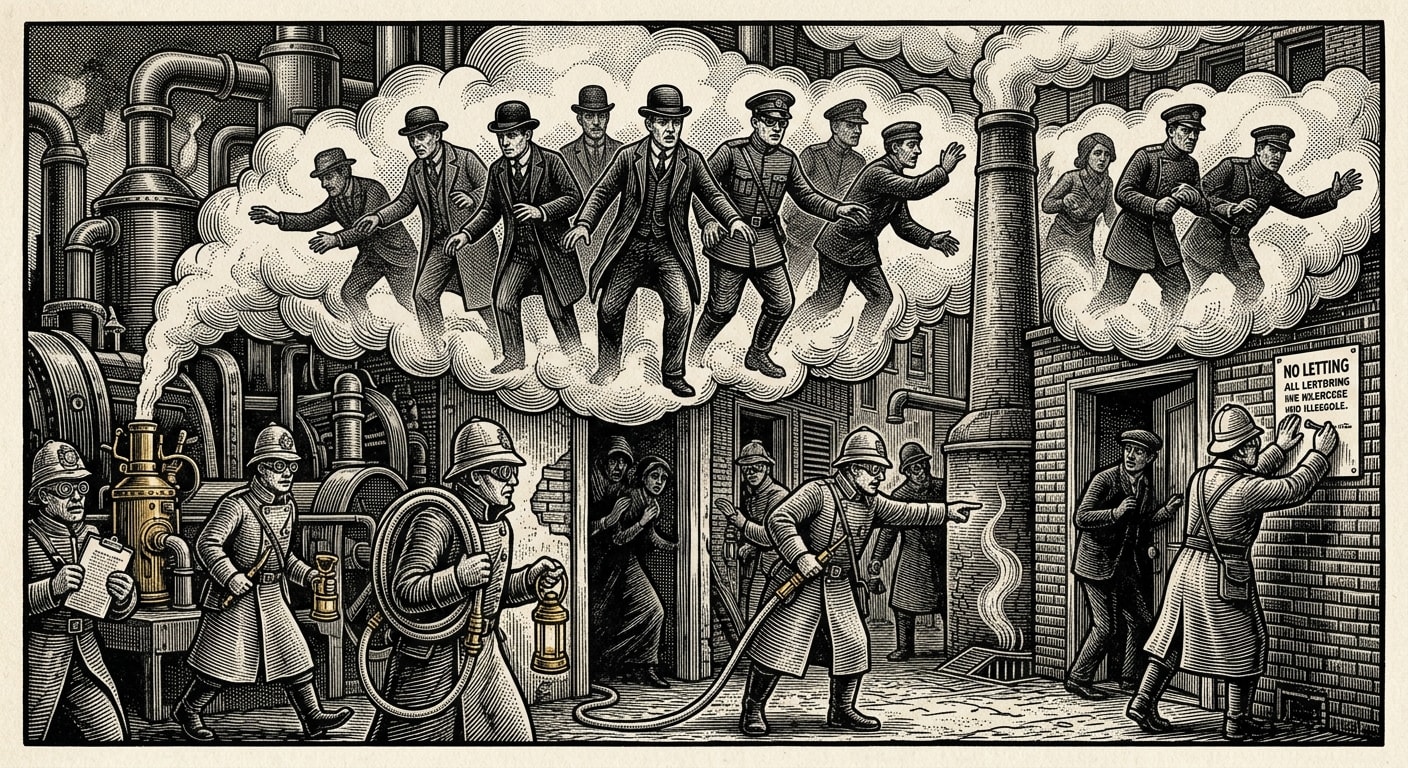
Powers Eight through Eleven make theatre lawful. The Inspector may cite aloud, mark the premises, compel two witnesses, and suspend movement through a block when smoke threatens public correction. The wax glyph on a door does more work than a sermon. It tells neighbours who has been seen, who may be next, and which household’s misery may safely be discussed in the bread queue.
The final three powers feed the state: report to Purity, archive with Records, escalate to Doctrine if script, voice, name, prayer-heat, child-listing, or demonic grammar appears in the smoke. The humble kitchen becomes a ladder: stove to sample, sample to docket, docket to tribunal, tribunal to sealed theological file. The citizen thought he was warming soup. Foolish mammal. He was participating in the hierarchy of proof.
#On Fume Paper
Directive 14 gave fume paper its throne. Before A.S. 143, reactive parchment existed as an Engineering curiosity: clever, expensive, temperamental, and generally less useful than a competent nose. The Directive made it legal speech. Bloom became witness. Colour became affidavit. Pattern became accusation.
A Fume-Inspector holding a blooming strip does more than observe. He exhibits. This distinction built the Ninth Mark. A smell may be mocked by a defendant and contradicted by a neighbour whose stove is worse. A strip of paper darkening in public creates silence. The crowd sees guilt arrive as colour. The officer seals the strip in a vial, calls the witnesses, and lets the state’s little miracle perform its work.
The first Directive kits were crude: lantern, scraper, six vials, wax stick, door-cord, citation slate, cloth mask, and three strips wrapped in oilskin. Within five years the kit had become a travelling chapel of atmospheric accusation. Brass ledger-lanterns carried the Ninth Mark. Ash cuffs turned the Inspector’s wrists into exposure ledgers. Censor-kits compared lawful incense against household air. Fume paper, manufactured under Engineering supervision and Purity complaint, sat in the inner tin like a relic that preferred kitchens to altars.
The paper also produced the profession’s first terror. On certain days the bloom became script. Not ring, spiral, feathering, or stain. Letters. Filing numbers. Names. Fragments of orders no office had issued. The Directive’s final escalation powers were amended after the third such event, though Purity still pretends the amendment concerns “atmospheric legibility irregularities.” The field instruction remains shorter: Seal. Report. Forget.
NINTH MARK INCIDENT ADDENDUM — EARLY SCRIPT-SMOKE CASE, A.S. 147 Location: furnace ward, Strasbourg east. Observed bloom: black ring resolving into docket sequence. Readable text: “RETURN THE ███████████ TO ASH.” Inspector response: recited citation before full seal. Casualties: █ inspectors, █ witnesses, one chimney continuing to write after demolition. Directive amendment: escalation power XIV expanded.
#On the Birth of the Index
An officer with entry power must know what he is entering for, or he becomes a soldier with worse boots. Directive 14 required a common language of fumes. From that requirement came the Index of Prohibited Emanations, the book that gives smoke its docket number and makes warmth answerable to print.
The Index gathered forty-seven items from parish nuisance law, furnace guild tables, War contraband memoranda, chapel wax complaints, Engineering residue studies, and Purity field fear. Black diesel took Item One because hypocrisy requires a front gate. Unconsecrated beeswax, whale oil, false incense, gutter tallow, demon-glass residue, prayer heat without licence, scripture-smoke precursors, marrow-lime vapours, and the immortal Item Thirty-Nine — air of suspicious warmth — followed in ranks like a miserable procession.
Early district courts treated Directive 14 as independent of the Index, permitting entry by general suspicion of foul air.
Clarified after the A.S. 151 Rheinscarp Vent Appeals. Directive 14 authorises entry; the Index supplies prosecutable naming; fume paper supplies visible proof. Remove one, and the Bureau must rely upon honesty. No office should be placed under such strain.
The Index made the Directive portable. An Inspector from Strasbourg could now raid a furnace alley in Essen, a convoy kitchen near Bastion-Constantinople, a bastion warren at Brest, or a tariff-chapel corridor in the southern ports and speak the same forty-seven accusations. This is how empire travels: by form first, by horse later, by rail once the invoices have cleared.
#On the First Winter of Enforcement
The first full winter under Directive 14 nearly killed the office it had created. Young Inspectors, drunk on authority and still able to smell without coughing blood, applied the order literally. They entered every warm stairwell. They sealed every black-diesel stove. They confiscated lamp oil from rooms where official coal had not arrived. They cited bakeries for keeping ovens alive after curfew. They closed tenement pipes that fed three families and one dying grandmother, then filed triumphal affidavits while the grandmother became statistically persuasive.
Riots followed. They were the dangerous civic convulsions historians and fools tend to miss: bread queues refusing to move, women hiding fuel under infants, soldiers buying contraband from the households they had been ordered to search, patrols warming their hands over seized stoves, Purity annexes discovered burning unlawful scraps while drafting notices against unlawful scraps. The order worked too well. That is the most damning failure available to policy.
War complained first because frozen soldiers are bad doctrine with rifles. Tithes complained next because confiscated fuel did not replace lost productivity. Records complained because every room in certain districts became a case file and paper carts jammed the sub-registries. Doctrine complained last, but with superior prose.
Out of that embarrassment came the unwritten Twenty-Percent Tolerance Directive. Directive 14 had made total enforcement possible. Winter made total enforcement suicidal. Senior Air Auditors learned to smell everything and record only what the district could survive losing. Twenty percent flows. Eighty percent bleeds. The city breathes; the Bureau claims omniscience; the dead are filed under weather.
#On the Men and Women It Made
Directive 14 created more than an office. It created temperaments. The Clean-Lung Purist is the Directive read by a young man with undamaged nostrils and no memory of famine. He sees the fourteen powers and hears trumpets. Open every breath. Cite every violation. Purify the district until the air itself salutes. He is useful for seven days, tragic by the third winter, and insufferable always.
The Twenty-Percenter is the Directive read by an old inspector whose mask has learned the shape of his regret. He knows every power and applies half of them sideways. Entry by smell becomes entry when the street can bear it. Seizure becomes instruction when the target is guilty enough and expendable enough. Suspicious warmth becomes a note on a cuff instead of a door mark, unless quota, sermon, bribe fatigue, or public insolence requires otherwise.
The Stagehand is the Directive read as liturgy. He loves Powers Eight through Eleven: citation, marking, witness compulsion, block suspension. Give him a door, a lantern, a pre-bloomed strip, two witnesses, and a household with theatrical poverty, and he will make the Bureau look omnipresent for the price of three ounces of lamp oil. The public thinks Stagehands enforce Directive 14. In truth they perform the portion already selected by men who cough more quietly.
It also made Saint Vellum-of-Breath necessary. The saint’s sealed nostril-ring is the devotional correction to the Directive’s madness. Open every smell and the district dies. Close what must close and the district owes you its life, which is more useful. Purity displays Vellum as perfect detector. Field men pray to him as patron of controlled non-detection. Both readings remain approved, because contradiction that keeps inspectors alive becomes doctrine by attrition.
#On Abuse, Which Is to Say Use
Every power in Directive 14 found its market. Entry by emanation became entry by dislike. Residual heat became a warrant against rooms whose politics were already too warm. Reactive proof became an industry of planted strips, bribed samples, pre-smoked cloth, and fume paper held too close to the officer’s own lantern. Seizure powers turned kitchen fuel into quarterly allowances. Door marks settled neighbourhood quarrels faster than priests. Block suspension became a way to break strikes, redirect queues, punish taverns, and remind furnace guilds that a chimney is never private.
Purity calls these abuses deviations. Doctrine calls them consequences. I prefer accuracy.
Directive commentary states: “No seizure under Fourteen may be conducted for fiscal advantage.”
Clarified by practice, precedent, and the Bureau of Tithes. Fiscal advantage cannot be the sole stated purpose of seizure. It may be the motive, the effect, the quarterly justification, the private reward, and the reason the confiscation cart arrived before dawn.
The Directive’s genius is that it never needs to prove intent. A man may claim he burned black diesel because his child was cold. The Directive does not care. A woman may claim the warmth came from a neighbour’s wall pipe. The Directive does not care. A baker may claim War requisitioned his lawful coal and left him pit-sludge or ruin. The Directive does not care, unless War is present with weapons and a memorandum. The air proceeded. Authority entered.
#On Present Authority
As of A.S. 201, Operational Directive 14 remains the root authority of the Ninth Mark. Every Fume-Inspector’s brass badge descends from it. Every kit-room oath repeats it. Every fume-paper vial, door glyph, ash cuff, seizure cart, witness slate, and block cord carries its old ash-year breath. The Index has grown around it like a legal fungus. The Tolerance custom has hollowed it from within without weakening its outer shell. Saint Vellum has made its necessary blindness pious. The Twenty-Percenters have made its failure operational. The Stagehands have made its cruelty photogenic.
The Directive failed to clean the air. Again: this accusation is childish. It made the air governable. It taught smoke to enter evidence, warmth to enter suspicion, breath to enter account, and the citizen to understand that even a closed room participates in public doctrine once the Bureau smells profit through the wall.
A.S. 143 gave us ash. Directive 14 gave ash a badge.