
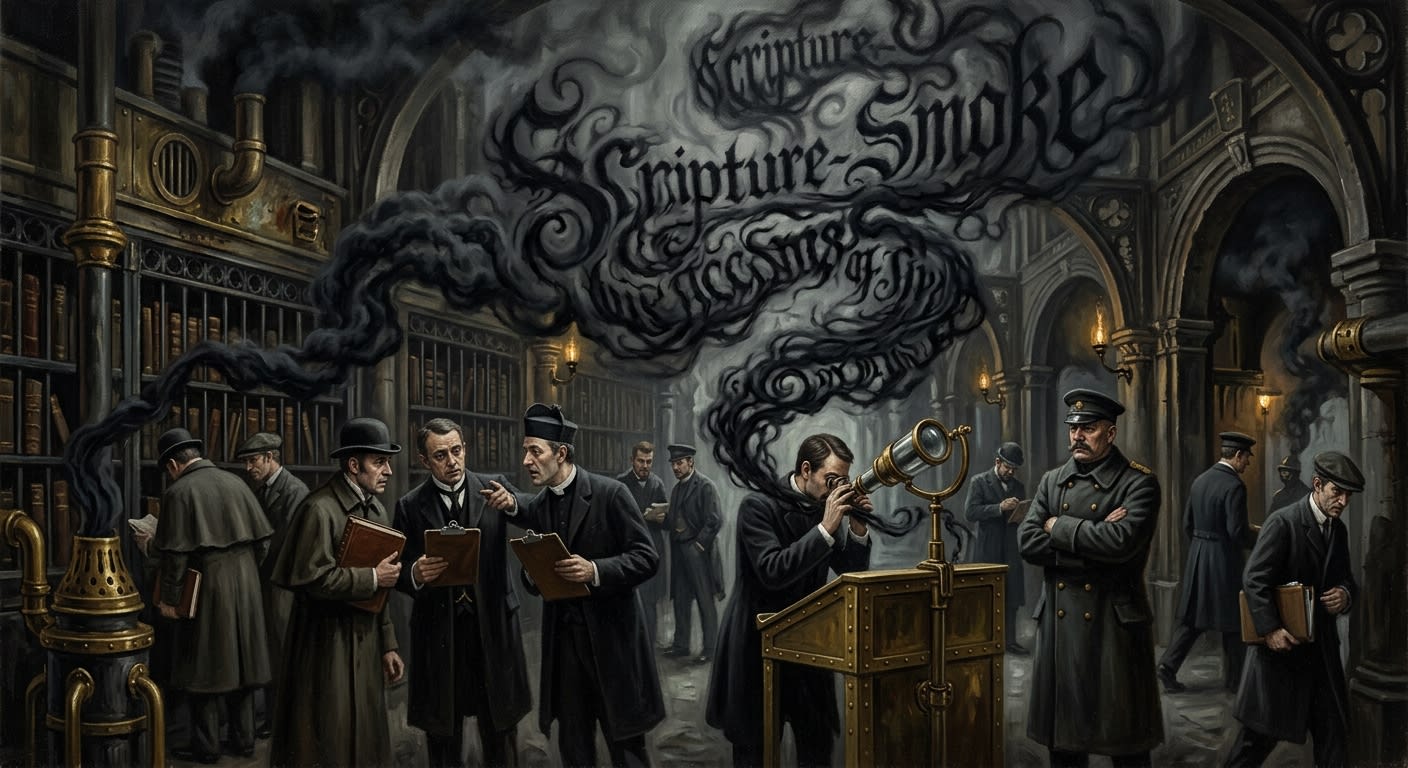
#On the Smoke That Reads Back
Scripture-Smoke is the vulgar field name for text-bearing fumes produced by black diesel under pressure, heat, bell-vibration, bad fuel cutting, frightened witnesses, and whatever other condition the Bureau of Purity has decided this week will keep blame affordable. The approved classification is Atmospheric Combustion, Anomalous, with categories varying from Two to Five depending on whether the smoke merely writes, sings, enters lungs, alters Creedal grammar, or kills men whose officers thought rifles could correct vapour.
It is encountered above furnace quarters, inside bell-ducts, along hidden pipe vents, in resonance tunnels, above warren roofs, and occasionally in private rooms where a household stove has been fed engine-grade fuel by someone too cold to be prudent. It forms letters, fragments, faces, liturgical signs, Index echoes, local dialect, pre-Sundering languages, wrong hymns, and names. The Bureau's public instruction is simple: do not read. The Bureau's private instruction is simpler: read first, punish later, deny always.
Scripture-Smoke is not recognised prophecy. Prophecy belongs to recognised offices, sealed commissions, dead saints, and embarrassing exceptions. Scripture-Smoke is an unauthorised utterance of combustion. The distinction is doctrinally enormous and practically invisible to a crowd staring upward while its chimney quotes the Creed with one word changed.
#On the Fuel That Remembers
The Pit-Masters say the fuel remembers what it ate. This is peasant chemistry, which means it is ignorant, insulting, and nearer the mark than three official memoranda. Black diesel begins in the Anatolian pitlands as crude sludge drawn from seams the Synod condemns, buys, loses, rediscovers, and condemns again. It is boiled in cellar stills, cut with bone-char, filtered through grave-wax knockoffs, pumped through pipes the Bureau of Engineering cannot find at the standard rate for failure, and burned in lamps, furnaces, engines, ward kitchens, Purity offices, and the very inspection houses that denounce it.
Most black diesel burns like fuel: hot, filthy, useful, and morally uncooperative. Scripture-Smoke appears when the substance is stressed beyond ordinary usefulness. Furnace-grade batches produce the clearest letters. Engine-grade fuel produces thicker strokes and more aggressive movement. Fuel transported near bellways absorbs vibration; fuel passed through resonance conduits carries tones the Diesel Resonance Plumbers hear with their brass horns and refuse to describe in mess halls. Fuel distilled during tolling can form scripture-flame (Unregistered), which is smoke's less literary and more murderous cousin.
The fuel's memory expresses itself in stolen language. It repeats Creed fragments because Creed is beaten into every pipe, barrack, schoolroom, ration queue, and terrified mouth in the Synod. It produces Index echoes because contraband lives under accusation and accusation leaves grammar behind. It speaks Wallachian because the eastern dead are not polite enough to remain untranslated. It writes names because names are the smallest handles by which the Ledger drags souls into use.
The old distiller maxim is Let it write. This means refusal to participate, not permission. Do not stare. Do not sound the word. Do not trace the letter with a finger. Do not correct spelling. Do not ask whether the smoke knows your childhood name. A sentence formed in soot may be meaningless until a frightened citizen grants it readership. The Bureau hates this teaching because it was not issued by the Bureau and because it works.
#On Constantinople, A.S. 136
The master case remains the Scripture-Smoke Incident of A.S. 136 in the furnace quarter of Bastion-Constantinople. Official allotments failed during a winter ration interval. Unofficial canisters multiplied. An entire quarter burned black diesel with the civic unanimity that only cold can produce. The chimneys answered in text.
Witnesses reported Creed phrases, Index fragments, and three pre-Sundering Wallachian sentences concerning appetite, custody, and the return of a thing miscounted. One Creed line appeared with a small grammatical alteration now sealed beneath three offices and one very nervous hymn table. Forty-three witnesses were later confirmed to have read at least part of the smoke before reading was forbidden retroactively. Twelve were punished for having already done what had not yet been made punishable. This is the sort of chronological refinement on which civilisation rests.
Early Purity notices described the Constantinople smoke as illegible staining produced by inferior fuel.
Corrected. The smoke was legible, persuasive, multilingual, and rude enough to draw a crowd before Purity found a category large enough to hold it.
A garrison patrol arrived, covered mouths, loaded rifles, and committed the professional soldier's old error of treating the sky as a target. A volley passed through the text. The smoke recoiled, gathered into seventeen human outlines, and descended on the men who had fired. Seventeen soldiers died. The lungs of several were found written upon from the inside. The quarter was sealed for nine months. Every slate, rag, card, tally scrap, child's chalk mark, chimney brush, and soot cloth was seized. Two carts of confiscated material disappeared between street and Records annex, proving that even horror travels better when properly misfiled.
FIELD SURGEON'S PRESERVED NOTE — CONSTANTINOPLE, A.S. 136 Subject Four: left lung marked beneath pleura. Subject Nine: repeated phrase visible under lamplight. Subject Eleven: post-mortem exhalation duration — nine minutes. Vapour formed word: █████████████████ Instruction attached in later hand: burn this copy after indexing.
#On Reading, Non-Reading, and the Saint With the Closed Nose
The Bureau's problem is not the writing. Writing can be seized. Writing can be blacked out. Writing can be placed in a sealed folder and made obedient through dust. Smoke writes publicly, temporarily, and high above witnesses who cannot be struck blind quickly enough without discouraging tax compliance.
The Fume-Inspector stands at this breach between air and law. His fume paper curls. His nostrils sting. His trainee wants to shout the first word aloud because trainees, like children and minor prophets, think discovery is service. The senior inspector reaches for Saint Vellum-of-Breath — the sealed nostril-ring, the lowered eyes, the field teaching: close what must close.
Clean-Lung Purists hate this. The Clean-Lung Purist wishes to open every breath, read every emission, file every chimney, prosecute every stove, and convert the district into a corpse with excellent air. He sees smoke-text and thinks total detection. The old Air Auditor sees smoke-text and thinks route, wind, crowd angle, which child has a slate, which chimney must be capped, which phrase may be safely forgotten, which witness will need beating, and which official allotment failure made the whole event inevitable.
Scripture-Smoke response doctrine divides into three practical acts. First, obscure the text: wet canvas, bell-dampening, chimney caps, counter-smoke from sanctioned incense if available and not comically insufficient. Second, break the audience: disperse upward gazes, confiscate writing surfaces, separate children from educated adults, and arrest the person translating too competently. Third, preserve enough evidence for Doctrine without allowing Records to acquire enough copies to become curious. Curiosity in Records grows shelves.
#On Pipes, Bells, and Tunnel Text
The roof plume is the theatrical form. The tunnel form is worse. In resonance lines and bell-ducts, Scripture-Smoke appears as dark condensation across vaulted stone, pipe ribs, inspection plates, and the undersides of thumper manifolds. Plumbers call it tunnel text. Pipe-Runners call it Skopje weather. Bells calls it unattributed substructural notation when sober and refuses the file when wise.
A cracked conduit at Bastion-Irongate once produced a line of smoke across the ceiling above two Diesel Resonance Plumbers. The words were doctrinal. The theology was wrong. Form 77-K was filed under Acoustic Artefact, Non-Hostile, because filing the truth would have required closing a forward section whose gaskets were already begging for death. The pipe was patched. The ceiling was scrubbed. The Plumbers stopped speaking while under that arch. This is how practical theology enters masonry.
At Bastion-Shipka in A.S. 158, lamps fed from a contaminated line hummed hymns no living chorister had composed. At Skopje in A.S. 171, a warren lamp-array produced a harmonic the Bureau of Bells found older than its own codex and did not enjoy finding. In bell corridors the smoke sometimes writes along the rhythm of the toll. Letters appear at the beat, vanish between beats, reappear altered at the next strike. This has led three junior clerks to suggest that the bells are editing the text as well as revealing it. All three discovered healthy careers in distant silence.
A Bureau of Bells sidebar described tunnel Scripture-Smoke as “visual residue incidental to acoustic maintenance.”
Clarified: visual residue does not usually conjugate verbs. The sidebar remains useful for calming engineers and deceiving visitors.
The danger lies in response. A roof plume gathers crowds. A tunnel text gathers specialists. Specialists are worse. A crowd repeats. Specialists compare. One Resonance Plumber with a memory for letters, one Fume-Inspector with fume paper, one Records clerk with access to older Wallachian, one Bell adept with forbidden intervals: four competent servants can make a heresy before supper without any of them intending treason.
#On What It Says
Most recorded Scripture-Smoke falls into five families. Creed alteration: the smoke repeats authorised formulae with small substitutions, inversions, or omissions. Index echo: the smoke quotes condemned entries, sometimes from sealed volumes the witness could not have read and should not know exist. Name-script: the smoke forms private names, dead names, nursery names, and ledger names withdrawn from public use. Appetite-script: the smoke speaks of hunger, heat, fuel, debt, return, custody, and things counted wrongly. Command-script: the smoke issues instructions.
Command-script is rare and treated as hostile even when it says something harmless. A chimney that writes CLOSE THE EAST VALVE may be warning against explosion, baiting a worker into sabotage, or mocking the entire principle of command. The Bureau's position is that no unauthorized vapour may issue binding instruction. In practice, every veteran Pipe-Runner reads enough of the first verb to decide whether to run. Doctrine condemns this. Doctrine also prefers living witnesses.
The fuel is not trusted. The smoke is not trusted. The witnesses are not trusted. The Bureaus are least trustworthy of all, which is why this matter survives: every office knows the others would exploit a legible atmosphere if given custody. Purity wants prosecutions. Doctrine wants interpretation. Records wants copies. Bells wants samples. Tithes wants undeclared fuel routes. Engineering wants pressure readings and will pretend not to be frightened while asking for them. War wants to know whether smoke that enters lungs can be aimed at the Enemy. That last request has been denied in public and investigated in three basements.
#On Present Handling
As of A.S. 201, Scripture-Smoke remains formally non-doctrinal, operationally dangerous, and administratively useful. It justifies raids against distillers, temporary restraint on Pipe-Runners, punishment of Clean-Lung excess when excess becomes embarrassing, expansion of Fume-Inspector budgets, and the continued denial that black diesel supplies half the warmth the Synod cannot admit it needs.
The common people have their own rules. Do not read alone. Do not read aloud. Do not write what the smoke writes unless a soldier is already watching you, in which case write badly. Do not let children point. Do not let old women translate. Cover mirrors. Wet cloth before looking up. If the smoke forms a face, lower your eyes. If it forms a name, leave before discovering whether it is yours.
These rules are illegal, superstitious, unsanctioned, and better than several circulars I have been forced to sign.