

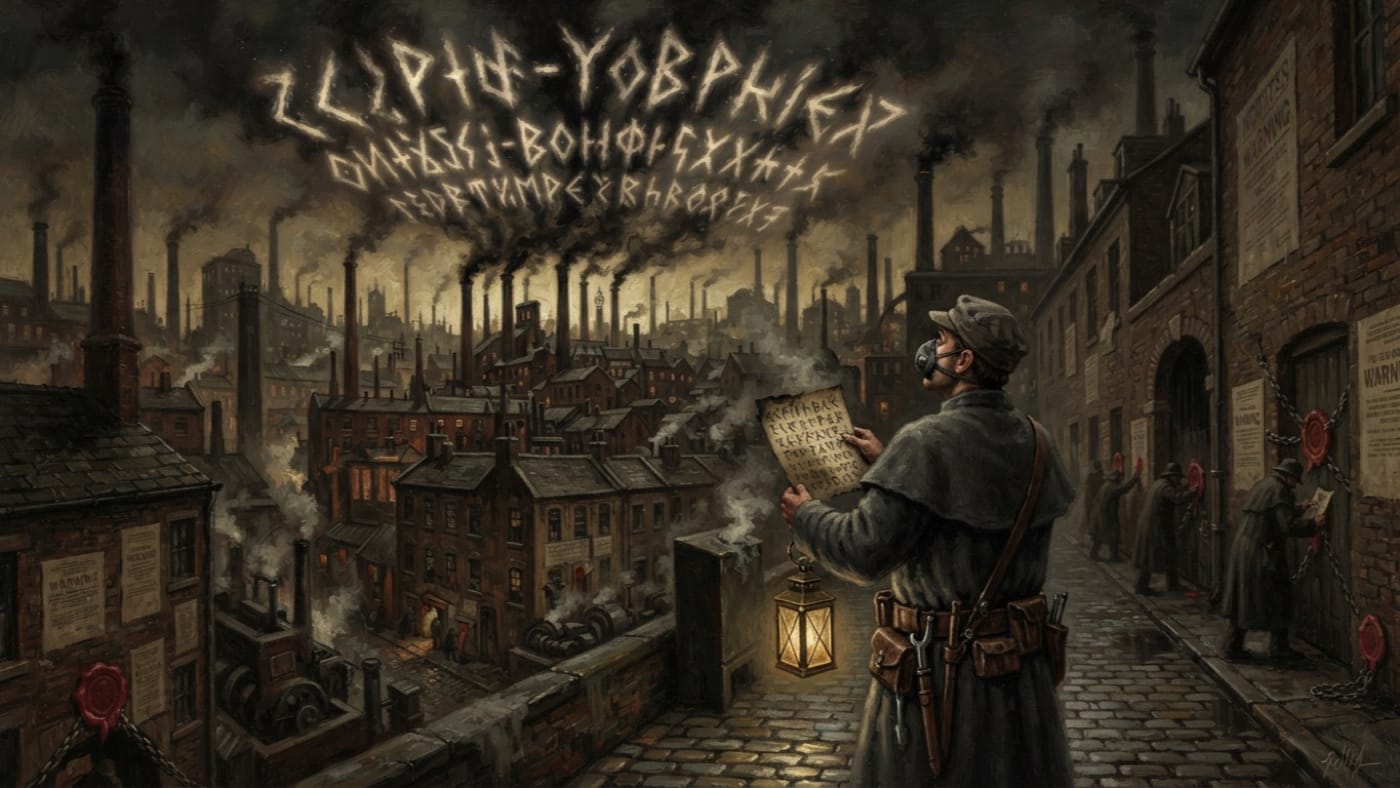
#On the Writing in the Fume
"Seal. Report. Forget." — Bureau of Purity, operational guidance on anomaly events. Complete text.
In the first three months of training, every Fume-Inspector of the Ninth Mark learns that smoke has handwriting. Petroleum distillates leave dark rings on the test sheet. Animal fat leaves ruddy spirals. Each of the forty-seven emanations on the Index has its own pattern, and the trainee learns them the way a clerk learns the hands of his regular correspondents, until he can identify the sinner from the slant of his ink. The phrase is a figure of speech. The Bureau would like it to stay one.
Sometimes it does not stay one. On certain days, in certain districts, the bloom on the sheet does not settle into a ring or a spiral. It takes on spacing, then strokes. It resolves into letters, then into words, and on occasion into phrases, written in an alphabet that the Bureau of Doctrine has classified and that the Bureau of Purity has been instructed to pretend it cannot read. The Bureau's filings call these anomaly events. The inspectors call them hymn-smoke days, and among themselves they use hymn-smoke as a code word for demon risk. That is a professional opinion, and I have entered it in this survey as one.
The test sheet is the commonest witness, and there are others. In the affected wards the chimneys take an oily stain that the profession calls scripture. More rarely the writing is reported in the district's cloudline itself, above the stacks, where anyone foolish enough to look up can see it. Nobody has settled whether this is one phenomenon or three, or whether the sheet records the chimney or the chimney records the sheet. The Bureau has not said, and I will not say it for the Bureau.
The inspector is trained to see that the bloom has become writing. He is forbidden to go further. The smoke supplies the legibility. Comprehension would need a reader, and the Bureau has taken care to employ none.
#On the Instruments of Recognition
Fume paper is reactive parchment made by the Bureau of Engineering's Scriptoria annex. The Engineering clerks list the treatment as "alchemically responsive cellulose." That entry names the product and explains nothing, which is the usual purpose of an Engineering entry. On an ordinary night the sheet is the most valuable document an inspector carries. A bloomed sheet becomes a citation. A citation becomes a seizure, and a seizure becomes a tax. Half the Bureau's revenue starts as a stain on a square of parchment held in a chimney's draught.
The procedure is simple, and the Bureau has made it ceremonial. The inspector holds the sheet in the vent's exhaust and raises his brass ledger-lantern so the bloom is lit. Under Bureau writ the lantern is also his badge, so whatever it lights has been officially witnessed. His grey half-priest robe identifies him as an officer of faith without giving him the courtesies owed to actual clergy. His nose-mask, stitched with charcoal filters, goes damp within the hour and gives the night its characteristic smell of wet cloth and soot. His ash cuffs turn from white to black over a shift, so his wrists keep their own record of where he has stood.
All of this equipment was built to detect what burns. Nothing in it was built for what writes. When the anomaly comes it arrives through the same sheet, under the same lantern, in front of the same mask, and it fits none of the forms the inspector has been trained to fill in. The paper that tells on the baker has started telling on something else. The procedure has one answer to that, and the answer is to leave.
I have also raised a matter of nomenclature with the Bureau of Engineering. Its reactive paper is made in a building named for the copying of texts. Engineering has noted my concern and passed it to nobody.
#On Sealing the Block
The ordinary inspector has three duties when the writing comes. He seals the entire block, not just the chimney. He alerts the Bureau. He withdraws. The authority for the seal is the right of entry and closure that the Ninth Mark has held since Operational Directive 14 in A.S. 143. That year is a regulatory milestone. It is not the phenomenon's first appearance, and no record I am permitted to cite gives a date for that.
He is not asked to read the writing. He is forbidden to. The prohibition works in practice because legibility and understanding are different things: an inspector can see that a shape is a letter and still have no idea which letter it is. The Bureau has confirmed that it prefers him that way. For the inspector, the instruction is three words, and the hardest of them is the third.
The Bureau has prepared him well for it. Eleven of his fourteen months of training are spent learning which smells to ignore. He learns to walk past the diesel in the baker's apron and to forget the unconsecrated grease two doors down, while keeping both in his nose, where nothing is ever really forgotten. It turns out those eleven months were rehearsal. Script-smoke asks him to forget something he has seen.
One officer is exempt from the withdrawal. The Script-Interpreter, the elite specialist rank of the profession, is the only officer authorised to approach an anomaly event without immediately falling back. The Bureau's last published count of Script-Interpreters is eleven. They are stationed at the seven bastions and at Strasbourg. I give the count with its qualification attached, because last published is the Bureau's phrase and the Bureau chooses its phrases carefully. Every inspector I have interviewed has testified, without exception, that they are the most frightened people in the profession. The rest of the procedure is outside the scope of this survey: what the Interpreter does once inside the seal, to whom the Interpreter reports, and what happens to the block after that.
#On the Bureau's Accounts
Ordinary inspection runs on the Twenty-Percent Tolerance. About a fifth of the city's contraband is tolerated. The rest is documented, cited and taxed, and the arithmetic keeps the furnaces lit and the coffers full. The Tolerance has no application to script-smoke. An anomaly event is never part of the tolerated fifth. It cannot be overlooked for the sake of district equilibrium, and no amount of incense delivered to a back door will make an inspector unsee it.
It is also unprofitable. A sealed block produces no citation, and a withdrawn inspector files no seizure. The Bureau cannot invoice the writing, because invoicing would mean reading it. Script-smoke is the only thing in the Bureau of Purity's jurisdiction that the Bureau holds as evidence and forbids its own officers to interpret. The guidance issued to the inspector does not say what becomes of the bloomed sheet once he has walked away from it, and I have not been asked to supply the omission.
An earlier edition of the Fume-Inspector entry described script-smoke events as "extremely rare, occurring perhaps once per decade per district."
That estimate is withdrawn and must not be repeated, in this survey or elsewhere. Current occurrence data is sealed. The inspectors' unofficial newsletter reports that events in Strasbourg's industrial wards have increased threefold since A.S. 195. The Bureau considers the figure unverified. It has published no figure of its own.
That leaves the only detail I am able to add, and I add it with no interpretation. A Script-Interpreter, whose name I withheld in the Fume-Inspector entry and withhold here, refused for most of our conversation to say anything at all about what the smoke writes. At the end of it she told me: "Hieromnemon, it writes filing numbers."
I have nothing to place beside that statement. I have no number to quote and no document to match it to, and I have no explanation the Church would accept or I would sign.
#On the Trades Beneath the Chimneys
The writing appears over the poorest roofs in the Synod. The wards where it is reported are the wards that run on illicit heat: black diesel cut with lamp-oil, burner-pressure bought on credit, and furnaces that keep children alive through a Strasbourg winter while the stacks above them break every statute on the Index. The households under those chimneys have no instrument for detecting script-smoke and need none. They wake to oily stains on the brickwork and decide for themselves what they mean.
The Black Diesel Distillers have their own name for it, scripture-smoke, and their own rule, which they teach every apprentice before he is trusted with a coil: If smoke writes, shut down. Don't negotiate with fumes. Part of their morning work is scraping soot-scripture off the vents before the street wakes. They have an idiom for anyone who lingers by a writing chimney too long: let it write, which means do not stare.
The inspectors' own lore is more anxious. Rookies are told never to breathe deep beneath a chimney that writes, because the air might remember them. They are told they may joke about anything in the profession, including tasting loyalty, the quota and the Bureau's own omniscience, but never about script-smoke, because script-smoke jokes back. These are superstitions. I record them as superstitions, attributed to the profession. Nothing in the evidence available to me shows that the writing has any of the powers these sayings credit it with, and I have watched the most cynical Twenty-Percenter in Strasbourg hold his breath walking past a stained stack anyway.
When the paper blooms into letters, the inspector seals the block and withdraws. The distiller shuts down the coil. The household stays where it is and keeps the stove lit, because the winter has not been sealed. Above all of them, the smoke goes on writing in an alphabet the Church has classified, for whatever reader it has in mind.