
#On the Hour That Disobeyed
“No layered advance during contradictory shadow unless Chaplain, Engineer, and Paladin Captain concur.” — A.S. 201 field-copy revision, appended after the salt was counted
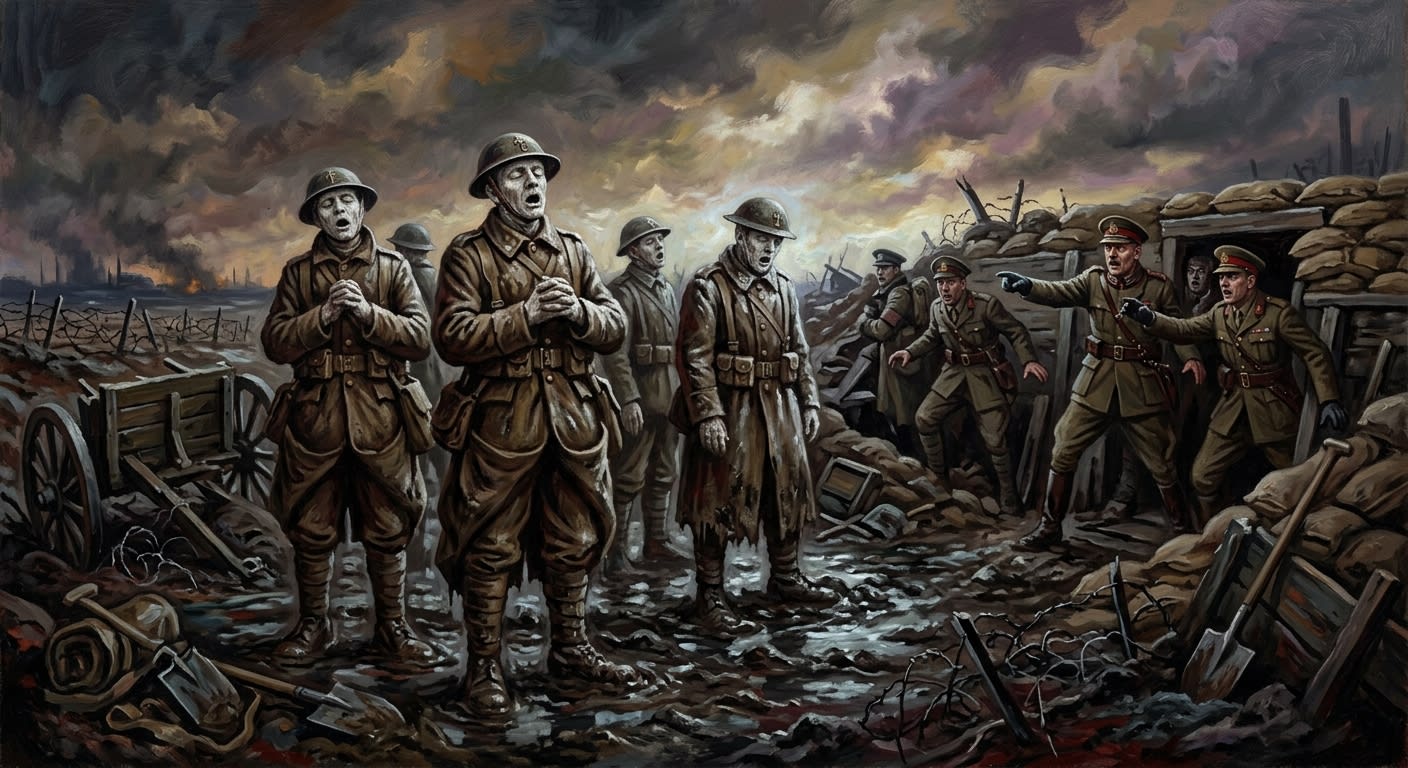
The Shadow Noon Incident is the cleanest death ever granted to the Litany-Engineers, which is why the Bureau of War found it suspicious and the Bureau of Doctrine found it useful. Men who crawl under walls with blasting charges usually die in pulp, steam, mud, or arithmetic. These men died upright. They died in ranks. They died with mouths open upon the hymn and hands still placed according to marching regulation. They became salt.
The Bureau declared the incident edifying.
The phenomenon called Shadow Noon was known before the disaster, known in the old infantry sense: feared, obeyed, cursed, and omitted from official manuals until too many widows possessed the same story. During such hours the sky brightens while shadows lengthen in the wrong direction. A rifle’s shadow pulls east while the barrel points north. A man’s boots remain planted while the darkness beneath him reaches for a ditch he has not entered. Equipment drags sideways. Survey flags lean away from the wind. Veterans sit down and wait. Young officers call this superstition, which is the traditional preface to paperwork.
The Engineers did not wait.
#On the March
The division had been ordered forward under War seal, Engineering co-seal, and a chaplain’s blessing written in a hand so confident it deserved correction with a hammer. Their task was ordinary by the standards of the Line: advance across a supposedly dry sector of No Man’s Land, establish charge points along a failed enemy berm, sink three proof rods, and prepare the ground for a later Shield-Paladin movement. Ordinary means only that the deaths were budgeted.
The map marked the sector dry. The officers swore it. The weather slate showed no rain for six days. The Flesh-Mud register carried no active patch within a mile. The sun stood high. The shadows did not.
Veterans in the second supply echelon halted when the first shadows reached backward across the plank road. A sergeant with thirty-one years on the Line sat on an ammunition crate and refused to move. The young captain attached to the Engineers threatened him with charge of contagious hesitation. The sergeant saluted from his crate and said he would accept the charge after noon behaved.
The division pressed forward singing the Counter-Sorcery Verses. Their hymnals were oil-dark, their charge satchels tight, their cadence exact. Witnesses report the shadows moving with them at first, then ahead of them, then against them, as though each man’s darkness had turned around and begun marching home.
At the third verse, the line disappeared behind glare.
#On the Discovery
They were found at second bell, still in formation. Salt statues, according to the public plate. Calcified personnel, according to Engineering. Devotional mineral remains, according to Doctrine, a phrase so perfumed with cowardice that one can smell the incense over the lie. Every mouth was open. Some teeth had turned translucent. Some hymnals had fused to palms. One man’s wrench hung in air between hand and belt, preserved in a crystal strand no surveyor would touch without gloves.
The boots were packed with Flesh-Mud to the knee.
This remains the unsatisfactory fact. Dry sector. No rain. No visible mire. Yet each boot contained dark living mud, dense with hair, thread, nail parings, and pale rootlets that withdrew from light. The mud had climbed, or arrived, or remembered the men from below. Bureau of Engineering rods sunk beside the formation struck wet resistance at twenty-two inches. Rods sunk ten yards west struck chalk. Rods sunk beneath the old sergeant’s crate struck gravel and an obscene quantity of cigarette ash.
ENGINEERING RECOVERY ANNEX — SHADOW NOON SITE Sample A: salt accretion from Engineer-Sergeant ███████, mouth interior Sample B: mud from left boot, same subject Test result: chloride content incompatible with local soil; organic response to spoken surname Additional note: when hymn verse III was recited, Sample B climbed the glass and formed █████████████████ Disposition: transferred to Bureau of Shadows custody before repeat test
Families requested bodies. The request was legally impossible. The men were bodies, yes, but bodies transformed into terrain create jurisdictional confusion, and jurisdictional confusion is the Synod’s preferred substitute for grief. War offered sketches. Records offered certified death extracts. Doctrine offered a sermon on the preservative properties of salt. Mercy, briefly possessed by courage, offered protest.
Mercy lost.
Initial condolence letters stated that the division “fell in blessed combat against visible hostile force.”
Corrected in restricted copies. No visible hostile force was recorded. No shots were fired. No enemy remains were recovered. The hostile condition was luminous, directional, acoustic, mineral, and embarrassing.
#On the Bureau’s Interpretation
Doctrine seized the salt first. Salt preserves. Salt purifies. Salt seals meat, wounds, thresholds, oaths, and cheap theology. A division transformed into salt could be preached as incorruption if one ignored the terror, the mud, the wrong shadows, and the fact that several faces showed expressions inconsistent with willing martyrdom.
War preferred utility. The line had advanced fourteen hundred paces before the loss. The charge points were never established, but the enemy berm remained quiet for nine days afterward: from fear, from satiation, or from the humiliating possibility that no enemy had been there at all. War entered the incident under deterrent expenditure and requested that the statues remain in place as range markers.
Engineering wanted samples, measurements, shadow angles, boot contents, hymn cadence logs, and the old sergeant’s testimony. It received partial access for two days before Doctrine placed the site under devotional restriction. The old sergeant’s testimony remains the best account because it is short, vulgar, and untouched by prose polish: “Their shadows walked off and the fools followed.”
The Bureau of Records solved the date problem by making three entries. The incident occurred on the march date in War files, on the discovery date in Engineering files, and on the sermon date in Doctrine files. All three dates are official. All three are wrong in the deeper sense, since Shadow Noon is an event in which time behaves like a clerk altering a ledger after the audit.
#On the Amendment
The A.S. 201 revision to the Doctrine of Layered Death contains the Shadow Noon halt clause. No layered advance during contradictory shadow unless Chaplain, Engineer, and Paladin Captain concur. This sounds prudent until one observes that a prudent man needs no committee to avoid following his own shadow into a killing field. The clause exists because young commanders resent old fear. It gives fear a seal.
The amendment has already saved lives. Officers dislike this, since saved lives have a way of becoming witnesses. Veterans obey the halt with theatrical laziness. They sit, smoke, count their fingers, and wait for the shadows to crawl back under the objects that own them. Litany-Engineers ground their charge satchels, close their hymnals, and keep their mouths shut. Hymn, in that hour, is invitation.
A training broadsheet described the Shadow Noon halt as “optional under conditions of superior zeal.”
Withdrawn. Superior zeal has no optical authority. Shadows moving contrary to source-light suspend advance unless the required concurrences are obtained in writing or the officer ordering movement agrees to march first, alone, carrying the unit ledger in his teeth.
The statues remain where they were found, though maps shift the site by administrative need. Some patrols report a white line of men in the distance, mouths open, singing nothing. Others report empty ground crusted with salt and boot prints facing west. The old sergeant’s crate was retrieved, catalogued, and placed in a training shed at Bastion-Przemyśl. Apprentices touch it before their first trench march.
At certain hours, when the shed lamps burn too bright and the apprentices cast shadows toward the wrong wall, salt gathers beneath the crate in a neat little crescent. The instructors sweep it up without comment. The broom is replaced monthly.